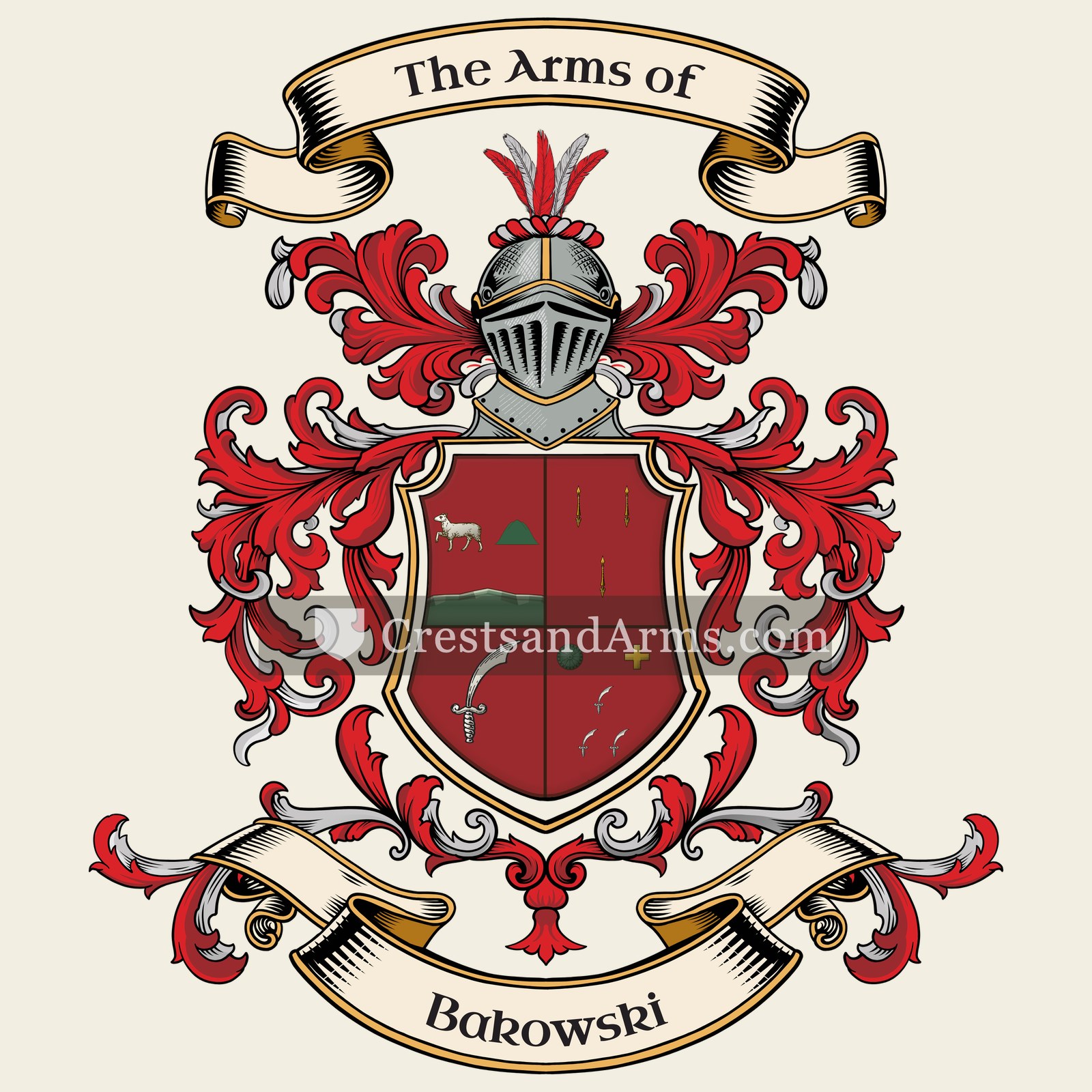
A record of documented arms, meaning and origin, researched for the Bakowski family of Poland.
Reg. 3929 · Polish, A–C
Coat of Arms & Family Crest Details
Symbols on this shield
mountThe ground held, and steadfastness upon it
cross symbolChristian faith and service
lambGentleness, patience and faith
lanceKnightly service and the tilt
swordJustice, and military honour
roundelA coin, and one who has been to the crusades
Colours
Red (Gules)Means: Military strength
Green (Vert)Means: Hope
Silver (Argent)Means: Peace and sincerity
Gold (Or)Means: Generosity
Historical info
Source
J. B. Rietstap, Armorial Général, Gouda: G. B. van Goor Zonen, 1884–87
Blazon (the actual original written record)
“Ec.: au 1 de gu. à l'agneau d'arg., pass. sur une terrasse de sin.; au 2 de gu. à trois lances de tournoi d'or, deux passées en saut., la troisième renv. et br. en pal; au 3 d'azur à un poignard renv. d'arg., garni d'or, accosté de deux fers-à-cheval adossés du sec., et acc. en p. d'un troisième fer-à-cheval du même; au 4 de gu. à une boule de sin., supp. une croisette pattée au pied fiché d'or; la boule traversée par trois épées d'arg., garnies d'or, deux en saut., les pointes en bas, la troisième en pal, la pointe en haut. Sur le tout de gu. au griffon d'arg. Quatre cq. cour. C.: 1° un bouquetin iss. et cont. de sa.; 1. d'or et de sa.; 2° un griffon iss. et cont. d'arg., senestré d'un huchet de gu., vir. d'arg., posé en pal, le pavillon en haut et tourné à sen.; 1. d'arg. et de gu.; 3° cinq pl. d'aut., alt. de gu. et d'arg.; 1. d'or et de gu.; 4° un dextrochère, arm. d'arg., brandissant le poignard du 3; 1. d'arg. et d'azur.”
Polandc. 1782
Digital archive packCoat of arms PNG, gold border print PDF, vector SVG and the certificate of authenticity. Sent to your email in minutes.
Map of Poland showing where the Bakowski arms are recorded
The Bakowski arms were recorded in Poland, c. 1782.
Arms such as these were typically recorded in Mazovia.
Mazovia held Warsaw, the Polish court and the assemblies where the szlachta met. Poland's nobles were unusually numerous and every one of them bore arms, and Warsaw is where those arms were argued over and recorded.
This is where the arms were entered in the register. Families often moved to other parts of the country, so the same name can turn up in more than one region.
Region
Mazovia
First recorded
1782
Granting Authority for the Bakowski Arms
Ennoblement by the Sejm
Author: Olek Remesz · CC BY-SA 3.0
The body that granted and recorded arms in Poland in this period.
Stanisław August Poniatowski
Sovereign of the period
Stanisław August Poniatowski
1764–1795
Reigning in Poland when the Bakowski arms are first recorded.
How Arms Worked in Poland
Polish noble families shared a single coat of arms across many different surnames, creating large clans rather than individual designs. These symbols were held collectively by all members of the clan regardless of their specific family name. When a new family joined the nobility, they were adopted into an existing clan and began using that group's established shield.
Granting authority
The Sejm, which was the Polish parliament, held the power to grant noble status and the right to bear arms.
How they got arms
Families typically received their coat of arms through a formal act of ennoblement granted by the Sejm for distinguished service.
Where arms were recorded
These grants were officially recorded in the Crown Metrica, which served as the central archive for state documents starting in the sixteenth century.
The family's standing
Recorded among the armigerous families of Poland.
Origin & History of the Bakowski Family in Poland
The surname Bakowski is a topographic name that originated in Poland, specifically derived from the root word "bak," which refers to a type of bird or a specific geographic feature. By the late 18th century, the family was well-established within the Mazovia region, a historical province in east-central Poland known for its distinct cultural identity and agricultural traditions. Records from 1782 confirm that members of the family were active participants in the local social and economic life of this area during a time of significant political transition for the Polish-Lithuanian Commonwealth. As the family grew, they became deeply integrated into the rural landscape of Mazovia, where they likely worked as landowners or skilled tradespeople. The name itself reflects the common practice of identifying families by their connection to specific lands or local landmarks, marking them as distinct members of their community long before modern census records were standardized.
Bakowski Meaning & Related Branches
Root word
bak
A Polish term referring to a buck or a male goat.
This name
BakowskiA topographic or habitational name for someone who lived near a place associated with goats.
also spelled
Bakowsky
Bakowskie
Bakowsk
Documented Sources
J. B. Rietstap, Armorial Général, Gouda: G. B. van Goor Zonen, 1884–87
Krzysztof Górski, Historia Mazowsza, 1994
Kazimierz Rymut, Nazwiska Polaków: Słownik historyczno-etymologiczny, 1999
Archiwum Główne Akt Dawnych w Warszawie, Księgi metrykalne parafii rzymskokatolickich z terenu Mazowsza, 1782
Digital archive packCoat of arms PNG, gold border print PDF, vector SVG and the certificate of authenticity. Sent to your email in minutes.


 mountThe ground held, and steadfastness upon it
 cross symbolChristian faith and service
 lambGentleness, patience and faith
 lanceKnightly service and the tilt
 swordJustice, and military honour
 roundelA coin, and one who has been to the crusades