Map of Italy showing where the Baldi arms are recorded
The Baldi arms were recorded in Italy, c. 1775.
Arms such as these were typically recorded in Venice.
Venice ran on trade, and its great families were merchants before they were anything else. The city kept a formal list of its noble houses, and a name on that list carried arms as a matter of record.
This is where the arms were entered in the register. Families often moved to other parts of the country, so the same name can turn up in more than one region.
The body that granted and recorded arms in Italy in this period.
Alvise Giovanni Mocenigo
Sovereign of the period
Alvise Giovanni Mocenigo
1763–1778
Reigning in Italy when the Baldi arms are first recorded.
How Arms Worked in Italy
In the Italian states, coats of arms were often used by noble families to show their status and history. These symbols were passed down through the generations to all legitimate male descendants. Younger branches of a family usually kept the original design but sometimes added small changes to distinguish their specific line from the main branch.
Granting authority
Various local rulers and city governments controlled the use of coats of arms across the different Italian states.
How they got arms
Families often assumed their own arms or received them as official grants from local lords, popes, or city councils.
Where arms were recorded
Arms were recorded in local city archives or private family books rather than in one single national register.
The family's standing
Recorded among the armigerous families of Italy.
Origin & History of the Baldi Family in Italy
The surname Baldi originates from the medieval personal name Baldo, which itself stems from Germanic roots meaning bold or brave. During the Middle Ages, it became common for families to adopt these descriptive names as hereditary surnames to distinguish themselves within growing Italian cities. By the time the Baldi family was documented in Venice in 1775, they were part of a long tradition of families who had settled in major urban centers to participate in trade and civic life. Venice served as a vital hub for commerce and culture, and families like the Baldi often integrated into the city’s complex social structure through professional guilds or maritime activities. Their presence in 18th-century Venice reflects the broader movement of families across the Italian peninsula as they sought new opportunities in the prosperous maritime republic.
Coat of Arms & Family Crest Details
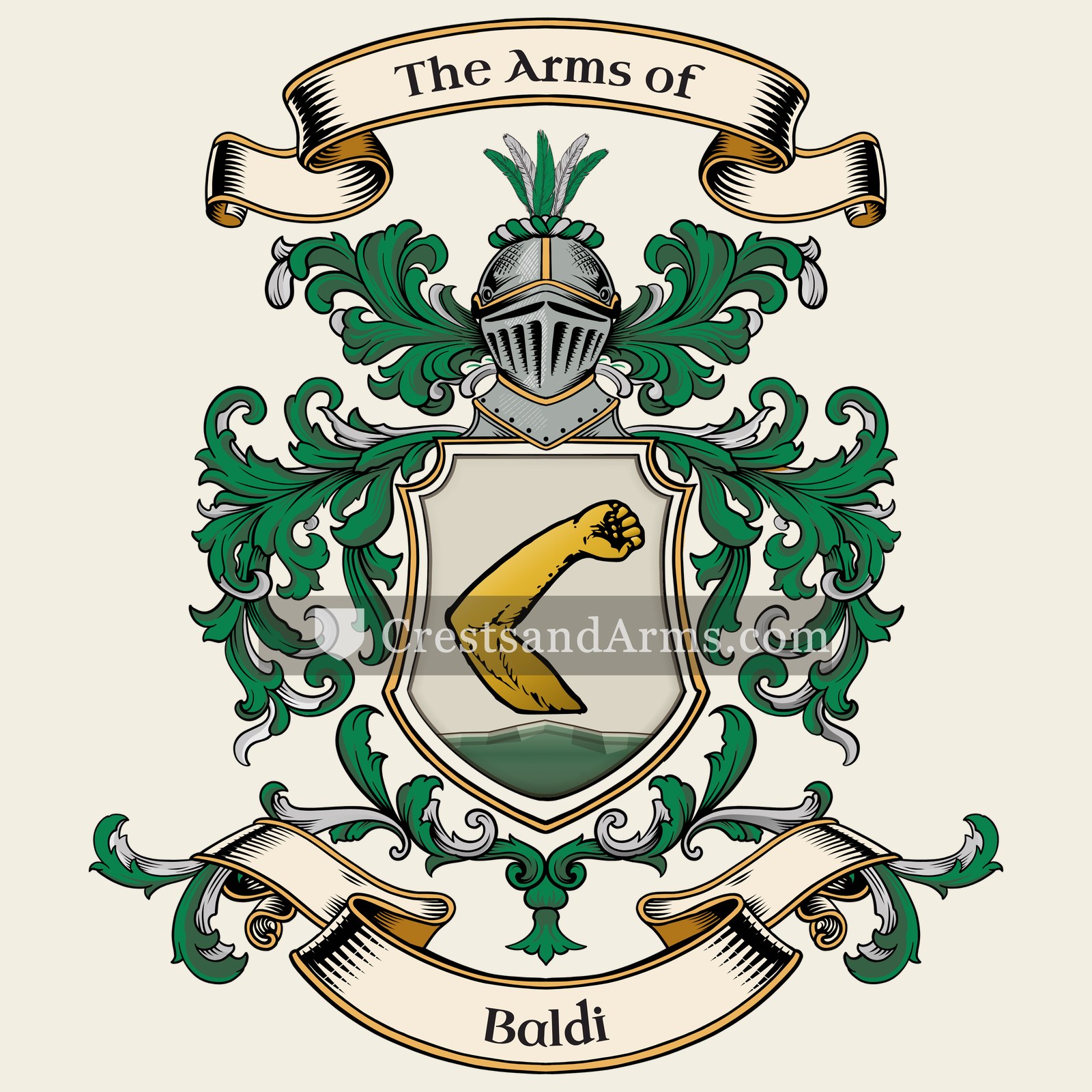
Symbols on this shield
mountThe ground held, and steadfastness upon it
armA person of action, industrious and laborious
Colours
Silver (Argent)Means: Peace and sincerity
Green (Vert)Means: Hope
Gold (Or)Means: Generosity
Historical info
Source
J. B. Rietstap, Armorial Général, Gouda: G. B. van Goor Zonen, 1884–87
Blazon (the actual original written record)
“D'arg. à un arbre terrassé de sin., fleuri de trois roses d'or, rangées en fasce; au senestrochère, paré d'or, mouv. du flanc, la main de carn. empoignant le fût de l'arbre. Cq. cour. C.: un lion iss. d'azur, sommé d'une molette d'éperon d'or, colletée du même, la molette en haut; le lion tenant de ses pattes une épée d'arg., garnie d'or, en pal. L. d'or et d'azur.”
Germanyc. 1765
Digital archive packCoat of arms PNG, gold border print PDF, vector SVG and the certificate of authenticity. Sent to your email in minutes.
Map of Germany showing where the Baldi arms are recorded
The Baldi arms were recorded in Germany, c. 1765.
Arms such as these were typically recorded in Bavaria.
Bavaria was a country of old landed families and walled market towns. Estates passed down the same line for centuries, and both the landowners and the leading townsmen kept arms, which is why so many Bavarian names sit in the registers.
This is where the arms were entered in the register. Families often moved to other parts of the country, so the same name can turn up in more than one region.
The body that granted and recorded arms in Germany in this period.
Francis I, Holy Roman Emperor
Sovereign of the period
Francis I, Holy Roman Emperor
1745–1765
Reigning in Italy when the Baldi arms are first recorded.
How Arms Worked in Germany
In the Holy Roman Empire, coats of arms were often granted to individuals by the Emperor or his representatives. These arms were then passed down through the generations to all legitimate descendants of the original holder. Younger branches of a family usually kept the same shield design without needing to change it, as the arms belonged to the entire lineage.
Granting authority
The Holy Roman Emperor held the sole power to grant new coats of arms throughout his vast imperial territories.
How they got arms
Families typically obtained their coats of arms through a formal imperial grant or by proving their noble status to the authorities.
Where arms were recorded
These grants were officially recorded in the Imperial Chancery registers, which began keeping formal records of such honors during the Middle Ages.
The family's standing
Recorded among the armigerous families of Germany.
Origin & History of the Baldi Family in Germany
The surname Baldi is rooted in the Germanic tradition of personal names derived from ancient linguistic roots meaning bold or brave. By the middle of the eighteenth century, the family had established a notable presence in the region of Bavaria. During this era, Bavaria was a center of agricultural development and local craftsmanship, and families like the Baldis often integrated into the social fabric of small rural communities or growing market towns. Living in this part of Germany meant that the family was likely subject to the strict administrative record-keeping of the local parish or the regional government. These early records suggest that the Baldi name was part of the steady movement of families across the southern German landscape during a time of significant transition in European social structures.
Baldi Meaning & Related Branches
Root word
Bald
A Germanic element meaning bold, brave, or courageous.
This name
BaldiDerived from a personal name signifying a bold or courageous individual.
also spelled
Baldy
Documented Sources
J. B. Rietstap, Armorial Général, Gouda: G. B. van Goor Zonen, 1884–87
De Felice, Emidio. Dizionario dei cognomi italiani. 1978
Fucilla, Joseph G. Our Italian Surnames. 1949
Archivio di Stato di Venezia, Anagrafe di Venezia
Digital archive packCoat of arms PNG, gold border print PDF, vector SVG and the certificate of authenticity. Sent to your email in minutes.




 mountThe ground held, and steadfastness upon it
 armA person of action, industrious and laborious