Map of Switzerland showing where the Baldinger arms are recorded
The Baldinger arms were recorded in Baden Argovie, c. 1745.
This is where the arms were entered in the register. Families often moved to other parts of the country, so the same name can turn up in more than one region.
The body that granted and recorded arms in Switzerland in this period.
How Arms Worked in Switzerland
In Switzerland, coats of arms were not restricted to the nobility and were often adopted by common citizens and families. These symbols were passed down through generations to show family identity. When branches of a family grew, they often changed small details of the design to distinguish their own line from the original group.
Granting authority
Cantonal and civic authorities managed the use of coats of arms within their specific regions and local jurisdictions.
How they got arms
Families typically assumed their own coats of arms based on local custom rather than receiving them from a central monarch.
Where arms were recorded
Arms were recorded in various cantonal and civic registers starting from the fourteenth century throughout the Swiss region.
The family's standing
Recorded among the armigerous families of Switzerland.
Origin & History of the Baldinger Family in Switzerland
The surname Baldinger is a locational name that identifies an individual as someone who originated from the town of Baldingen. While the name is now spread across many regions, its historical roots in Switzerland are tied to the movement of families across the northern cantons. By the year 1745, records confirm that members of the Baldinger family were well-established in the region of Baden. During this period, families in the Aargau area were often involved in local agriculture and trade, which required them to maintain strong ties to their home parishes. As the family grew, they became part of the social fabric of the Swiss countryside, often appearing in local tax registers and church records that tracked the movement of residents between neighboring villages. This transition from a specific town identity to a recognized family name reflects the way many Swiss families solidified their heritage through local land ownership and community participation during the eighteenth century.
Coat of Arms & Family Crest Details
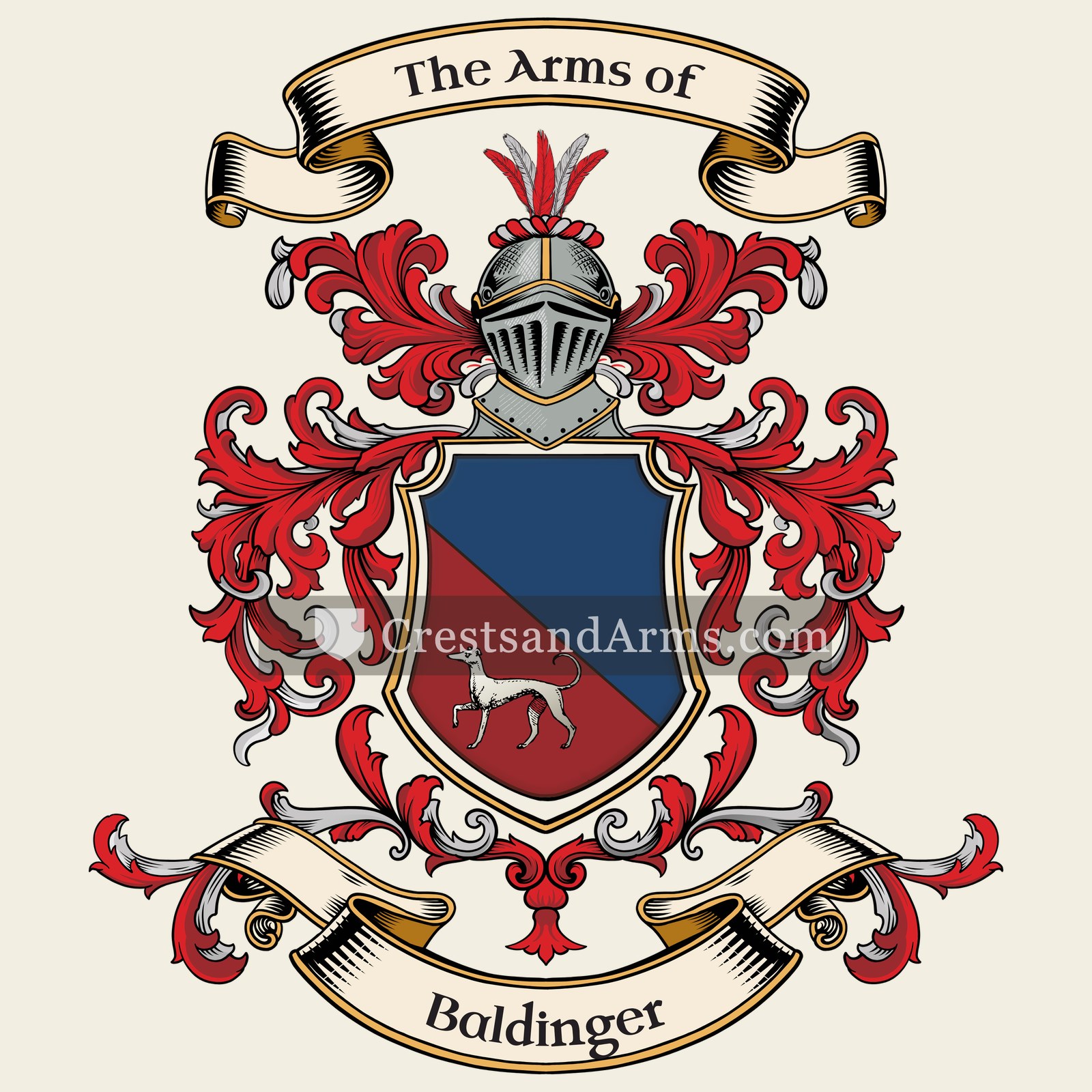
Symbols on this shield
greyhoundCourage, vigilance and loyalty
Colours
Red (Gules)Means: Military strength
Blue (Azure)Means: Loyalty and truth
Silver (Argent)Means: Peace and sincerity
Historical info
Source
J. B. Rietstap, Armorial Général, Gouda: G. B. van Goor Zonen, 1884–87
Blazon (the actual original written record)
“Taillé de gu. sur azur; au lévrier ramp. d'arg., coll. et bouclé d'or, br. sur le taillé. C.: le lévrier, assis entre une ramure de cerf, à dextre de gu. et à sen. d'azur, ou à dextre d'azur et à sen. de gu. L. de gu. et d'azur.”
BavariaBavaria, c. 1489
Digital archive packCoat of arms PNG, gold border print PDF, vector SVG and the certificate of authenticity. Sent to your email in minutes.
Map of Germany showing where the Baldinger arms are recorded
The Baldinger arms were recorded in Bavaria, c. 1489.
Bavaria was a country of old landed families and walled market towns. Estates passed down the same line for centuries, and both the landowners and the leading townsmen kept arms, which is why so many Bavarian names sit in the registers.
This is where the arms were entered in the register. Families often moved to other parts of the country, so the same name can turn up in more than one region.
The body that granted and recorded arms in Germany in this period.
Frederick III, Holy Roman Emperor
Sovereign of the period
Frederick III, Holy Roman Emperor
1440–1493
Reigning in Switzerland when the Baldinger arms are first recorded.
How Arms Worked in Germany
In the Holy Roman Empire, coats of arms were often granted to individuals by the Emperor or his representatives. These arms were then passed down through the generations to all legitimate descendants of the original holder. Younger branches of a family usually kept the same shield design without needing to change it, as the arms belonged to the entire lineage.
Granting authority
The Holy Roman Emperor held the sole power to grant new coats of arms throughout his vast imperial territories.
How they got arms
Families typically obtained their coats of arms through a formal imperial grant or by proving their noble status to the authorities.
Where arms were recorded
These grants were officially recorded in the Imperial Chancery registers, which began keeping formal records of such honors during the Middle Ages.
The family's standing
Recorded among the armigerous families of Bavaria.
Origin & History of the Baldinger Family in Germany
The name Baldinger is a topographic surname that originated in the southern regions of Germany, specifically within the historical landscape of Bavaria. During the late Middle Ages, names were often derived from a person’s place of residence or their town of origin. The suffix "-er" typically denotes an inhabitant or a person who comes from a specific location, suggesting that the first individuals to carry this name were likely residents of a place called Baldingen. Records confirm that members of the family were established in Bavaria by 1489, a time when the region was a center for trade and agricultural development under the Holy Roman Empire. As families began to settle more permanently in towns and villages, these location-based names became essential for distinguishing individuals in official tax rolls and legal documents. By the late 15th century, the Baldinger name was firmly rooted in the Bavarian social structure, reflecting the movement and settlement patterns of people living in the foothills of the Alps during that era.
Baldinger Meaning & Related Branches
Root word
Bald
Old High German term meaning bold, brave, or courageous.
This name
BaldingerA habitational name for someone originating from the town of Baldingen in Switzerland.
also spelled
Baldingar
Balding
Related arms
Bexsimilar arms
Pahlensimilar arms
Veenhoevensimilar arms
Documented Sources
J. B. Rietstap, Armorial Général, Gouda: G. B. van Goor Zonen, 1884–87
Historisches Lexikon der Schweiz, Familiennamenbuch der Schweiz, 1989
Staatsarchiv Aargau, Kirchenbücher der Pfarrei Baden, 1745
Digital archive packCoat of arms PNG, gold border print PDF, vector SVG and the certificate of authenticity. Sent to your email in minutes.


 leafHappiness and abundance
 leafHappiness and abundance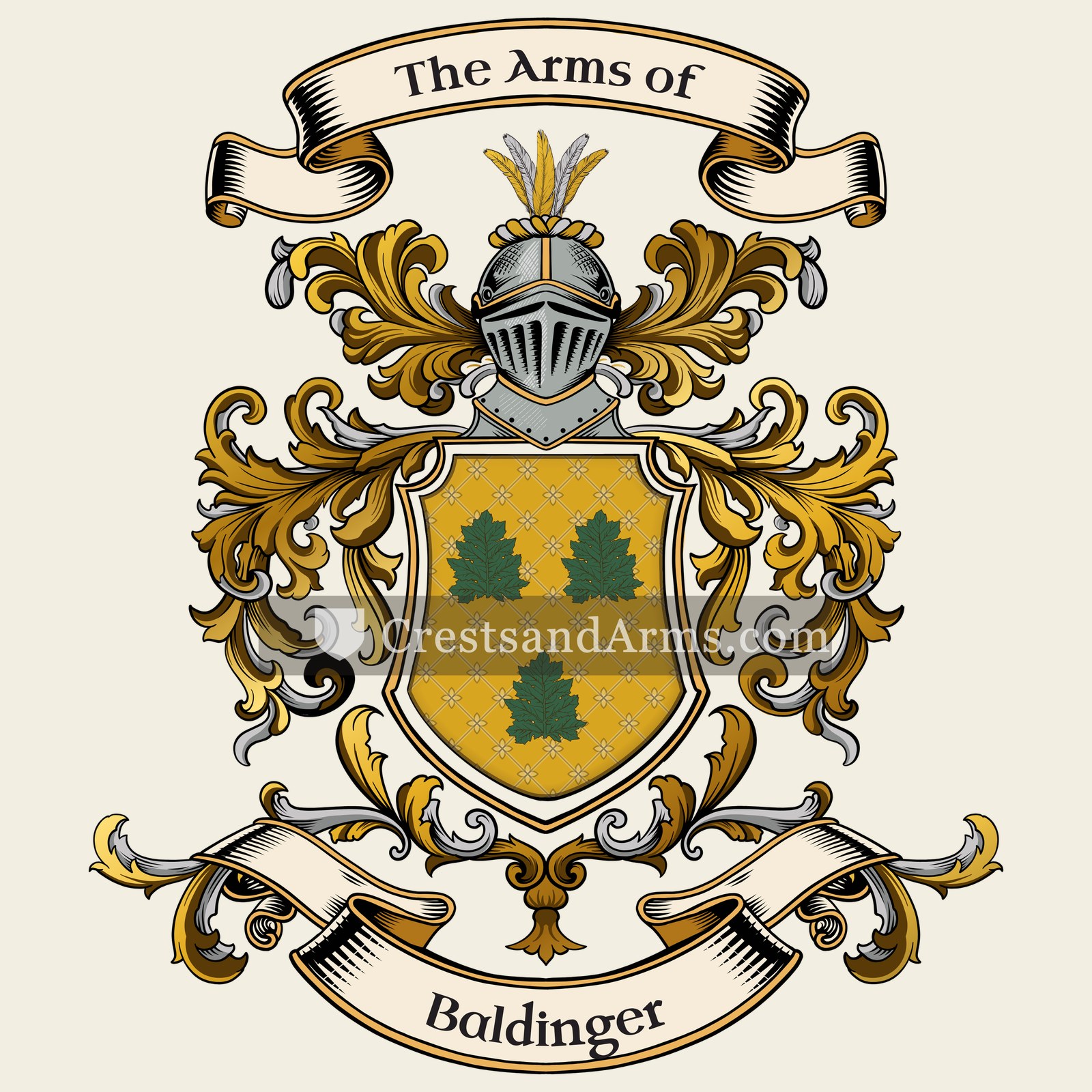

 greyhoundCourage, vigilance and loyalty