A record of documented arms, meaning and origin, researched for the Balle family lines. Documented in 3 countries.
Reg. 1258 · French, A–C
Coat of Arms & Family Crest Details
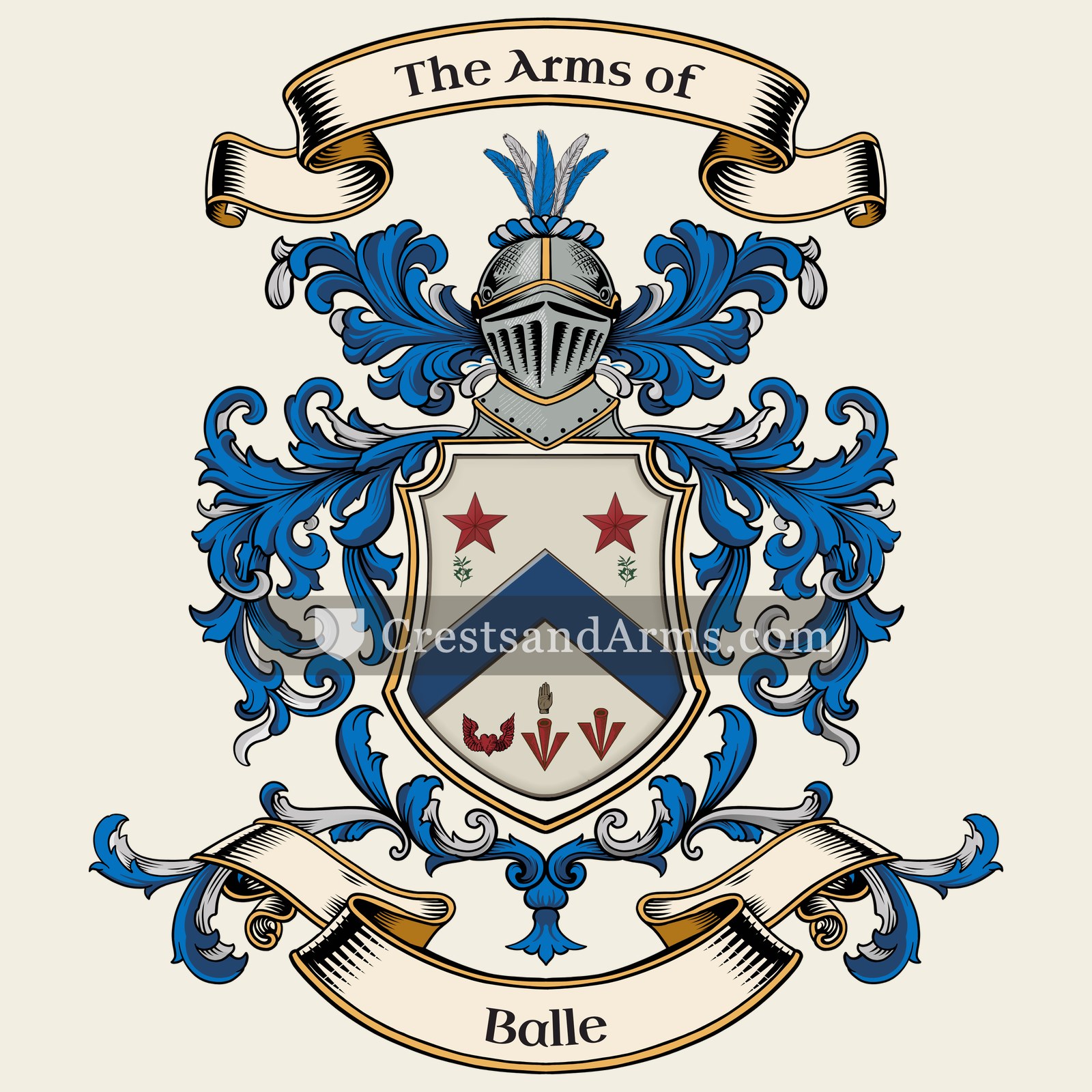
Symbols on this shield
chevronProtection, and faithful service completed
saltireResolution, and St Andrew's cross
handFaith, sincerity and justice
branchPeace, and new growth
mulletThe third son, and a divine quality from above
heartSincerity, charity and true affection
arrowReadiness for battle, and affliction endured
Colours
Silver (Argent)Means: Peace and sincerity
Blue (Azure)Means: Loyalty and truth
Green (Vert)Means: Hope
Red (Gules)Means: Military strength
Historical info
Source
J. B. Rietstap, Armorial Général, Gouda: G. B. van Goor Zonen, 1884–87
Blazon (the actual original written record)
“D'arg. au chev. d'azur, surm. d'une Foi de carn., tenant une double branche de sin. passée en saut., acc. en chef de deux étoiles de gu. et en p. d'un coeur du même, percé de deux flèches.”
FranceParis, c. 1663
Where the Balle Arms Were Recorded
Paris
Map of France showing where the Balle arms are recorded
The Balle arms were recorded in Paris, c. 1663.
This is where the arms were entered in the register. Families often moved to other parts of the country, so the same name can turn up in more than one region.
The body that granted and recorded arms in France in this period.
Louis XIV of France
Sovereign of the period
Louis XIV of France
1643–1715
Reigning in France when the Balle arms are first recorded.
How Arms Worked in France
In France, a coat of arms was a mark of honor that passed down through the male line to all legitimate descendants. Families often used the same shield without changes to show their shared heritage. If a branch wanted to stand out, they could add a small mark to their shield to show their specific place in the family tree.
Granting authority
The Juge d'armes de France acted as the official authority that regulated and verified coats of arms across the country.
How they got arms
Families typically inherited their arms from ancestors, though they could also receive them through royal grants or by proving their noble status.
Where arms were recorded
Coats of arms were officially recorded in the Armorial Général de France, which began its main collection in the year 1696.
The family's standing
Recorded among the armigerous families of France.
Origin & History of the Balle Family in France
The family name Balle has roots that stretch back into the vibrant social fabric of seventeenth-century France. By 1663, records confirm that members of the Balle family were established residents of Paris, a city that served as the bustling heart of the French kingdom under the reign of Louis XIV. During this era, families with this name were often integrated into the urban life of the capital, likely participating in the skilled trades or the growing administrative services that supported the royal court. The name itself may have evolved from regional dialects or descriptive nicknames common in northern France, reflecting the linguistic diversity of the time. As the family navigated the challenges of life in a rapidly modernizing Paris, they contributed to the local community through their work and daily interactions. Their presence in the city during this period provides a clear window into the lives of ordinary citizens who helped shape the history of the French capital.
Coat of Arms & Family Crest Details
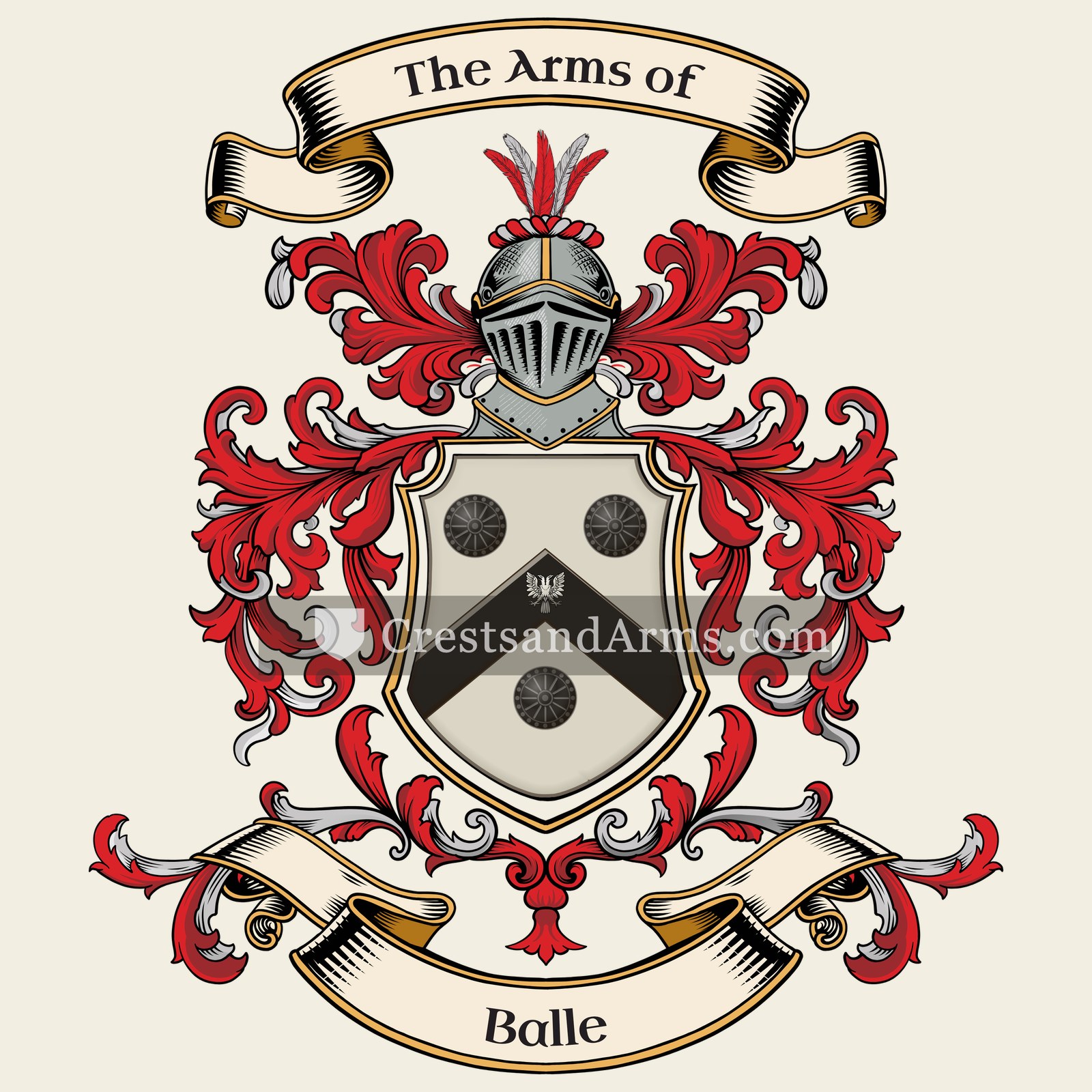
Symbols on this shield
chevronProtection, and faithful service completed
roundelA coin, and one who has been to the crusades
eagleNobility, strength and a keen mind
Colours
Silver (Argent)Means: Peace and sincerity
Black (Sable)Means: Constancy
Historical info
Source
Sir Bernard Burke, The General Armory of England, Scotland, Ireland and Wales, London: Harrison & Sons, 1884
Blazon (the actual original written record)
“Ar. on a chev. sa. betw. three pellets an eagle displ. ar”
DevonshireDevonshire, c. 1620
Where the Balle Arms Were Recorded
Devonshire
Map of England showing where the Balle arms are recorded
The Balle arms were recorded in Devonshire, c. 1620.
This is where the arms were entered in the register. Families often moved to other parts of the country, so the same name can turn up in more than one region.
The body that granted and recorded arms in England in this period.
James VI and I
Sovereign of the period
James VI and I
1603–1625
Reigning in France when the Balle arms are first recorded.
How Arms Worked in England
English heraldry allowed arms to be shared by all legitimate descendants of the original owner. These symbols were treated as personal property that moved through the generations to all children. While the eldest son kept the original design, other family members could use the same shield without needing to change it or register their own unique versions.
Granting authority
The College of Arms in London has regulated the use of coats of arms throughout England and Wales since 1484.
How they got arms
Families typically obtained their coats of arms through a formal grant from the Crown or by proving their ancient right to them.
Where arms were recorded
All official coats of arms are recorded in the registers kept at the College of Arms, which date back to the fifteenth century.
The family's standing
Recorded among the armigerous families of Devonshire.
Origin & History of the Balle Family in England
The Balle family name has deep roots in the rural landscape of Devonshire, where members of the family were firmly established by the early seventeenth century. During this period, the name was closely tied to the agricultural and maritime traditions of the West Country. Families with this surname often lived as tenant farmers or tradespeople, contributing to the local economy of small parishes near the coast. Because Devonshire served as a major hub for trade and exploration during the 1600s, the Balle name became associated with the steady growth of local communities. The family lived through a time of significant social change, yet they maintained a consistent presence in the region’s parish registers and land records. By settling in this specific part of England, early generations of the Balle family helped shape the local identity of the area for centuries to come.
Coat of Arms & Family Crest Details
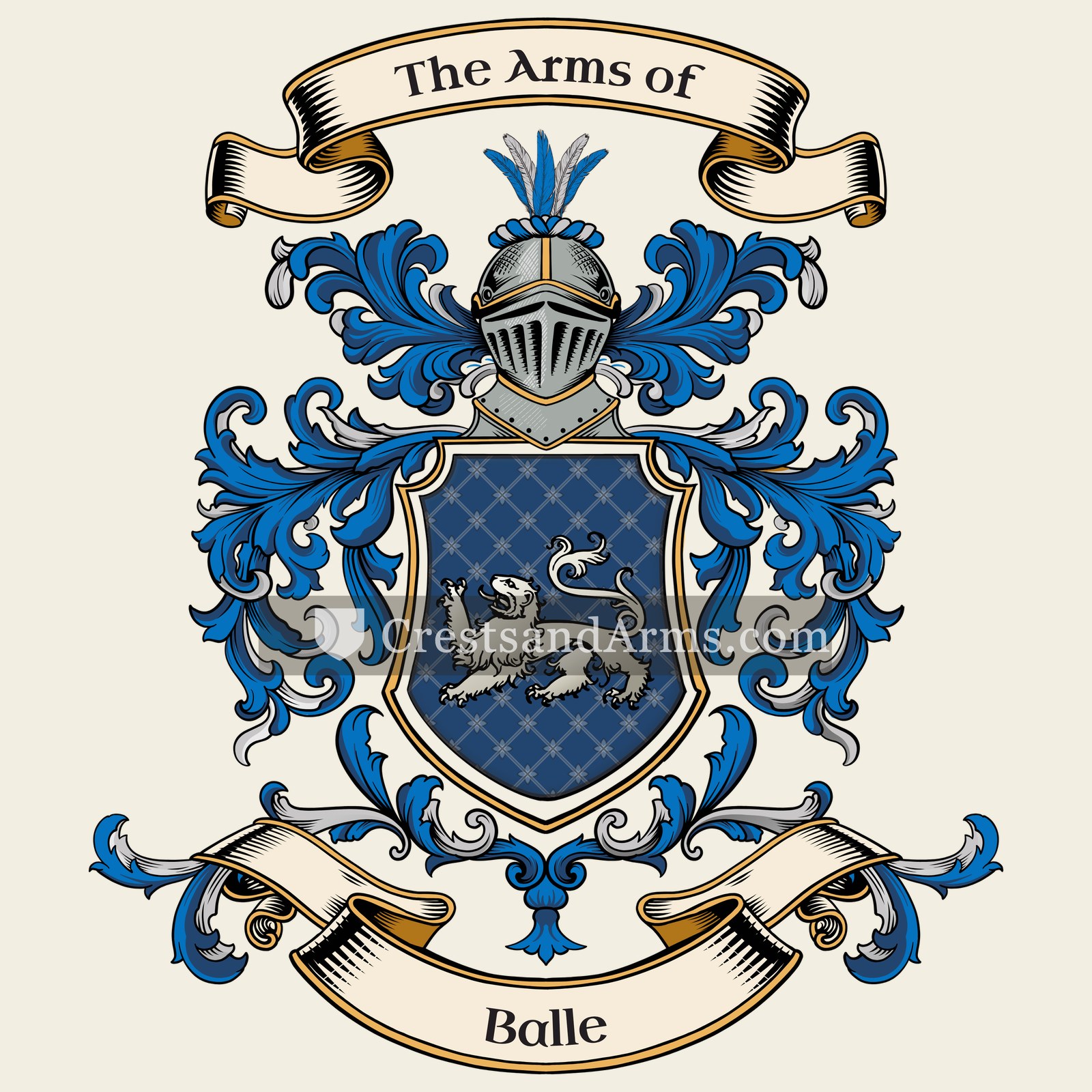
Symbols on this shield
lionCourage, strength and royalty
Colours
Blue (Azure)Means: Loyalty and truth
Silver (Argent)Means: Peace and sincerity
Historical info
Source
Sir Bernard Burke, The General Armory of England, Scotland, Ireland and Wales, London: Harrison & Sons, 1884
Blazon (the actual original written record)
“Az. a lion ramp. ar”
Irelandc. 1645
Where the Balle Arms Were Recorded
Dublin
Map of Ireland showing where the Balle arms are recorded
The Balle arms were recorded in Ireland, c. 1645.
Arms such as these were typically recorded in Dublin.
Dublin was the seat of government in Ireland and the place where grants were sought and recorded. Families with business at the castle or the courts settled nearby, and settling there put their arms on record.
This is where the arms were entered in the register. Families often moved to other parts of the country, so the same name can turn up in more than one region.
The body that granted and recorded arms in Ireland in this period.
Charles I of England
Sovereign of the period
Charles I of England
1625–1649
Reigning in France when the Balle arms are first recorded.
How Arms Worked in Ireland
The Ulster King of Arms granted coats of arms to individuals who proved their social standing and good character. These symbols were typically inherited by all legitimate descendants of the original holder. If a family branch wanted a unique look, they could apply for a specific change to their design through the office to ensure their identity remained distinct.
Granting authority
The Ulster King of Arms acted as the official body that regulated and issued all coats of arms throughout Ireland.
How they got arms
Families obtained their arms through formal grants issued by the office after proving their eligibility and paying the required fees.
Where arms were recorded
All official grants were recorded in the registers held by the Ulster King of Arms starting from the year 1552.
The family's standing
Recorded among the armigerous families of Ireland.
Origin & History of the Balle Family in Ireland
The Balle family name has a distinct presence in the historical records of seventeenth-century Ireland, particularly within the bustling urban environment of Dublin. By 1645, members of the family were already established residents of the city, living during a time of intense political and social upheaval. During this era, Dublin served as a central hub for trade and administration, and families like the Balles were often integrated into the city’s growing merchant class. While the name may have roots in older naming traditions, its appearance in Dublin records suggests that these early family members were part of the vital population that helped shape the capital’s development. Their presence in the city archives during the mid-1600s highlights a long-standing connection to the urban landscape of Ireland, marking them as part of the historical fabric of the region long before the modern era.
Related Branches & Arms
Root word
balla
A Germanic term referring to a round object or a ball.
This name
BalleA topographic name for someone living near a rounded hill or a nickname for a stout person.
also spelled
Bal
Balay
Ball
Baull
Baulle
Related arms
Balvariant spelling
Ball de Blofieldvariant spelling
Bal van Wieringenvariant spelling
Balesvariant spelling
Documented Sources
J. B. Rietstap, Armorial Général, Gouda: G. B. van Goor Zonen, 1884–87
Archives nationales, Minutier central des notaires de Paris
Boudon, Françoise, Sauval et la topographie historique de Paris, 1989
Foisil, Madeleine, Le Sire de Gouberville: un gentilhomme normand au XVIe siècle, 1981
Digital archive packCoat of arms PNG, gold border print PDF, vector SVG and the certificate of authenticity. Sent to your email in minutes.


 chevronProtection, and faithful service completed
 saltireResolution, and St Andrew's cross
 handFaith, sincerity and justice
 branchPeace, and new growth
 mulletThe third son, and a divine quality from above
 heartSincerity, charity and true affection
 arrowReadiness for battle, and affliction endured
 chevronProtection, and faithful service completed
 saltireResolution, and St Andrew's cross
 handFaith, sincerity and justice
 branchPeace, and new growth
 mulletThe third son, and a divine quality from above
 heartSincerity, charity and true affection
 arrowReadiness for battle, and affliction endured

 roundelA coin, and one who has been to the crusades
 eagleNobility, strength and a keen mind

 lionCourage, strength and royalty