Map of France showing where the Ballet arms are recorded
The Ballet arms were recorded in Flandre, c. 1540.
Flandre grew rich on cloth, and its towns were among the busiest in Europe. Merchant families bought land with their profits and took arms to go with it, so trade put as many names in the registers here as land did.
This is where the arms were entered in the register. Families often moved to other parts of the country, so the same name can turn up in more than one region.
The body that granted and recorded arms in France in this period.
Francis I of France
Sovereign of the period
Francis I of France
1515–1547
Reigning in France when the Ballet arms are first recorded.
How Arms Worked in France
In France, a coat of arms was a mark of honor that passed down through the male line to all legitimate descendants. Families often used the same shield without changes to show their shared heritage. If a branch wanted to stand out, they could add a small mark to their shield to show their specific place in the family tree.
Granting authority
The Juge d'armes de France acted as the official authority that regulated and verified coats of arms across the country.
How they got arms
Families typically inherited their arms from ancestors, though they could also receive them through royal grants or by proving their noble status.
Where arms were recorded
Coats of arms were officially recorded in the Armorial Général de France, which began its main collection in the year 1696.
The family's standing
Recorded among the armigerous families of Flandre.
Origin & History of the Ballet Family in France
The family name Ballet traces its roots to the northern regions of France, with documented evidence placing members of the family in the historical territory of Flandre by 1540. During this period, the name likely emerged as a descriptive term or a nickname derived from the Old French word baler, which meant to dance. In the social context of sixteenth-century Flanders, such names were often given to individuals known for their lively spirit or their participation in local festivities. As the family established itself in the region, they became part of the complex social fabric of a territory that was frequently caught between the shifting borders of the French kingdom and the neighboring Burgundian lands. Over time, the name spread from these northern roots into other parts of France, reflecting the natural migration patterns of families seeking new opportunities in trade and agriculture during the Renaissance.
Coat of Arms & Family Crest Details
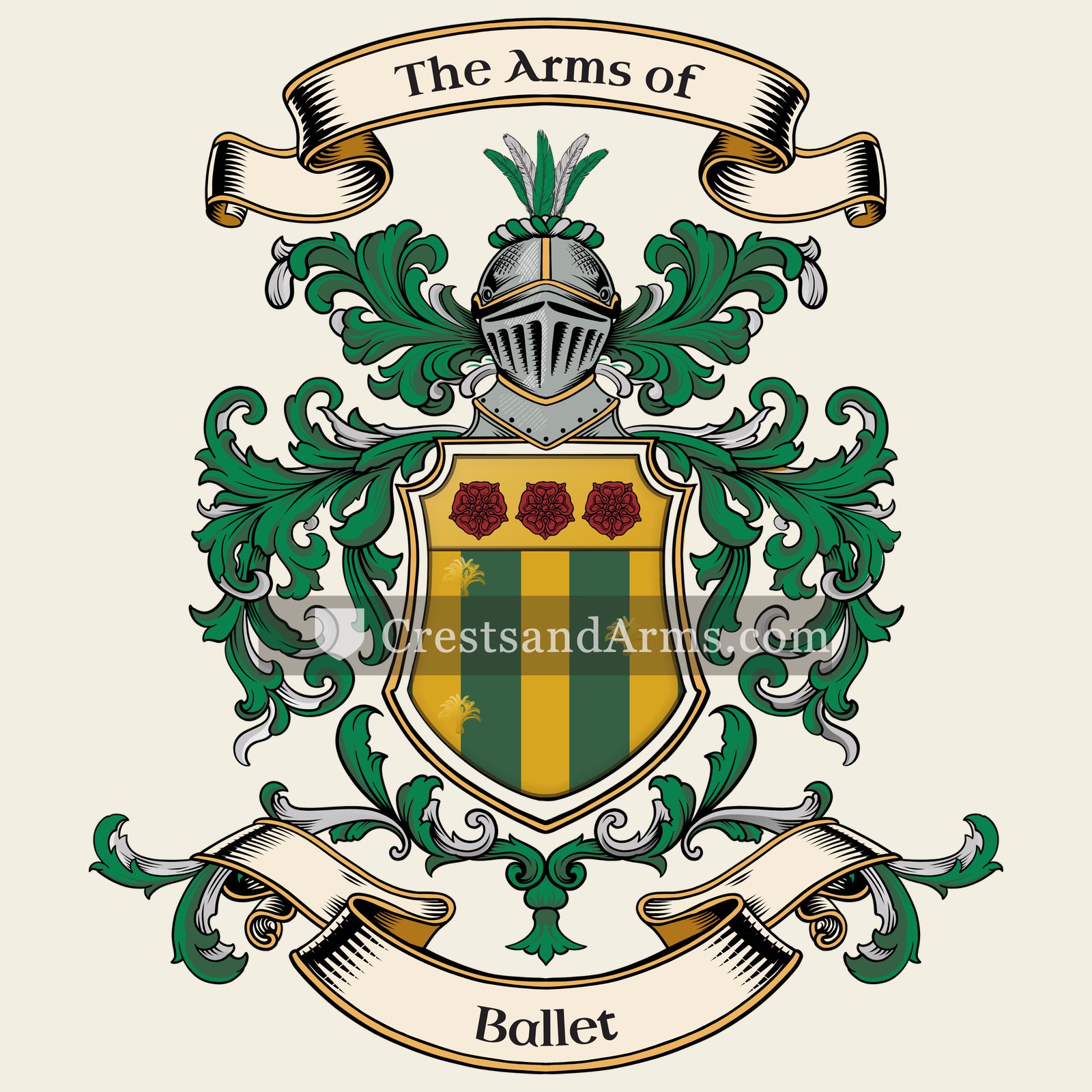
Symbols on this shield
chiefAuthority, wisdom and dominion
palm treeVictory, and righteousness that flourishes
roseThe seventh son, and beauty with grace
Colours
Green (Vert)Means: Hope
Gold (Or)Means: Generosity
Red (Gules)Means: Military strength
Historical info
Source
J. B. Rietstap, Armorial Général, Gouda: G. B. van Goor Zonen, 1884–87
Blazon (the actual original written record)
“De sin. à trois palmes d'or; au chef du même, ch. de trois roses de gu.”
AustriaVienne Dauphiné, c. 1772
Digital archive packCoat of arms PNG, gold border print PDF, vector SVG and the certificate of authenticity. Sent to your email in minutes.
Map of Austria showing where the Ballet arms are recorded
The Ballet arms were recorded in Vienne Dauphiné, c. 1772.
This is where the arms were entered in the register. Families often moved to other parts of the country, so the same name can turn up in more than one region.
Region
Vienne Dauphiné
Town
Vienne Dauphiné
First recorded
1772
Granting Authority for the Ballet Arms
Imperial and Royal chancery
Sodacan · CC BY-SA 3.0
The body that granted and recorded arms in Austria in this period.
Joseph II, Holy Roman Emperor
Sovereign of the period
Joseph II, Holy Roman Emperor
1765–1790
Reigning in France when the Ballet arms are first recorded.
How Arms Worked in Austria
Austrian coats of arms were often linked directly to noble titles granted by the Emperor. These symbols belonged to the entire family line rather than just one individual. When a family grew, new branches kept the original design without needing to change it. This system allowed all members of a noble house to share the same identity across many generations.
Granting authority
The Imperial and Royal chancery managed all heraldic matters and controlled the official granting of arms throughout the Austrian lands.
How they got arms
Families typically received their arms through a formal imperial decree that often accompanied the elevation of a person to noble status.
Where arms were recorded
Official records of these grants were kept in the Imperial Register of Nobility which began its formal documentation process in 1453.
The family's standing
Recorded among the armigerous families of Austria.
Origin & History of the Ballet Family in Austria
The surname Ballet traces its roots to the historical region of Dauphiné in southeastern France, where records confirm the family was well-established by 1772. While the name is deeply connected to this French province, the movement of families across European borders during the eighteenth century often brought such lineages into contact with the Austrian Empire. As the Habsburg monarchy expanded its influence and administrative reach, individuals from French-speaking territories frequently migrated eastward to serve in professional or military capacities. In the context of Austria, the Ballet name likely traveled alongside these shifting political boundaries and trade routes. The family members were typically recognized for their involvement in local governance or regional commerce, which allowed them to integrate into the social fabric of their new homes. By maintaining their identity while adapting to the customs of the Austrian lands, the early bearers of this name played a quiet but steady role in the regional history of the era.
Coat of Arms & Family Crest Details
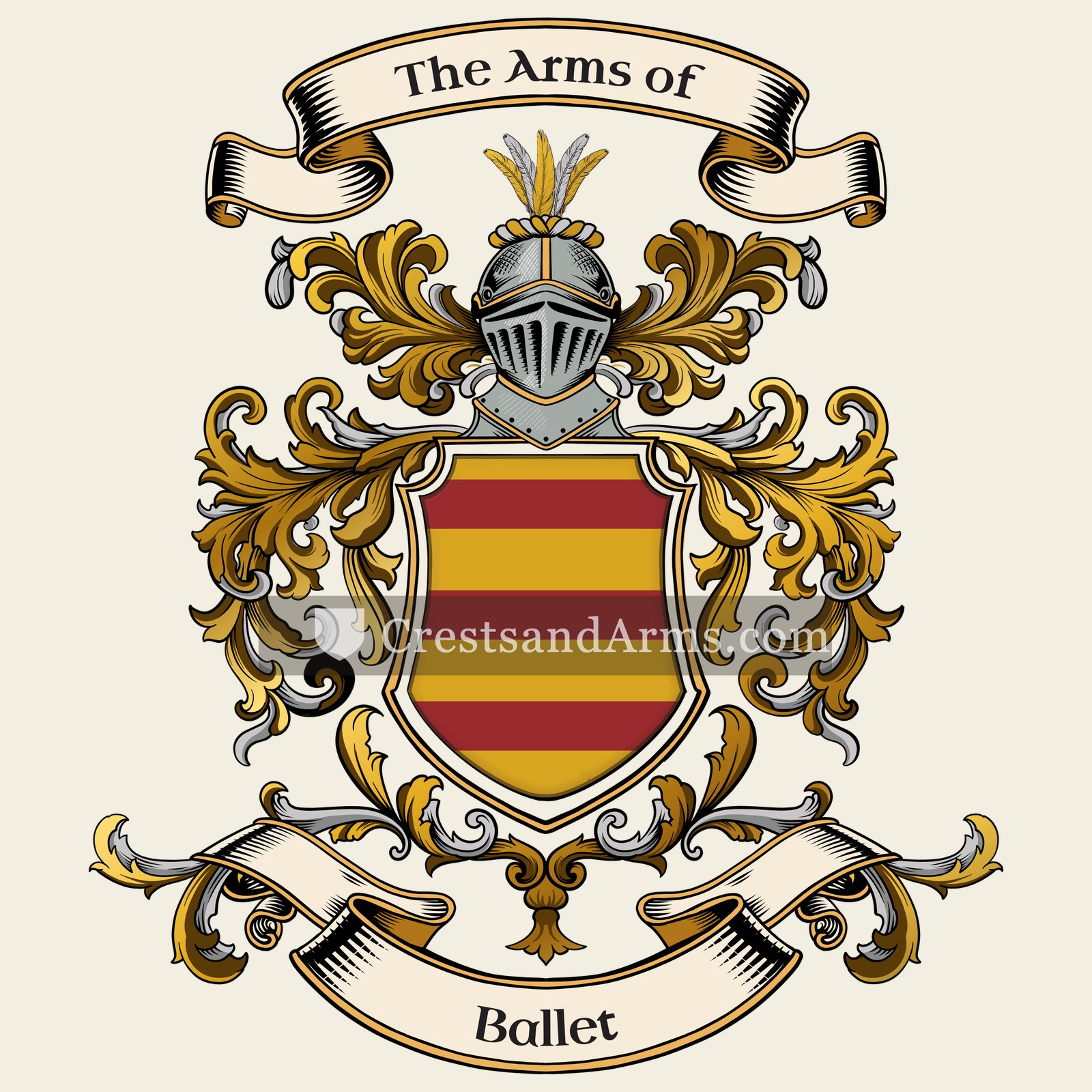
Colours
Gold (Or)Means: Generosity
Red (Gules)Means: Military strength
Historical info
Source
Sir Bernard Burke, The General Armory of England, Scotland, Ireland and Wales, London: Harrison & Sons, 1884
Blazon (the actual original written record)
“Or, three bars wavy gu”
Irelandc. 1645
Digital archive packCoat of arms PNG, gold border print PDF, vector SVG and the certificate of authenticity. Sent to your email in minutes.
Map of Ireland showing where the Ballet arms are recorded
The Ballet arms were recorded in Ireland, c. 1645.
Arms such as these were typically recorded in Dublin.
Dublin was the seat of government in Ireland and the place where grants were sought and recorded. Families with business at the castle or the courts settled nearby, and settling there put their arms on record.
This is where the arms were entered in the register. Families often moved to other parts of the country, so the same name can turn up in more than one region.
The body that granted and recorded arms in Ireland in this period.
Charles I of England
Sovereign of the period
Charles I of England
1625–1649
Reigning in France when the Ballet arms are first recorded.
How Arms Worked in Ireland
The Ulster King of Arms granted coats of arms to individuals who proved their social standing and good character. These symbols were typically inherited by all legitimate descendants of the original holder. If a family branch wanted a unique look, they could apply for a specific change to their design through the office to ensure their identity remained distinct.
Granting authority
The Ulster King of Arms acted as the official body that regulated and issued all coats of arms throughout Ireland.
How they got arms
Families obtained their arms through formal grants issued by the office after proving their eligibility and paying the required fees.
Where arms were recorded
All official grants were recorded in the registers held by the Ulster King of Arms starting from the year 1552.
The family's standing
Recorded among the armigerous families of Ireland.
Origin & History of the Ballet Family in Ireland
The history of the Ballet family in Ireland begins to emerge clearly in the mid-seventeenth century, specifically with documented records of the family residing in Dublin by 1645. During this period, Dublin was a bustling center of trade and political transition, and families like the Ballets were often part of the professional or merchant classes that helped shape the city’s urban growth. The name itself is thought to have roots in older European naming traditions, likely arriving in Ireland through the movement of people across the Irish Sea during times of economic change. As the family settled into the social fabric of the capital, they became part of the diverse population that navigated the complex religious and civil shifts of the era. While many families of that time left few traces, the presence of the Ballets in official records suggests they were established citizens who contributed to the local community during a formative time in Irish history.
Ballet Meaning & Related Branches
Root word
ballare
A Latin verb meaning to dance or move rhythmically.
This name
BalletA nickname for a dancer or someone who performed in public festivities.
also spelled
Ballay
Balay
Ballete
Ballat
Balat
Related arms
Almerassimilar arms
Ballayvariant spelling
Carlinrecorded with Ballet, same area
Carronrecorded with Ballet, same area
Documented Sources
J. B. Rietstap, Armorial Général, Gouda: G. B. van Goor Zonen, 1884–87
Dauzat, Albert, Dictionnaire étymologique des noms de famille et prénoms de France, 1951
Morlet, Marie-Thérèse, Dictionnaire étymologique des noms de famille, 1991
Archives départementales du Nord, Série B: Cours et juridictions (Chambre des comptes de Lille)
Digital archive packCoat of arms PNG, gold border print PDF, vector SVG and the certificate of authenticity. Sent to your email in minutes.


 chiefAuthority, wisdom and dominion
 lionCourage, strength and royalty
 eagleNobility, strength and a keen mind
 chiefAuthority, wisdom and dominion
 lionCourage, strength and royalty
 eagleNobility, strength and a keen mind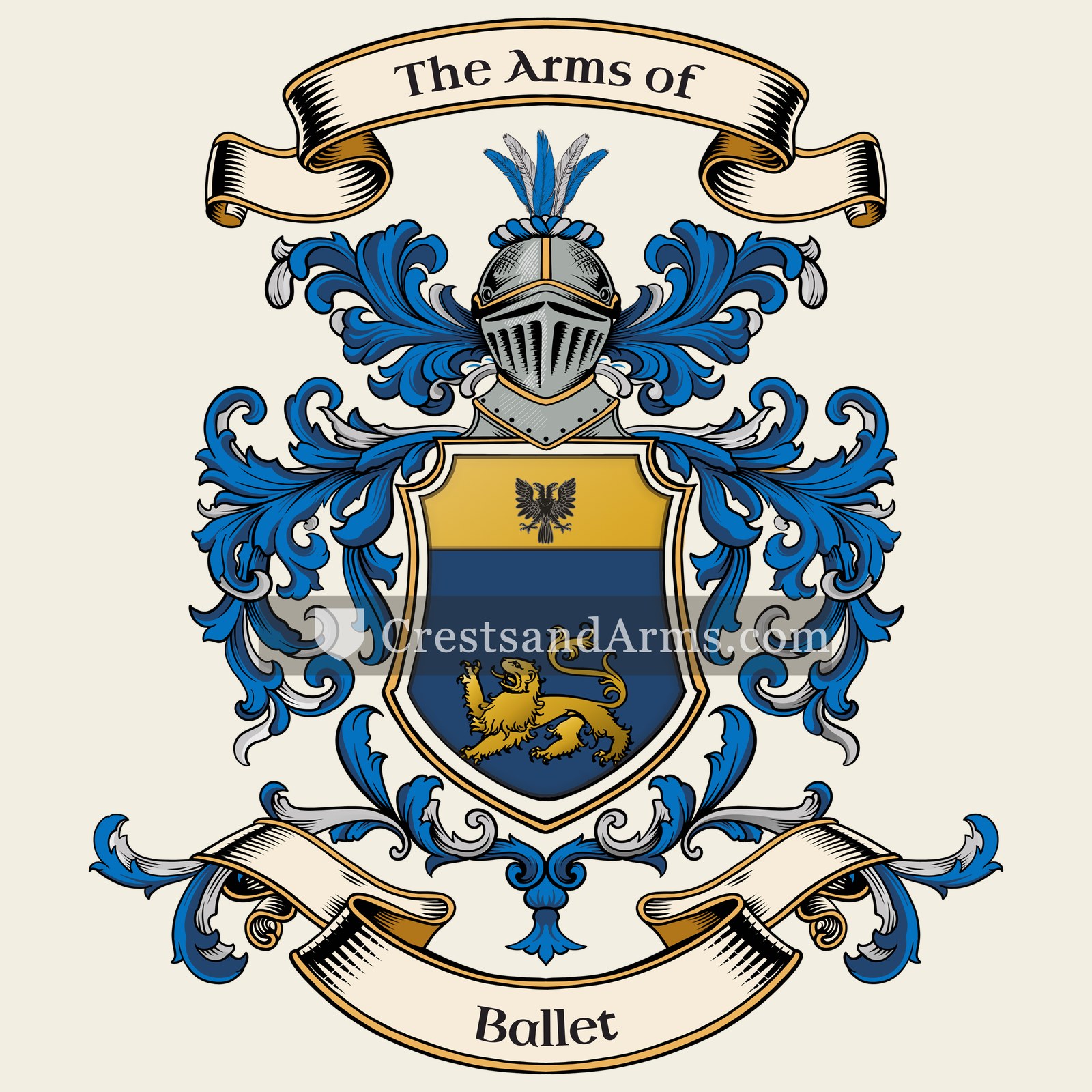


 palm treeVictory, and righteousness that flourishes
 roseThe seventh son, and beauty with grace