Map of France showing where the Ballin arms are recorded
The Ballin arms were recorded in Paris, c. 1663.
This is where the arms were entered in the register. Families often moved to other parts of the country, so the same name can turn up in more than one region.
The body that granted and recorded arms in France in this period.
Louis XIV of France
Sovereign of the period
Louis XIV of France
1643–1715
Reigning in France when the Ballin arms are first recorded.
How Arms Worked in France
In France, a coat of arms was a mark of honor that passed down through the male line to all legitimate descendants. Families often used the same shield without changes to show their shared heritage. If a branch wanted to stand out, they could add a small mark to their shield to show their specific place in the family tree.
Granting authority
The Juge d'armes de France acted as the official authority that regulated and verified coats of arms across the country.
How they got arms
Families typically inherited their arms from ancestors, though they could also receive them through royal grants or by proving their noble status.
Where arms were recorded
Coats of arms were officially recorded in the Armorial Général de France, which began its main collection in the year 1696.
The family's standing
Recorded among the armigerous families of France.
Origin & History of the Ballin Family in France
The family name Ballin has deep roots in French history, with documented evidence placing members of the family in Paris as early as 1663. During this period, the name was associated with skilled craftsmanship and the vibrant artistic life of the city. One notable figure from this era was Claude Ballin, a renowned goldsmith who served the French royal court. His work was highly regarded for its intricate detail and elegance, reflecting the sophisticated culture of the seventeenth century. As the family established itself in the capital, they became part of the growing class of artisans and professionals who helped define the aesthetic standards of the time. This early presence in Paris suggests that the Ballin name was closely tied to the development of French decorative arts and the professional guilds that flourished under the monarchy.
Ballin Meaning & Related Branches
Root word
Ballo
A Germanic personal name derived from the word for a ball.
This name
BallinA patronymic surname indicating descent from a person named Ballo.
also spelled
Balin
Related arms
Balinvariant spelling
Documented Sources
J. B. Rietstap, Armorial Général, Gouda: G. B. van Goor Zonen, 1884–87
Bouchot, Henri. Les arts du métal. 1891
Guiffrey, Jules. Inventaire général du mobilier de la Couronne sous Louis XIV. 1885
Archives Nationales de France, Minutier central des notaires de Paris
Digital archive packCoat of arms PNG, gold border print PDF, vector SVG and the certificate of authenticity. Sent to your email in minutes.


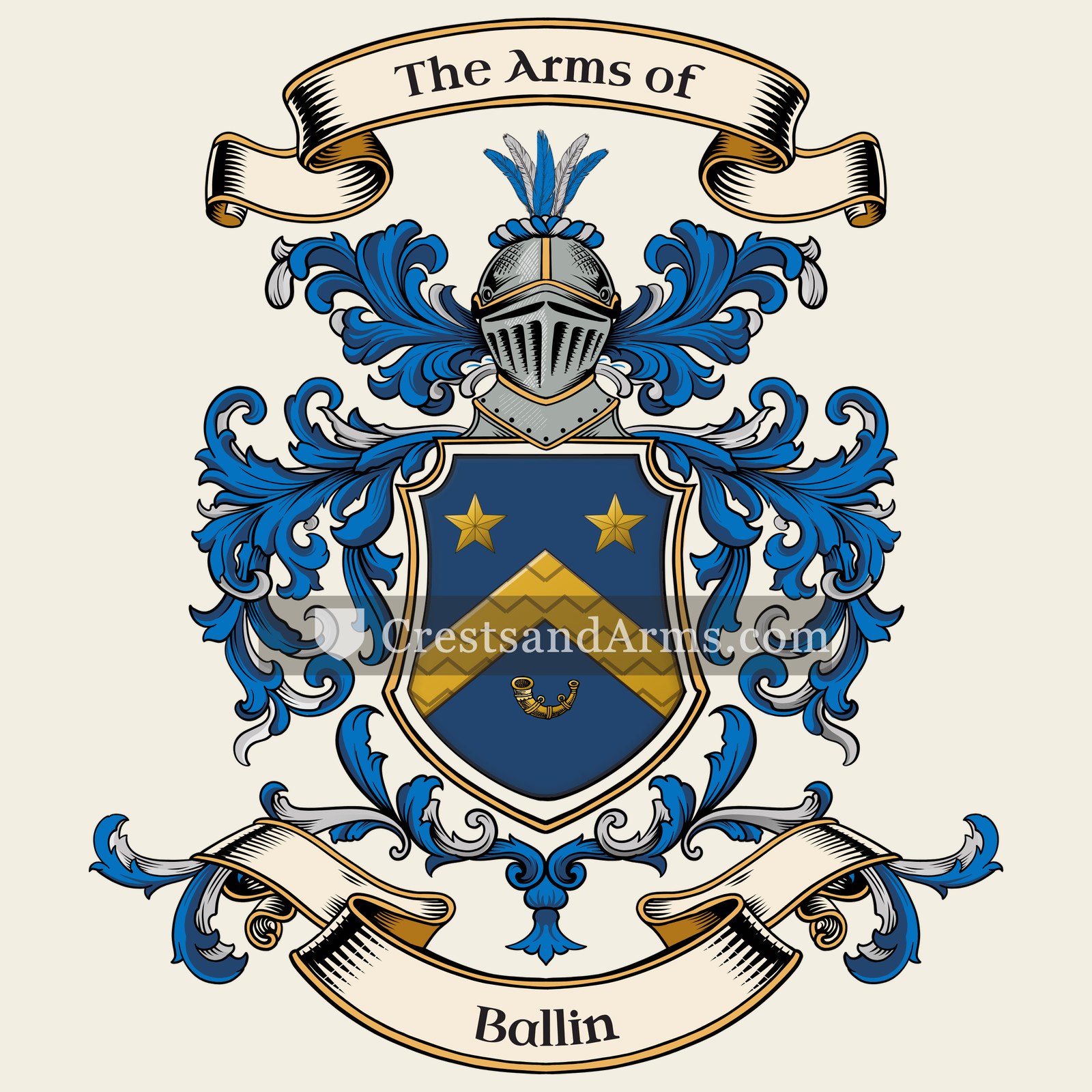
 chevronProtection, and faithful service completed
 mulletThe third son, and a divine quality from above
 hunting horn stringedOne who delights in the chase
 chevronProtection, and faithful service completed
 mulletThe third son, and a divine quality from above
 hunting horn stringedOne who delights in the chase