Map of Switzerland showing where the Baltas arms are recorded
The Baltas arms were recorded in Genève, c. 1745.
This is where the arms were entered in the register. Families often moved to other parts of the country, so the same name can turn up in more than one region.
The body that granted and recorded arms in Switzerland in this period.
How Arms Worked in Switzerland
In Switzerland, coats of arms were not restricted to the nobility and were often adopted by common citizens and families. These symbols were passed down through generations to show family identity. When branches of a family grew, they often changed small details of the design to distinguish their own line from the original group.
Granting authority
Cantonal and civic authorities managed the use of coats of arms within their specific regions and local jurisdictions.
How they got arms
Families typically assumed their own coats of arms based on local custom rather than receiving them from a central monarch.
Where arms were recorded
Arms were recorded in various cantonal and civic registers starting from the fourteenth century throughout the Swiss region.
The family's standing
Recorded among the armigerous families of Switzerland.
Origin & History of the Baltas Family in Switzerland
The family name Baltas has deep roots in the city of Geneva, where records confirm members of the family were established by 1745. During the eighteenth century, Geneva was a major center for trade and intellectual exchange, attracting families who sought stability and opportunity in a growing urban environment. The name itself is often linked to the Greek name Balthasar, which suggests that the family may have migrated to Switzerland from regions influenced by Mediterranean or Eastern European naming traditions. Once in Geneva, these early family members likely integrated into the local social structure by participating in the city's active craft or merchant guilds. By settling in this region, the Baltas family became part of the long history of migration that shaped the unique cultural identity of the Swiss Republic during the Enlightenment.
Coat of Arms & Family Crest Details
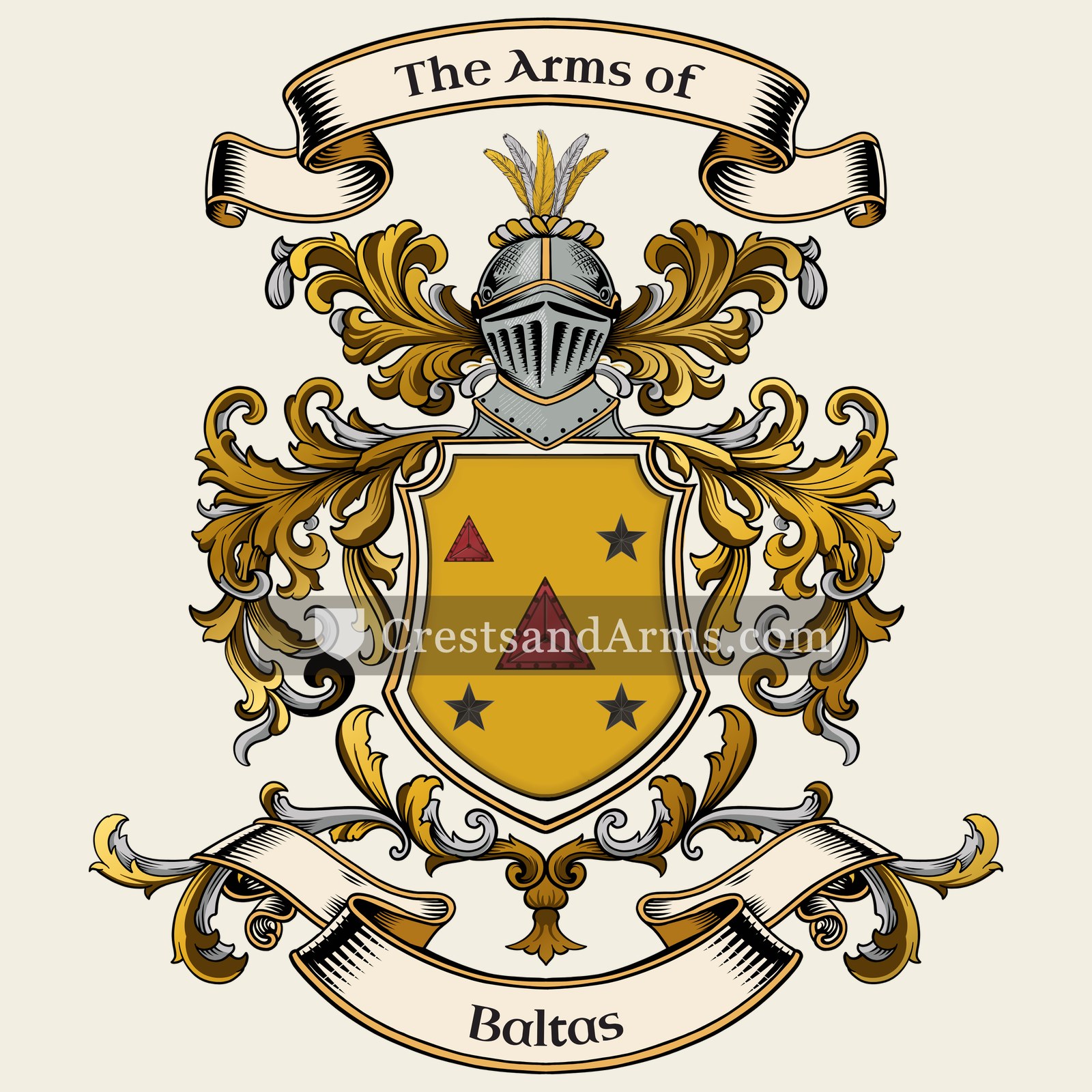
Symbols on this shield
triangleThe Trinity, and stability
mulletThe third son, and a divine quality from above
Colours
Gold (Or)Means: Generosity
Red (Gules)Means: Military strength
Historical info
Source
J. B. Rietstap, Armorial Général, Gouda: G. B. van Goor Zonen, 1884–87
Blazon (the actual original written record)
“D'or à un triangle vide de gu., renfermant un autre triangle vidé renversé du même, et trois étoiles mal-ordonnées d'or, posées dans les coins. C.: un homme barbu iss., posé de front, hab. d'azur, ceint d'or, coiffé d'un chapeau au nat., tenant de sa main dextre une fleur-de-lis d'or et de sa sen. un marteau d'arg. L. d'arg., de gu. et d'or.”
PomeraniaPomerania, c. 1765
Digital archive packCoat of arms PNG, gold border print PDF, vector SVG and the certificate of authenticity. Sent to your email in minutes.
Map of Germany showing where the Baltas arms are recorded
The Baltas arms were recorded in Pomerania, c. 1765.
Pomerania was flat farming country on the Baltic coast, held in large estates by a small number of families. They kept their land for generations, and generations of landholding is what fills the registers.
This is where the arms were entered in the register. Families often moved to other parts of the country, so the same name can turn up in more than one region.
The body that granted and recorded arms in Germany in this period.
Francis I, Holy Roman Emperor
Sovereign of the period
Francis I, Holy Roman Emperor
1745–1765
Reigning in Switzerland when the Baltas arms are first recorded.
How Arms Worked in Germany
In the Holy Roman Empire, coats of arms were often granted to individuals by the Emperor or his representatives. These arms were then passed down through the generations to all legitimate descendants of the original holder. Younger branches of a family usually kept the same shield design without needing to change it, as the arms belonged to the entire lineage.
Granting authority
The Holy Roman Emperor held the sole power to grant new coats of arms throughout his vast imperial territories.
How they got arms
Families typically obtained their coats of arms through a formal imperial grant or by proving their noble status to the authorities.
Where arms were recorded
These grants were officially recorded in the Imperial Chancery registers, which began keeping formal records of such honors during the Middle Ages.
The family's standing
Recorded among the armigerous families of Pomerania.
Origin & History of the Baltas Family in Germany
The family name Baltas has roots that trace back to the historical region of Pomerania, where members of the family were documented as early as 1765. During this period, Pomerania was a territory defined by its shifting borders and agricultural focus, situated along the southern coast of the Baltic Sea. Families living in this area often took names that reflected their local identity or their connection to specific trades and community roles. The name Baltas likely emerged as a linguistic variation used by families living within these northern German lands, where German, Slavic, and Baltic cultural influences frequently overlapped. By the mid-18th century, the Baltas family was part of a rural society that relied on land cultivation and local commerce to sustain their households. Their presence in the historical records of Pomerania provides a clear window into the lives of families who helped shape the social and economic landscape of the region during the 1700s.
Related Branches & Arms
Root word
Balthasar
Derived from the Akkadian phrase meaning protect the king.
This name
BaltasA patronymic surname originating from the given name Balthasar, signifying a descendant of the bearer.
also spelled
Balthazar
Documented Sources
J. B. Rietstap, Armorial Général, Gouda: G. B. van Goor Zonen, 1884–87
Archives: Archives d’État de Genève, Registres du Conseil d’État
Archives: Archives d’État de Genève, État civil et registres paroissiaux
Historical Reference: Galiffe, Jacques-Auguste, Notices généalogiques sur les familles genevoises, 1829
Digital archive packCoat of arms PNG, gold border print PDF, vector SVG and the certificate of authenticity. Sent to your email in minutes.


 lionCourage, strength and royalty
 serpentWisdom, healing and prudence
 lionCourage, strength and royalty
 serpentWisdom, healing and prudence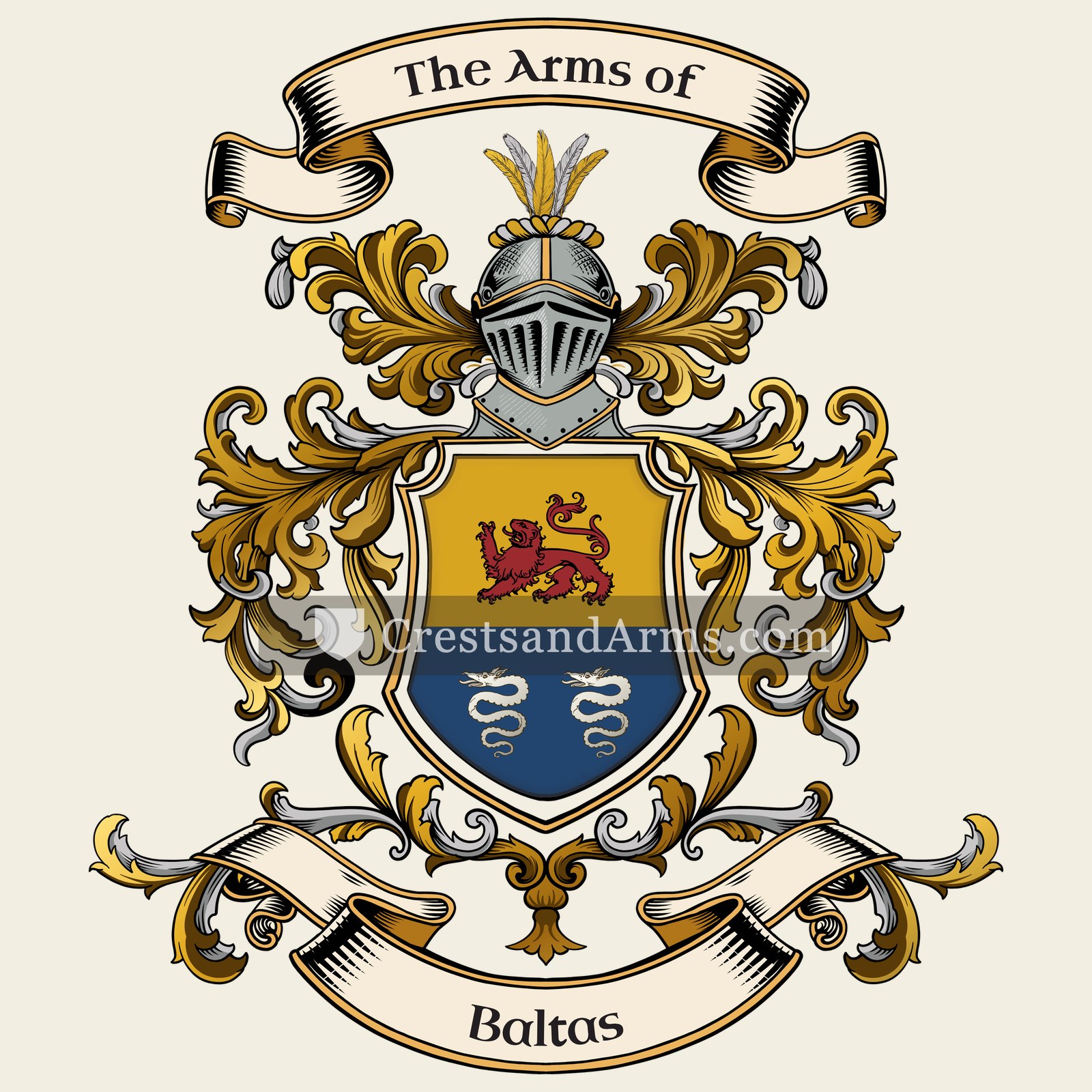

 triangleThe Trinity, and stability
 mulletThe third son, and a divine quality from above