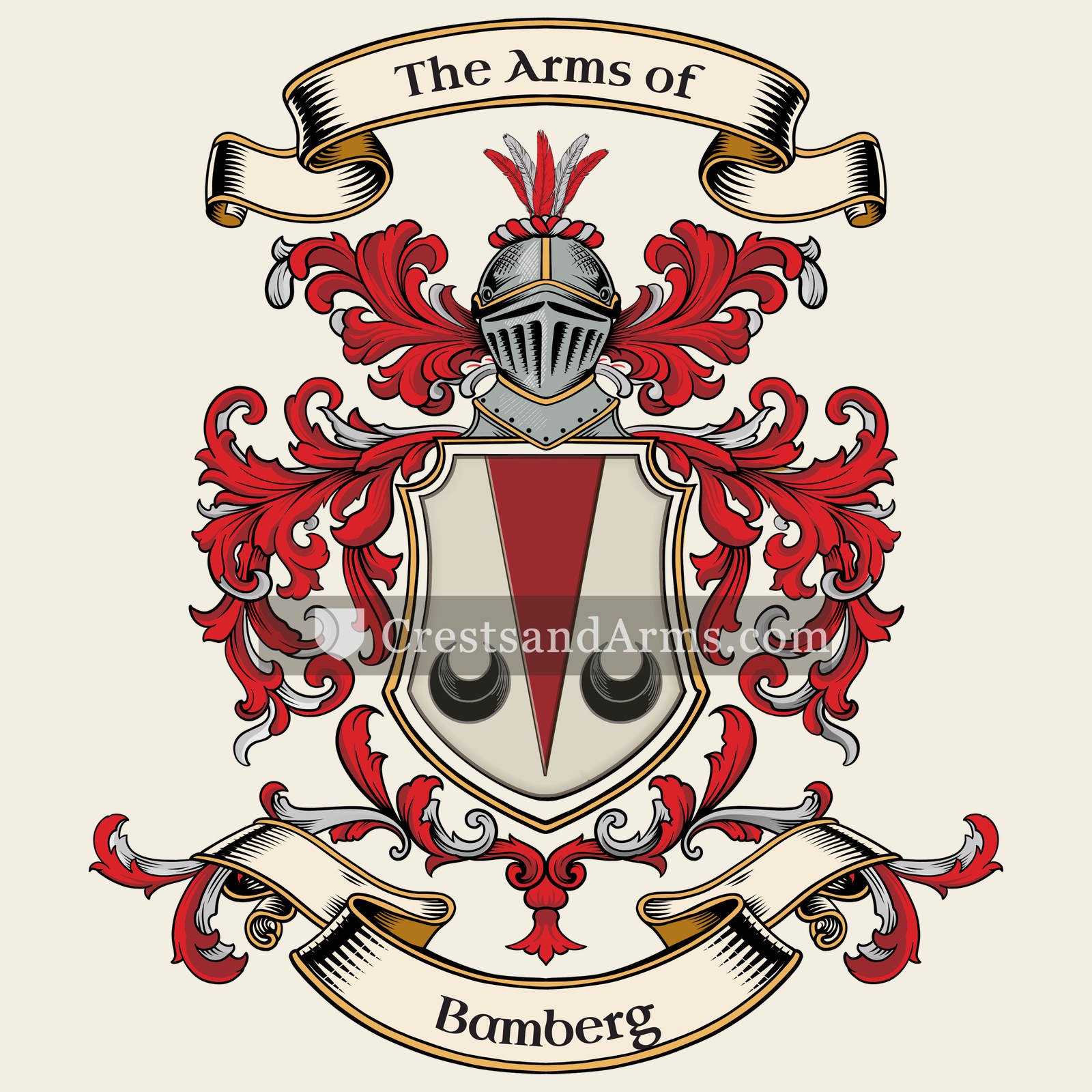
A record of documented arms, meaning and origin, researched for the Bamberg family of Germany.
Reg. 2179 · German, A–C
Coat of Arms & Family Crest Details
Symbols on this shield
pileWell-doing, and a mark of distinction
crescentHonour by the sovereign, and the second son
Colours
Silver (Argent)Means: Peace and sincerity
Red (Gules)Means: Military strength
Historical info
Source
J. B. Rietstap, Armorial Général, Gouda: G. B. van Goor Zonen, 1884–87
Blazon (the actual original written record)
“D'arg. à une pile de gu., en bande, mouv. de l'angle dextre du chef, et acc. de deux croiss. du même, celui en chef cont., celui en p. tourné. Cq. cour. C.:”
GermanySchwarzbourg, c. 1788
Digital archive packCoat of arms PNG, gold border print PDF, vector SVG and the certificate of authenticity. Sent to your email in minutes.
Map of Germany showing where the Bamberg arms are recorded
The Bamberg arms were recorded in Schwarzbourg, c. 1788.
This is where the arms were entered in the register. Families often moved to other parts of the country, so the same name can turn up in more than one region.
The body that granted and recorded arms in Germany in this period.
Joseph II, Holy Roman Emperor
Sovereign of the period
Joseph II, Holy Roman Emperor
1765–1790
Reigning in Germany when the Bamberg arms are first recorded.
How Arms Worked in Germany
In the Holy Roman Empire, coats of arms were often granted to individuals by the Emperor or his representatives. These arms were then passed down through the generations to all legitimate descendants of the original holder. Younger branches of a family usually kept the same shield design without needing to change it, as the arms belonged to the entire lineage.
Granting authority
The Holy Roman Emperor held the sole power to grant new coats of arms throughout his vast imperial territories.
How they got arms
Families typically obtained their coats of arms through a formal imperial grant or by proving their noble status to the authorities.
Where arms were recorded
These grants were officially recorded in the Imperial Chancery registers, which began keeping formal records of such honors during the Middle Ages.
The family's standing
Recorded among the armigerous families of Germany.
Origin & History of the Bamberg Family in Germany
The family name Bamberg is a locative surname, meaning it was originally derived from the historic city of Bamberg in the Upper Franconia region of Germany. During the late 18th century, members of the family were documented residing in the Schwarzburg region, which was a territory governed by the princely House of Schwarzburg. By 1788, these individuals were likely part of the local administrative or agrarian workforce that sustained the small principalities of the Holy Roman Empire. The migration of families from major urban centers like Bamberg into smaller sovereign territories was common during this era as people sought new opportunities in trade or service. While the name links the family to a significant religious and political center in Bavaria, the branch established in Schwarzburg eventually became deeply rooted in the social fabric of that specific Thuringian landscape.
Bamberg Meaning & Related Branches
Root word
Babenberg
Derived from the name Babo and the German word for mountain.
This name
BambergRefers to a person originating from the city of Bamberg in Bavaria.
also spelled
Bamberge
Related arms
Briesenrecorded with Bamberg, same area
Brucknerrecorded with Bamberg, same area
Dammanrecorded with Bamberg, same area
Hoheneckrecorded with Bamberg, same area
Documented Sources
J. B. Rietstap, Armorial Général, Gouda: G. B. van Goor Zonen, 1884–87
Büttner, Heinrich. Geschichte des Bistums Bamberg. 1950
Thüringer Landesarchiv Rudolstadt. Fürstentum Schwarzburg-Rudolstadt, Behörden und Ämter. 1788
Digital archive packCoat of arms PNG, gold border print PDF, vector SVG and the certificate of authenticity. Sent to your email in minutes.


 pileWell-doing, and a mark of distinction
 crescentHonour by the sovereign, and the second son
 pileWell-doing, and a mark of distinction
 crescentHonour by the sovereign, and the second son