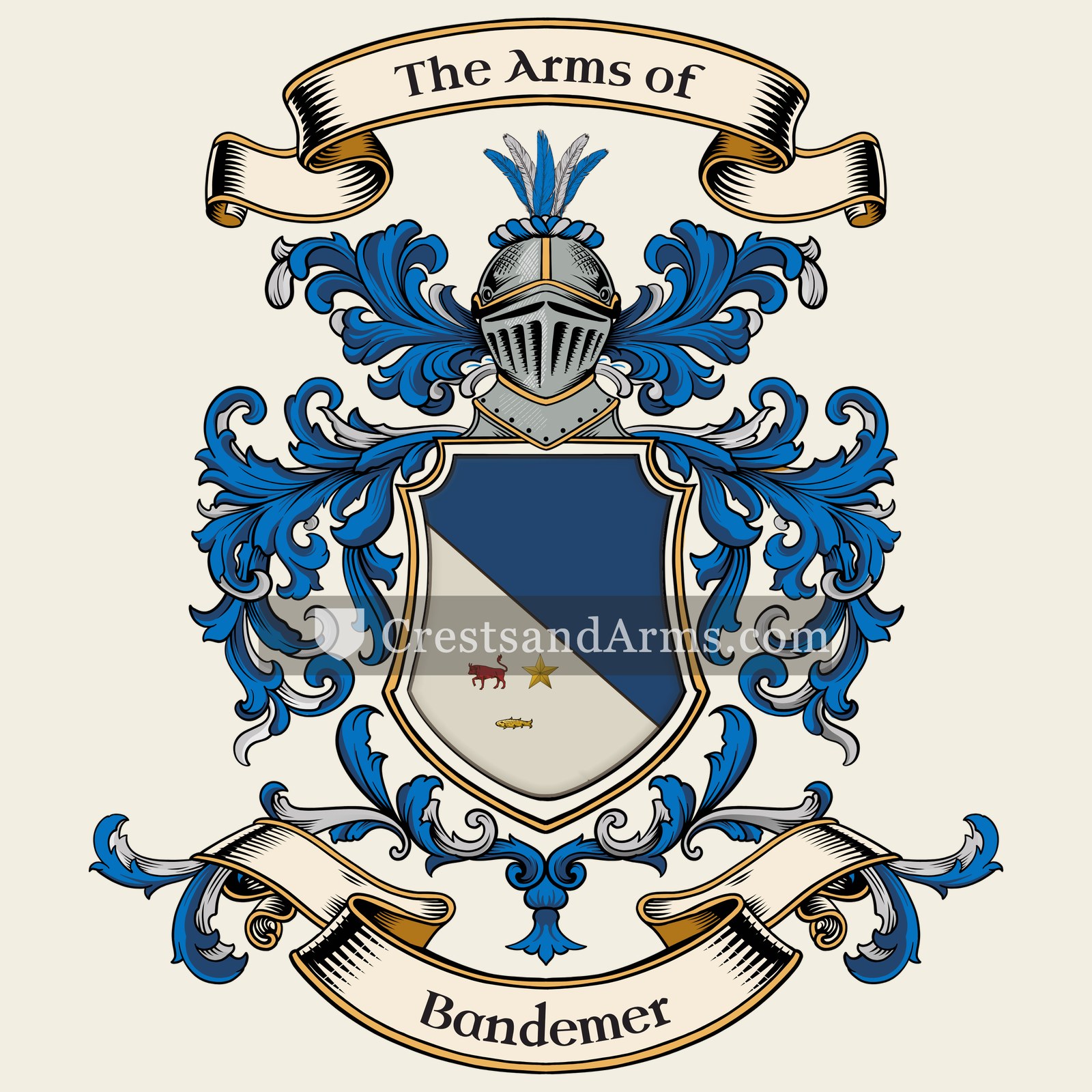
A record of documented arms, meaning and origin, researched for the Bandemer family of Germany.
Reg. 5290 · German, A–C
Coat of Arms & Family Crest Details
Symbols on this shield
chequyConstancy, and the counting-board
bullValour and generosity
mulletThe third son, and a divine quality from above
fishA true and generous mind, and Christian faith
Colours
Silver (Argent)Means: Peace and sincerity
Blue (Azure)Means: Loyalty and truth
Red (Gules)Means: Military strength
Gold (Or)Means: Generosity
Historical info
Source
J. B. Rietstap, Armorial Général, Gouda: G. B. van Goor Zonen, 1884–87
Blazon (the actual original written record)
“Taillé: au 1 d'arg. au buffle naiss. de gu., mouv. du taillé, portant entre ses cornes une étoile d'or, le col percé d'une pique d'or, arm. au nat., en barre, le fer en haut; au 2 échiq. en barre d'azur et d'arg., de quatre tires, la première de huit points, les autres diminuant. Cq. cour. C.: une étoile d'or; ou, le buffle iss. L. d'arg. et d'azur.”
PomeraniaPomerania, c. 1765
Digital archive packCoat of arms PNG, gold border print PDF, vector SVG and the certificate of authenticity. Sent to your email in minutes.
Map of Germany showing where the Bandemer arms are recorded
The Bandemer arms were recorded in Pomerania, c. 1765.
Pomerania was flat farming country on the Baltic coast, held in large estates by a small number of families. They kept their land for generations, and generations of landholding is what fills the registers.
This is where the arms were entered in the register. Families often moved to other parts of the country, so the same name can turn up in more than one region.
The body that granted and recorded arms in Germany in this period.
Francis I, Holy Roman Emperor
Sovereign of the period
Francis I, Holy Roman Emperor
1745–1765
Reigning in Germany when the Bandemer arms are first recorded.
How Arms Worked in Germany
In the Holy Roman Empire, coats of arms were often granted to individuals by the Emperor or his representatives. These arms were then passed down through the generations to all legitimate descendants of the original holder. Younger branches of a family usually kept the same shield design without needing to change it, as the arms belonged to the entire lineage.
Granting authority
The Holy Roman Emperor held the sole power to grant new coats of arms throughout his vast imperial territories.
How they got arms
Families typically obtained their coats of arms through a formal imperial grant or by proving their noble status to the authorities.
Where arms were recorded
These grants were officially recorded in the Imperial Chancery registers, which began keeping formal records of such honors during the Middle Ages.
The family's standing
Recorded among the armigerous families of Pomerania.
Origin & History of the Bandemer Family in Germany
The family name Bandemer is deeply rooted in the historical region of Pomerania, which was a territory located along the southern coast of the Baltic Sea. By the mid-eighteenth century, the family was well-established in this area, with records confirming their presence there as early as 1765. The name itself is thought to be of Slavic origin, reflecting the complex cultural history of Pomerania where German and Slavic influences blended over many generations. Families like the Bandemers often lived as landowners or farmers during this period, playing a vital role in the rural economy of the Prussian state. As the region underwent significant political and social changes during the eighteenth century, the family remained tied to the land and the local traditions of their Pomeranian home. Their history serves as a window into the lives of the people who shaped the development of northern Germany long before modern borders were established.
Bandemer Meaning & Related Branches
Root word
Bandemer
Derived from the Slavic place name Bandemer in Pomerania.
This name
BandemerRefers to a person originating from the village of Bandemer located in the historical Pomerania region.
also spelled
Bandemere
Documented Sources
J. B. Rietstap, Armorial Général, Gouda: G. B. van Goor Zonen, 1884–87
Kneschke, Ernst Heinrich, Neues allgemeines deutsches Adels-Lexicon, 1859
Ledebur, Leopold von, Adelslexicon der preussischen Monarchie, 1855
Landesarchiv Greifswald, General-Musterungslisten von Pommern
Geheimes Staatsarchiv Preußischer Kulturbesitz, General-Direktorium, Ostpreußische und Pommersche Departements
Digital archive packCoat of arms PNG, gold border print PDF, vector SVG and the certificate of authenticity. Sent to your email in minutes.


 chequyConstancy, and the counting-board
 bullValour and generosity
 mulletThe third son, and a divine quality from above
 fishA true and generous mind, and Christian faith
 chequyConstancy, and the counting-board
 bullValour and generosity
 mulletThe third son, and a divine quality from above
 fishA true and generous mind, and Christian faith