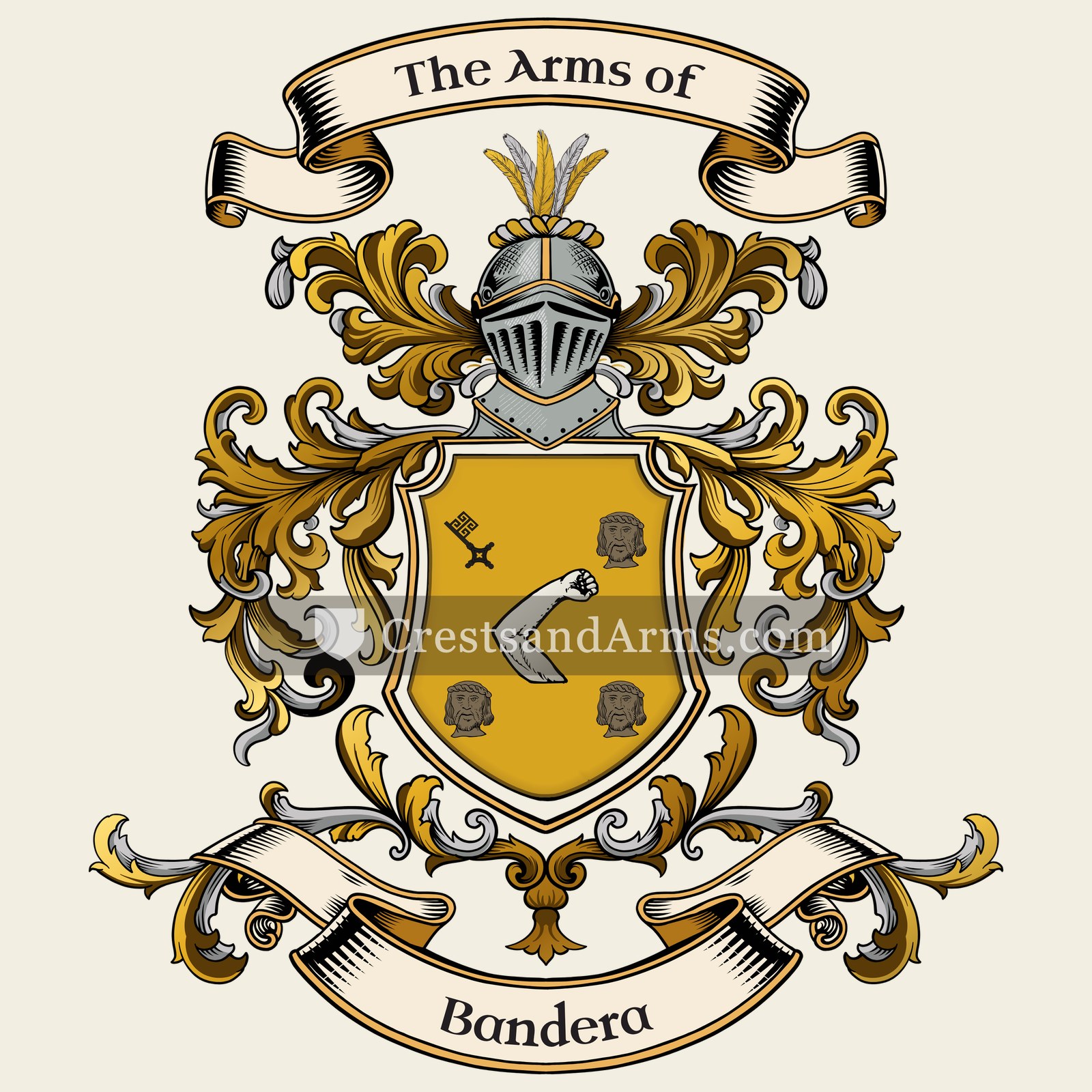
A record of documented arms, meaning and origin, researched for the Bandera family of Spain.
Reg. 9686 · Spanish, A–C
Coat of Arms & Family Crest Details
Symbols on this shield
armA person of action, industrious and laborious
keyGuardianship, and the office of a steward
saracens head affronty coupedA crusade fought, and an enemy met in the field
Colours
Gold (Or)Means: Generosity
Silver (Argent)Means: Peace and sincerity
Historical info
Source
J. B. Rietstap, Armorial Général, Gouda: G. B. van Goor Zonen, 1884–87
Blazon (the actual original written record)
“D'or à un senestrochère, arm. d'arg., mouv. du flanc, tenant un guidon d'arg., flottant à sen., et acc. d'une clé d'or, en pal, posée au flanc dextre, le panneton en haut et à sen.; le tout acc. de trois têtes de Sarasin de carn., accostées, en p., coiffées de turbans d'arg., rayés de gu., la tête de milieu posee de front, les deux autres de profil et affr.”
SpainAsturies, c. 1722
Digital archive packCoat of arms PNG, gold border print PDF, vector SVG and the certificate of authenticity. Sent to your email in minutes.
Map of Spain showing where the Bandera arms are recorded
The Bandera arms were recorded in Asturies, c. 1722.
This is where the arms were entered in the register. Families often moved to other parts of the country, so the same name can turn up in more than one region.
The body that granted and recorded arms in Spain in this period.
Philip V of Spain
Sovereign of the period
Philip V of Spain
1714–1724
Reigning in Spain when the Bandera arms are first recorded.
How Arms Worked in Spain
In Spain, a coat of arms was considered a form of property that belonged to the entire family line. These arms were passed down from a father to all his children equally. Younger branches of the family usually kept the original design without needing to add any special marks to distinguish their specific line.
Granting authority
The Cronista Rey de Armas was the official body that regulated and granted coats of arms throughout Spain.
How they got arms
Families often obtained their arms through royal grants or by proving their noble status to the official heraldic authority.
Where arms were recorded
Coats of arms were officially recorded in the registers of the Cronista Rey de Armas starting in 1496.
The family's standing
Recorded among the armigerous families of Spain.
Origin & History of the Bandera Family in Spain
The family name Bandera finds its historical roots in the rugged landscape of northern Spain, specifically within the region of Asturias. By the year 1722, records confirm that members of the family were already established in this area, living among the mountains and coastal valleys that define the Asturian identity. The name itself is derived from the Spanish word for a flag or banner, which suggests that the earliest ancestors may have held positions of responsibility or leadership within their local communities. During the eighteenth century, families in Asturias were often tied to the land through agriculture and livestock, and the Banderas were likely part of this traditional social structure. As they moved through the generations, the family became deeply integrated into the local culture, contributing to the development of the region during a period of significant social and economic change in Spain.
Bandera Meaning & Related Branches
Root word
Bandum
A Latin term referring to a standard, banner, or military flag.
This name
BanderaA topographic or occupational name for someone who carried a flag or lived near a banner.
also spelled
Bandere
Documented Sources
J. B. Rietstap, Armorial Général, Gouda: G. B. van Goor Zonen, 1884–87
Archivo Histórico de Asturias, Protocolos Notariales de Oviedo, 1722
Canella Secades, Fermín, Historia de Asturias, 1895
Madoz, Pascual, Diccionario geográfico-estadístico-histórico de España y sus posesiones de Ultramar, 1845
Digital archive packCoat of arms PNG, gold border print PDF, vector SVG and the certificate of authenticity. Sent to your email in minutes.


 armA person of action, industrious and laborious
 keyGuardianship, and the office of a steward
 saracens head affronty coupedA crusade fought, and an enemy met in the field
 armA person of action, industrious and laborious
 keyGuardianship, and the office of a steward
 saracens head affronty coupedA crusade fought, and an enemy met in the field