A record of documented arms, meaning and origin, researched for the Baner family lines. Documented in 2 countries.
Reg. 9235 · German, A–C
Coat of Arms & Family Crest Details
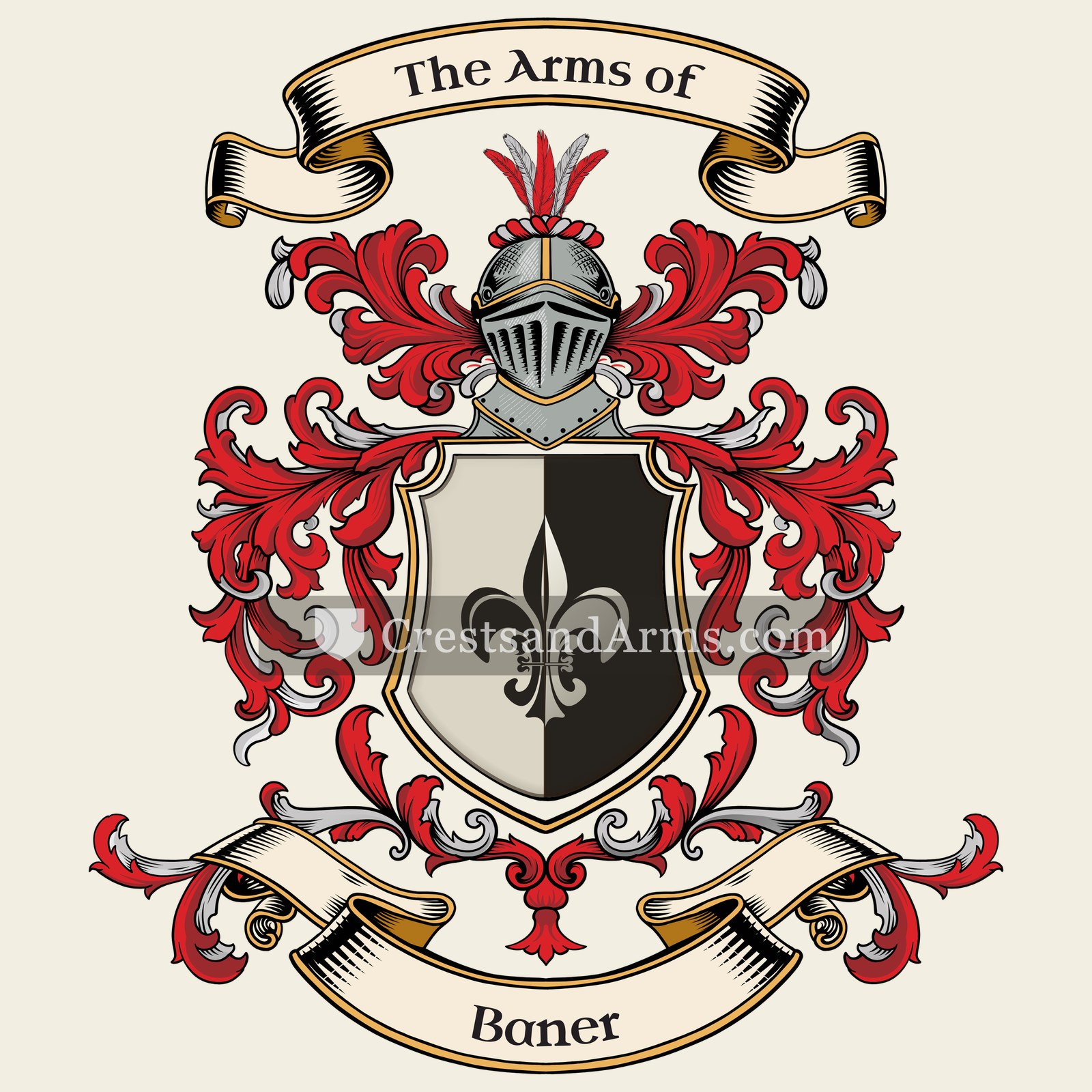
Symbols on this shield
fleur de lisPurity, light, and the sixth son
Colours
Silver (Argent)Means: Peace and sincerity
Black (Sable)Means: Constancy
Historical info
Source
J. B. Rietstap, Armorial Général, Gouda: G. B. van Goor Zonen, 1884–87
Blazon (the actual original written record)
“Parti d'arg. et de sa.; à la fleur-de-lis de l'un en l'autre. C.: un homme iss., hab. d'un parti de sa. et d'arg., coiffé d'un chapeau parti de sa. et d'arg., retr. d'un parti pareil; le chapeau sommé de la fleur-de-lis de l'écu; ledit homme tenant de chaque main un drapeau, celui à dextre de sa., celui à sen. d'arg.”
SilesiaSilesia, c. 1765
Where the Baner Arms Were Recorded
Map of Germany showing where the Baner arms are recorded
The Baner arms were recorded in Silesia, c. 1765.
Silesia was farming country in the east of the German lands, held in large estates by families who stayed put for generations. Owning land was what entitled a family to arms, so the region fills a good deal of the register.
This is where the arms were entered in the register. Families often moved to other parts of the country, so the same name can turn up in more than one region.
The body that granted and recorded arms in Germany in this period.
Francis I, Holy Roman Emperor
Sovereign of the period
Francis I, Holy Roman Emperor
1745–1765
Reigning in Germany when the Baner arms are first recorded.
How Arms Worked in Germany
In the Holy Roman Empire, coats of arms were often granted to individuals by the Emperor or his representatives. These arms were then passed down through the generations to all legitimate descendants of the original holder. Younger branches of a family usually kept the same shield design without needing to change it, as the arms belonged to the entire lineage.
Granting authority
The Holy Roman Emperor held the sole power to grant new coats of arms throughout his vast imperial territories.
How they got arms
Families typically obtained their coats of arms through a formal imperial grant or by proving their noble status to the authorities.
Where arms were recorded
These grants were officially recorded in the Imperial Chancery registers, which began keeping formal records of such honors during the Middle Ages.
The family's standing
Recorded among the armigerous families of Silesia.
Origin & History of the Baner Family in Germany
The history of the Baner family in Germany is deeply rooted in the cultural landscape of the eighteenth century, particularly within the region of Silesia. By 1765, records confirm that members of the family were well-established in this area, which was a crossroads of trade and shifting political borders between Prussia and the Austrian Empire. The name itself likely evolved from older Germanic naming traditions that focused on descriptive traits or geographic origins, reflecting the family’s integration into the local agrarian and civic life of the time. During this period, Silesia was undergoing significant social changes as it transitioned under Prussian rule, and families like the Baners were part of the backbone of the local community. They lived through a time of intense regional development, where the family name became a marker of their presence in the towns and villages that defined the Silesian identity. By tracing their history to this specific era, we see a family that was actively participating in the growth and stability of their home region long before the modern era.
Coat of Arms & Family Crest Details
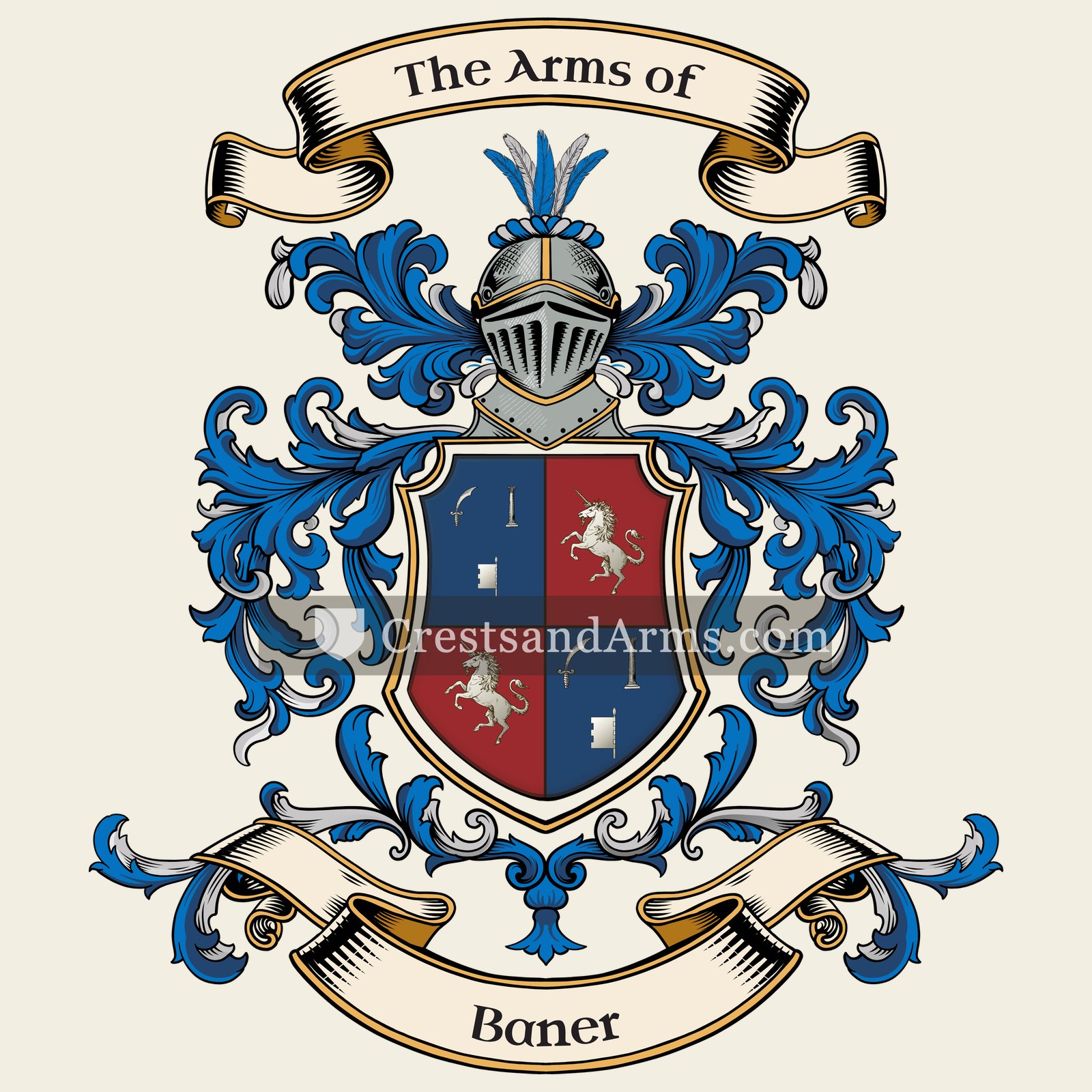
Symbols on this shield
swordJustice, and military honour
columnFortitude and constancy
flag / pennantA command held, and a following kept
unicornPurity, and extreme courage in defence of honour
Colours
Blue (Azure)Means: Loyalty and truth
Red (Gules)Means: Military strength
Silver (Argent)Means: Peace and sincerity
Historical info
Source
J. B. Rietstap, Armorial Général, Gouda: G. B. van Goor Zonen, 1884–87
Blazon (the actual original written record)
“Ec.: aux 1 et 4 d'azur à une épée d'arg., garnie d'or, posée en bande; une colonne d'arg., br. sur l'épée; et un guidon d'arg., attaché à une lance de tournoi au nat., br. en barre sur le tout; aux 2 et 3 de gu. à la licorne saillante d'arg. Sur le tout d'arg., embrassé à sen. de gu. Trois cq. cour. C.: 1° et 3° une licorne iss. d'arg., celle du 3 cont.; 2° dix guidons aux armes du surtout, cinq à dextre et cinq à sen. Manteau à dextre de gu., à sen. d'azur, doublé d'un écartelé d'arg. et d'or.”
Swedenc. 1651
Where the Baner Arms Were Recorded
Stockholm
Map of Sweden showing where the Baner arms are recorded
The Baner arms were recorded in Sweden, c. 1651.
Arms such as these were typically recorded in Stockholm.
Stockholm held the Swedish court and the House of Nobility, where every noble family's arms were entered and kept. Families ennobled for service registered there, which is why so many are recorded around the city.
This is where the arms were entered in the register. Families often moved to other parts of the country, so the same name can turn up in more than one region.
The body that granted and recorded arms in Sweden in this period.
Christina of Sweden
Sovereign of the period
Christina of Sweden
1632–1654
Reigning in Germany when the Baner arms are first recorded.
How Arms Worked in Sweden
In Sweden, a coat of arms belonged to a noble family as a whole rather than just one individual. These arms were passed down through the generations to all legitimate descendants. Younger branches of the family used the same shield without needing to change it. This system ensured that the entire lineage shared the same identity and status under the law.
Granting authority
The Riddarhuset, or House of Nobility, regulated all noble coats of arms in Sweden under royal authority.
How they got arms
Families received their coats of arms through royal grants of nobility which were then officially registered with the House.
Where arms were recorded
Coats of arms were officially recorded in the Swedish House of Nobility register starting in the year 1626.
The family's standing
Recorded among the armigerous families of Sweden.
Origin & History of the Baner Family in Sweden
The Banér family stands as one of the most prominent noble houses in Swedish history, with their influence deeply rooted in the political and military life of the seventeenth century. While the family name gained significant prestige through their service to the Swedish Crown, their presence in the capital city of Stockholm by 1651 reflects their established position among the nation’s elite during the height of the Swedish Empire. Members of the family frequently served as high-ranking officers and government officials, playing crucial roles in shaping the administration of the country. Their history is closely tied to the expansion of Swedish power in Europe, as they held lands and responsibilities that required them to be central figures in the royal court. By maintaining a home in Stockholm, the family ensured they remained at the heart of the political decisions that defined their era. This long-standing connection to the capital helped solidify their reputation as a family of great importance and lasting legacy in Swedish society.
Related Branches & Arms
Root word
Banner
A flag or standard carried by a knight or military leader.
This name
BanerAn occupational name for a standard-bearer or someone who lived near a prominent flag.
also spelled
Banner
Related arms
Bannervariant spelling
Documented Sources
J. B. Rietstap, Armorial Général, Gouda: G. B. van Goor Zonen, 1884–87
State Archive in Wrocław (Archiwum Państwowe we Wrocławiu), Akta stanu cywilnego parafii rzymskokatolickiej w Śląsku
Knie, Johann Georg, Alphabetisch-statistisch-topographische Uebersicht der Dörfer, Flecken, Städte und andern Orte der Königl. Preuss. Provinz Schlesien, 1845
Zimmermann, Friedrich Albert, Beyträge zur Beschreibung von Schlesien, 1783
Digital archive packCoat of arms PNG, gold border print PDF, vector SVG and the certificate of authenticity. Sent to your email in minutes.


 fleur de lisPurity, light, and the sixth son
 fleur de lisPurity, light, and the sixth son

 swordJustice, and military honour
 columnFortitude and constancy
 flag / pennantA command held, and a following kept
 unicornPurity, and extreme courage in defence of honour