A record of documented arms, meaning and origin, researched for the Banner family lines. Documented in 2 countries.
Reg. 6284 · Danish, A–C
Coat of Arms & Family Crest Details
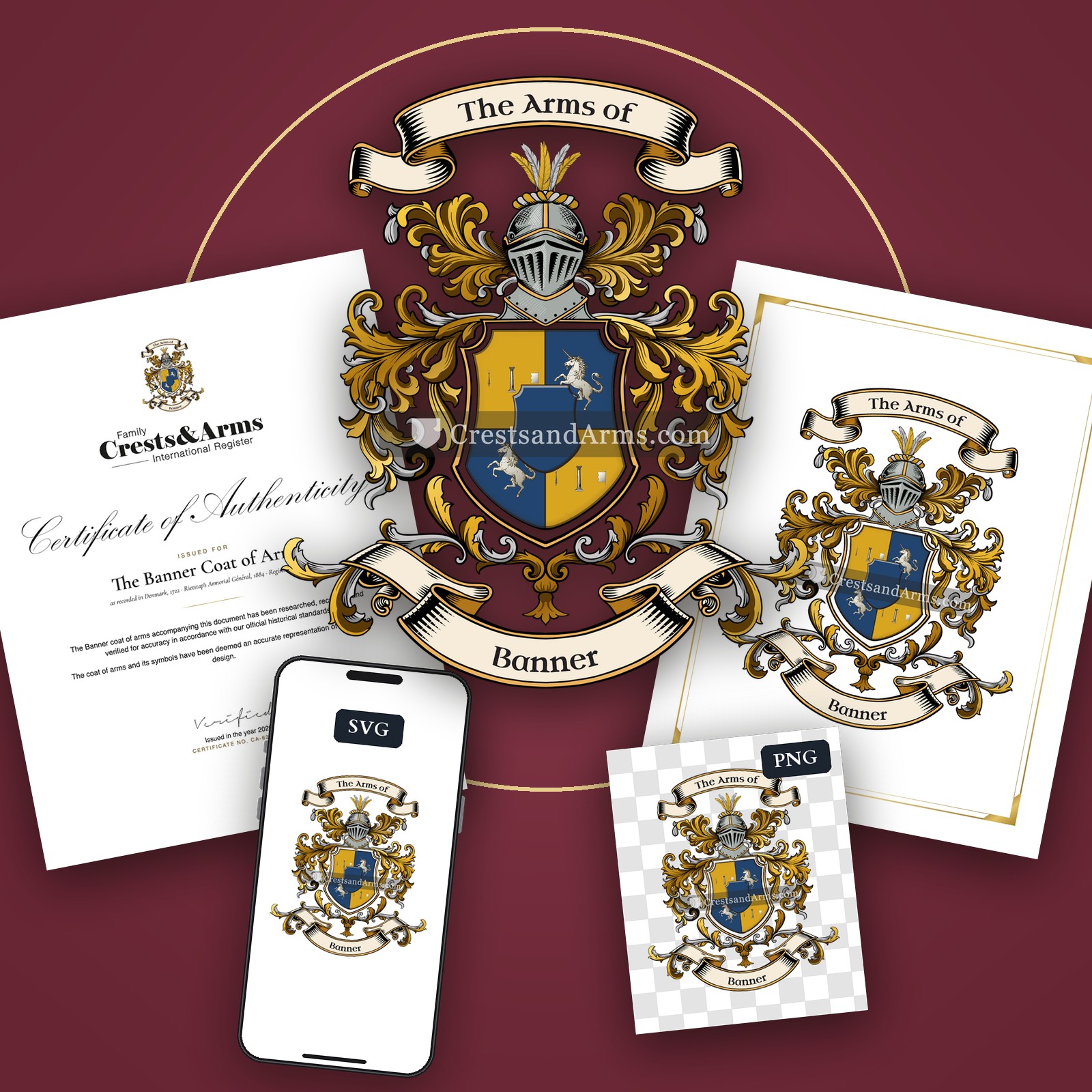
Symbols on this shield
columnFortitude and constancy
lanceKnightly service and the tilt
flag / pennantA command held, and a following kept
unicornPurity, and extreme courage in defence of honour
Colours
Gold (Or)Means: Generosity
Blue (Azure)Means: Loyalty and truth
Silver (Argent)Means: Peace and sincerity
Historical info
Source
J. B. Rietstap, Armorial Général, Gouda: G. B. van Goor Zonen, 1884–87
Blazon (the actual original written record)
“Ec.: aux 1 et 4 d'or à une lance de tournoi et un drapeau, passés en saut., tous deux d'arg. et une colonne du même, br. sur le tout; aux 2 et 3 d'azur à la licorne saillante d'arg. Sur le tout d'azur au chev. couché d'arg., mouv. du flanc dextre.”
Denmarkc. 1722
Digital archive packCoat of arms PNG, gold border print PDF, vector SVG and the certificate of authenticity. Sent to your email in minutes.
Map of Denmark showing where the Banner arms are recorded
The Banner arms were recorded in Denmark, c. 1722.
Arms such as these were typically recorded in Sjaælland.
Zealand held the Danish court, the crown's offices and Copenhagen itself. Families who served the king kept estates within reach of it, and royal service was the ordinary route to a coat of arms.
This is where the arms were entered in the register. Families often moved to other parts of the country, so the same name can turn up in more than one region.
The body that granted and recorded arms in Denmark in this period.
Frederik IV of Denmark
Sovereign of the period
Frederik IV of Denmark
1699–1730
Reigning in Denmark when the Banner arms are first recorded.
How Arms Worked in Denmark
Danish heraldry during this period was closely tied to noble status and royal favor rather than being open to all citizens. Arms were typically granted by the monarch to individuals, and these symbols were then shared by all members of the noble house. If a family line died out, the right to use those specific arms ended with them.
Granting authority
The Danish royal chancery held the power to issue and regulate official coats of arms for the kingdom.
How they got arms
Families usually received their arms through a formal royal grant that confirmed their noble status and rights.
Where arms were recorded
These grants were officially recorded in the Danish Royal Chancery records starting in the sixteenth century.
The family's standing
Recorded among the armigerous families of Denmark.
Origin & History of the Banner Family in Denmark
The history of the Banner family in Denmark is deeply rooted in the cultural and social landscape of the island of Sjælland. By the early eighteenth century, records confirm that family members were well established in this region, living during a time when Denmark was transitioning through significant agricultural and administrative reforms. The name itself reflects a period when surnames were becoming more fixed as a way to track families for tax and military purposes. Living on Sjælland, which served as the political and economic heart of the nation, the Banner family likely participated in the local agrarian economy that defined life for most citizens in 1722. Their presence in the historical record during this era provides a clear window into the lives of families who helped shape the local communities of the Danish countryside long before the modern era of record keeping began.
Coat of Arms & Family Crest Details
Symbols on this shield
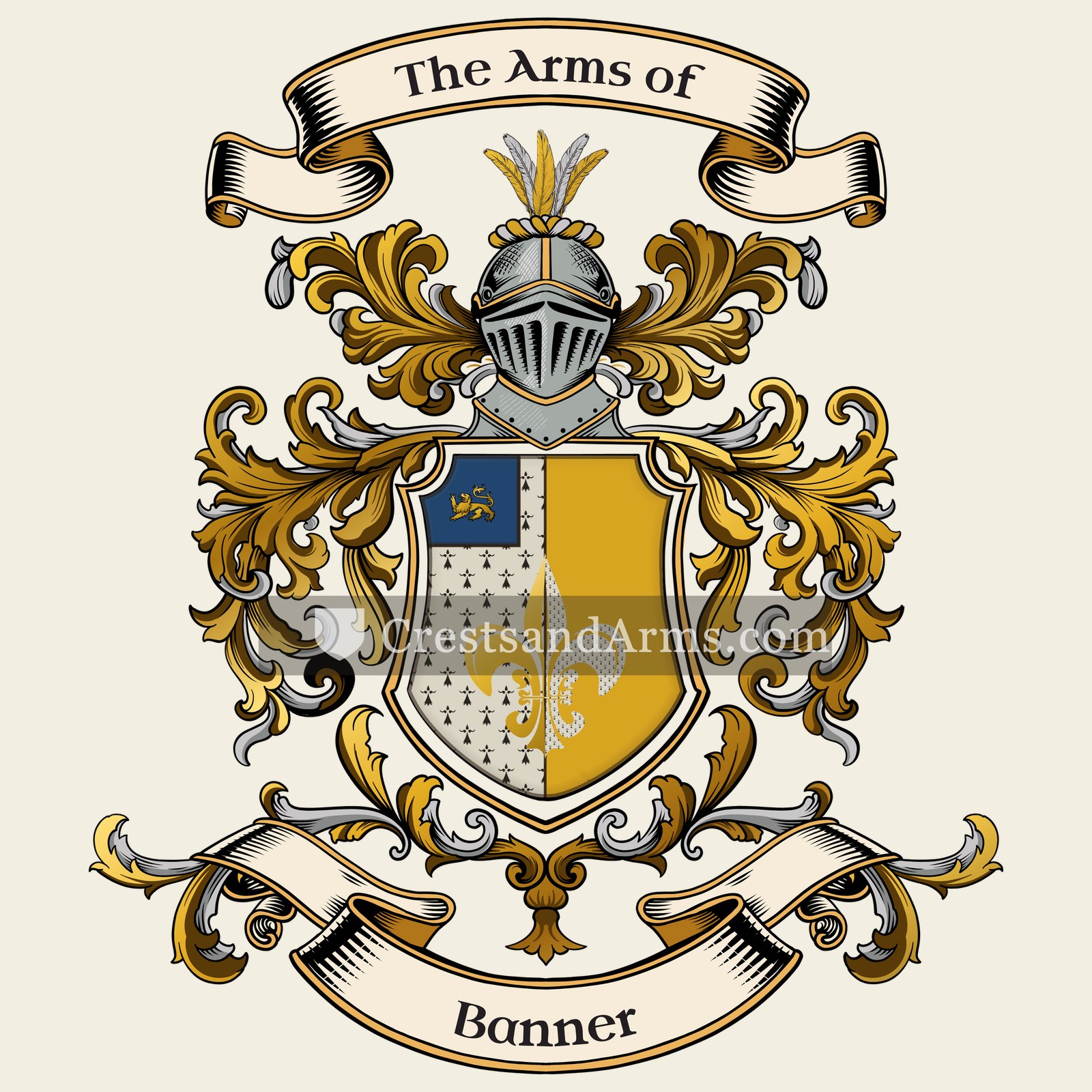
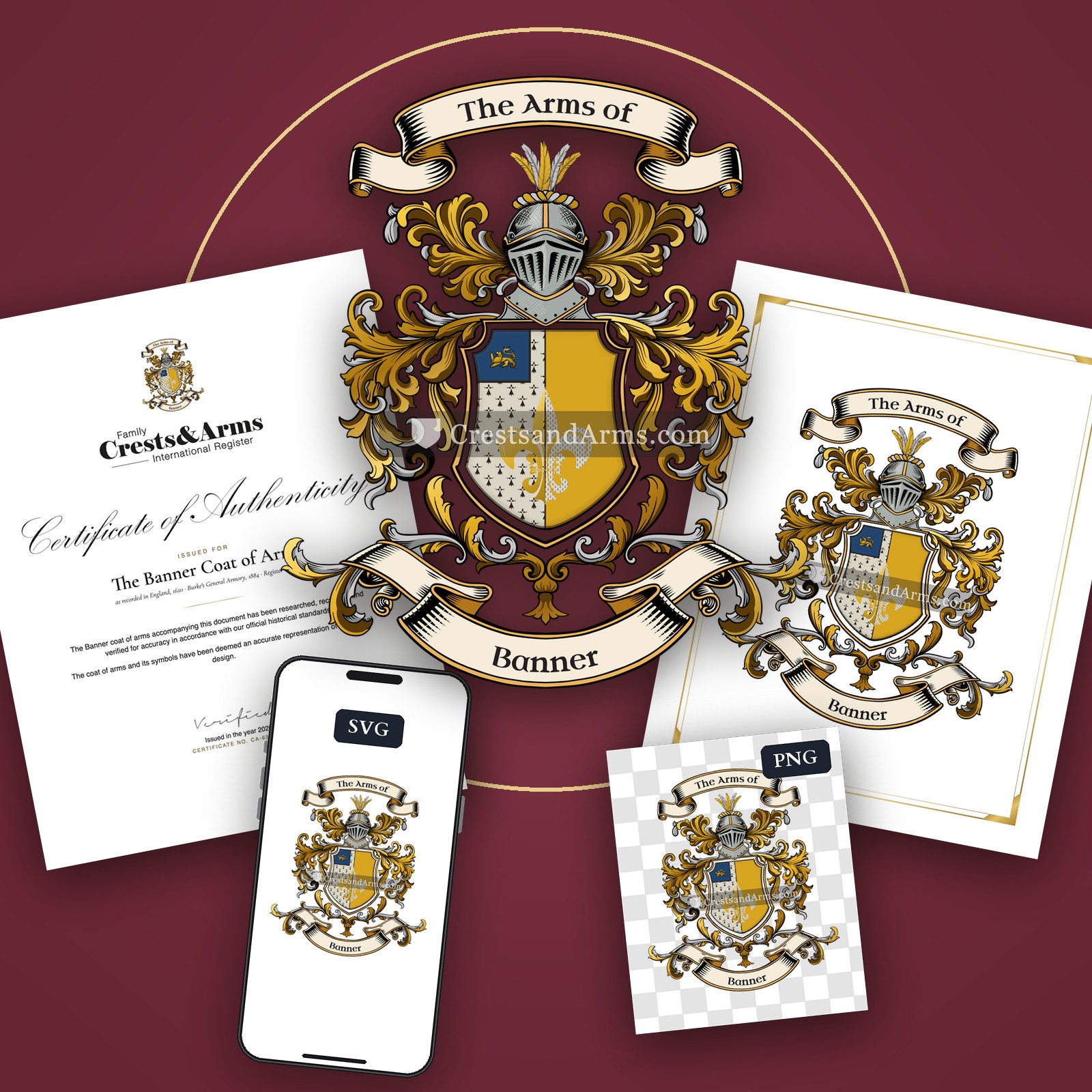
cantonA mark of honour granted by the sovereign
fleur de lisPurity, light, and the sixth son
lionCourage, strength and royalty
Colours
ErmineMeans: Dignity
Gold (Or)Means: Generosity
Blue (Azure)Means: Loyalty and truth
Silver (Argent)Means: Peace and sincerity
Historical info
Source
Sir Bernard Burke, The General Armory of England, Scotland, Ireland and Wales, London: Harrison & Sons, 1884
Blazon (the actual original written record)
“Per pale erm. and or, a fleur-de-lis counterchanged, on a canton az. a lion pass. ar”
EnglandLondon, c. 1620
Digital archive packCoat of arms PNG, gold border print PDF, vector SVG and the certificate of authenticity. Sent to your email in minutes.
Map of England showing where the Banner arms are recorded
The Banner arms were recorded in London, c. 1620.
This is where the arms were entered in the register. Families often moved to other parts of the country, so the same name can turn up in more than one region.
The body that granted and recorded arms in England in this period.
James VI and I
Sovereign of the period
James VI and I
1603–1625
Reigning in Denmark when the Banner arms are first recorded.
How Arms Worked in England
English heraldry allowed arms to be shared by all legitimate descendants of the original owner. These symbols were treated as personal property that moved through the generations to all children. While the eldest son kept the original design, other family members could use the same shield without needing to change it or register their own unique versions.
Granting authority
The College of Arms in London has regulated the use of coats of arms throughout England and Wales since 1484.
How they got arms
Families typically obtained their coats of arms through a formal grant from the Crown or by proving their ancient right to them.
Where arms were recorded
All official coats of arms are recorded in the registers kept at the College of Arms, which date back to the fifteenth century.
The family's standing
Recorded among the armigerous families of England.
Origin & History of the Banner Family in England
The surname Banner emerged in England as a descriptive name, likely referring to a person who carried a flag or a banner in a professional or ceremonial capacity. By the time the family was firmly established in London during the early 17th century, the name had become a permanent fixture of the urban landscape. In 1620, members of the Banner family were active participants in the bustling social and economic life of the city. During this era, London was a center of rapid growth and trade, and families with this name were often involved in the skilled crafts and merchant classes that powered the English economy. As the family settled into these neighborhoods, they became part of the long tradition of English surnames that reflected the specific roles or occupations held by their medieval ancestors. This transition from a descriptive title to a hereditary family name highlights how the social structure of early modern England helped shape the identities of its citizens.
Banner Meaning & Related Branches
Root word
Band
A strip of cloth or a banner used as a sign.
This name
BannerAn occupational name for a standard-bearer or someone who carried a flag in battle.
also spelled
Baner
Bannar
Related arms
Banervariant spelling
Documented Sources
J. B. Rietstap, Armorial Général, Gouda: G. B. van Goor Zonen, 1884–87
Dansk Demografisk Database, Folketælling 1787 (1787)
Rigsarkivet, Danske Kancelli, Sjællandske Tegnelser (1722)
Trap, J.P., Kongeriget Danmark (1920)
Digital archive packCoat of arms PNG, gold border print PDF, vector SVG and the certificate of authenticity. Sent to your email in minutes.


 columnFortitude and constancy
 lanceKnightly service and the tilt
 flag / pennantA command held, and a following kept
 unicornPurity, and extreme courage in defence of honour
 columnFortitude and constancy
 lanceKnightly service and the tilt
 flag / pennantA command held, and a following kept
 unicornPurity, and extreme courage in defence of honour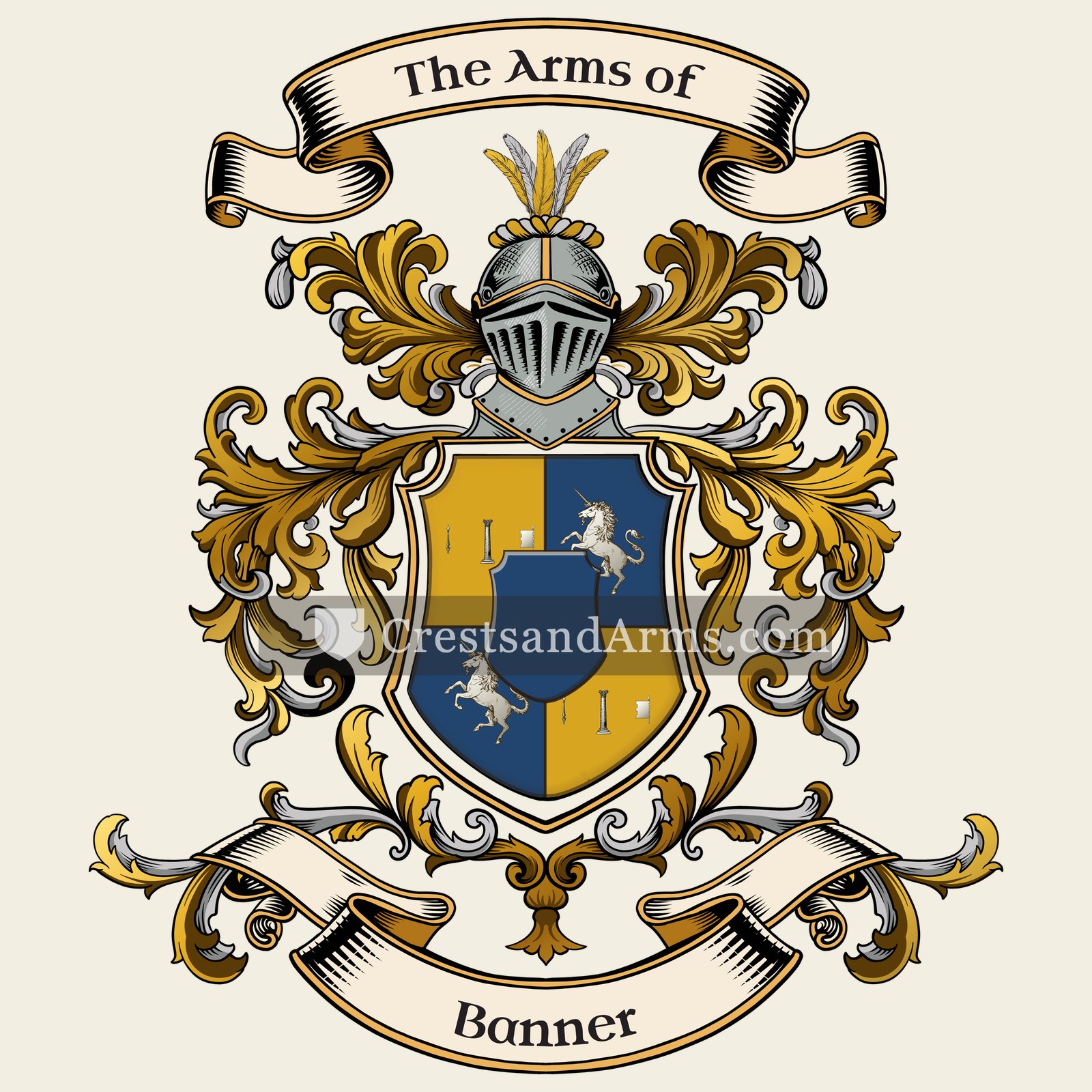


 cantonA mark of honour granted by the sovereign
 fleur de lisPurity, light, and the sixth son
 lionCourage, strength and royalty