Map of Scotland showing where the Bannerman arms are recorded
The Bannerman arms were recorded in Kincardine, c. 1682.
Kincardineshire was a narrow strip of farmland between the hills and the North Sea. Its landed families were few but very long-settled, and long settlement brought arms.
This is where the arms were entered in the register. Families often moved to other parts of the country, so the same name can turn up in more than one region.
The body that granted and recorded arms in Scotland in this period.
Charles II of England
Sovereign of the period
Charles II of England
1660–1685
Reigning in Scotland when the Bannerman arms are first recorded.
How Arms Worked in Scotland
Scottish heraldry is unique because it treats a coat of arms as a piece of personal property protected by law. Only one person can own a specific design at any given time. When a family grows, the head keeps the original shield while other relatives must apply for their own distinct version with slight changes to prove their specific identity.
Granting authority
The Court of the Lord Lyon acts as the official body that regulates and controls all heraldic matters throughout Scotland.
How they got arms
Individuals obtain a legal right to their arms through a formal petition process that confirms their identity and family connection.
Where arms were recorded
All valid coats of arms are officially entered into the Public Register of All Arms and Bearings starting from 1672.
The family's standing
Recorded among the armigerous families of Kincardine.
Origin & History of the Bannerman Family in Scotland
The name Bannerman originated in Scotland as an occupational title for a person who carried a banner or flag into battle for a king or a high-ranking nobleman. These individuals held a position of great trust because they were responsible for guiding troops and signaling movements during the chaos of medieval warfare. By the late seventeenth century, the family had established a clear presence in the region of Kincardine. Records from 1682 confirm that members of the family were living and working in this area, which was known for its rugged landscape and deep connections to the Scottish nobility. Over time, the name transitioned from a description of a military duty into a hereditary surname that passed from one generation to the next. This evolution reflects the broader history of Scottish families who moved from specific roles in service to becoming settled landowners and community members in their local parishes.
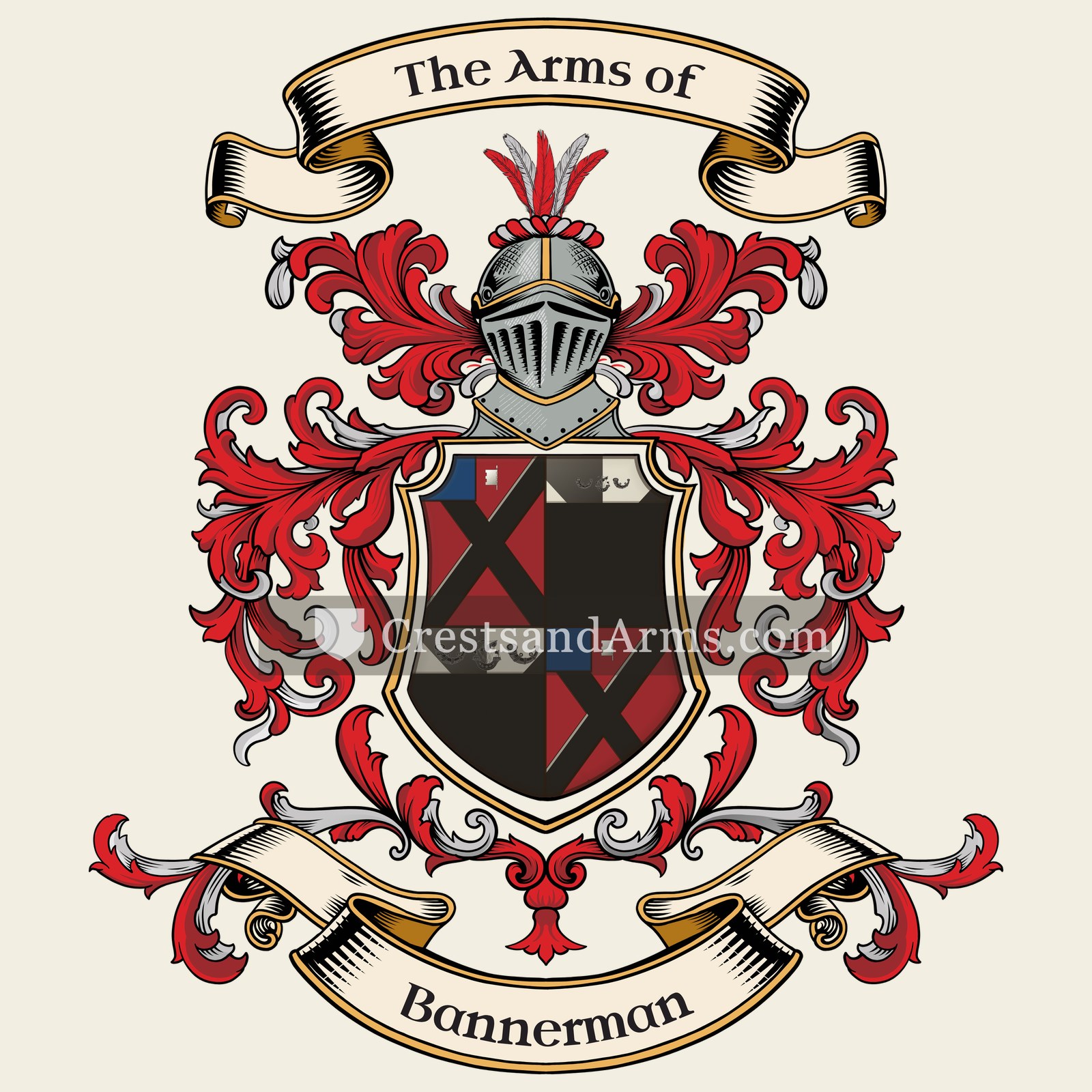
Coat of Arms & Family Crest Details
Symbols on this shield
cantonA mark of honour granted by the sovereign
saltireResolution, and St Andrew's cross
chiefAuthority, wisdom and dominion
flag / pennantA command held, and a following kept
shipEnterprise, and a great voyage undertaken
hunting horn stringedOne who delights in the chase
Colours
Red (Gules)Means: Military strength
Black (Sable)Means: Constancy
Blue (Azure)Means: Loyalty and truth
Silver (Argent)Means: Peace and sincerity
Historical info
Source
Sir Bernard Burke, The General Armory of England, Scotland, Ireland and Wales, London: Harrison & Sons, 1884
Blazon (the actual original written record)
“Quarterly, 1st and 4th, per pale gu. and sa. a banner displ. bendways ar. thereon a canton az. charged with a saltire of the second, for BANNERMAN; 2nd and 3rd, gyronny of eight or and sa. on a chief engr. ar. a lymphad sails furled and oars in action betw. two hunting horns stringed all of the second, for CAMPBELL of Stracathro”
KentKent, c. 1620
Digital archive packCoat of arms PNG, gold border print PDF, vector SVG and the certificate of authenticity. Sent to your email in minutes.
Map of England showing where the Bannerman arms are recorded
The Bannerman arms were recorded in Kent, c. 1620.
Kent sits between London and the short crossing to Europe, and the trade passing through made it wealthy. Merchant families bought land with that money, and it was landowners who took coats of arms.
This is where the arms were entered in the register. Families often moved to other parts of the country, so the same name can turn up in more than one region.
The body that granted and recorded arms in England in this period.
James VI and I
Sovereign of the period
James VI and I
1603–1625
Reigning in Scotland when the Bannerman arms are first recorded.
How Arms Worked in England
English heraldry allowed arms to be shared by all legitimate descendants of the original owner. These symbols were treated as personal property that moved through the generations to all children. While the eldest son kept the original design, other family members could use the same shield without needing to change it or register their own unique versions.
Granting authority
The College of Arms in London has regulated the use of coats of arms throughout England and Wales since 1484.
How they got arms
Families typically obtained their coats of arms through a formal grant from the Crown or by proving their ancient right to them.
Where arms were recorded
All official coats of arms are recorded in the registers kept at the College of Arms, which date back to the fifteenth century.
The family's standing
Recorded among the armigerous families of Kent.
Origin & History of the Bannerman Family in England
The family name Bannerman originates from the medieval role of a banner-bearer, a person entrusted with carrying the standard or flag of a lord or king into battle. While the name is often associated with Scottish history, the presence of the family in Kent by 1620 suggests a migration pattern that brought individuals south during the period of political and economic shifts in the early seventeenth century. In the context of Kent, these early settlers likely integrated into local agricultural or trade communities, moving away from the military duties implied by their surname. As the name became established in southern England, it transitioned from a title of service into a hereditary surname used to identify families across generations. This shift reflects the broader social changes of the time, as people moved across regional borders to seek new opportunities in the growing English economy.
Bannerman Meaning & Related Branches
Root word
Banner
A flag or standard carried by a military leader.
This name
BannermanAn occupational title for a person who carried the flag for a feudal lord.
also spelled
Bannarman
Bannermanne
Related arms
Forbesrecorded with Bannerman, same area
Documented Sources
Sir Bernard Burke, The General Armory of England, Scotland, Ireland and Wales, London: Harrison & Sons, 1884
Black, George F., The Surnames of Scotland: Their Origin, Meaning, and History, 1946
National Records of Scotland, Register of the Privy Council of Scotland, 1682
National Records of Scotland, Commissariot Record of Brechin: Register of Testaments, 1682
Digital archive packCoat of arms PNG, gold border print PDF, vector SVG and the certificate of authenticity. Sent to your email in minutes.


 cantonA mark of honour granted by the sovereign
 cross symbolChristian faith and service
 flag / pennantA command held, and a following kept
 cantonA mark of honour granted by the sovereign
 cross symbolChristian faith and service
 flag / pennantA command held, and a following kept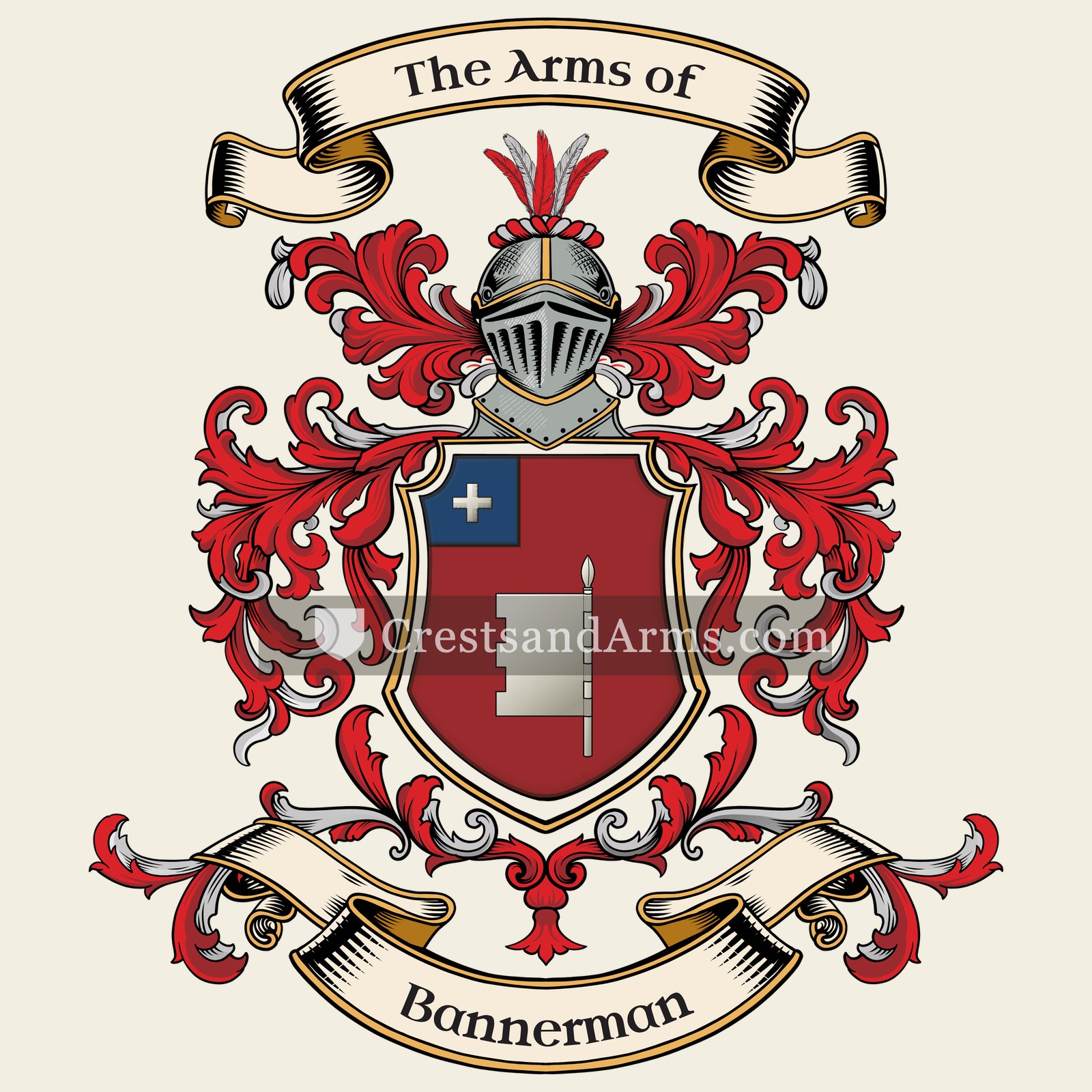


 saltireResolution, and St Andrew's cross
 chiefAuthority, wisdom and dominion
 shipEnterprise, and a great voyage undertaken
 hunting horn stringedOne who delights in the chase