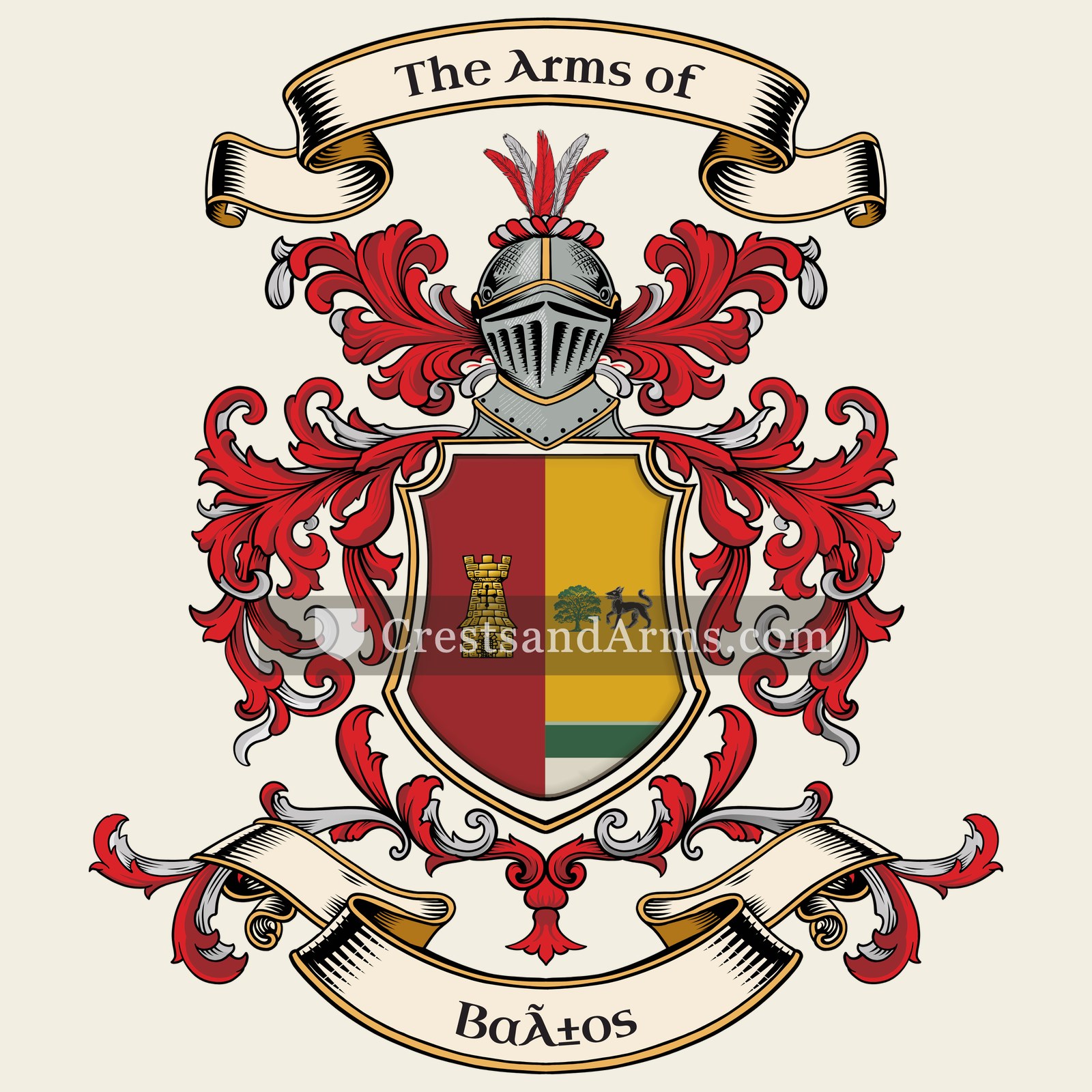
A record of documented arms, meaning and origin, researched for the Baños family of Spain.
Reg. 1380 · Spanish, A–C
Coat of Arms & Family Crest Details
Symbols on this shield
fessThe military belt, and readiness to serve
towerGrandeur and solidity, and a stronghold defended
treeLife, endurance and deep roots
wolfReward from long service and hard work
Colours
Red (Gules)Means: Military strength
Gold (Or)Means: Generosity
Green (Vert)Means: Hope
Silver (Argent)Means: Peace and sincerity
Black (Sable)Means: Constancy
Historical info
Source
J. B. Rietstap, Armorial Général, Gouda: G. B. van Goor Zonen, 1884–87
Blazon (the actual original written record)
“Parti: au 1 de gu. à la tour d'or; au 2 d'or à un arbre de sin. et un loup pass. de sa., br. sur le pied du fût, le tout soutenu d'un fascé-ondé d'azur et d'arg. de six pièces.”
CastileCastile, c. 1722
Digital archive packCoat of arms PNG, gold border print PDF, vector SVG and the certificate of authenticity. Sent to your email in minutes.
Map of Spain showing where the Baños arms are recorded
The Baños arms were recorded in Castile, c. 1722.
Castile was the heart of Spain and the source of most of its noble families. Land won in the long wars against the Moors was granted out to fighting men, and a man granted land was granted arms along with it.
This is where the arms were entered in the register. Families often moved to other parts of the country, so the same name can turn up in more than one region.
The body that granted and recorded arms in Spain in this period.
Philip V of Spain
Sovereign of the period
Philip V of Spain
1714–1724
Reigning in Spain when the Baños arms are first recorded.
How Arms Worked in Spain
In Spain, a coat of arms was considered a form of property that belonged to the entire family line. These arms were passed down from a father to all his children equally. Younger branches of the family usually kept the original design without needing to add any special marks to distinguish their specific line.
Granting authority
The Cronista Rey de Armas was the official body that regulated and granted coats of arms throughout Spain.
How they got arms
Families often obtained their arms through royal grants or by proving their noble status to the official heraldic authority.
Where arms were recorded
Coats of arms were officially recorded in the registers of the Cronista Rey de Armas starting in 1496.
The family's standing
Recorded among the armigerous families of Castile.
Origin & History of the Baños Family in Spain
The surname Baños is a topographic name that originated in the Iberian Peninsula, specifically derived from the Spanish word for baths. It was historically used to identify families who lived near public baths, thermal springs, or Roman-era bathing structures. By the early 18th century, the family had established a clear presence in the region of Castile, a central area of Spain known for its deep historical roots and influence on the Spanish language. During this period, families with this name were often integrated into the local agricultural or administrative life of Castilian towns. Because the name is tied to specific geographical features rather than a single ancestor, it likely emerged independently in different locations where such landmarks existed. This allows the family history to be traced back to the social and physical landscape of rural Castile during the 1700s.
Baños Meaning & Related Branches
Root word
balneum
Latin term referring to a bath or bathing facility.
This name
BañosRefers to a person who lived near public baths or a bathing establishment.
also spelled
Banyos
Banose
Documented Sources
J. B. Rietstap, Armorial Général, Gouda: G. B. van Goor Zonen, 1884–87
Moll, Francesc de Borja, Els llinatges catalans: Catalunya, País Valencià, Illes Balears, 1959
Albaigès i Olivart, Josep Maria, El gran libro de los apellidos, 2005
Archivo Histórico Nacional, Sección Nobleza, Protocolos Notariales de Castilla, 1722
Digital archive packCoat of arms PNG, gold border print PDF, vector SVG and the certificate of authenticity. Sent to your email in minutes.


 fessThe military belt, and readiness to serve
 towerGrandeur and solidity, and a stronghold defended
 treeLife, endurance and deep roots
 wolfReward from long service and hard work
 fessThe military belt, and readiness to serve
 towerGrandeur and solidity, and a stronghold defended
 treeLife, endurance and deep roots
 wolfReward from long service and hard work