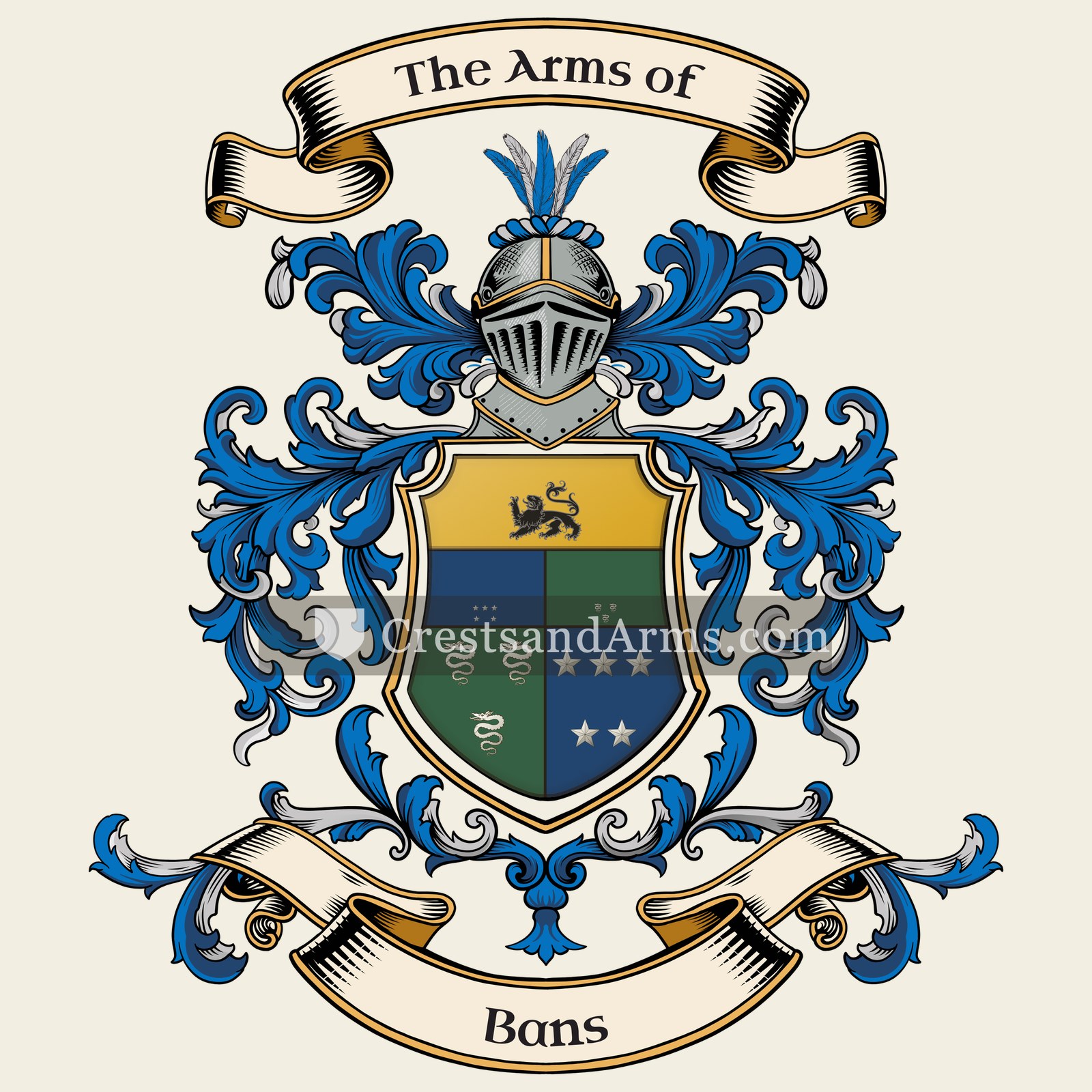
A record of documented arms, meaning and origin, researched for the Bans family of France.
Reg. 5913 · French, A–C
Coat of Arms & Family Crest Details
Symbols on this shield
chiefAuthority, wisdom and dominion
lionCourage, strength and royalty
mulletThe third son, and a divine quality from above
serpentWisdom, healing and prudence
Colours
Blue (Azure)Means: Loyalty and truth
Green (Vert)Means: Hope
Gold (Or)Means: Generosity
Black (Sable)Means: Constancy
Silver (Argent)Means: Peace and sincerity
Historical info
Source
J. B. Rietstap, Armorial Général, Gouda: G. B. van Goor Zonen, 1884–87
Blazon (the actual original written record)
“Ec.: aux 1 et 4 d'azur à cinq étoiles d'arg., 3 et 2; aux 2 et 3 de sin. à trois têtes de serpent d'arg., 2 et 1, et au chef d'or, ch. d'un lion léopardé de sa.”
FranceBourges, c. 1663
Digital archive packCoat of arms PNG, gold border print PDF, vector SVG and the certificate of authenticity. Sent to your email in minutes.
Map of France showing where the Bans arms are recorded
The Bans arms were recorded in Bourges, c. 1663.
This is where the arms were entered in the register. Families often moved to other parts of the country, so the same name can turn up in more than one region.
The body that granted and recorded arms in France in this period.
Louis XIV of France
Sovereign of the period
Louis XIV of France
1643–1715
Reigning in France when the Bans arms are first recorded.
How Arms Worked in France
In France, a coat of arms was a mark of honor that passed down through the male line to all legitimate descendants. Families often used the same shield without changes to show their shared heritage. If a branch wanted to stand out, they could add a small mark to their shield to show their specific place in the family tree.
Granting authority
The Juge d'armes de France acted as the official authority that regulated and verified coats of arms across the country.
How they got arms
Families typically inherited their arms from ancestors, though they could also receive them through royal grants or by proving their noble status.
Where arms were recorded
Coats of arms were officially recorded in the Armorial Général de France, which began its main collection in the year 1696.
The family's standing
Recorded among the armigerous families of France.
Origin & History of the Bans Family in France
The family name Bans traces its roots back to the historic city of Bourges, France, where records confirm members of the family were established by 1663. During this period, Bourges was a significant center for trade and administration, suggesting that the early Bans family likely integrated into the local urban economy as skilled workers, merchants, or minor officials. The name itself is thought to be linked to the medieval term "ban," which referred to a public proclamation or a territorial jurisdiction under the authority of a local lord. By living in a prominent city like Bourges, the family was positioned at the heart of French social and political life during the reign of King Louis XIV. Over time, the family name became a permanent fixture in the region, reflecting the steady growth and stability of a lineage that helped shape the local community for generations.
Bans Meaning & Related Branches
Root word
bannum
A public proclamation, edict, or a territory under legal jurisdiction.
This name
BansRefers to a person who lived near a proclaimed boundary or served as a local official.
also spelled
Banz
Related arms
Autrocherecorded with Bans, same area
Chancenayrecorded with Bans, same area
Coeardouxrecorded with Bans, same area
Dareau de Laubadèrerecorded with Bans, same area
Documented Sources
J. B. Rietstap, Armorial Général, Gouda: G. B. van Goor Zonen, 1884–87
Archives départementales du Cher, Série E (État civil et registres paroissiaux de Bourges)
Lorris, Pierre, Histoire de Bourges, 1950
Pérouse de Montclos, Jean-Marie, Le guide du patrimoine: Centre, Val de Loire, 1992
Digital archive packCoat of arms PNG, gold border print PDF, vector SVG and the certificate of authenticity. Sent to your email in minutes.


 chiefAuthority, wisdom and dominion
 lionCourage, strength and royalty
 mulletThe third son, and a divine quality from above
 serpentWisdom, healing and prudence
 chiefAuthority, wisdom and dominion
 lionCourage, strength and royalty
 mulletThe third son, and a divine quality from above
 serpentWisdom, healing and prudence