Map of Belgium showing where the Bara arms are recorded
The Bara arms were recorded in Tournaisis, c. 1737.
This is where the arms were entered in the register. Families often moved to other parts of the country, so the same name can turn up in more than one region.
The body that granted and recorded arms in Belgium in this period.
Charles VI, Holy Roman Emperor
Sovereign of the period
Charles VI, Holy Roman Emperor
1711–1740
Reigning in Belgium when the Bara arms are first recorded.
How Arms Worked in Belgium
In Belgium, a coat of arms is considered personal property that is passed down through the male line to legitimate descendants. Families often use the same shield design across generations to show their shared heritage. If a branch of the family wants to change the design, they must apply for an official update to their specific version of the arms.
Granting authority
The Conseil héraldique is the official body that regulates and approves all coats of arms in Belgium.
How they got arms
Families obtain their coats of arms through formal royal grants or by confirming their historical right to use existing designs.
Where arms were recorded
All approved coats of arms are officially recorded in the public registers of the Conseil héraldique since 1844.
The family's standing
Recorded among the armigerous families of Belgium.
Origin & History of the Bara Family in Belgium
The Bara family name has deep roots in the region of Tournaisis, a historic area in modern-day Belgium that was once a crossroads of cultural and political influence. By the year 1737, records confirm that members of the family were well-established residents within this territory. During the eighteenth century, the people of Tournaisis lived in a landscape defined by shifting borders and the transition between different European powers. Families like the Baras often played essential roles in the local economy and community life of these rural and semi-urban districts. Because the region was a center for trade and agriculture, the early ancestors of the Bara name were likely involved in the daily commerce and social structures that defined life in the Southern Netherlands. Their presence in the area during this time reflects a long history of stability and local connection that helped shape the identity of the family for generations to come.
Meaning of the Bara family crest colors & symbols
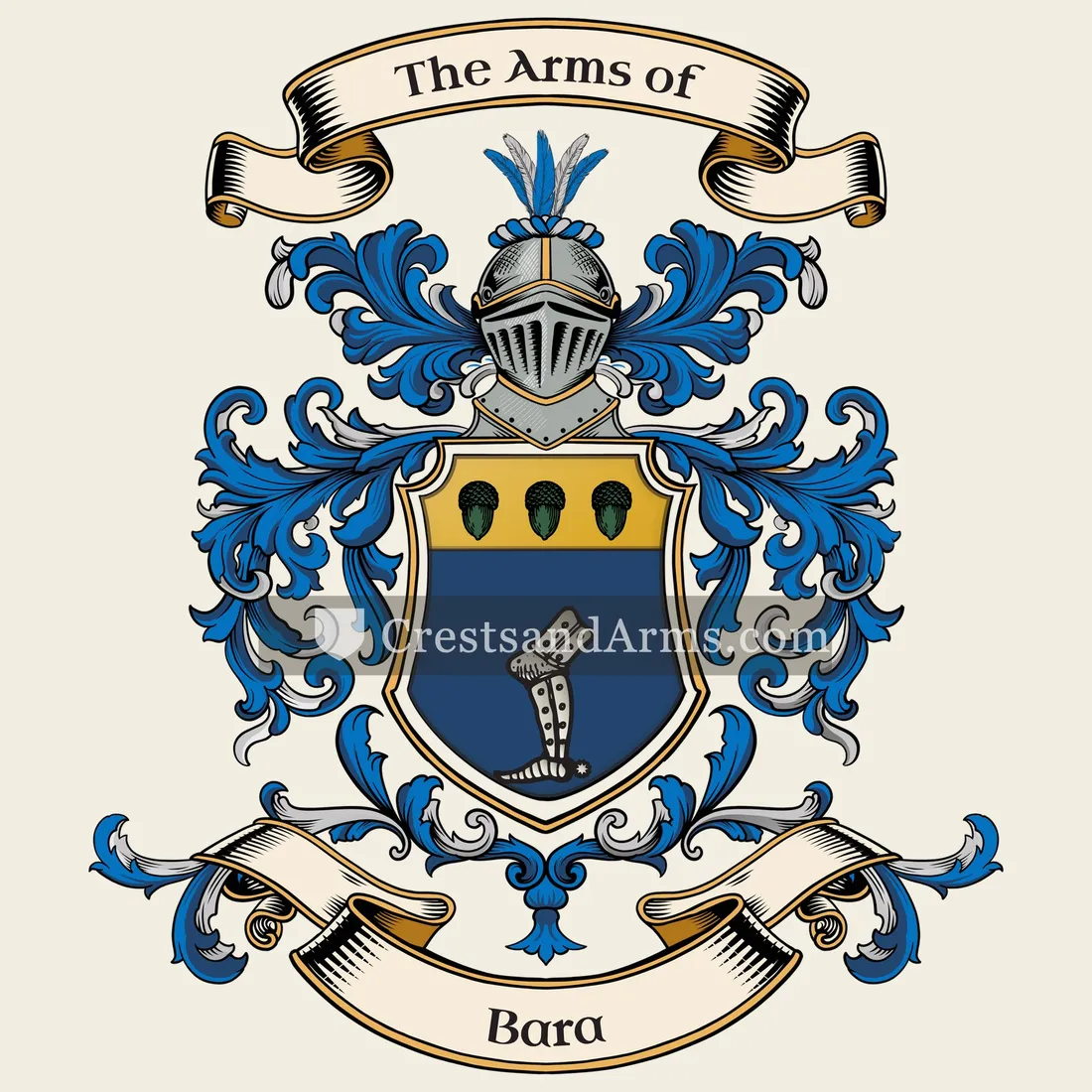
Symbols on this shield
chiefAuthority, wisdom and dominion
legStrength and swiftness
acornAntiquity and strength from small beginnings
Colours
Blue (Azure)Means: Loyalty and truth
Gold (Or)Means: Generosity
Green (Vert)Means: Hope
Historical info
Source
J. B. Rietstap, Armorial Général, Gouda: G. B. van Goor Zonen, 1884–87
Blazon (the actual original written record)
“D'azur à une patte d'oie en pal ; au chef d'or, ch. de trois glands de sin., feuillés du même.”
LorraineLorraine, c. 1596
Digital archive packCoat of arms PNG, gold border print PDF, vector SVG and the certificate of authenticity. Sent to your email in minutes.
Map of France showing where the Bara arms are recorded
The Bara arms were recorded in Lorraine, c. 1596.
Lorraine sat on the border between France and the German lands, and border country bred soldiers. Families here held small estates and served in arms, and a fighting man was exactly the sort who carried a shield of his own.
This is where the arms were entered in the register. Families often moved to other parts of the country, so the same name can turn up in more than one region.
The body that granted and recorded arms in France in this period.
Henry IV of France
Sovereign of the period
Henry IV of France
1589–1610
Reigning in Belgium when the Bara arms are first recorded.
How Arms Worked in France
In France, a coat of arms was a mark of honor that passed down through the male line to all legitimate descendants. Families often used the same shield without changes to show their shared heritage. If a branch wanted to stand out, they could add a small mark to their shield to show their specific place in the family tree.
Granting authority
The Juge d'armes de France acted as the official authority that regulated and verified coats of arms across the country.
How they got arms
Families typically inherited their arms from ancestors, though they could also receive them through royal grants or by proving their noble status.
Where arms were recorded
Coats of arms were officially recorded in the Armorial Général de France, which began its main collection in the year 1696.
The family's standing
Recorded among the armigerous families of Lorraine.
Origin & History of the Bara Family in France
The Bara family name has deep roots in the historical region of Lorraine, where records confirm members of the family were living as early as 1596. During this period, Lorraine was a sovereign duchy that served as a cultural bridge between the French-speaking world and the Holy Roman Empire. Families like the Baras often lived in small, tight-knit rural communities where they worked as farmers, craftsmen, or local administrators. The name itself likely originated as a descriptive term or a nickname that evolved into a permanent surname as local governments began keeping more formal tax and birth records. Because Lorraine was frequently caught in the middle of shifting borders and regional conflicts, the Bara family would have needed to be highly adaptable to survive the changing political landscape of the seventeenth century. Their presence in these early parish registers suggests they were well-established members of the local society long before the region was fully integrated into the Kingdom of France.
Bara Meaning & Related Branches
Root word
Bar
A Hebrew term meaning son or a Celtic term meaning summit.
This name
BaraA topographical surname referring to someone who lived near a hill or a high point.
also spelled
Barad
Bara
Documented Sources
J. B. Rietstap, Armorial Général, Gouda: G. B. van Goor Zonen, 1884–87
Archives de l'État à Tournai, État civil et registres paroissiaux du Tournaisis (1700-1800)
Desmazières, Émile, Histoire de la ville de Tournai, 1864
Rolland, Victor, Dictionnaire généalogique des familles du Tournaisis, 1905
Digital archive packCoat of arms PNG, gold border print PDF, vector SVG and the certificate of authenticity. Sent to your email in minutes.


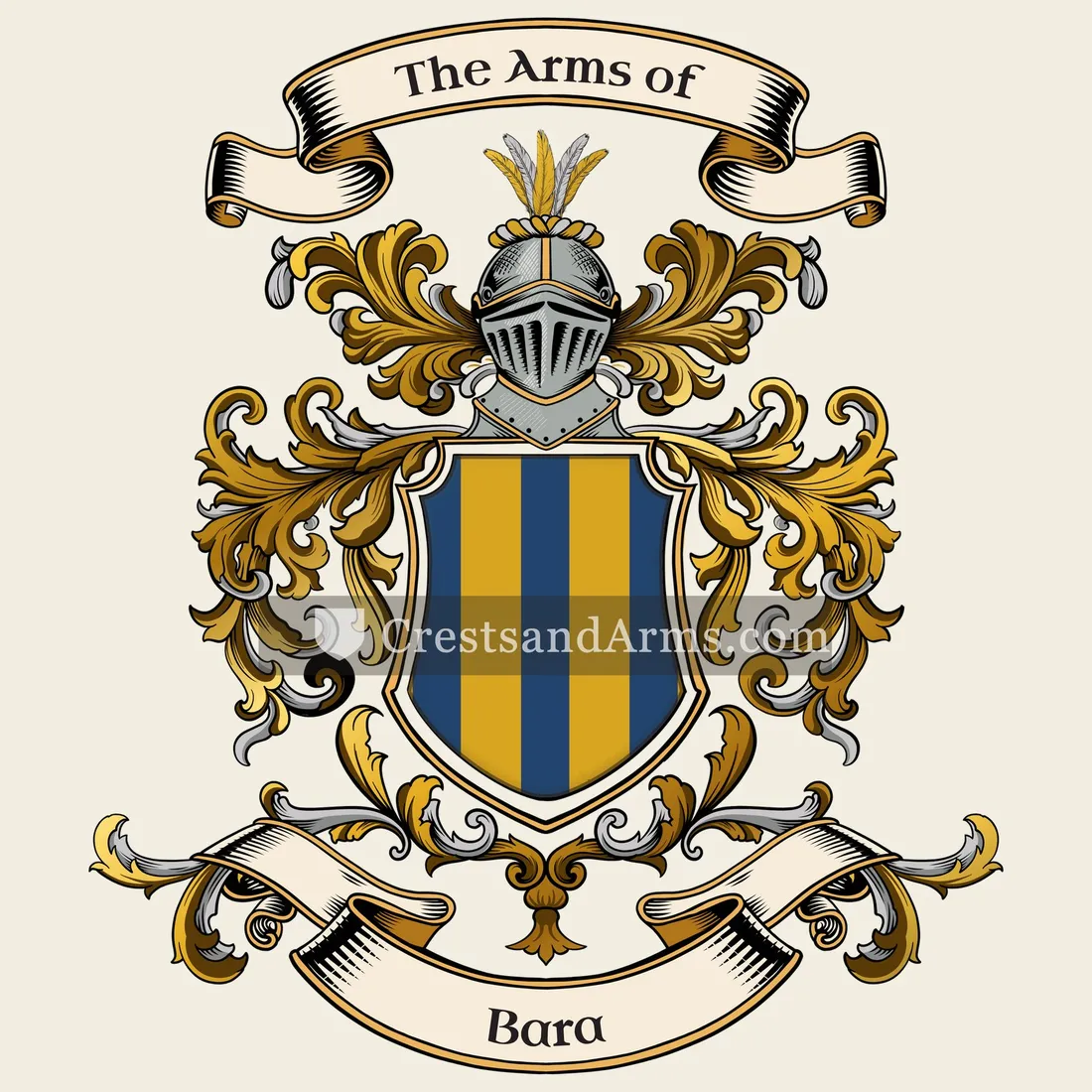
 paleMilitary strength, and a fortified defence
 paleMilitary strength, and a fortified defence


 chiefAuthority, wisdom and dominion
 legStrength and swiftness
 acornAntiquity and strength from small beginnings