A record of documented arms, meaning and origin, researched for the Baranda family lines. Documented in 3 countries.
Reg. 6115 · German, A–C
Coat of Arms & Family Crest Details
Symbols on this shield
mountThe ground held, and steadfastness upon it
dragonA most valiant defender of treasure
mulletThe third son, and a divine quality from above
Colours
Red (Gules)Means: Military strength
Blue (Azure)Means: Loyalty and truth
Green (Vert)Means: Hope
Silver (Argent)Means: Peace and sincerity
Gold (Or)Means: Generosity
Historical info
Source
J. B. Rietstap, Armorial Général, Gouda: G. B. van Goor Zonen, 1884–87
Blazon (the actual original written record)
“Ec.: aux 1 et 4 de gu. à un dragon ailé d'arg.; au 2 d'azur à deux étoiles accostées d'or; au 3 d'arg. à une montagne de sin., mouv. de la p. et ch. d'une échelle de cinq barreaux d'arg., en pal. Cq. cour. C.: un homme iss., cuirassé au nat., coiffé d'un casque, supp. de sa main dextre une étoile d'or et tenant de sa sen. un marteau d'arg. L.: à dextre d'arg. et de gu., à sen. d'or et d'azur.”
MecklenburgMecklenburg, c. 1749
Digital archive packCoat of arms PNG, gold border print PDF, vector SVG and the certificate of authenticity. Sent to your email in minutes.
Map of Germany showing where the Baranda arms are recorded
The Baranda arms were recorded in Mecklenburg, c. 1749.
Mecklenburg was farming country in the north of Germany, held by a small number of families who kept their estates for generations. Owning land was what entitled a family to arms, so a great many Mecklenburg names ended up in the registers.
This is where the arms were entered in the register. Families often moved to other parts of the country, so the same name can turn up in more than one region.
The body that granted and recorded arms in Germany in this period.
Francis I, Holy Roman Emperor
Sovereign of the period
Francis I, Holy Roman Emperor
1745–1765
Reigning in Germany when the Baranda arms are first recorded.
How Arms Worked in Germany
In the Holy Roman Empire, coats of arms were often granted to individuals by the Emperor or his representatives. These arms were then passed down through the generations to all legitimate descendants of the original holder. Younger branches of a family usually kept the same shield design without needing to change it, as the arms belonged to the entire lineage.
Granting authority
The Holy Roman Emperor held the sole power to grant new coats of arms throughout his vast imperial territories.
How they got arms
Families typically obtained their coats of arms through a formal imperial grant or by proving their noble status to the authorities.
Where arms were recorded
These grants were officially recorded in the Imperial Chancery registers, which began keeping formal records of such honors during the Middle Ages.
The family's standing
Recorded among the armigerous families of Mecklenburg.
Origin & History of the Baranda Family in Germany
The Baranda family name holds a distinct place in the historical records of the Mecklenburg region, where members were firmly established by 1749. During the mid-18th century, this area was part of the Duchy of Mecklenburg-Schwerin, a landscape defined by rural estates and a rigid social structure. Families like the Barandas often served as integral parts of the local community, likely working within the agricultural or administrative systems that supported the regional economy. Because Mecklenburg was a hub for trade and migration across the Baltic Sea, the presence of the family there suggests they were part of a mobile population that navigated the shifting borders and political changes of northern Germany. By tracing their roots to this specific time and place, we see a family that helped build the foundations of local village life during a period of significant growth and transition for the German states.
Coat of Arms & Family Crest Details
Symbols on this shield
paleMilitary strength, and a fortified defence
mountThe ground held, and steadfastness upon it
Colours
Silver (Argent)Means: Peace and sincerity
Gold (Or)Means: Generosity
Black (Sable)Means: Constancy
Historical info
Source
J. B. Rietstap, Armorial Général, Gouda: G. B. van Goor Zonen, 1884–87
Blazon (the actual original written record)
“D'arg. à deux brandons de sa., allumés au sommet, au nat., posés en pals sur un tertre de trois coupeaux de sin.; à la bord. d'or. Cq. cour. C.: un buste d'homme, hab. aux armes de l'écu (moins la bord.), coiffé d'un bonnet albanais d'arg., le rebord du bonnet tort. de sa. et d'arg.”
SwitzerlandBâle, c. 1745
Digital archive packCoat of arms PNG, gold border print PDF, vector SVG and the certificate of authenticity. Sent to your email in minutes.
Map of Switzerland showing where the Baranda arms are recorded
The Baranda arms were recorded in Bâle, c. 1745.
This is where the arms were entered in the register. Families often moved to other parts of the country, so the same name can turn up in more than one region.
The body that granted and recorded arms in Switzerland in this period.
How Arms Worked in Switzerland
In Switzerland, coats of arms were not restricted to the nobility and were often adopted by common citizens and families. These symbols were passed down through generations to show family identity. When branches of a family grew, they often changed small details of the design to distinguish their own line from the original group.
Granting authority
Cantonal and civic authorities managed the use of coats of arms within their specific regions and local jurisdictions.
How they got arms
Families typically assumed their own coats of arms based on local custom rather than receiving them from a central monarch.
Where arms were recorded
Arms were recorded in various cantonal and civic registers starting from the fourteenth century throughout the Swiss region.
The family's standing
Recorded among the armigerous families of Switzerland.
Origin & History of the Baranda Family in Switzerland
The Baranda family name holds a distinct place in the historical records of Basel, Switzerland, where members of the family were documented as early as 1745. During the eighteenth century, Basel served as a bustling center for trade and intellectual exchange, and families like the Barandas often integrated into the city’s professional and merchant classes. While the name itself may have roots that extend into broader European linguistic traditions, its presence in Basel suggests that these early ancestors were likely part of the urban migration patterns common in the Rhine valley. By establishing themselves in this Swiss city, the family became part of a society that valued record-keeping and civic participation. These early residents helped shape the local community, leaving behind a legacy that reflects the steady growth and social development of the region during the mid-1700s.
Coat of Arms & Family Crest Details
Symbols on this shield
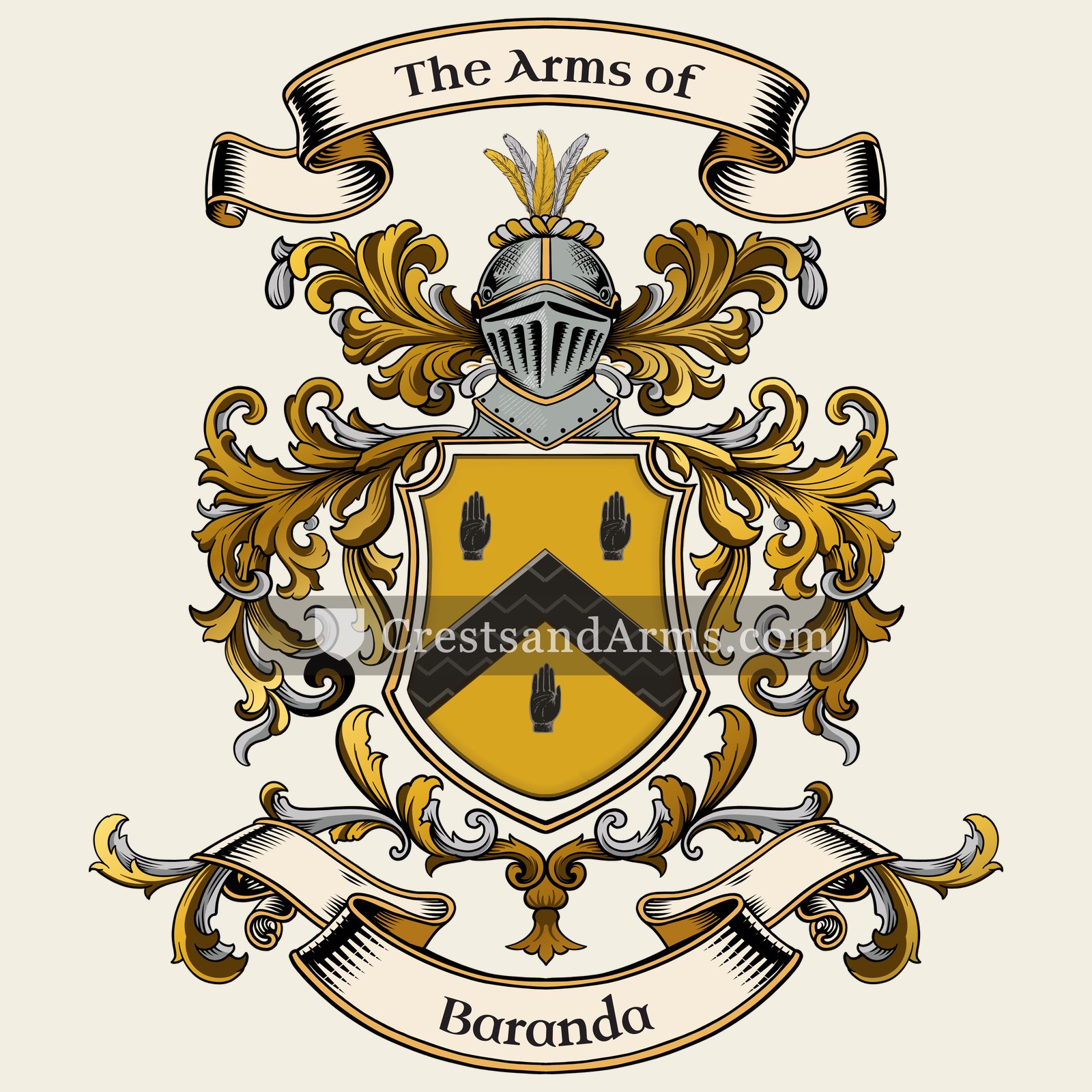
chevronProtection, and faithful service completed
handFaith, sincerity and justice
Colours
Gold (Or)Means: Generosity
Black (Sable)Means: Constancy
Historical info
Source
Sir Bernard Burke, The General Armory of England, Scotland, Ireland and Wales, London: Harrison & Sons, 1884
Blazon (the actual original written record)
“Or, a chev. betw. three dexter hands couped at the wrist sa”
SurreyMoulsey · Surrey, c. 1591
Digital archive packCoat of arms PNG, gold border print PDF, vector SVG and the certificate of authenticity. Sent to your email in minutes.
Map of England showing where the Baranda arms are recorded
The Baranda arms were recorded in Surrey, c. 1591.
Surrey sat just south of London and filled up with families who had made money in the City. Buying an estate there was the usual next step, and an estate was the usual reason to take arms.
This is where the arms were entered in the register. Families often moved to other parts of the country, so the same name can turn up in more than one region.
The body that granted and recorded arms in England in this period.
Elizabeth I of England
Sovereign of the period
Elizabeth I of England
1558–1603
Reigning in Germany when the Baranda arms are first recorded.
How Arms Worked in England
English heraldry allowed arms to be shared by all legitimate descendants of the original owner. These symbols were treated as personal property that moved through the generations to all children. While the eldest son kept the original design, other family members could use the same shield without needing to change it or register their own unique versions.
Granting authority
The College of Arms in London has regulated the use of coats of arms throughout England and Wales since 1484.
How they got arms
Families typically obtained their coats of arms through a formal grant from the Crown or by proving their ancient right to them.
Where arms were recorded
All official coats of arms are recorded in the registers kept at the College of Arms, which date back to the fifteenth century.
The family's standing
Recorded among the armigerous families of Surrey.
Origin & History of the Baranda Family in England
The surname Baranda appears in English records as early as the late sixteenth century, specifically within the county of Surrey. By 1591, members of the family were established in this region, which was a time of significant social and economic change in England. During this period, families often settled in areas surrounding London to take advantage of the growing trade and agricultural opportunities near the capital. While the name itself carries roots that suggest a connection to continental Europe, its presence in Surrey indicates that these early individuals were integrated into the local parish systems and community life of Elizabethan England. These early records provide a glimpse into a family that was part of the steady movement of people across the English landscape during the Renaissance.
Related Branches & Arms
Root word
Bar
A Germanic term referring to a bear or a wild boar.
This name
BarandaDerived from a topographic location near a bear habitat or a dwelling place.
also spelled
Brande
Brandt
Brann
Brant
Documented Sources
J. B. Rietstap, Armorial Général, Gouda: G. B. van Goor Zonen, 1884–87


 mountThe ground held, and steadfastness upon it
 dragonA most valiant defender of treasure
 mulletThe third son, and a divine quality from above
 mountThe ground held, and steadfastness upon it
 dragonA most valiant defender of treasure
 mulletThe third son, and a divine quality from above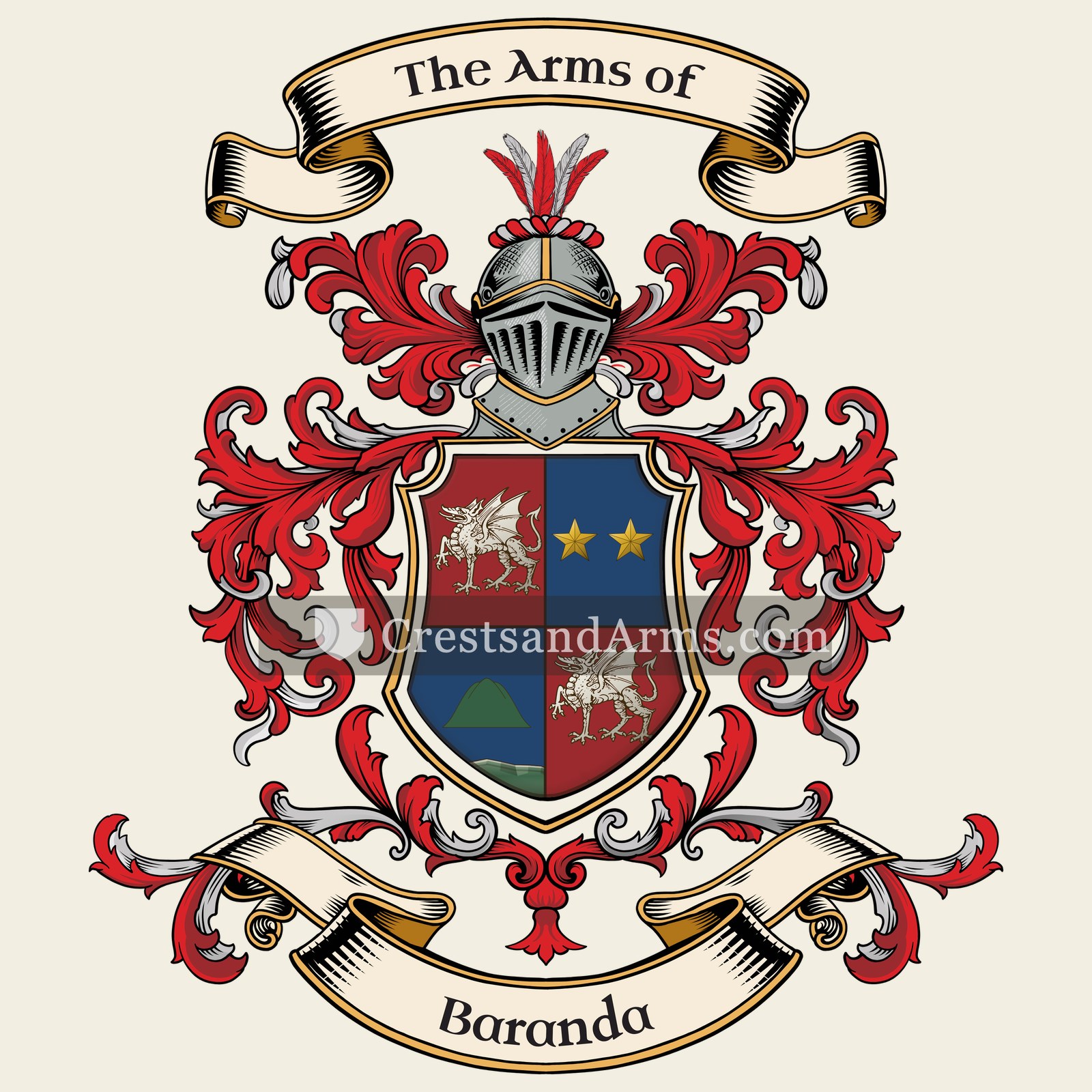


 paleMilitary strength, and a fortified defence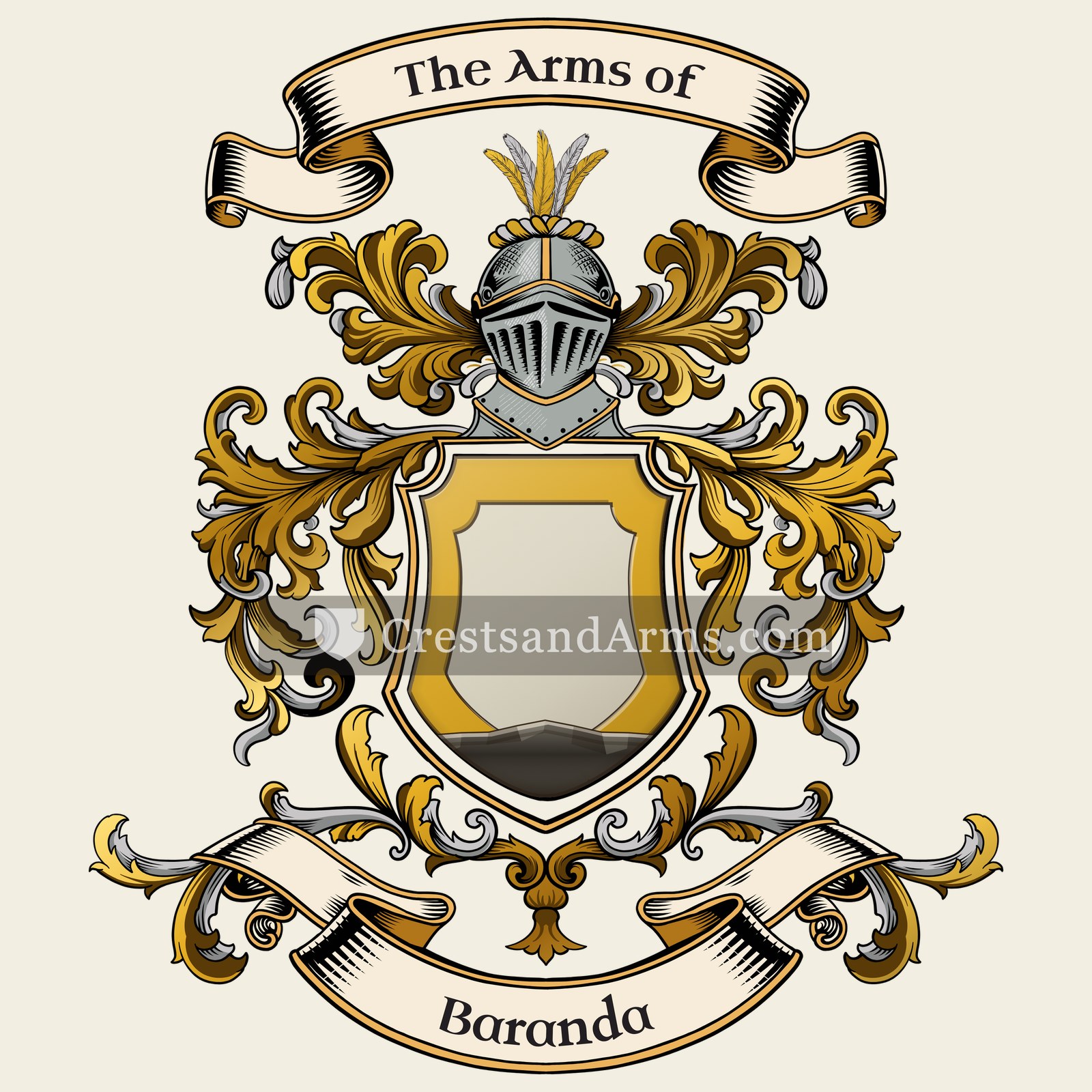

 chevronProtection, and faithful service completed
 handFaith, sincerity and justice