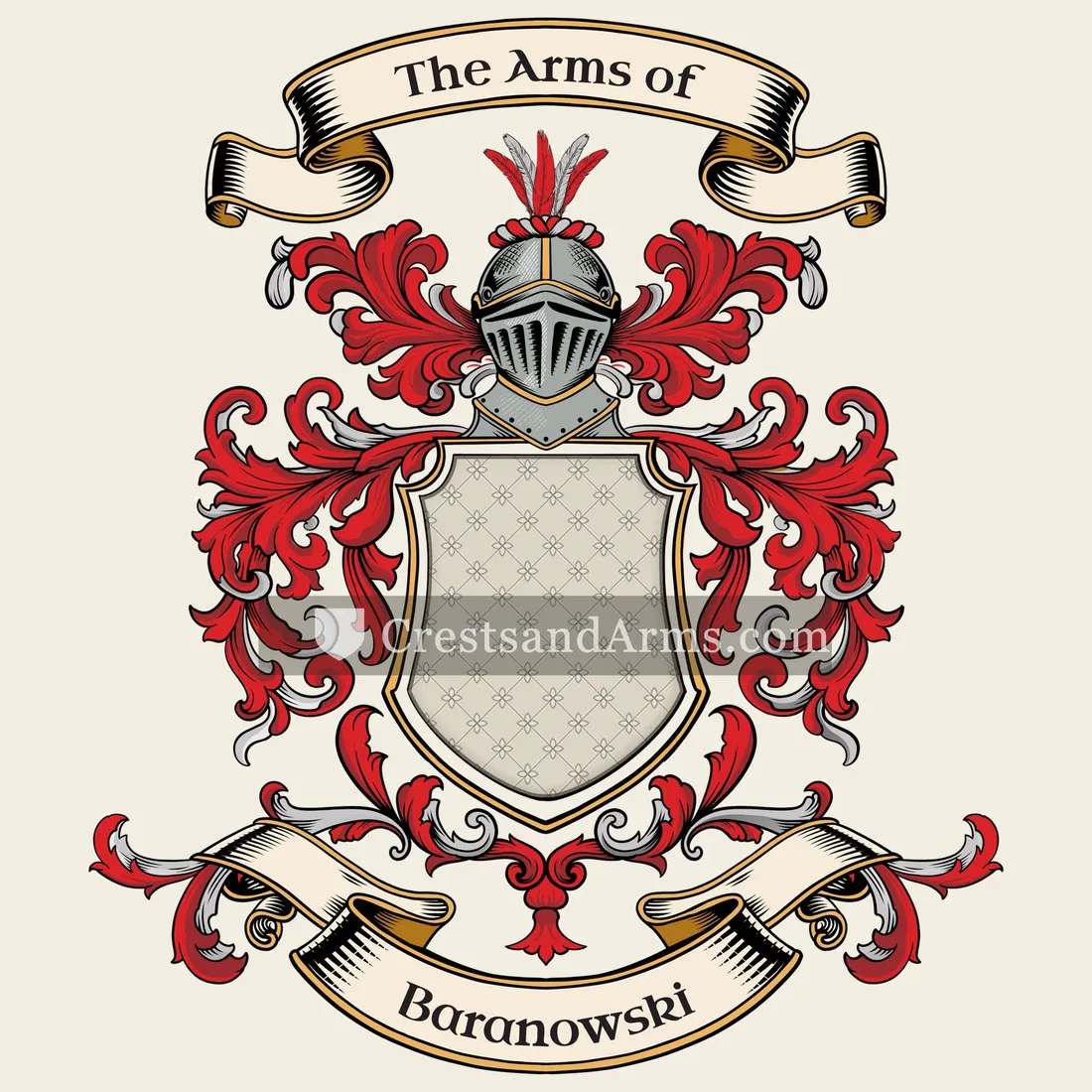
Map of Poland showing where the Baranowski arms are recorded
The Baranowski arms were recorded in Silesia, c. 1772.
Silesia was farming country in the east of the German lands, held in large estates by families who stayed put for generations. Owning land was what entitled a family to arms, so the region fills a good deal of the register.
This is where the arms were entered in the register. Families often moved to other parts of the country, so the same name can turn up in more than one region.
Region
Silesia
First recorded
1772
Granting Authority for the Baranowski Arms
Ennoblement by the Sejm
Author: Olek Remesz · CC BY-SA 3.0
The body that granted and recorded arms in Poland in this period.
Stanisław August Poniatowski
Sovereign of the period
Stanisław August Poniatowski
1764–1795
Reigning in Poland when the Baranowski arms are first recorded.
How Arms Worked in Poland
Polish noble families shared a single coat of arms across many different surnames, creating large clans rather than individual designs. These symbols were held collectively by all members of the clan regardless of their specific family name. When a new family joined the nobility, they were adopted into an existing clan and began using that group's established shield.
Granting authority
The Sejm, which was the Polish parliament, held the power to grant noble status and the right to bear arms.
How they got arms
Families typically received their coat of arms through a formal act of ennoblement granted by the Sejm for distinguished service.
Where arms were recorded
These grants were officially recorded in the Crown Metrica, which served as the central archive for state documents starting in the sixteenth century.
The family's standing
Recorded among the armigerous families of Silesia.
Origin & History of the Baranowski Family in Poland
The family name Baranowski is a topographic surname that originated in the Polish-speaking regions of Central Europe. It is derived from the word baran, which means ram, combined with a suffix that indicates a connection to a specific place or estate. By the late 18th century, the family was well established in the region of Silesia. In 1772, this area was undergoing significant political changes as it transitioned under the administration of the Kingdom of Prussia. During this era, families with this name were often associated with land ownership or agricultural management in rural villages. The name served as a way to identify individuals based on their ancestral home or their role as stewards of livestock within the local community. As the family grew, they became part of the social fabric of Silesian life, maintaining their presence in the region through generations of farming and trade.
Baranowski Meaning & Related Branches
Root word
baran
A male sheep or ram.
This name
BaranowskiA topographic name for someone who lived near a place where rams were kept or raised.
also spelled
Bronikowski
Documented Sources
J. B. Rietstap, Armorial Général, Gouda: G. B. van Goor Zonen, 1884–87
Brückner, Aleksander. Słownik etymologiczny języka polskiego. 1927