A record of documented arms, meaning and origin, researched for the Barata family lines. Documented in 2 countries.
Reg. 8629 · Austrian, A–C
Coat of Arms & Family Crest Details
Symbols on this shield
fleur de lisPurity, light, and the sixth son
Colours
Silver (Argent)Means: Peace and sincerity
Black (Sable)Means: Constancy
Historical info
Source
J. B. Rietstap, Armorial Général, Gouda: G. B. van Goor Zonen, 1884–87
Blazon (the actual original written record)
“D'arg. à neuf fleurs-de-lis de sa., 3, 3 et 3. Deux cq. cour. C.: 1º un lion iss. et cont. d'or, cour. du même; 2º trois pl. d'aut., une d'arg. entre deux de sa. S.: deux lions d'or. D.: A DEO NOBILITAS.”
MoraviaMoravia, c. 1873
Digital archive packCoat of arms PNG, gold border print PDF, vector SVG and the certificate of authenticity. Sent to your email in minutes.
Map of Austria showing where the Barata arms are recorded
The Barata arms were recorded in Moravia, c. 1873.
Moravia was rich farming country held in large estates by a small number of families. Land there passed down whole for centuries, and unbroken tenure of that kind fills a register.
This is where the arms were entered in the register. Families often moved to other parts of the country, so the same name can turn up in more than one region.
Region
Moravia
First recorded
1873
Granting Authority for the Barata Arms
Imperial and Royal chancery
Sodacan · CC BY-SA 3.0
The body that granted and recorded arms in Austria in this period.
Franz Joseph I of Austria
Sovereign of the period
Franz Joseph I of Austria
1848–1916
Reigning in Austria when the Barata arms are first recorded.
How Arms Worked in Austria
Austrian coats of arms were often linked directly to noble titles granted by the Emperor. These symbols belonged to the entire family line rather than just one individual. When a family grew, new branches kept the original design without needing to change it. This system allowed all members of a noble house to share the same identity across many generations.
Granting authority
The Imperial and Royal chancery managed all heraldic matters and controlled the official granting of arms throughout the Austrian lands.
How they got arms
Families typically received their arms through a formal imperial decree that often accompanied the elevation of a person to noble status.
Where arms were recorded
Official records of these grants were kept in the Imperial Register of Nobility which began its formal documentation process in 1453.
The family's standing
Recorded among the armigerous families of Moravia.
Origin & History of the Barata Family in Austria
The Barata family name carries a history deeply rooted in the cultural crossroads of Central Europe, particularly within the lands of the former Austro-Hungarian Empire. By 1873, records confirm that members of the family were well-established in Moravia, a region that served as a vital industrial and agricultural hub under the Habsburg monarchy. During this era, the movement of families across the empire was often driven by the expansion of railways and the growth of civil service roles in cities like Brno and Olomouc. The name itself suggests a connection to the diverse linguistic landscape of the region, where families often navigated the complex social shifts between German and Slavic influences. As the family settled into Moravian life during the late nineteenth century, they became part of the steady development of the middle class, contributing to the local economy and the evolving social fabric of the Austro-Hungarian territories before the major political changes of the twentieth century.
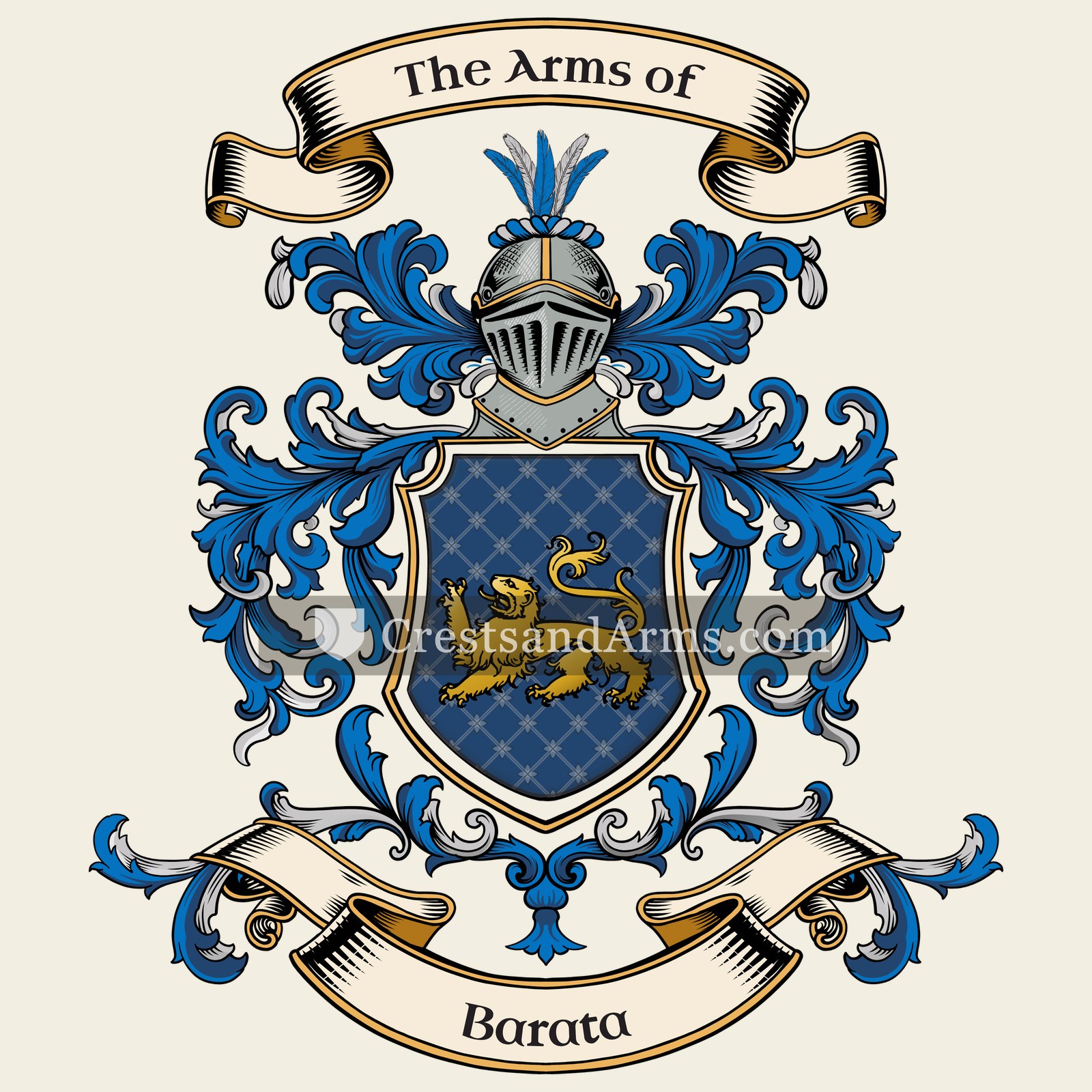
Coat of Arms & Family Crest Details
Symbols on this shield
lionCourage, strength and royalty
Colours
Blue (Azure)Means: Loyalty and truth
Gold (Or)Means: Generosity
Historical info
Source
J. B. Rietstap, Armorial Général, Gouda: G. B. van Goor Zonen, 1884–87
Blazon (the actual original written record)
“D'azur au lion d'or, tenant de chaque patte une fleur-de-lis du même. C.: un lion cour. d'or.”
NaplesNaples, c. 1775
Digital archive packCoat of arms PNG, gold border print PDF, vector SVG and the certificate of authenticity. Sent to your email in minutes.
Map of Italy showing where the Barata arms are recorded
The Barata arms were recorded in Naples, c. 1775.
Naples was the largest city in Italy and the seat of a kingdom. Its noble houses were numerous, and the kingdom kept formal lists of the families entitled to arms, which is why so many appear in the records.
This is where the arms were entered in the register. Families often moved to other parts of the country, so the same name can turn up in more than one region.
The body that granted and recorded arms in Italy in this period.
Alvise Giovanni Mocenigo
Sovereign of the period
Alvise Giovanni Mocenigo
1763–1778
Reigning in Austria when the Barata arms are first recorded.
How Arms Worked in Italy
In the Italian states, coats of arms were often used by noble families to show their status and history. These symbols were passed down through the generations to all legitimate male descendants. Younger branches of a family usually kept the original design but sometimes added small changes to distinguish their specific line from the main branch.
Granting authority
Various local rulers and city governments controlled the use of coats of arms across the different Italian states.
How they got arms
Families often assumed their own arms or received them as official grants from local lords, popes, or city councils.
Where arms were recorded
Arms were recorded in local city archives or private family books rather than in one single national register.
The family's standing
Recorded among the armigerous families of Naples.
Origin & History of the Barata Family in Italy
The history of the Barata family in Italy is deeply rooted in the vibrant social landscape of Naples during the late eighteenth century. By 1775, the family was already established within the city, a period when Naples served as a major cultural and economic hub under the Bourbon monarchy. The name Barata likely emerged from regional linguistic roots, potentially linked to the historical practice of trade or exchange, which was a common way for families to earn their surnames in Mediterranean port cities. During this era, families like the Baratas were often part of the growing urban middle class, participating in the daily life of a city that was then one of the largest and most influential capitals in Europe. Their presence in Naples suggests they were integrated into the local community, navigating the complex legal and social structures of the Kingdom of the Two Sicilies as the region transitioned through significant political changes.
Related Branches & Arms
Root word
Beatus
Latin term meaning blessed, happy, or prosperous.
This name
BarataDerived from a nickname for a fortunate or blessed individual.
also spelled
Barata
Baratte
Documented Sources
J. B. Rietstap, Armorial Général, Gouda: G. B. van Goor Zonen, 1884–87
Moravian Provincial Archives (Moravský zemský archiv v Brně), Matriky narozených, oddaných a zemřelých (1870–1880)


 fleur de lisPurity, light, and the sixth son
 fleur de lisPurity, light, and the sixth son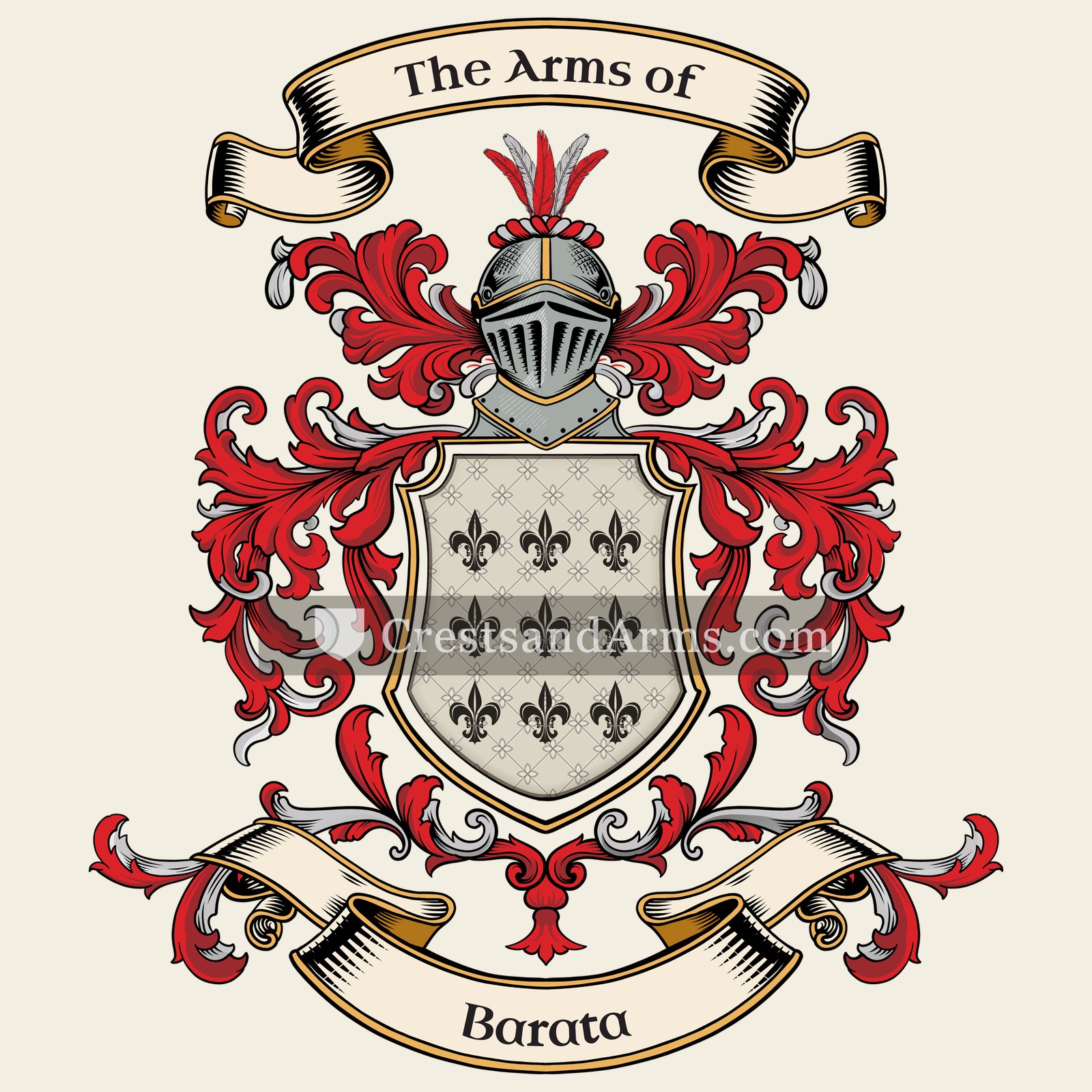


 lionCourage, strength and royalty