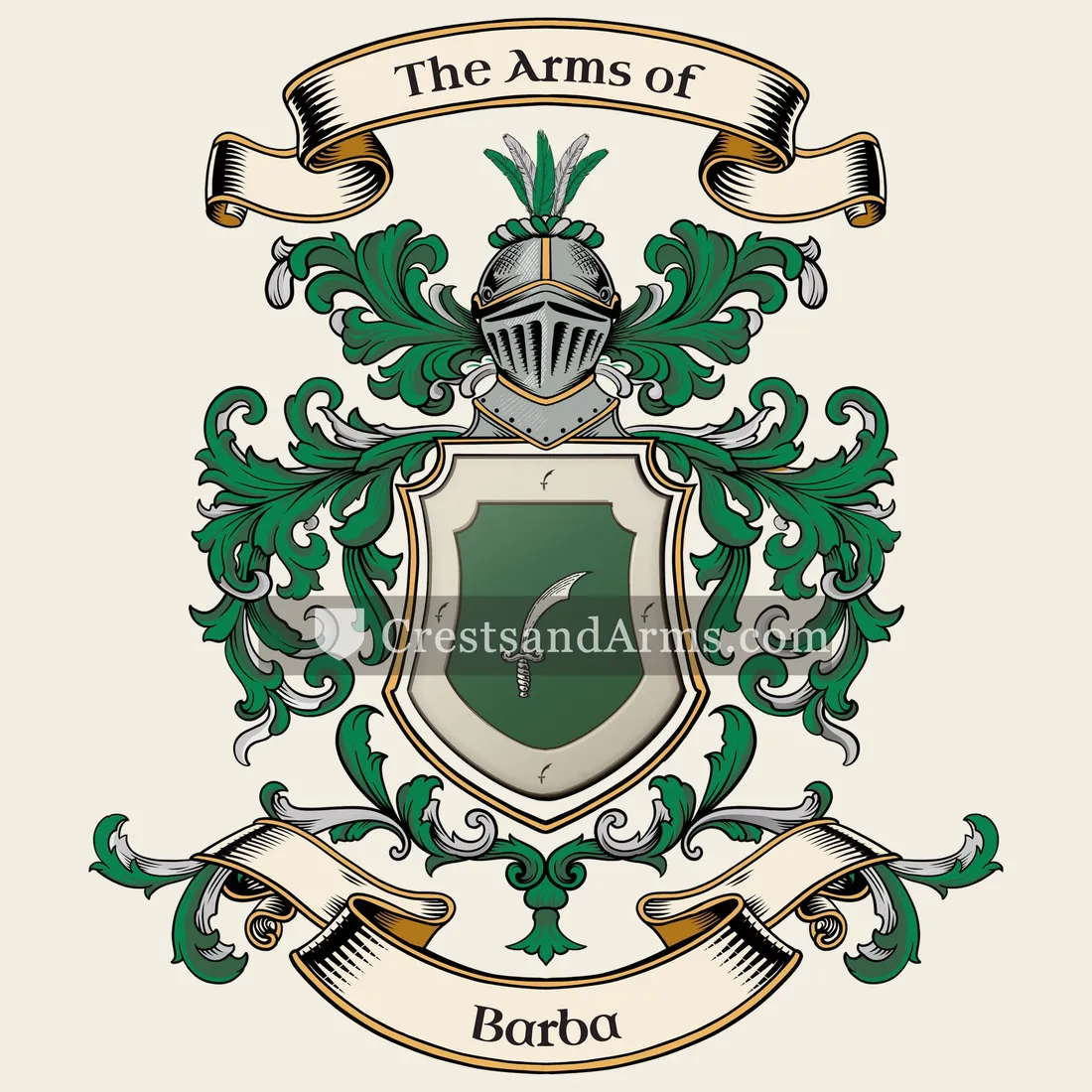
A record of documented arms, meaning and origin, researched for the Barba family of Spain.
Reg. 8080 · Spanish, A–C
Meaning of the Barba family crest colors & symbols
Symbols on this shield
swordJustice, and military honour
Colours
Green (Vert)Means: Hope
Silver (Argent)Means: Peace and sincerity
Black (Sable)Means: Constancy
Historical info
Source
J. B. Rietstap, Armorial Général, Gouda: G. B. van Goor Zonen, 1884–87
Blazon (the actual original written record)
“De sin. à l'épée d'arg., garnie d'or, posée en bande: à la bord. d'arg. ch. de quatre épées de sa., posées dans le sens de la bord. et se suivant, celle en chef ayant la pointe à dextre.”
AragonAragon, c. 1722
Digital archive packCoat of arms PNG, gold border print PDF, vector SVG and the certificate of authenticity. Sent to your email in minutes.
Map of Spain showing where the Barba arms are recorded
The Barba arms were recorded in Aragon, c. 1722.
Aragon was mountain and river country in north-eastern Spain, with a strong tradition of small independent landholders. A great many families counted as gentry there, and each one needed a shield to be told apart.
This is where the arms were entered in the register. Families often moved to other parts of the country, so the same name can turn up in more than one region.
The body that granted and recorded arms in Spain in this period.
Philip V of Spain
Sovereign of the period
Philip V of Spain
1714–1724
Reigning in Spain when the Barba arms are first recorded.
How Arms Worked in Spain
In Spain, a coat of arms was considered a form of property that belonged to the entire family line. These arms were passed down from a father to all his children equally. Younger branches of the family usually kept the original design without needing to add any special marks to distinguish their specific line.
Granting authority
The Cronista Rey de Armas was the official body that regulated and granted coats of arms throughout Spain.
How they got arms
Families often obtained their arms through royal grants or by proving their noble status to the official heraldic authority.
Where arms were recorded
Coats of arms were officially recorded in the registers of the Cronista Rey de Armas starting in 1496.
The family's standing
Recorded among the armigerous families of Aragon.
Origin & History of the Barba Family in Spain
The surname Barba has deep roots in the Iberian Peninsula, where it emerged as a descriptive name long before it became a formal family identifier. In the Spanish language, the word refers to a beard, and it was likely first used as a nickname to distinguish a specific individual by their facial hair. By the early 18th century, the family had established a notable presence in the Kingdom of Aragon. Records from 1722 confirm that members of the Barba family were active participants in the social and economic life of this region. During this period, families in Aragon often lived in tight-knit communities where surnames helped track lineage across generations. As the family grew, they integrated into the local culture of northeastern Spain, contributing to the agricultural and civic development of the Aragonese landscape.
Barba Meaning & Related Branches
Root word
barba
Latin term referring to the hair growing on the chin or face.
This name
BarbaA descriptive occupational or physical nickname for a man with a prominent or thick beard.
also spelled
Barbah
Barbaa
Barbae
Related arms
Barbevariant spelling
Documented Sources
J. B. Rietstap, Armorial Général, Gouda: G. B. van Goor Zonen, 1884–87
Moll, Francesc de Borja. Els llinatges catalans. 1959
Faure, Roberto, Ribes, María Asunción, and García, Antonio. Diccionario de apellidos españoles. 2001
Archivo de la Corona de Aragón, Archivo General de la Corona de Aragón, Sección Cancillería Real
Digital archive packCoat of arms PNG, gold border print PDF, vector SVG and the certificate of authenticity. Sent to your email in minutes.


 swordJustice, and military honour
 swordJustice, and military honour