Map of France showing where the Barbara arms are recorded
The Barbara arms were recorded in Lorraine, c. 1663.
Lorraine sat on the border between France and the German lands, and border country bred soldiers. Families here held small estates and served in arms, and a fighting man was exactly the sort who carried a shield of his own.
This is where the arms were entered in the register. Families often moved to other parts of the country, so the same name can turn up in more than one region.
The body that granted and recorded arms in France in this period.
Louis XIV of France
Sovereign of the period
Louis XIV of France
1643–1715
Reigning in France when the Barbara arms are first recorded.
How Arms Worked in France
In France, a coat of arms was a mark of honor that passed down through the male line to all legitimate descendants. Families often used the same shield without changes to show their shared heritage. If a branch wanted to stand out, they could add a small mark to their shield to show their specific place in the family tree.
Granting authority
The Juge d'armes de France acted as the official authority that regulated and verified coats of arms across the country.
How they got arms
Families typically inherited their arms from ancestors, though they could also receive them through royal grants or by proving their noble status.
Where arms were recorded
Coats of arms were officially recorded in the Armorial Général de France, which began its main collection in the year 1696.
The family's standing
Recorded among the armigerous families of Lorraine.
Origin & History of the Barbara Family in France
The family name Barbara has deep roots in the French region of Lorraine, where records confirm the family was established by at least 1663. The name itself is derived from the Latin word *barbarus*, which originally referred to people who did not speak Greek or Latin. During the Middle Ages, the name became associated with Saint Barbara, a popular religious figure whose story of faith and martyrdom led many families to adopt her name as a way to honor her legacy. In the specific context of Lorraine, a region known for its complex history of shifting borders and cultural exchanges between France and the Germanic lands, the Barbara family likely integrated into the local community as farmers, artisans, or tradespeople. By the mid-17th century, the family was well-embedded in the social fabric of the area, participating in the parish life and local administrative systems that defined village existence in the French countryside. Their presence in Lorraine during this period reflects the broader movement of families who settled and grew within the stable, church-centered communities of the Old Regime.
Coat of Arms & Family Crest Details
Symbols on this shield
eagleNobility, strength and a keen mind
roundelA coin, and one who has been to the crusades
swordJustice, and military honour
Colours
Gold (Or)Means: Generosity
Blue (Azure)Means: Loyalty and truth
Silver (Argent)Means: Peace and sincerity
Black (Sable)Means: Constancy
Historical info
Source
J. B. Rietstap, Armorial Général, Gouda: G. B. van Goor Zonen, 1884–87
Blazon (the actual original written record)
“Coupé: au 1 d'or à l'aigle naiss. de sa., mouv. du coupe; au 2 d'azur à trois boules d'arg., 2 et 1, adextrees d'une fiole médicinale et senestrees d'une épée d'arg., garnie d'or. Cq. cour. C.: un vol de sa. L.: à dextre d'or et de sa., à sen. d'arg. et d'azur.”
Austriac. 1772
Digital archive packCoat of arms PNG, gold border print PDF, vector SVG and the certificate of authenticity. Sent to your email in minutes.
Map of Austria showing where the Barbara arms are recorded
The Barbara arms were recorded in Austria, c. 1772.
Arms such as these were typically recorded in Tyrol.
Tyrol was mountain country in western Austria, where the valleys were held by families who had been there a very long time. Old tenure counted for more than money, and old families carried arms.
This is where the arms were entered in the register. Families often moved to other parts of the country, so the same name can turn up in more than one region.
Region
Tyrol
First recorded
1772
Granting Authority for the Barbara Arms
Imperial and Royal chancery
Sodacan · CC BY-SA 3.0
The body that granted and recorded arms in Austria in this period.
Joseph II, Holy Roman Emperor
Sovereign of the period
Joseph II, Holy Roman Emperor
1765–1790
Reigning in France when the Barbara arms are first recorded.
How Arms Worked in Austria
Austrian coats of arms were often linked directly to noble titles granted by the Emperor. These symbols belonged to the entire family line rather than just one individual. When a family grew, new branches kept the original design without needing to change it. This system allowed all members of a noble house to share the same identity across many generations.
Granting authority
The Imperial and Royal chancery managed all heraldic matters and controlled the official granting of arms throughout the Austrian lands.
How they got arms
Families typically received their arms through a formal imperial decree that often accompanied the elevation of a person to noble status.
Where arms were recorded
Official records of these grants were kept in the Imperial Register of Nobility which began its formal documentation process in 1453.
The family's standing
Recorded among the armigerous families of Austria.
Origin & History of the Barbara Family in Austria
The surname Barbara has deep roots in the Alpine region of Tyrol, where families bearing this name were well-established by the year 1772. During this era, the name often functioned as a patronymic, derived from the Greek name Barbara, which signifies a person from a foreign land. In the mountainous landscape of western Austria, families like yours were typically integrated into the local agrarian or artisan economy, living in small, tight-knit village communities. Because Tyrol served as a vital crossroads for trade between the Italian peninsula and the German-speaking lands, the name likely moved along these mountain passes as families sought new opportunities in the valleys. By the late 18th century, these individuals were already deeply embedded in the administrative and religious life of the region, often appearing in local parish registers that documented births, marriages, and deaths in the harsh but beautiful Tyrolean highlands.
Coat of Arms & Family Crest Details
Symbols on this shield
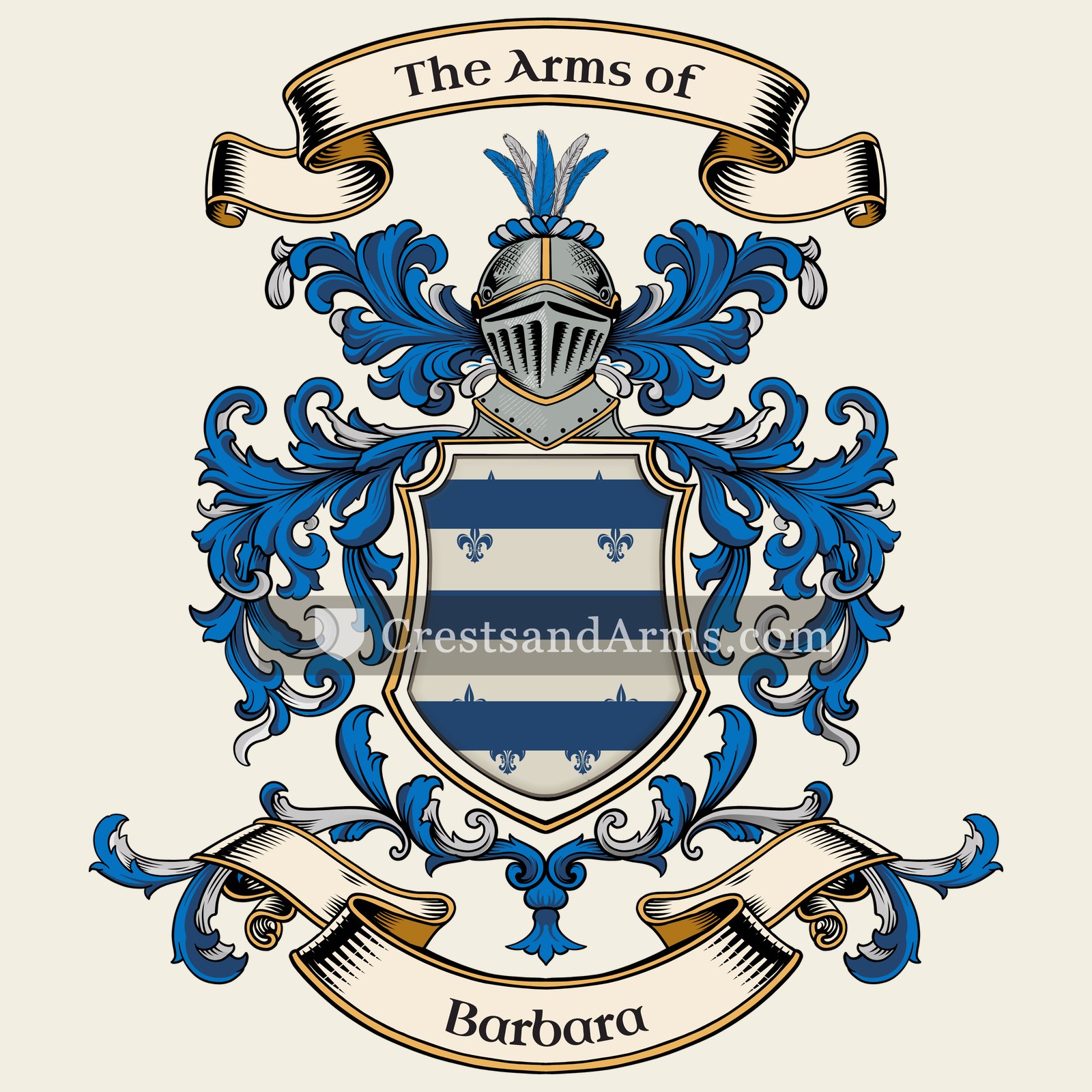
fessThe military belt, and readiness to serve
fleur de lisPurity, light, and the sixth son
Colours
Silver (Argent)Means: Peace and sincerity
Blue (Azure)Means: Loyalty and truth
Historical info
Source
J. B. Rietstap, Armorial Général, Gouda: G. B. van Goor Zonen, 1884–87
Blazon (the actual original written record)
“D'arg. à trois fasces d'azur, acc. de douze fleurs-de-lis du même.”
SicilySicily, c. 1775
Digital archive packCoat of arms PNG, gold border print PDF, vector SVG and the certificate of authenticity. Sent to your email in minutes.
Map of Italy showing where the Barbara arms are recorded
The Barbara arms were recorded in Sicily, c. 1775.
Sicily was ruled in turn by Normans, Germans, French and Spanish, and each left landed families behind. The island kept formal lists of its noble houses, which is why so many Sicilian names carry recorded arms.
This is where the arms were entered in the register. Families often moved to other parts of the country, so the same name can turn up in more than one region.
The body that granted and recorded arms in Italy in this period.
Alvise Giovanni Mocenigo
Sovereign of the period
Alvise Giovanni Mocenigo
1763–1778
Reigning in France when the Barbara arms are first recorded.
How Arms Worked in Italy
In the Italian states, coats of arms were often used by noble families to show their status and history. These symbols were passed down through the generations to all legitimate male descendants. Younger branches of a family usually kept the original design but sometimes added small changes to distinguish their specific line from the main branch.
Granting authority
Various local rulers and city governments controlled the use of coats of arms across the different Italian states.
How they got arms
Families often assumed their own arms or received them as official grants from local lords, popes, or city councils.
Where arms were recorded
Arms were recorded in local city archives or private family books rather than in one single national register.
The family's standing
Recorded among the armigerous families of Sicily.
Origin & History of the Barbara Family in Italy
The surname Barbara carries a deep connection to the Mediterranean world, rooted in the ancient Greek term *barbaros*, which originally described those who did not speak Greek. As the name moved into Italy, it evolved from a descriptive label into a formal family name, particularly within the distinct cultural landscape of Sicily. By the late eighteenth century, the Barbara family had established a documented presence on the island, reflecting the complex history of a region shaped by centuries of migration and shifting empires. Living in Sicily during the 1770s, members of this family were part of a society that balanced traditional agricultural life with the influence of the Bourbon monarchy. While the name itself evokes a sense of ancient origins, its specific history in Sicily highlights how families integrated into local communities, eventually becoming a permanent part of the island’s social fabric through generations of growth and local development.
Barbara Meaning & Related Branches
Root word
barbarus
A Latin term meaning foreign, strange, or non-Greek speaking.
This name
BarbaraDerived from the Latin word for a foreigner or someone who speaks a different language.
also spelled
Barbare
Barbaras
Documented Sources
J. B. Rietstap, Armorial Général, Gouda: G. B. van Goor Zonen, 1884–87
Archives départementales de la Meurthe-et-Moselle, Registres paroissiaux de Lorraine
Bouteiller, Ernest, Dictionnaire topographique de l'ancien département de la Moselle, 1868
Dauzat, Albert, Dictionnaire étymologique des noms de famille et prénoms de France, 1951
Digital archive packCoat of arms PNG, gold border print PDF, vector SVG and the certificate of authenticity. Sent to your email in minutes.


 chevronProtection, and faithful service completed
 mulletThe third son, and a divine quality from above
 swanGrace, light and the poet's art
 chevronProtection, and faithful service completed
 mulletThe third son, and a divine quality from above
 swanGrace, light and the poet's art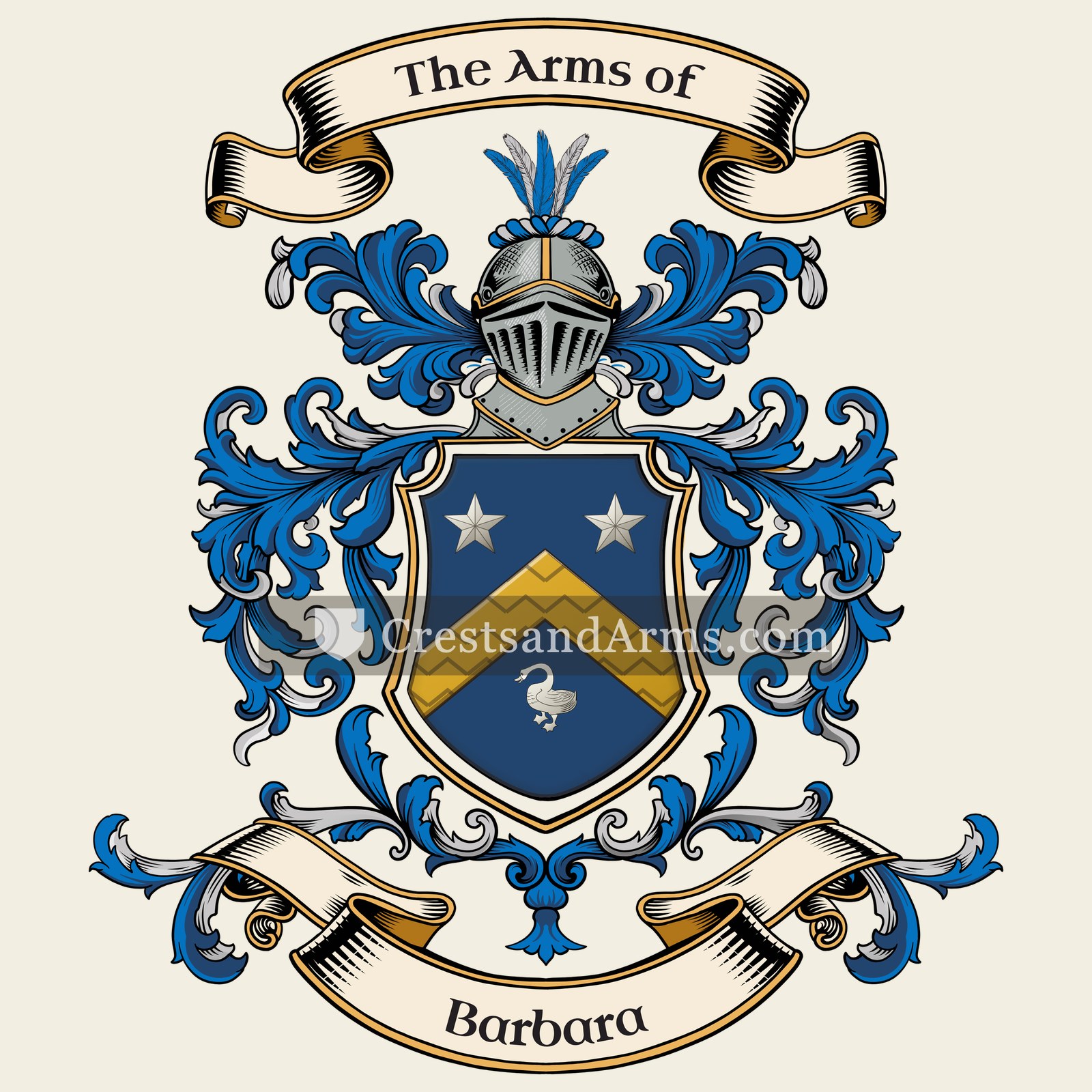


 eagleNobility, strength and a keen mind
 roundelA coin, and one who has been to the crusades
 swordJustice, and military honour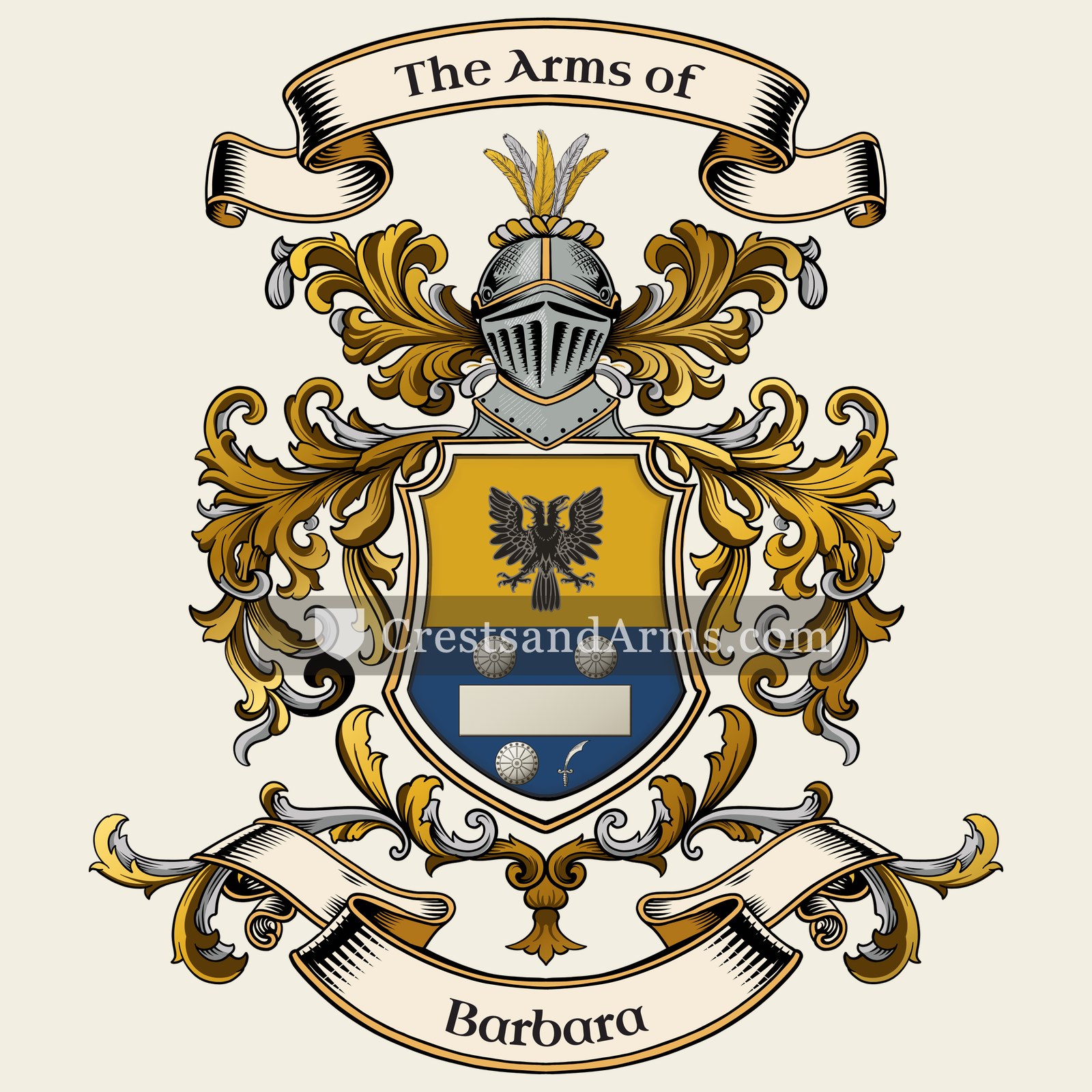


 fessThe military belt, and readiness to serve
 fleur de lisPurity, light, and the sixth son