Map of England showing where the Barber arms are recorded
The Barber arms were recorded in Suffolk, c. 1620.
Suffolk was wool country, and its cloth towns were among the wealthiest in England. Clothier families bought manors with their profits, and holding a manor was the ordinary route to a coat of arms.
This is where the arms were entered in the register. Families often moved to other parts of the country, so the same name can turn up in more than one region.
The body that granted and recorded arms in England in this period.
James VI and I
Sovereign of the period
James VI and I
1603–1625
Reigning in England when the Barber arms are first recorded.
How Arms Worked in England
English heraldry allowed arms to be shared by all legitimate descendants of the original owner. These symbols were treated as personal property that moved through the generations to all children. While the eldest son kept the original design, other family members could use the same shield without needing to change it or register their own unique versions.
Granting authority
The College of Arms in London has regulated the use of coats of arms throughout England and Wales since 1484.
How they got arms
Families typically obtained their coats of arms through a formal grant from the Crown or by proving their ancient right to them.
Where arms were recorded
All official coats of arms are recorded in the registers kept at the College of Arms, which date back to the fifteenth century.
The family's standing
Recorded among the armigerous families of Suffolk.
Origin & History of the Barber Family in England
The surname Barber originated as an occupational name during the Middle Ages, identifying individuals who worked as barbers or surgeons. In those times, a barber did much more than cut hair, as they were also responsible for bloodletting, tooth extractions, and minor surgical procedures. By the year 1620, families carrying this name were well-established in the county of Suffolk, England. These early ancestors were likely part of the skilled working class that helped maintain the local economy in East Anglia. As the name became hereditary, it spread across the region, reflecting the essential role these tradespeople played in the daily lives of their village communities.
Barber Meaning & Related Branches
Root word
barba
Latin term meaning beard or facial hair.
This name
BarberAn occupational surname for a person who cut hair and shaved beards.
also spelled
Barbour
Barberie
Related arms
Barborvariant spelling
Barbourvariant spelling
Documented Sources
Sir Bernard Burke, The General Armory of England, Scotland, Ireland and Wales, London: Harrison & Sons, 1884
Reaney, P.H., A Dictionary of English Surnames, 1958
Bardsley, Charles Wareing, A Dictionary of English and Welsh Surnames, 1901


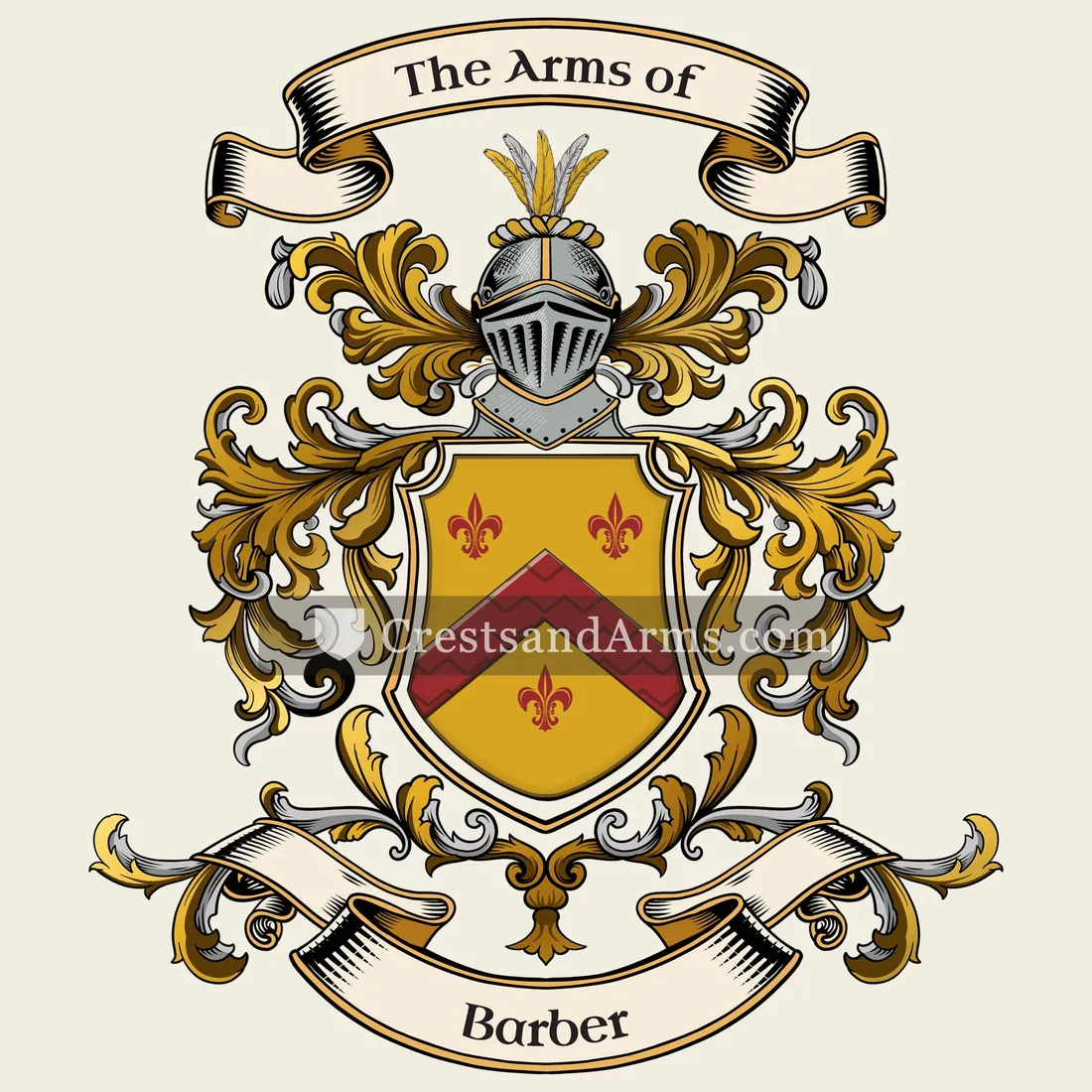
 chevronProtection, and faithful service completed
 fleur de lisPurity, light, and the sixth son
 chevronProtection, and faithful service completed
 fleur de lisPurity, light, and the sixth son