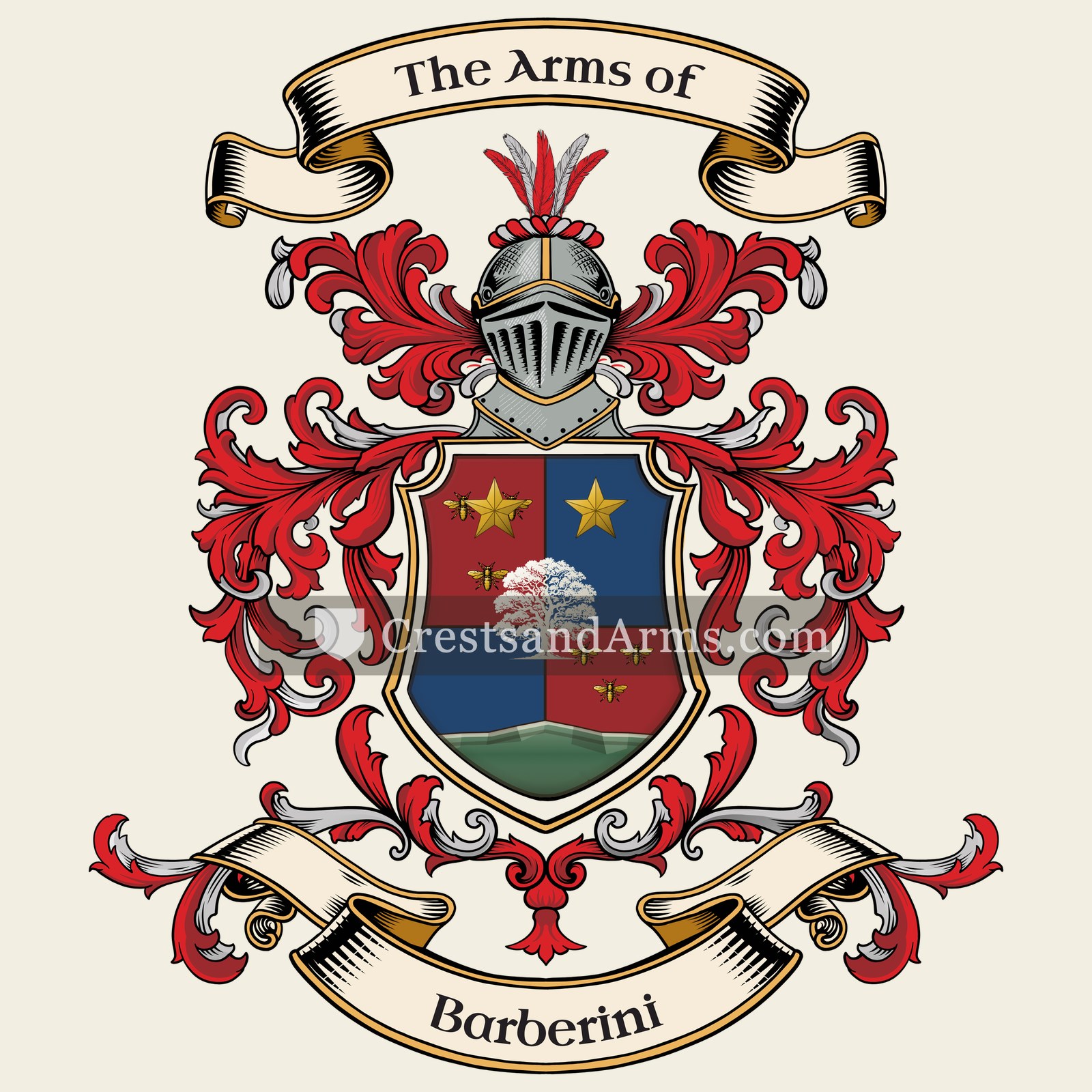
A record of documented arms, meaning and origin, researched for the Barberini family of Switzerland.
Reg. 0764 · Swiss, A–C
Coat of Arms & Family Crest Details
Symbols on this shield
mountThe ground held, and steadfastness upon it
treeLife, endurance and deep roots
mulletThe third son, and a divine quality from above
beeIndustry, order and tireless work
Colours
Red (Gules)Means: Military strength
Blue (Azure)Means: Loyalty and truth
Green (Vert)Means: Hope
Gold (Or)Means: Generosity
Historical info
Source
J. B. Rietstap, Armorial Général, Gouda: G. B. van Goor Zonen, 1884–87
Blazon (the actual original written record)
“De gu. à un arbre au nat., fruité de gu., posé sur un tertre de trois coupeaux de sin. et acc. en chef de deux étoiles (6) d'or. - Armes mod.: Ec.: aux 1 et 4 d'azur à trois abeilles d'or; aux 2 et 3 les armes anciennes.”
SwitzerlandValais, c. 1745
Digital archive packCoat of arms PNG, gold border print PDF, vector SVG and the certificate of authenticity. Sent to your email in minutes.
Map of Switzerland showing where the Barberini arms are recorded
The Barberini arms were recorded in Valais, c. 1745.
This is where the arms were entered in the register. Families often moved to other parts of the country, so the same name can turn up in more than one region.
The body that granted and recorded arms in Switzerland in this period.
How Arms Worked in Switzerland
In Switzerland, coats of arms were not restricted to the nobility and were often adopted by common citizens and families. These symbols were passed down through generations to show family identity. When branches of a family grew, they often changed small details of the design to distinguish their own line from the original group.
Granting authority
Cantonal and civic authorities managed the use of coats of arms within their specific regions and local jurisdictions.
How they got arms
Families typically assumed their own coats of arms based on local custom rather than receiving them from a central monarch.
Where arms were recorded
Arms were recorded in various cantonal and civic registers starting from the fourteenth century throughout the Swiss region.
The family's standing
Recorded among the armigerous families of Switzerland.
Origin & History of the Barberini Family in Switzerland
The Barberini family name traces its roots to the Tuscany region of Italy, where the family gained prominence as wealthy merchants and bankers during the Middle Ages. The name itself is thought to be derived from the Italian word "barba," which refers to a beard, suggesting that an early ancestor may have been known for a distinct facial feature. While the family is most famous for its influence in Rome during the seventeenth century, members of the lineage eventually spread across Europe for trade and political reasons. By the middle of the eighteenth century, specific branches of the family had established a presence in the Valais region of Switzerland. These settlers integrated into the local mountain communities, transitioning from their urban Italian origins to the distinct social and economic life of the Swiss Alps by 1745.
Barberini Meaning & Related Branches
Root word
barba
Latin term referring to hair growing on the chin or face.
This name
BarberiniDerived from a nickname for a bearded man or a barber.
also spelled
Barberiny
Barberine
Barberinee
Documented Sources
J. B. Rietstap, Armorial Général, Gouda: G. B. van Goor Zonen, 1884–87
Pastor, Ludwig von, Geschichte der Päpste seit dem Ausgang des Mittelalters, 1928
Pollak, Oskar, Die Kunsttätigkeit unter Urban VIII, 1928
Archives de l'État du Valais, Fonds de la famille Barberini (1745–1850)
Digital archive packCoat of arms PNG, gold border print PDF, vector SVG and the certificate of authenticity. Sent to your email in minutes.


 mountThe ground held, and steadfastness upon it
 treeLife, endurance and deep roots
 mulletThe third son, and a divine quality from above
 beeIndustry, order and tireless work
 mountThe ground held, and steadfastness upon it
 treeLife, endurance and deep roots
 mulletThe third son, and a divine quality from above
 beeIndustry, order and tireless work