Map of France showing where the Barbier arms are recorded
The Barbier arms were recorded in Dauphine, c. 1425.
Dauphine lay in the mountains of south-eastern France, a country of small estates and scattered valleys. Its gentry were many and mostly modest, and even a small landholding was enough to justify arms.
This is where the arms were entered in the register. Families often moved to other parts of the country, so the same name can turn up in more than one region.
The body that granted and recorded arms in France in this period.
Charles VII of France
Sovereign of the period
Charles VII of France
1422–1461
Reigning in France when the Barbier arms are first recorded.
How Arms Worked in France
In France, a coat of arms was a mark of honor that passed down through the male line to all legitimate descendants. Families often used the same shield without changes to show their shared heritage. If a branch wanted to stand out, they could add a small mark to their shield to show their specific place in the family tree.
Granting authority
The Juge d'armes de France acted as the official authority that regulated and verified coats of arms across the country.
How they got arms
Families typically inherited their arms from ancestors, though they could also receive them through royal grants or by proving their noble status.
Where arms were recorded
Coats of arms were officially recorded in the Armorial Général de France, which began its main collection in the year 1696.
The family's standing
Recorded among the armigerous families of Dauphine.
Origin & History of the Barbier Family in France
The name Barbier originated in France as a professional surname derived from the Latin word *barbarius*, which identified a person who practiced the trade of barbering. During the Middle Ages, a barber was much more than a person who cut hair, as they frequently performed minor surgeries, bloodletting, and dentistry. By the year 1425, records confirm that families bearing this name were well established in the Dauphiné region of southeastern France. At that time, the Dauphiné was a province with a unique legal status under the French crown, and families living there often held positions of local influence or served as skilled tradespeople in growing mountain towns. As the family spread across the country, the name remained a common marker of those who held essential roles in the health and grooming services of their communities.
Coat of Arms & Family Crest Details
Symbols on this shield
fleur de lisPurity, light, and the sixth son
millrind / fer de molineThe mill's iron, and the grinding of grain
Colours
Silver (Argent)Means: Peace and sincerity
Blue (Azure)Means: Loyalty and truth
Historical info
Source
J. B. Rietstap, Armorial Général, Gouda: G. B. van Goor Zonen, 1884–87
Blazon (the actual original written record)
“Ec.: aux 1 et 4 d'arg. à la fleur-de-lis d'azur; aux 2 et 3 coupé d'azur sur or, l'or ch. d'une anille d'azur. C.: la fleur-de-lis.”
LiegeLiege, c. 1737
Digital archive packCoat of arms PNG, gold border print PDF, vector SVG and the certificate of authenticity. Sent to your email in minutes.
Map of Belgium showing where the Barbier arms are recorded
The Barbier arms were recorded in Liege, c. 1737.
Liege was a prosperous town and its surrounding country, living on metalworking and trade. Merchant families grew rich, bought land outside the walls, and took arms as landowners rather than tradesmen.
This is where the arms were entered in the register. Families often moved to other parts of the country, so the same name can turn up in more than one region.
The body that granted and recorded arms in Belgium in this period.
Charles VI, Holy Roman Emperor
Sovereign of the period
Charles VI, Holy Roman Emperor
1711–1740
Reigning in France when the Barbier arms are first recorded.
How Arms Worked in Belgium
In Belgium, a coat of arms is considered personal property that is passed down through the male line to legitimate descendants. Families often use the same shield design across generations to show their shared heritage. If a branch of the family wants to change the design, they must apply for an official update to their specific version of the arms.
Granting authority
The Conseil héraldique is the official body that regulates and approves all coats of arms in Belgium.
How they got arms
Families obtain their coats of arms through formal royal grants or by confirming their historical right to use existing designs.
Where arms were recorded
All approved coats of arms are officially recorded in the public registers of the Conseil héraldique since 1844.
The family's standing
Recorded among the armigerous families of Liege.
Origin & History of the Barbier Family in Belgium
The surname Barbier originated as an occupational name derived from the Old French word for a barber, a profession that held significant social importance in medieval and early modern society. While many people associate the name with France, the Barbier family established a notable presence in the Prince-Bishopric of Liège by at least 1737. During this period, Liège was a bustling industrial and cultural hub where barbers often performed more than just haircuts. They were frequently trained in minor surgical procedures, bloodletting, and dentistry, making them essential members of the local community. As the family settled into the region, they became part of the complex social fabric of the Meuse valley, likely adapting to the unique legal and linguistic traditions of the area. Their presence in Liège suggests they were integrated into the urban workforce, contributing to the daily life and medical maintenance of the city’s growing population during the eighteenth century.
Coat of Arms & Family Crest Details
Symbols on this shield
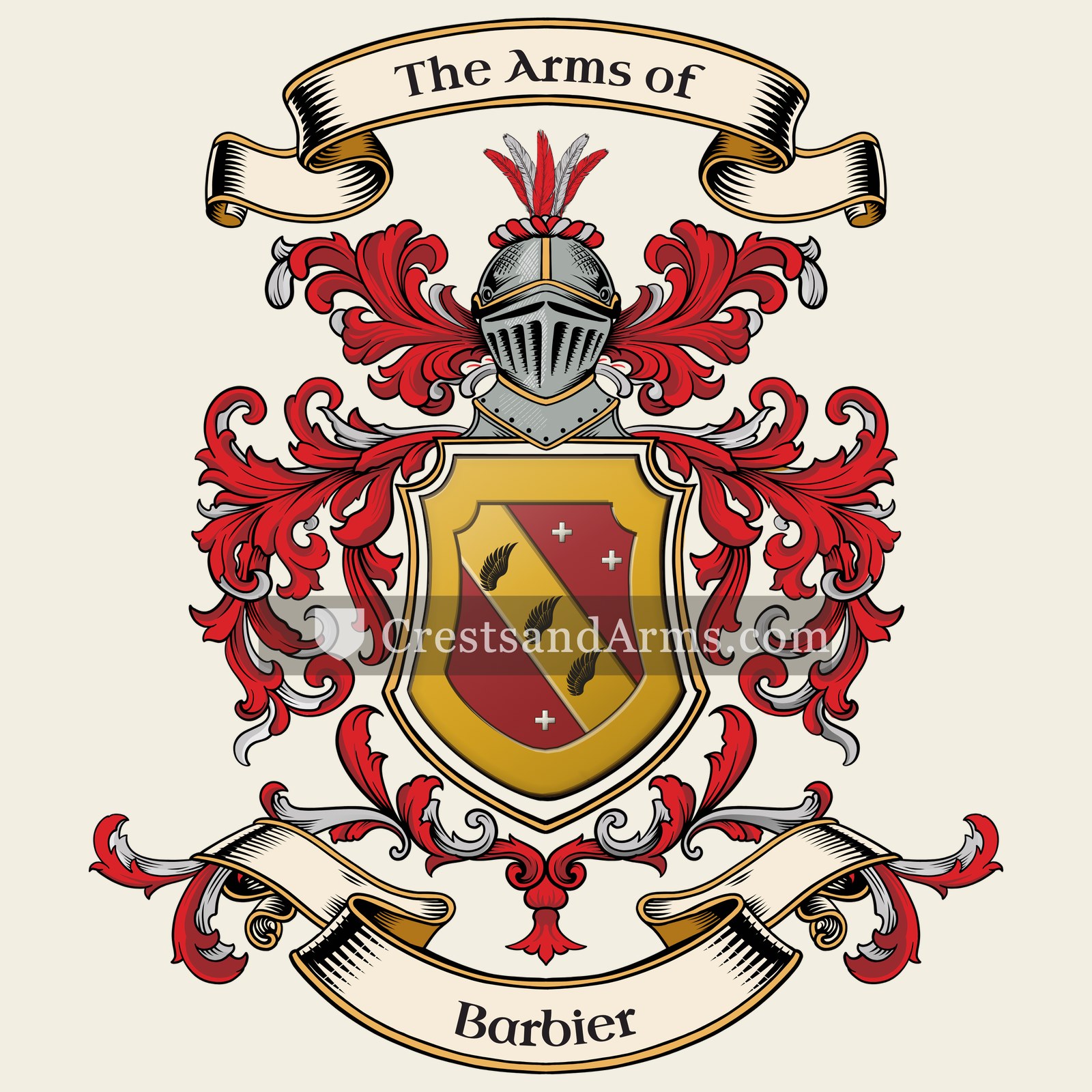
bendDefence, and the scarf of a commander
cross symbolChristian faith and service
wingSwiftness, and protection under a raised wing
Colours
Red (Gules)Means: Military strength
Gold (Or)Means: Generosity
Black (Sable)Means: Constancy
Historical info
Source
J. B. Rietstap, Armorial Général, Gouda: G. B. van Goor Zonen, 1884–87
Blazon (the actual original written record)
“De gu. à la bande d'or, ch. de trois demi-vols de sa. et acc. de trois croisettes du sec., 2 en chef et 1 en p. L'écu bordé d'or. Cq. cour. C.: un vol de sa L.: à dextre d'or et de sa., à sen. d'or et de gu.”
SwitzerlandNeufchâtel, c. 1728
Digital archive packCoat of arms PNG, gold border print PDF, vector SVG and the certificate of authenticity. Sent to your email in minutes.
Map of Switzerland showing where the Barbier arms are recorded
The Barbier arms were recorded in Neufchâtel, c. 1728.
This is where the arms were entered in the register. Families often moved to other parts of the country, so the same name can turn up in more than one region.
The body that granted and recorded arms in Switzerland in this period.
How Arms Worked in Switzerland
In Switzerland, coats of arms were not restricted to the nobility and were often adopted by common citizens and families. These symbols were passed down through generations to show family identity. When branches of a family grew, they often changed small details of the design to distinguish their own line from the original group.
Granting authority
Cantonal and civic authorities managed the use of coats of arms within their specific regions and local jurisdictions.
How they got arms
Families typically assumed their own coats of arms based on local custom rather than receiving them from a central monarch.
Where arms were recorded
Arms were recorded in various cantonal and civic registers starting from the fourteenth century throughout the Swiss region.
The family's standing
Recorded among the armigerous families of Switzerland.
Origin & History of the Barbier Family in Switzerland
The name Barbier is rooted in the French word for barber, a profession that held significant social importance in medieval and early modern Europe. Beyond simple grooming, these individuals often acted as surgeons and dentists, making them essential members of their local communities. By the time the family established a documented presence in the Swiss canton of Neuchâtel in 1728, the name had transitioned from a functional job title to a hereditary surname. In this region, the Barbier family integrated into the local social fabric, likely benefiting from the area's reputation for craftsmanship and trade. As they settled into the Swiss landscape, they became part of the long tradition of families who helped shape the administrative and economic life of the Jura region. Their survival and growth in Neuchâtel reflect the broader movement of skilled workers who sought stability and opportunity within the Swiss cantons during the eighteenth century.
Barbier Meaning & Related Branches
Root word
barba
Latin term referring to the hair growing on the chin or face.
This name
BarbierAn occupational surname for a barber or someone who trimmed hair and beards.
also spelled
Barbie
Barbyer
Barbeeay
Related arms
Bodinsimilar arms
Guymontsimilar arms
van Havresimilar arms
Brestrecorded with Barbier, same area
Documented Sources
J. B. Rietstap, Armorial Général, Gouda: G. B. van Goor Zonen, 1884–87
Albert Dauzat, Les noms de famille de France, 1949
Marie-Thérèse Morlet, Dictionnaire étymologique des noms de famille, 1991
Archives départementales de l'Isère, Série B: Cours et juridictions (Fonds du Dauphiné)
Digital archive packCoat of arms PNG, gold border print PDF, vector SVG and the certificate of authenticity. Sent to your email in minutes.


 duckResourcefulness on land and water
 duckResourcefulness on land and water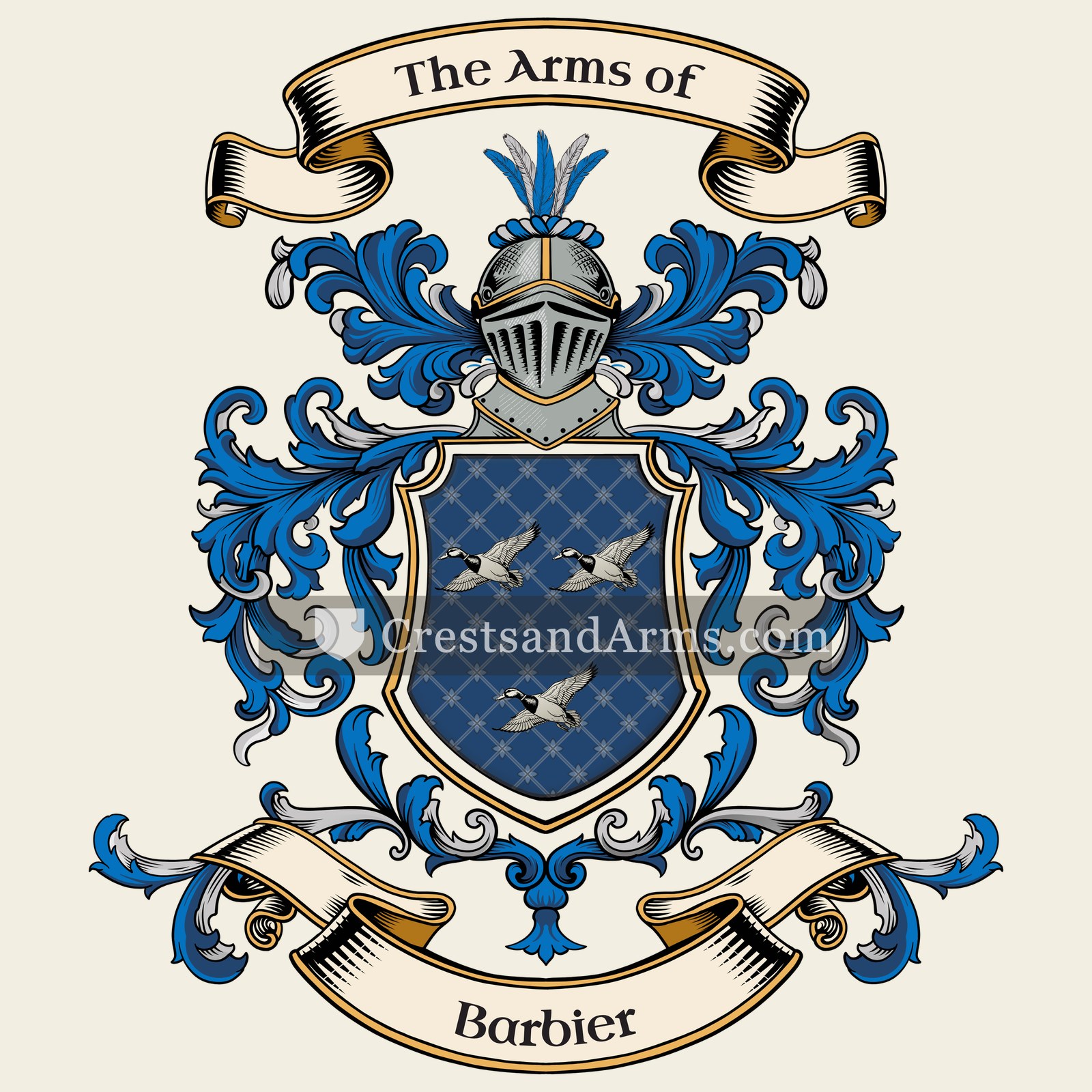


 fleur de lisPurity, light, and the sixth son
 millrind / fer de molineThe mill's iron, and the grinding of grain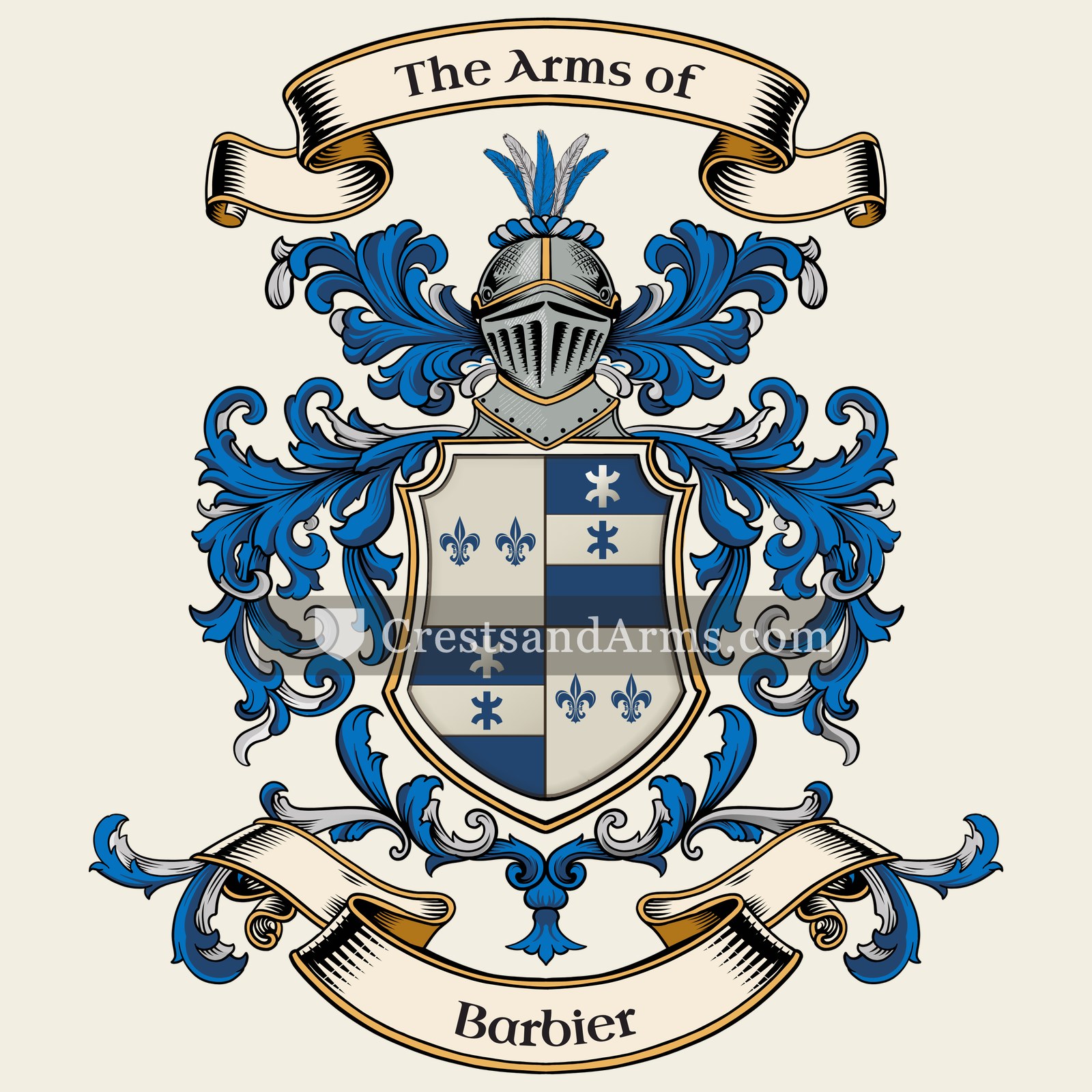


 bendDefence, and the scarf of a commander
 cross symbolChristian faith and service
 wingSwiftness, and protection under a raised wing