Map of England showing where the Barbon arms are recorded
The Barbon arms were recorded in London, c. 1620.
This is where the arms were entered in the register. Families often moved to other parts of the country, so the same name can turn up in more than one region.
The body that granted and recorded arms in England in this period.
James VI and I
Sovereign of the period
James VI and I
1603–1625
Reigning in England when the Barbon arms are first recorded.
How Arms Worked in England
English heraldry allowed arms to be shared by all legitimate descendants of the original owner. These symbols were treated as personal property that moved through the generations to all children. While the eldest son kept the original design, other family members could use the same shield without needing to change it or register their own unique versions.
Granting authority
The College of Arms in London has regulated the use of coats of arms throughout England and Wales since 1484.
How they got arms
Families typically obtained their coats of arms through a formal grant from the Crown or by proving their ancient right to them.
Where arms were recorded
All official coats of arms are recorded in the registers kept at the College of Arms, which date back to the fifteenth century.
The family's standing
Recorded among the armigerous families of England.
Origin & History of the Barbon Family in England
The Barbon family name is historically linked to the bustling urban environment of seventeenth-century London. By 1620, members of the family were already established in the city, participating in the rapid growth and commercial expansion that defined the era. The name is often associated with Nicholas Barbon, a notable figure who became a pioneer in property development and fire insurance following the Great Fire of London in 1666. His work helped reshape the city’s landscape and laid the foundation for modern urban planning. The family’s presence in London during this period suggests they were deeply involved in the professional and economic life of England as it transitioned into a global trade hub. Their influence reflects the broader social mobility and entrepreneurial spirit that characterized London families during the early modern period.
Barbon Meaning & Related Branches
Root word
barba
Latin term meaning beard or a bearded person.
This name
BarbonA locational surname derived from the French place name Bourbon-l'Archambault or a nickname for a bearded man.
also spelled
Barbun
Barbunne
Documented Sources
Sir Bernard Burke, The General Armory of England, Scotland, Ireland and Wales, London: Harrison & Sons, 1884
Archer, Ian W., The Pursuit of Stability: Social Relations in Elizabethan London, 1991
Barbon, Nicholas, An Apology for the Builder: Or a Discourse Shewing the Cause and Effects of the Increase of Building, 1685
The National Archives, Kew, Prerogative Court of Canterbury and Related Probate Jurisdictions: Will Registers, 1384–1858
Digital archive packCoat of arms PNG, gold border print PDF, vector SVG and the certificate of authenticity. Sent to your email in minutes.


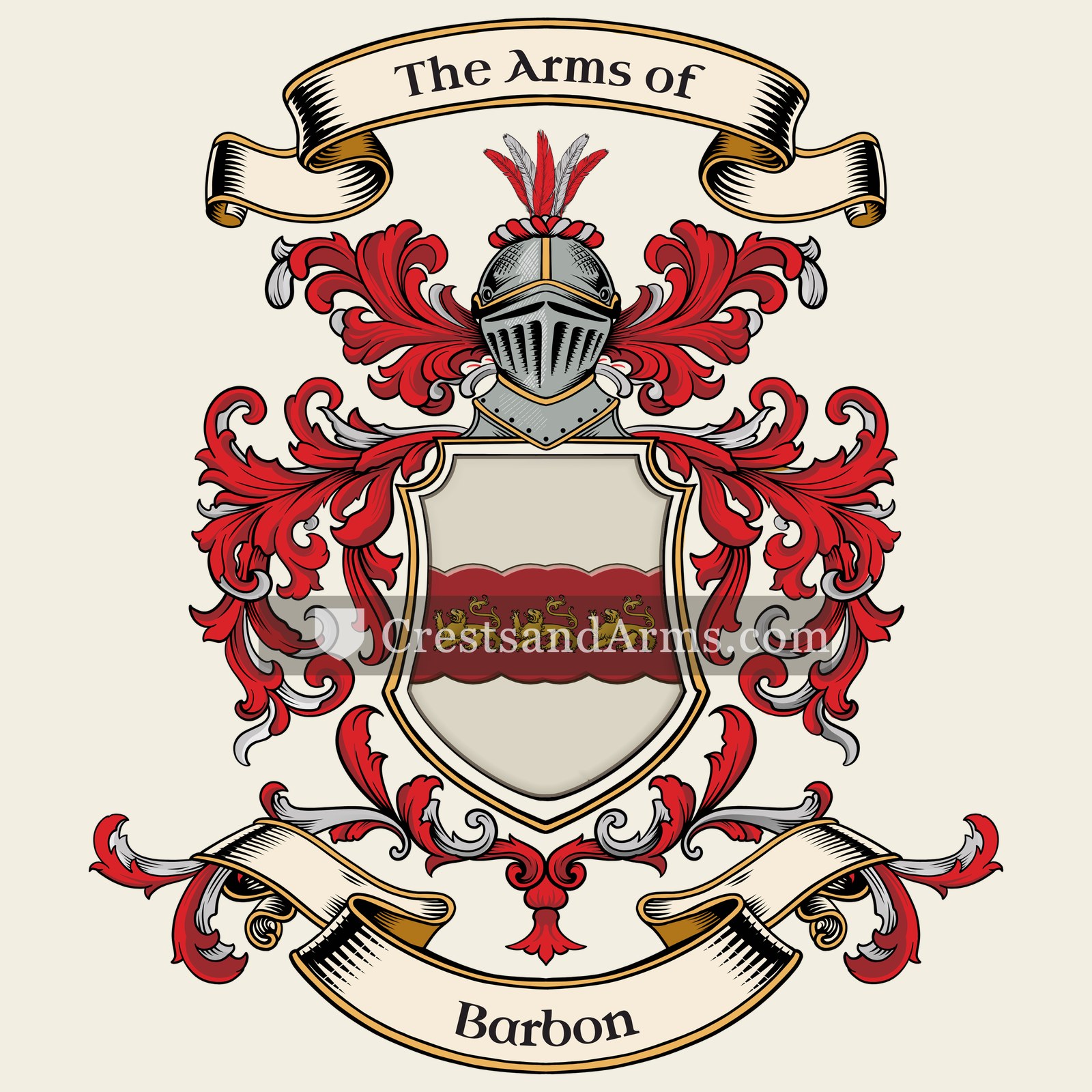
 fessThe military belt, and readiness to serve
 lionCourage, strength and royalty
 fessThe military belt, and readiness to serve
 lionCourage, strength and royalty