A record of documented arms, meaning and origin, researched for the Barck family lines. Documented in 2 countries.
Reg. 5440 · Swedish, A–C
Coat of Arms & Family Crest Details
Symbols on this shield
paleMilitary strength, and a fortified defence
greyhoundCourage, vigilance and loyalty
dovePeace, love and the Holy Spirit
Colours
Blue (Azure)Means: Loyalty and truth
Red (Gules)Means: Military strength
Silver (Argent)Means: Peace and sincerity
Gold (Or)Means: Generosity
Historical info
Source
J. B. Rietstap, Armorial Général, Gouda: G. B. van Goor Zonen, 1884–87
Blazon (the actual original written record)
“d'azur au lévrier ramp. et cont. d'arg., coll. de gu., bouclé d'or; b. coupé d'un palé de gu. et d'or de huit pièces, sur gu. à une colombe d'arg. C.: 1° une étoile (8) d'or, entre deux prob. d'arg.; 1. d'arg. et de gu.; 2° une tête et col de lévrier d'or, coll. de gu., bouclé d'or; 1. d'or et d'azur.”
Swedenc. 1700
Digital archive packCoat of arms PNG, gold border print PDF, vector SVG and the certificate of authenticity. Sent to your email in minutes.
Map of Sweden showing where the Barck arms are recorded
The Barck arms were recorded in Sweden, c. 1700.
Arms such as these were typically recorded in Stockholm.
Stockholm held the Swedish court and the House of Nobility, where every noble family's arms were entered and kept. Families ennobled for service registered there, which is why so many are recorded around the city.
This is where the arms were entered in the register. Families often moved to other parts of the country, so the same name can turn up in more than one region.
The body that granted and recorded arms in Sweden in this period.
Carl XII of Sweden
Sovereign of the period
Carl XII of Sweden
1697–1718
Reigning in Sweden when the Barck arms are first recorded.
How Arms Worked in Sweden
In Sweden, a coat of arms belonged to a noble family as a whole rather than just one individual. These arms were passed down through the generations to all legitimate descendants. Younger branches of the family used the same shield without needing to change it. This system ensured that the entire lineage shared the same identity and status under the law.
Granting authority
The Riddarhuset, or House of Nobility, regulated all noble coats of arms in Sweden under royal authority.
How they got arms
Families received their coats of arms through royal grants of nobility which were then officially registered with the House.
Where arms were recorded
Coats of arms were officially recorded in the Swedish House of Nobility register starting in the year 1626.
The family's standing
Recorded among the armigerous families of Sweden.
Origin & History of the Barck Family in Sweden
The Barck family name became a notable part of the Swedish social landscape during the early eighteenth century, with documented roots established in Stockholm by the year 1700. During this period, the family began to integrate into the professional and administrative circles of the Swedish capital. Members of the family were often involved in the complex bureaucratic systems that supported the Swedish state, which was a common path for rising families at the time. As the family grew in prominence, they became connected to the intellectual and political life of the city. Their presence in Stockholm during this era suggests they were part of the urban middle class that helped shape the city’s development during the Swedish Empire’s later years. By establishing themselves in the capital, the early Barck family members laid a foundation that allowed them to participate in the evolving social and professional structures of Sweden for generations to come.
Coat of Arms & Family Crest Details
Symbols on this shield
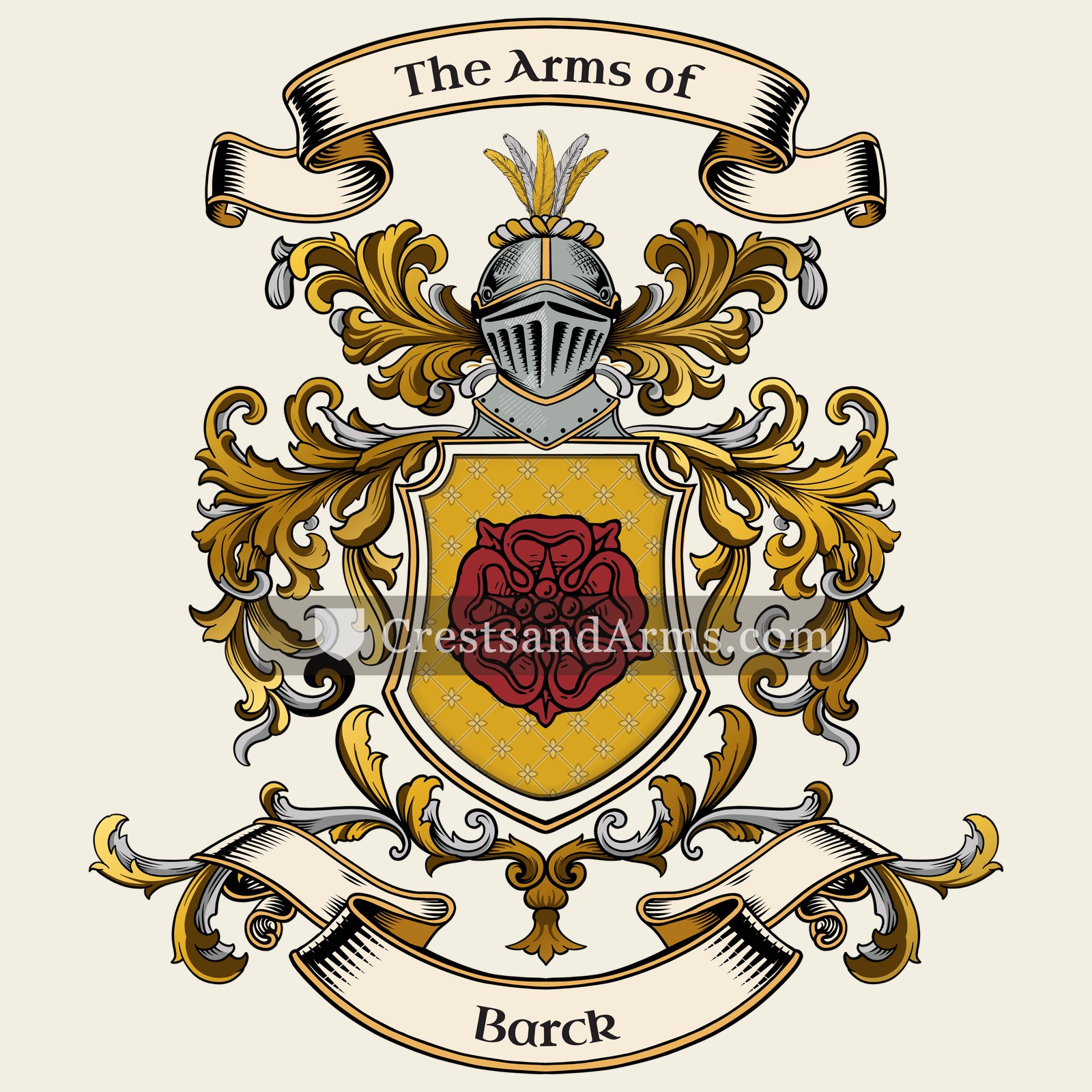
roseThe seventh son, and beauty with grace
Colours
Gold (Or)Means: Generosity
Red (Gules)Means: Military strength
Historical info
Source
J. B. Rietstap, Armorial Général, Gouda: G. B. van Goor Zonen, 1884–87
Blazon (the actual original written record)
“D'or à une rose de gu., bout. du champ.”
Netherlandsc. 1815
Digital archive packCoat of arms PNG, gold border print PDF, vector SVG and the certificate of authenticity. Sent to your email in minutes.
Map of Netherlands showing where the Barck arms are recorded
The Barck arms were recorded in Netherlands, c. 1815.
Arms such as these were typically recorded in Friesland.
Friesland was low, wet country on the northern coast of the Netherlands, farmed by families who had held the same land for centuries. Free landholders were unusually common there, and a free landholder could carry arms.
This is where the arms were entered in the register. Families often moved to other parts of the country, so the same name can turn up in more than one region.
Region
Friesland
First recorded
1815
Granting Authority for the Barck Arms
Hoge Raad van Adel
Photograph made by me · CC BY-SA 3.0
The body that granted and recorded arms in Netherlands in this period.
William I of the Netherlands
Sovereign of the period
William I of the Netherlands
1815–1840
Reigning in Sweden when the Barck arms are first recorded.
How Arms Worked in Netherlands
In the Netherlands, coats of arms were often used by noble families and those who held specific public offices. These arms were passed down through the generations to legitimate descendants. Younger branches of a family usually kept the original design without needing to add special marks. This system ensured that the family identity remained clear and consistent over many years.
Granting authority
The Hoge Raad van Adel is the official body that regulates and manages noble titles and coats of arms in the Netherlands.
How they got arms
Families typically obtained their coats of arms through official royal grants or by proving their long-standing historical use of the symbols.
Where arms were recorded
Coats of arms are officially recorded in the registers held by the Hoge Raad van Adel, which began its work in 1814.
The family's standing
Recorded among the armigerous families of Netherlands.
Origin & History of the Barck Family in Netherlands
The history of the Barck family in the Netherlands is deeply connected to the distinct cultural landscape of the northern province of Friesland. By the early nineteenth century, records confirm that members of the family were established residents in this region, a time when the Netherlands was transitioning into a unified kingdom following the Napoleonic era. During this period, Frisian society was characterized by strong local traditions and a unique linguistic heritage that set it apart from the rest of the country. Families living in Friesland during the 1800s often navigated a changing legal landscape, as the government began to standardize civil registration and formalize family surnames across all provinces. The presence of the Barck name in these early official documents suggests that the family was part of a stable community that participated in the agricultural and maritime growth of the northern territories. As the region modernized, the family integrated into the local economy, contributing to the social fabric of a province known for its resilience and independent spirit.
Barck Meaning & Related Branches
Root word
Bark
The outer protective layer of a tree trunk.
This name
BarckAn ornamental surname likely derived from a topographical feature or tree-related location.
also spelled
Bark
Related arms
Ascheberg de Soefdeborgsimilar arms
Cronstedtsimilar arms
Edelcrantzsimilar arms
Gyllenstierna d'Eriksbergsimilar arms
Documented Sources
J. B. Rietstap, Armorial Général, Gouda: G. B. van Goor Zonen, 1884–87
Elgenstierna, Gustaf. Den introducerade svenska adelns ättartavlor. 1925
Riksarkivet (National Archives of Sweden). Stockholms rådhusrätt och magistrat, Bouppteckningar
Digital archive packCoat of arms PNG, gold border print PDF, vector SVG and the certificate of authenticity. Sent to your email in minutes.


 paleMilitary strength, and a fortified defence
 greyhoundCourage, vigilance and loyalty
 dovePeace, love and the Holy Spirit
 paleMilitary strength, and a fortified defence
 greyhoundCourage, vigilance and loyalty
 dovePeace, love and the Holy Spirit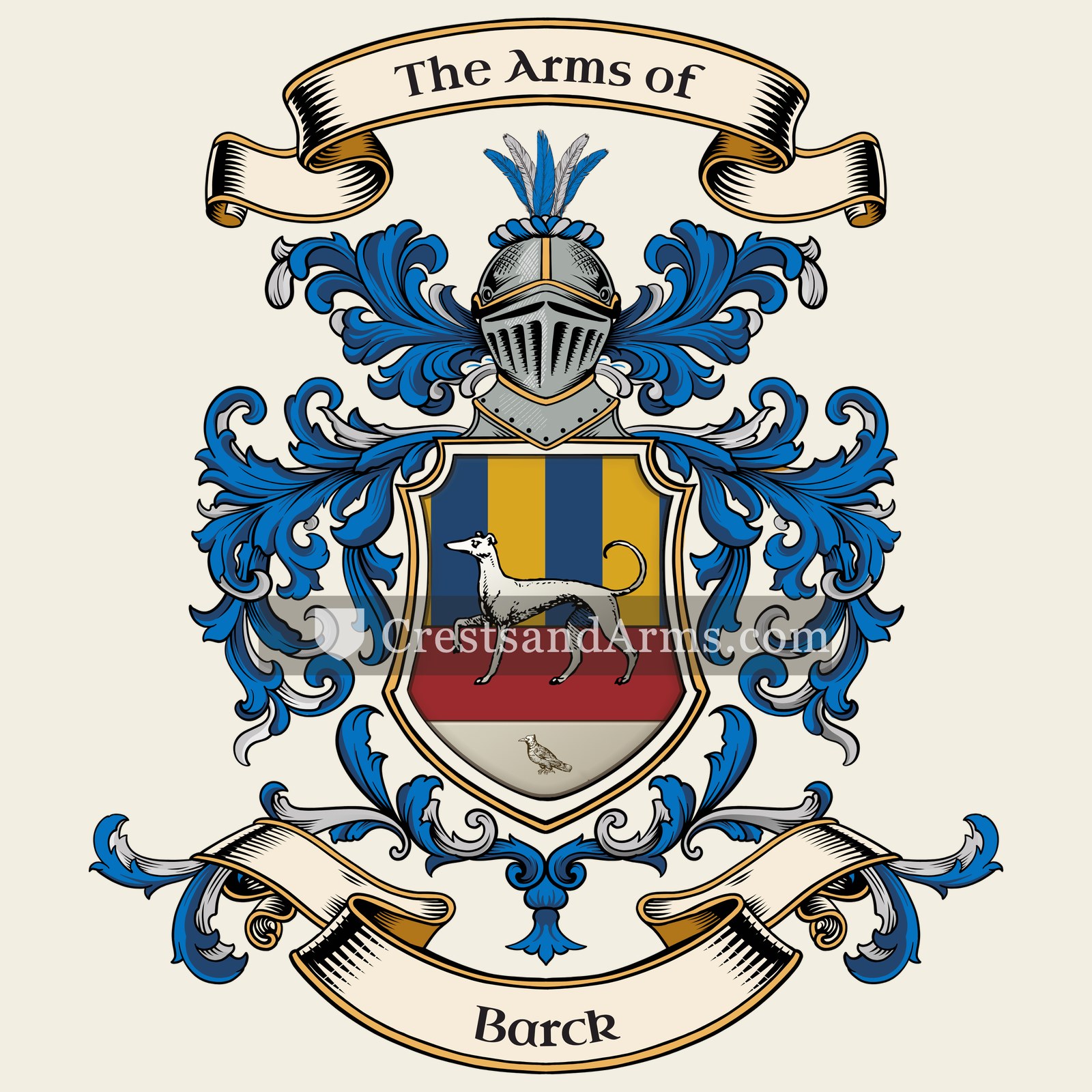


 roseThe seventh son, and beauty with grace