Map of England showing where the Barclay arms are recorded
The Barclay arms were recorded in Surrey, c. 1620.
Surrey sat just south of London and filled up with families who had made money in the City. Buying an estate there was the usual next step, and an estate was the usual reason to take arms.
This is where the arms were entered in the register. Families often moved to other parts of the country, so the same name can turn up in more than one region.
The body that granted and recorded arms in England in this period.
James VI and I
Sovereign of the period
James VI and I
1603–1625
Reigning in England when the Barclay arms are first recorded.
How Arms Worked in England
English heraldry allowed arms to be shared by all legitimate descendants of the original owner. These symbols were treated as personal property that moved through the generations to all children. While the eldest son kept the original design, other family members could use the same shield without needing to change it or register their own unique versions.
Granting authority
The College of Arms in London has regulated the use of coats of arms throughout England and Wales since 1484.
How they got arms
Families typically obtained their coats of arms through a formal grant from the Crown or by proving their ancient right to them.
Where arms were recorded
All official coats of arms are recorded in the registers kept at the College of Arms, which date back to the fifteenth century.
The family's standing
Recorded among the armigerous families of Surrey.
Origin & History of the Barclay Family in England
The history of the Barclay family in England is deeply rooted in the social and land-owning traditions of the seventeenth century. While the name has older origins, records confirm that members of the family were firmly established in Surrey by 1620. During this period, families like the Barclays often held roles as local landowners or members of the gentry, which allowed them to influence the development of their local parishes. They lived through a time of significant political and religious change in England, which often dictated where families moved and how they managed their estates. By settling in Surrey, the Barclays became part of a regional network of families who helped shape the rural economy and community life of the English countryside during the early modern era.
Coat of Arms & Family Crest Details
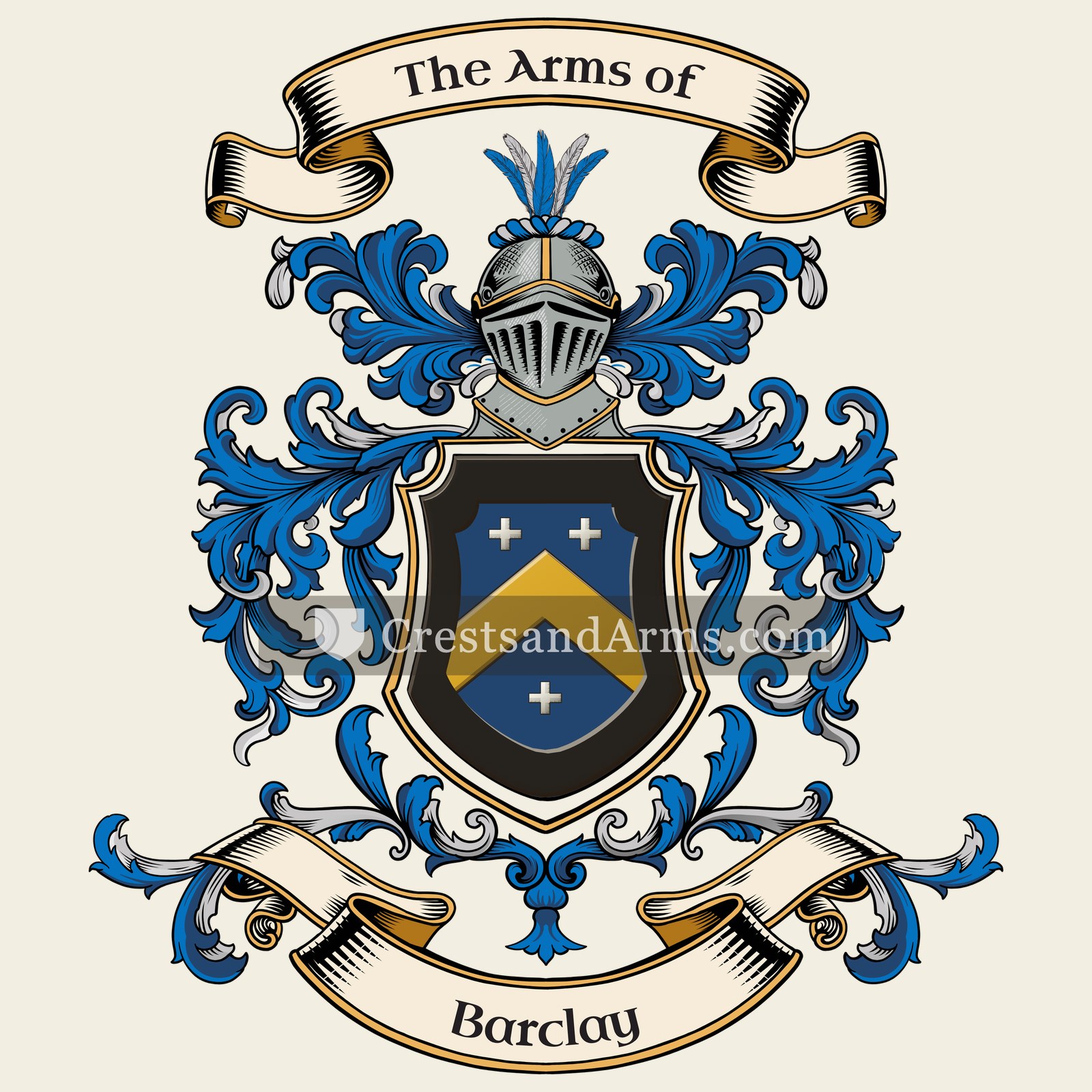
Symbols on this shield
chevronProtection, and faithful service completed
cross symbolChristian faith and service
Colours
Blue (Azure)Means: Loyalty and truth
Silver (Argent)Means: Peace and sincerity
Historical info
Source
Sir Bernard Burke, The General Armory of England, Scotland, Ireland and Wales, London: Harrison & Sons, 1884
Blazon (the actual original written record)
“Az. a chev. ar. in chief three crosses pattée of the last (or, as recorded in 1725, az. three crosses pattée in chief ar.)”
KincardineMathers · Kincardine, c. 1725
Digital archive packCoat of arms PNG, gold border print PDF, vector SVG and the certificate of authenticity. Sent to your email in minutes.
Map of Scotland showing where the Barclay arms are recorded
The Barclay arms were recorded in Kincardine, c. 1725.
Kincardineshire was a narrow strip of farmland between the hills and the North Sea. Its landed families were few but very long-settled, and long settlement brought arms.
This is where the arms were entered in the register. Families often moved to other parts of the country, so the same name can turn up in more than one region.
The body that granted and recorded arms in Scotland in this period.
George I of Great Britain
Sovereign of the period
George I of Great Britain
1714–1727
Reigning in England when the Barclay arms are first recorded.
How Arms Worked in Scotland
Scottish heraldry is unique because it treats a coat of arms as a piece of personal property protected by law. Only one person can own a specific design at any given time. When a family grows, the head keeps the original shield while other relatives must apply for their own distinct version with slight changes to prove their specific identity.
Granting authority
The Court of the Lord Lyon acts as the official body that regulates and controls all heraldic matters throughout Scotland.
How they got arms
Individuals obtain a legal right to their arms through a formal petition process that confirms their identity and family connection.
Where arms were recorded
All valid coats of arms are officially entered into the Public Register of All Arms and Bearings starting from 1672.
The family's standing
Recorded among the armigerous families of Kincardine.
Origin & History of the Barclay Family in Scotland
The surname Barclay has deep roots in the Scottish landscape, with the family establishing a significant presence in the region of Kincardine by the early eighteenth century. The name itself is thought to have originated from the Norman French term for a birch tree, and it traveled north as families migrated into Scotland during the Middle Ages. By 1725, members of the Barclay family were well-integrated into the local community, living as part of the agricultural and social fabric of the Kincardine area. These early settlers were often involved in the management of land and local trade, which helped the family name persist across generations. Their history reflects the broader patterns of Scottish settlement, where families put down roots in specific parishes and maintained their identity through local landholding and community ties.
Coat of Arms & Family Crest Details
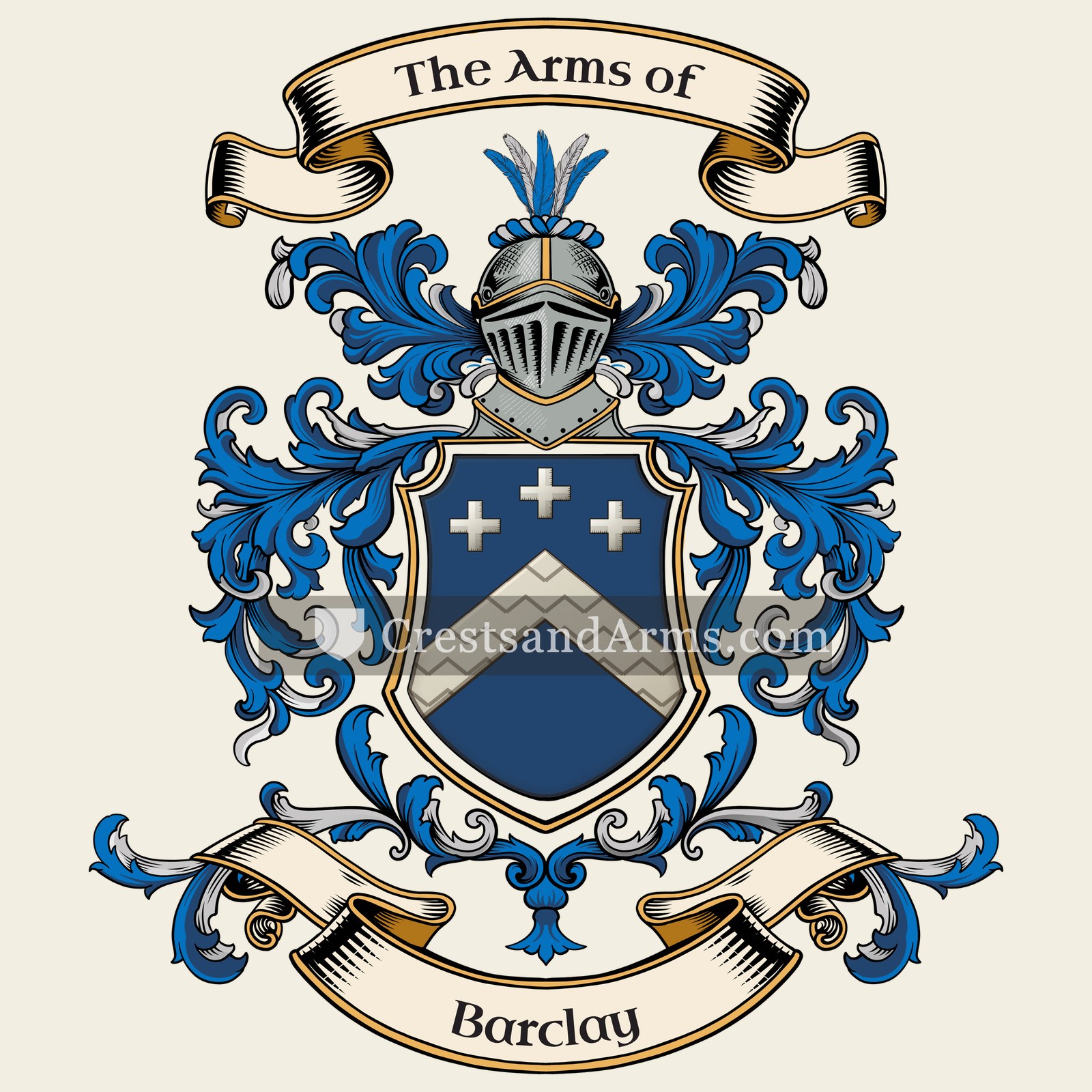
Symbols on this shield
chevronProtection, and faithful service completed
cross symbolChristian faith and service
bordureA difference between branches of one family
Colours
Blue (Azure)Means: Loyalty and truth
Gold (Or)Means: Generosity
Black (Sable)Means: Constancy
Silver (Argent)Means: Peace and sincerity
Historical info
Source
Sir Bernard Burke, The General Armory of England, Scotland, Ireland and Wales, London: Harrison & Sons, 1884
Blazon (the actual original written record)
“Az. a chev. or, betw. three crosses pattée ar. a bordure gyronny of eight of the second and sa”
SwedenSweden, c. 1839
Digital archive packCoat of arms PNG, gold border print PDF, vector SVG and the certificate of authenticity. Sent to your email in minutes.
Map of Sweden showing where the Barclay arms are recorded
The Barclay arms were recorded in Sweden, c. 1839.
Arms such as these were typically recorded in Stockholm.
Stockholm held the Swedish court and the House of Nobility, where every noble family's arms were entered and kept. Families ennobled for service registered there, which is why so many are recorded around the city.
This is where the arms were entered in the register. Families often moved to other parts of the country, so the same name can turn up in more than one region.
The body that granted and recorded arms in Sweden in this period.
Charles XIV John of Sweden
Sovereign of the period
Charles XIV John of Sweden
1818–1844
Reigning in England when the Barclay arms are first recorded.
How Arms Worked in Sweden
In Sweden, a coat of arms belonged to a noble family as a whole rather than just one individual. These arms were passed down through the generations to all legitimate descendants. Younger branches of the family used the same shield without needing to change it. This system ensured that the entire lineage shared the same identity and status under the law.
Granting authority
The Riddarhuset, or House of Nobility, regulated all noble coats of arms in Sweden under royal authority.
How they got arms
Families received their coats of arms through royal grants of nobility which were then officially registered with the House.
Where arms were recorded
Coats of arms were officially recorded in the Swedish House of Nobility register starting in the year 1626.
The family's standing
Recorded among the armigerous families of Sweden.
Origin & History of the Barclay Family in Sweden
The Barclay family name arrived in Sweden during a period of significant industrial and social change in the nineteenth century. By 1839, records confirm that members of the family were already established in Stockholm, where they integrated into the city’s growing merchant and professional classes. The name itself originates from Scottish roots, likely derived from a place name in Aberdeenshire, but its Swedish chapter began as these individuals sought new opportunities in the Baltic region. As they settled into Swedish society, the family participated in the urban development of Stockholm, contributing to the local economy and the cosmopolitan atmosphere of the capital. Their presence reflects the broader movement of European families who relocated to Sweden during this era to pursue trade, diplomacy, and administrative roles. Over time, the family became a part of the Swedish historical landscape, blending their ancestral heritage with the customs and language of their new home.
Barclay Meaning & Related Branches
Root word
Berchelai
A clearing or meadow where birch trees grow.
This name
BarclayDerived from a locational surname referring to one who lived near a birch wood.
also spelled
Barcley
Barkley
Berkeley
Related arms
Barcley, or Barkelevariant spelling
Barkleyvariant spelling
Berkeleyvariant spelling
Cahun, or Gahnrecorded with Barclay, same area
Documented Sources
Sir Bernard Burke, The General Armory of England, Scotland, Ireland and Wales, London: Harrison & Sons, 1884
Aubrey, John, The Natural History and Antiquities of the County of Surrey, 1718
Surrey History Centre, Quarter Sessions Records, QS2/1/1
The National Archives, Prerogative Court of Canterbury Wills, PROB 11
Digital archive packCoat of arms PNG, gold border print PDF, vector SVG and the certificate of authenticity. Sent to your email in minutes.


 chevronProtection, and faithful service completed
 cross symbolChristian faith and service
 chevronProtection, and faithful service completed
 cross symbolChristian faith and service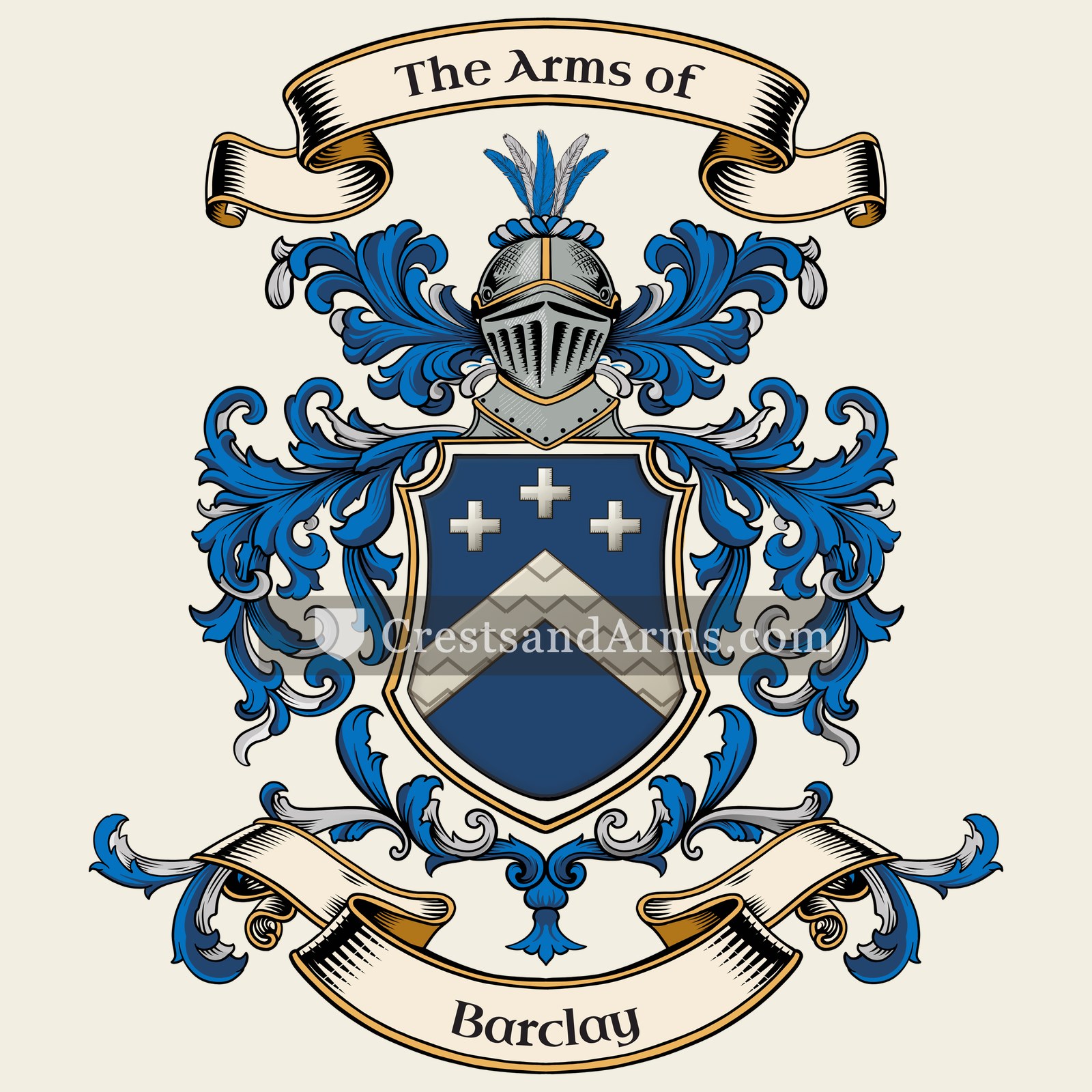




 bordureA difference between branches of one family