A record of documented arms, meaning and origin, researched for the Barco family lines. Documented in 2 countries.
Reg. 2449 · Austrian, A–C
Coat of Arms & Family Crest Details
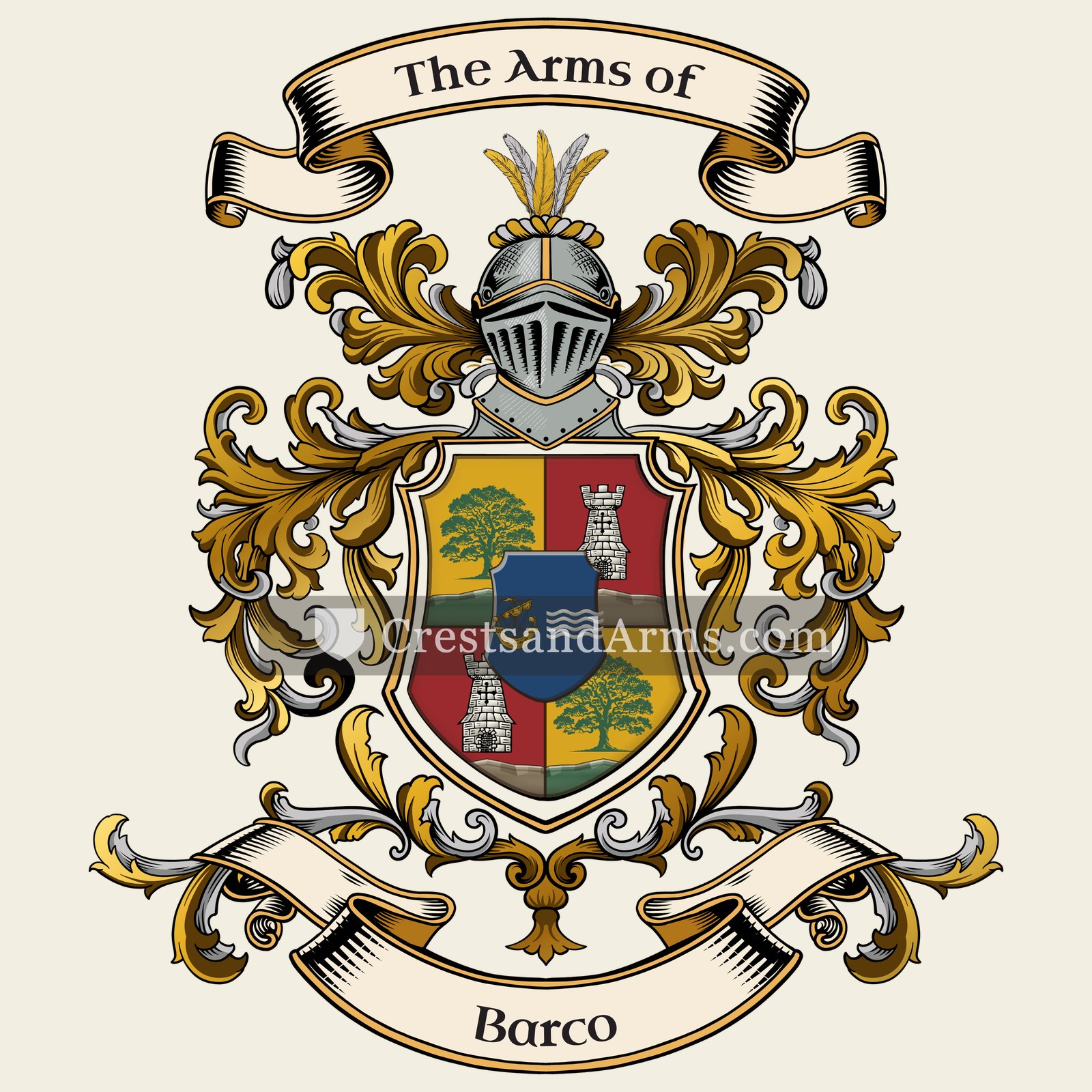
Symbols on this shield
mountThe ground held, and steadfastness upon it
shipEnterprise, and a great voyage undertaken
riverThe bounds of a land, and life carried through it
treeLife, endurance and deep roots
towerGrandeur and solidity, and a stronghold defended
Colours
Gold (Or)Means: Generosity
Red (Gules)Means: Military strength
Blue (Azure)Means: Loyalty and truth
Green (Vert)Means: Hope
Silver (Argent)Means: Peace and sincerity
Historical info
Source
J. B. Rietstap, Armorial Général, Gouda: G. B. van Goor Zonen, 1884–87
Blazon (the actual original written record)
“Ec.: aux 1 et 4 d'or à un arbre terrassé de sin.; aux 2 et 3 de gu. à un mur crén. sommé d'une tour crén., le tout au nat., ouv. du champ. Sur le tout d'azur à une barque d'or à un seul mât, à la banderole d'or, flottante à sen.; ladite barque soutenue d'une mer d'arg. Trois cq. cour. C.: 1º une aigle cont. de sa., languée de gu., cour. d'or; 2º un chevalier, iss., arm. de toutes pièces d'arg., la visière levée, le casque panaché de trois pl. d'aut., de gu., d'azur et d'arg., supp. de sa main dextre une étoile d'or; 3º un lion iss. d'or, lamp. de gu., tenant une épée d'arg., garnie d'or. L.: à dextre d'or et d'azur, à sen. d'arg. et de gu.”
Austriac. 1772
Where the Barco Arms Were Recorded
Tyrol
Map of Austria showing where the Barco arms are recorded
The Barco arms were recorded in Austria, c. 1772.
Arms such as these were typically recorded in Tyrol.
Tyrol was mountain country in western Austria, where the valleys were held by families who had been there a very long time. Old tenure counted for more than money, and old families carried arms.
This is where the arms were entered in the register. Families often moved to other parts of the country, so the same name can turn up in more than one region.
Region
Tyrol
First recorded
1772
Granting Authority for the Barco Arms
Imperial and Royal chancery
Sodacan · CC BY-SA 3.0
The body that granted and recorded arms in Austria in this period.
Joseph II, Holy Roman Emperor
Sovereign of the period
Joseph II, Holy Roman Emperor
1765–1790
Reigning in Austria when the Barco arms are first recorded.
How Arms Worked in Austria
Austrian coats of arms were often linked directly to noble titles granted by the Emperor. These symbols belonged to the entire family line rather than just one individual. When a family grew, new branches kept the original design without needing to change it. This system allowed all members of a noble house to share the same identity across many generations.
Granting authority
The Imperial and Royal chancery managed all heraldic matters and controlled the official granting of arms throughout the Austrian lands.
How they got arms
Families typically received their arms through a formal imperial decree that often accompanied the elevation of a person to noble status.
Where arms were recorded
Official records of these grants were kept in the Imperial Register of Nobility which began its formal documentation process in 1453.
The family's standing
Recorded among the armigerous families of Austria.
Origin & History of the Barco Family in Austria
The family name Barco carries a deep connection to the rugged landscapes of the Austrian Tyrol, where records confirm members of the family were established by 1772. During this era, the Tyrol region served as a vital crossroads for trade and cultural exchange between the Germanic north and the Italian south. The name itself likely reflects this geographic fluidity, as it shares linguistic roots with terms for small boats or river crossings, suggesting that early ancestors may have been involved in the vital transport of goods across the alpine waterways. Living in such a mountainous environment required the family to be resilient and adaptable, traits that allowed them to integrate into the local social structures of the late eighteenth century. As they settled into these high-altitude communities, the Barco family became part of the unique tapestry of Tyrolean history, contributing to the local economy and the distinct traditions of the region.
Coat of Arms & Family Crest Details
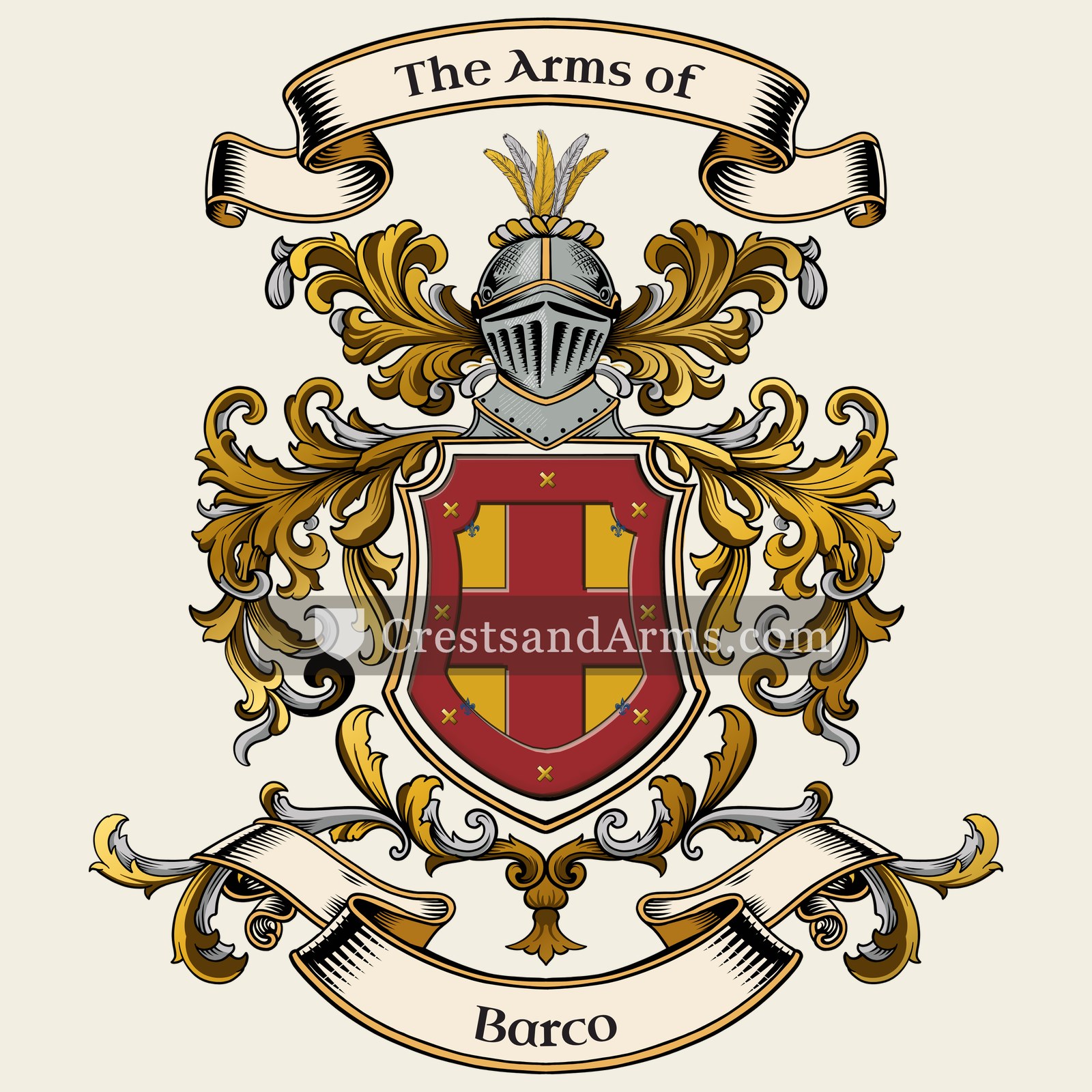
Symbols on this shield
cross symbolChristian faith and service
cantonA mark of honour granted by the sovereign
saltireResolution, and St Andrew's cross
fleur de lisPurity, light, and the sixth son
saltire coupedResolution, and the cross of St Andrew
Colours
Gold (Or)Means: Generosity
Red (Gules)Means: Military strength
Blue (Azure)Means: Loyalty and truth
Historical info
Source
J. B. Rietstap, Armorial Général, Gouda: G. B. van Goor Zonen, 1884–87
Blazon (the actual original written record)
“D'or à la croix florencée de gu., acc. de quatre fleurs-de-lis d'azur dans les cantons de l'écu; à la bord. du sec., ch. de huit flanchis du champ [Comp. Romano.]”
Spainc. 1722
Where the Barco Arms Were Recorded
Castile
Map of Spain showing where the Barco arms are recorded
The Barco arms were recorded in Spain, c. 1722.
Arms such as these were typically recorded in Castile.
Castile was the heart of Spain and the source of most of its noble families. Land won in the long wars against the Moors was granted out to fighting men, and a man granted land was granted arms along with it.
This is where the arms were entered in the register. Families often moved to other parts of the country, so the same name can turn up in more than one region.
The body that granted and recorded arms in Spain in this period.
Philip V of Spain
Sovereign of the period
Philip V of Spain
1714–1724
Reigning in Austria when the Barco arms are first recorded.
How Arms Worked in Spain
In Spain, a coat of arms was considered a form of property that belonged to the entire family line. These arms were passed down from a father to all his children equally. Younger branches of the family usually kept the original design without needing to add any special marks to distinguish their specific line.
Granting authority
The Cronista Rey de Armas was the official body that regulated and granted coats of arms throughout Spain.
How they got arms
Families often obtained their arms through royal grants or by proving their noble status to the official heraldic authority.
Where arms were recorded
Coats of arms were officially recorded in the registers of the Cronista Rey de Armas starting in 1496.
The family's standing
Recorded among the armigerous families of Spain.
Origin & History of the Barco Family in Spain
The surname Barco is deeply rooted in the geography of the Iberian Peninsula, originating as a topographic name for families who lived near a river crossing or worked as boatmen. In the Spanish language, the word barco refers to a boat or a vessel, suggesting that the earliest ancestors to carry this name likely earned their livelihood through water transport or resided near a significant ferry point. By the early eighteenth century, historical records confirm that members of the Barco family were well-established in the region of Castile. During this era, Castile served as the political and cultural heart of Spain, and families living there were often involved in local agriculture, trade, or regional administration. The presence of the Barco name in Castilian records from 1722 indicates that the family had successfully integrated into the social fabric of the Spanish interior, moving from their origins as local laborers or river workers into the broader community of the Spanish kingdom.
Related Branches & Arms
Root word
Barca
Latin term for a small boat or vessel.
This name
BarcoOccupational name for a boatman or someone who lived near a ferry crossing.
also spelled
Barcoe
Barcou
Barkoh
Related arms
Romanosimilar arms
Documented Sources
J. B. Rietstap, Armorial Général, Gouda: G. B. van Goor Zonen, 1884–87


 mountThe ground held, and steadfastness upon it
 shipEnterprise, and a great voyage undertaken
 riverThe bounds of a land, and life carried through it
 treeLife, endurance and deep roots
 towerGrandeur and solidity, and a stronghold defended
 mountThe ground held, and steadfastness upon it
 shipEnterprise, and a great voyage undertaken
 riverThe bounds of a land, and life carried through it
 treeLife, endurance and deep roots
 towerGrandeur and solidity, and a stronghold defended

 cross symbolChristian faith and service
 cantonA mark of honour granted by the sovereign
 saltireResolution, and St Andrew's cross
 fleur de lisPurity, light, and the sixth son
 saltire coupedResolution, and the cross of St Andrew