A record of documented arms, meaning and origin, researched for the Bardi family lines. Documented in 2 countries.
Reg. 9730 · Italian, A–C
Coat of Arms & Family Crest Details
Symbols on this shield
unicornPurity, and extreme courage in defence of honour
escutcheonA shield within a shield, and a claim inherited
Colours
Gold (Or)Means: Generosity
Red (Gules)Means: Military strength
Silver (Argent)Means: Peace and sincerity
Historical info
Source
J. B. Rietstap, Armorial Général, Gouda: G. B. van Goor Zonen, 1884–87
Blazon (the actual original written record)
“D'or à cinq los. de gu., accolées en bande, acc. en chef à sen. d'une licorne ramp. du sec. ou d'un écusson d'arg. ch. de trois lions léopardés d'azur, l'un sur l'autre.”
ItalyFlorence, c. 1775
Digital archive packCoat of arms PNG, gold border print PDF, vector SVG and the certificate of authenticity. Sent to your email in minutes.
Map of Italy showing where the Bardi arms are recorded
The Bardi arms were recorded in Florence, c. 1775.
This is where the arms were entered in the register. Families often moved to other parts of the country, so the same name can turn up in more than one region.
The body that granted and recorded arms in Italy in this period.
Alvise Giovanni Mocenigo
Sovereign of the period
Alvise Giovanni Mocenigo
1763–1778
Reigning in Italy when the Bardi arms are first recorded.
How Arms Worked in Italy
In the Italian states, coats of arms were often used by noble families to show their status and history. These symbols were passed down through the generations to all legitimate male descendants. Younger branches of a family usually kept the original design but sometimes added small changes to distinguish their specific line from the main branch.
Granting authority
Various local rulers and city governments controlled the use of coats of arms across the different Italian states.
How they got arms
Families often assumed their own arms or received them as official grants from local lords, popes, or city councils.
Where arms were recorded
Arms were recorded in local city archives or private family books rather than in one single national register.
The family's standing
Recorded among the armigerous families of Italy.
Origin & History of the Bardi Family in Italy
The Bardi family name is deeply rooted in the history of Florence, where the family established themselves as a powerful force in banking and politics during the Middle Ages. Long before the late eighteenth century, the Bardi were known as one of the most influential merchant families in Italy. They operated a massive international banking house that provided loans to monarchs and popes across Europe, which helped shape the economic landscape of the Renaissance. While the family faced significant financial challenges in the fourteenth century due to unpaid royal debts, they remained a prominent part of Florentine society for generations. By the time the family records become more distinct in the late 1700s, they were already part of a long-standing tradition of civic involvement and social status that defined the upper classes of Tuscany. Their history reflects the broader story of how Italian merchant families rose to prominence through trade, finance, and careful management of their family reputation over several centuries.
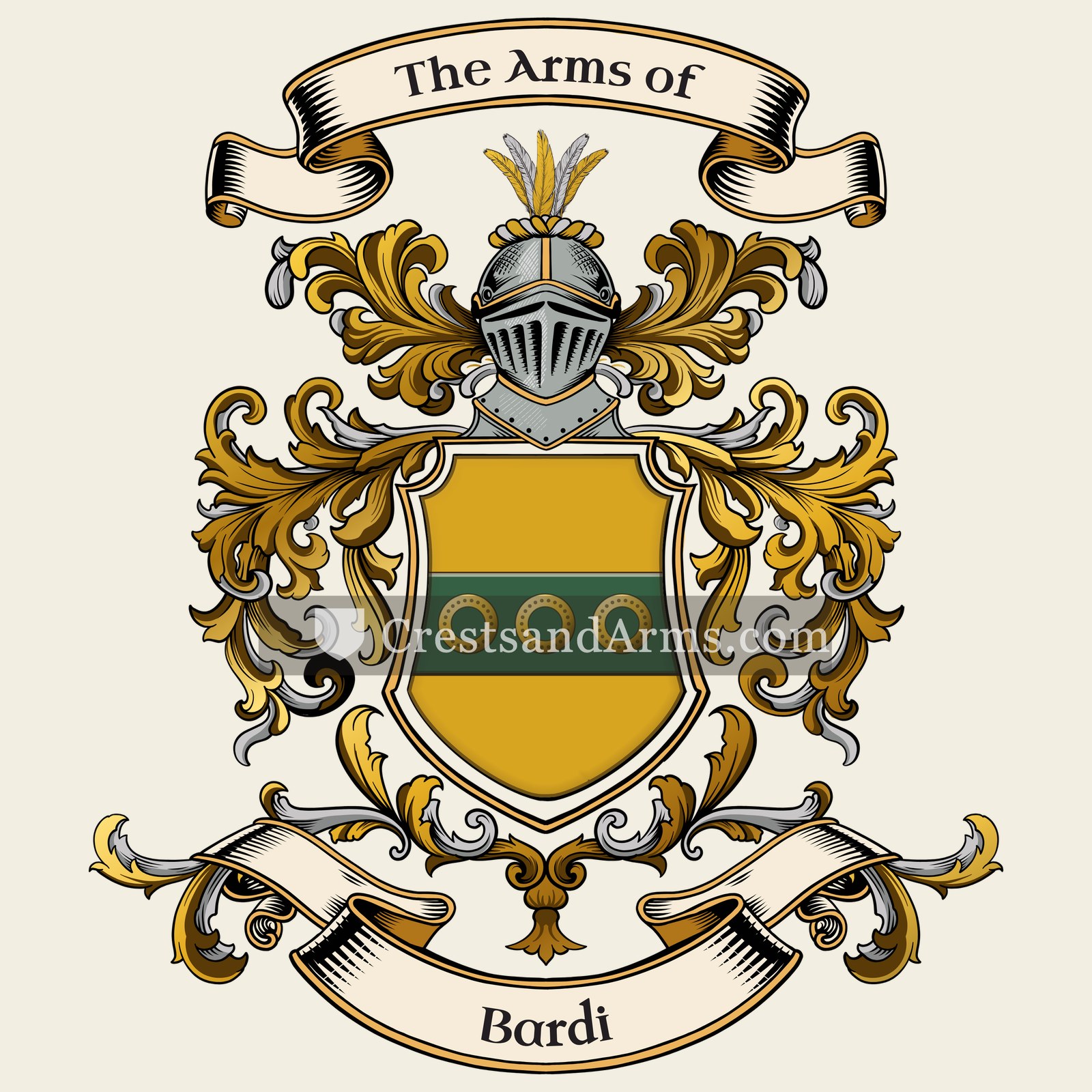
Coat of Arms & Family Crest Details
Symbols on this shield
fessThe military belt, and readiness to serve
ringFidelity, and a promise kept
Colours
Gold (Or)Means: Generosity
Green (Vert)Means: Hope
Historical info
Source
J. B. Rietstap, Armorial Général, Gouda: G. B. van Goor Zonen, 1884–87
Blazon (the actual original written record)
“Coticé de douze pièces: de gu., d'or, d'azur, d'or, de gu., d'or, d'azur, d'or, de gu., d'or, d'azur et d'or; à la fasce de sin., bordée d'arg., br. sur le tout et ch. de trois annelets d'or.”
SwitzerlandValais, c. 1745
Digital archive packCoat of arms PNG, gold border print PDF, vector SVG and the certificate of authenticity. Sent to your email in minutes.
Map of Switzerland showing where the Bardi arms are recorded
The Bardi arms were recorded in Valais, c. 1745.
This is where the arms were entered in the register. Families often moved to other parts of the country, so the same name can turn up in more than one region.
The body that granted and recorded arms in Switzerland in this period.
How Arms Worked in Switzerland
In Switzerland, coats of arms were not restricted to the nobility and were often adopted by common citizens and families. These symbols were passed down through generations to show family identity. When branches of a family grew, they often changed small details of the design to distinguish their own line from the original group.
Granting authority
Cantonal and civic authorities managed the use of coats of arms within their specific regions and local jurisdictions.
How they got arms
Families typically assumed their own coats of arms based on local custom rather than receiving them from a central monarch.
Where arms were recorded
Arms were recorded in various cantonal and civic registers starting from the fourteenth century throughout the Swiss region.
The family's standing
Recorded among the armigerous families of Switzerland.
Origin & History of the Bardi Family in Switzerland
The Bardi family has deep roots in the rugged landscape of the Valais region in Switzerland. By 1745, records confirm that members of the family were already established residents in this alpine area. The name itself likely originated from a shortened form of names like Bartolomeo, which were common across Europe during the Middle Ages. As the family settled in the high valleys of the Swiss Alps, they became part of the local social structure that relied on mountain farming and trade. Over time, the Bardi name became tied to the specific customs and dialects of the Valais, reflecting the resilience required to live in such a challenging environment. Their presence in the region during the mid-eighteenth century suggests that they were well-integrated into the local community long before modern record-keeping became standard.
Bardi Meaning & Related Branches
Root word
Longobard
A Germanic tribe known for their long beards.
This name
BardiA patronymic or locative surname derived from the historical Lombard people.
also spelled
Bardie
Bardih
Bardii
Bardy
Documented Sources
J. B. Rietstap, Armorial Général, Gouda: G. B. van Goor Zonen, 1884–87
Goldthwaite, Richard A., The Economy of Renaissance Florence, 2009
Hunt, Edwin S., The Medieval Super-Companies: A Study of the Peruzzi Company of Florence, 1994
Archivio di Stato di Firenze, Carte Strozziane, serie V
Archivio di Stato di Firenze, Notarile Antecosimiano
Digital archive packCoat of arms PNG, gold border print PDF, vector SVG and the certificate of authenticity. Sent to your email in minutes.


 unicornPurity, and extreme courage in defence of honour
 escutcheonA shield within a shield, and a claim inherited
 unicornPurity, and extreme courage in defence of honour
 escutcheonA shield within a shield, and a claim inherited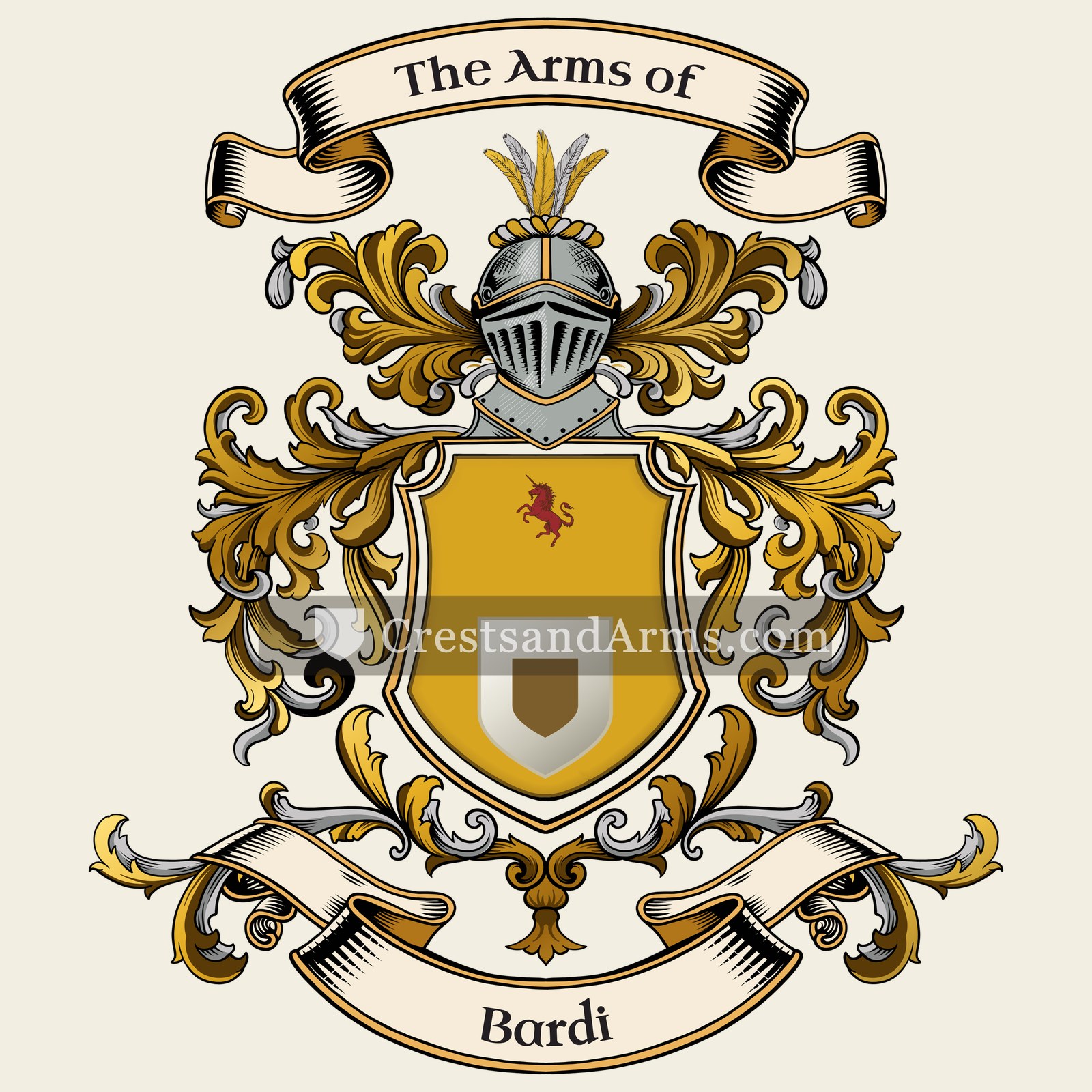


 fessThe military belt, and readiness to serve
 ringFidelity, and a promise kept