Map of France showing where the Baril arms are recorded
The Baril arms were recorded in Normandie, c. 1663.
Normandie held a dense crowd of knightly families on some of the best farmland in France. Its men had fought and settled abroad for generations, and a family that sent sons to war needed a shield they could be recognised by.
This is where the arms were entered in the register. Families often moved to other parts of the country, so the same name can turn up in more than one region.
The body that granted and recorded arms in France in this period.
Louis XIV of France
Sovereign of the period
Louis XIV of France
1643–1715
Reigning in France when the Baril arms are first recorded.
How Arms Worked in France
In France, a coat of arms was a mark of honor that passed down through the male line to all legitimate descendants. Families often used the same shield without changes to show their shared heritage. If a branch wanted to stand out, they could add a small mark to their shield to show their specific place in the family tree.
Granting authority
The Juge d'armes de France acted as the official authority that regulated and verified coats of arms across the country.
How they got arms
Families typically inherited their arms from ancestors, though they could also receive them through royal grants or by proving their noble status.
Where arms were recorded
Coats of arms were officially recorded in the Armorial Général de France, which began its main collection in the year 1696.
The family's standing
Recorded among the armigerous families of Normandie.
Origin & History of the Baril Family in France
The family name Baril originates from the historic region of Normandy in northern France. By the year 1663, records confirm that members of the Baril family were established in this area before many of them decided to cross the Atlantic to settle in New France. The name itself is thought to be derived from the Old French word for a barrel, which suggests that early ancestors may have been skilled coopers or merchants involved in the trade and transport of goods. As these families moved from their ancestral homes in Normandy to the Saint Lawrence River valley, they brought their traditional skills and regional customs with them. This migration helped them adapt to the challenging environment of early North America while maintaining their strong connection to their French roots.
Baril Meaning & Related Branches
Root word
Baril
Derived from the Old French word for a wooden cask or barrel.
This name
BarilAn occupational surname for a barrel maker or a cooper.
also spelled
Barill
Barile
Bareel
Documented Sources
J. B. Rietstap, Armorial Général, Gouda: G. B. van Goor Zonen, 1884–87
Jetté, René. Dictionnaire généalogique des familles du Québec. 1983
Tanguay, Cyprien. Dictionnaire généalogique des familles canadiennes depuis la fondation de la colonie jusqu'à nos jours. 1871
Digital archive packCoat of arms PNG, gold border print PDF, vector SVG and the certificate of authenticity. Sent to your email in minutes.


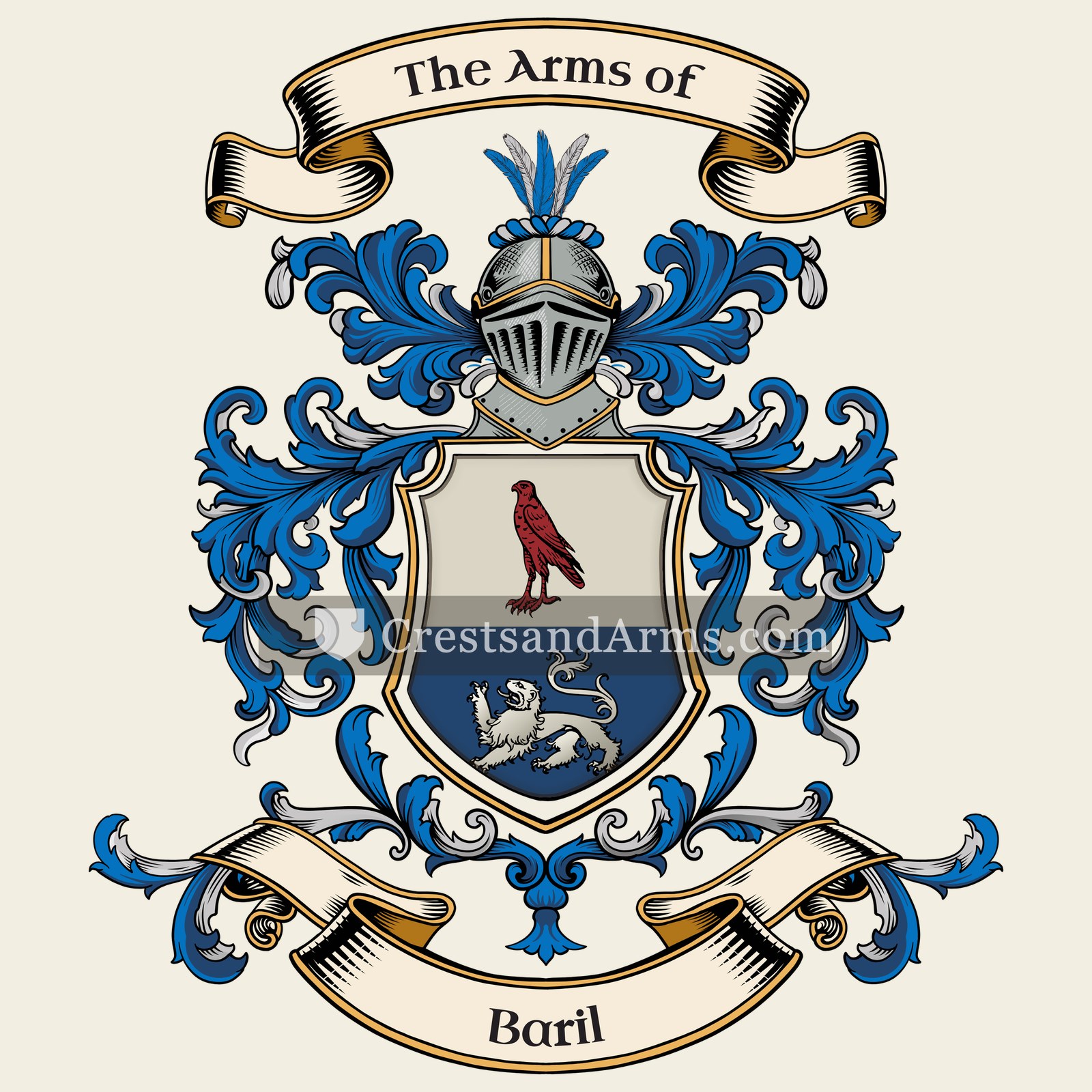
 falconOne eager and quick in pursuit
 lionCourage, strength and royalty
 falconOne eager and quick in pursuit
 lionCourage, strength and royalty