A record of documented arms, meaning and origin, researched for the Baring family lines. Documented in 2 countries.
Reg. 2969 · Britain, A–C
Coat of Arms & Family Crest Details
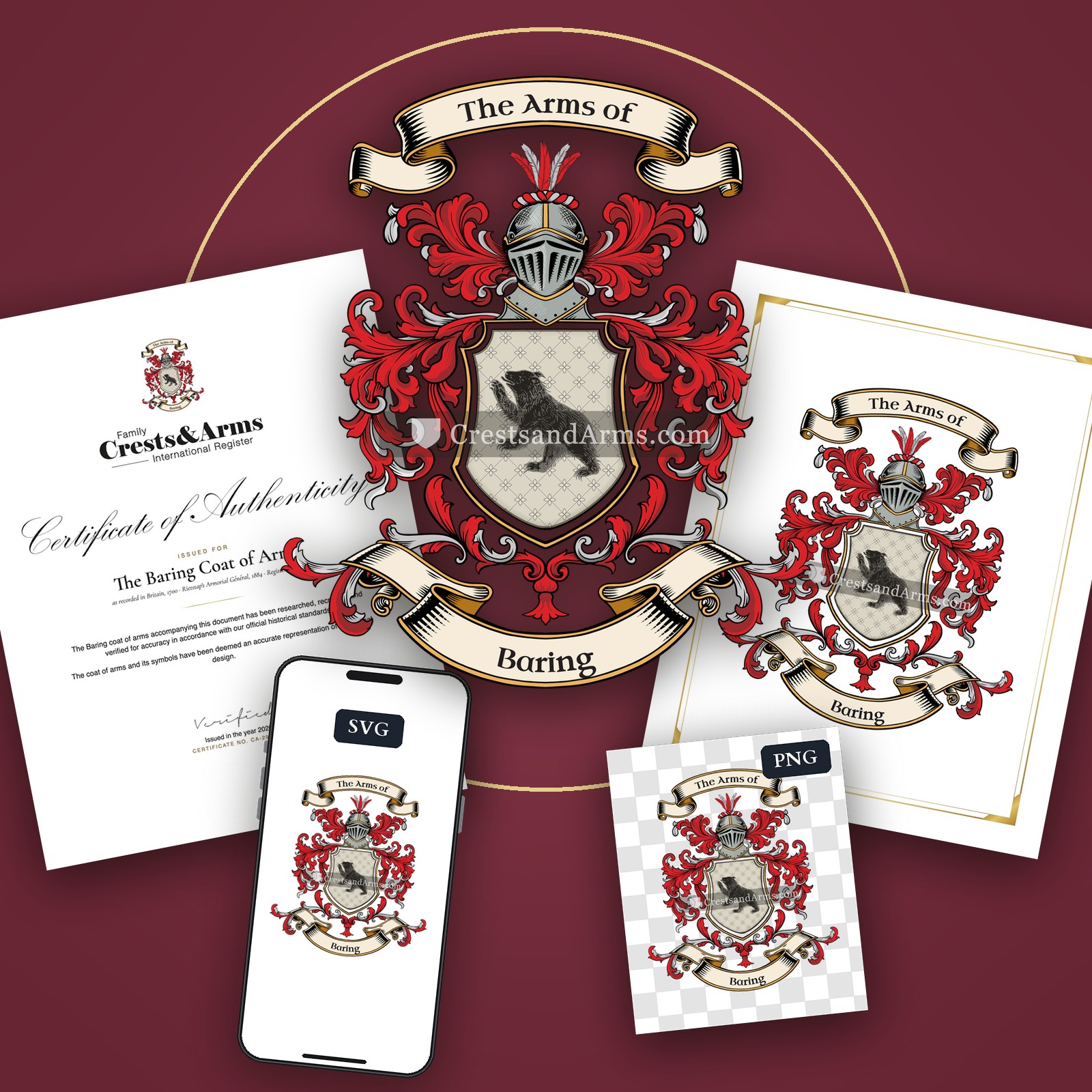
Symbols on this shield
bearStrength, cunning and protection of kin
Colours
Silver (Argent)Means: Peace and sincerity
Black (Sable)Means: Constancy
Historical info
Source
J. B. Rietstap, Armorial Général, Gouda: G. B. van Goor Zonen, 1884–87
Blazon (the actual original written record)
“D'arg. à une tête et col d'ours de sa., bouclée du même, lamp. de gu. C.: le meuble de l'écu. S.: à dextre un lévrier au nat., coll. de gu., bordé et bouclé d'or; à sen. un lion d'or. D.: FIDES ET SINCERITAS.”
HampshireHampshire, c. 1700
Digital archive packCoat of arms PNG, gold border print PDF, vector SVG and the certificate of authenticity. Sent to your email in minutes.
Map of Britain showing where the Baring arms are recorded
The Baring arms were recorded in Hampshire, c. 1700.
This is where the arms were entered in the register. Families often moved to other parts of the country, so the same name can turn up in more than one region.
The body that granted and recorded arms in Britain in this period.
William III of England
Sovereign of the period
William III of England
1694–1702
Reigning in Britain when the Baring arms are first recorded.
How Arms Worked in Britain
English heraldry allowed arms to be shared by all legitimate descendants of the original owner. These symbols were treated as personal property that moved through the generations to all children. While the eldest son kept the original design, other family members could use the same shield without needing to change it or register their own unique versions.
Granting authority
The College of Arms in London has regulated the use of coats of arms throughout England and Wales since 1484.
How they got arms
Families typically obtained their coats of arms through a formal grant from the Crown or by proving their ancient right to them.
Where arms were recorded
All official coats of arms are recorded in the registers kept at the College of Arms, which date back to the fifteenth century.
The family's standing
Recorded among the armigerous families of Hampshire.
Origin & History of the Baring Family in Britain
The Baring family first established their prominence in Britain during the early 18th century when they settled in the county of Hampshire. The family roots trace back to Franz Baring, a Lutheran minister from Bremen who moved to England around 1717. His son, John Baring, settled in the town of Larkbeare near Exeter before moving to Hampshire, where he began to build the foundations of a massive commercial empire. By focusing on the wool trade and later expanding into international banking, the family transformed from modest immigrants into one of the most influential financial dynasties in British history. This rapid rise was fueled by their ability to navigate the complex world of global commerce during the Georgian era. Their presence in Hampshire served as the anchor for a family that would eventually play a central role in financing the growth of the British Empire and the development of international trade networks.
Coat of Arms & Family Crest Details
Symbols on this shield
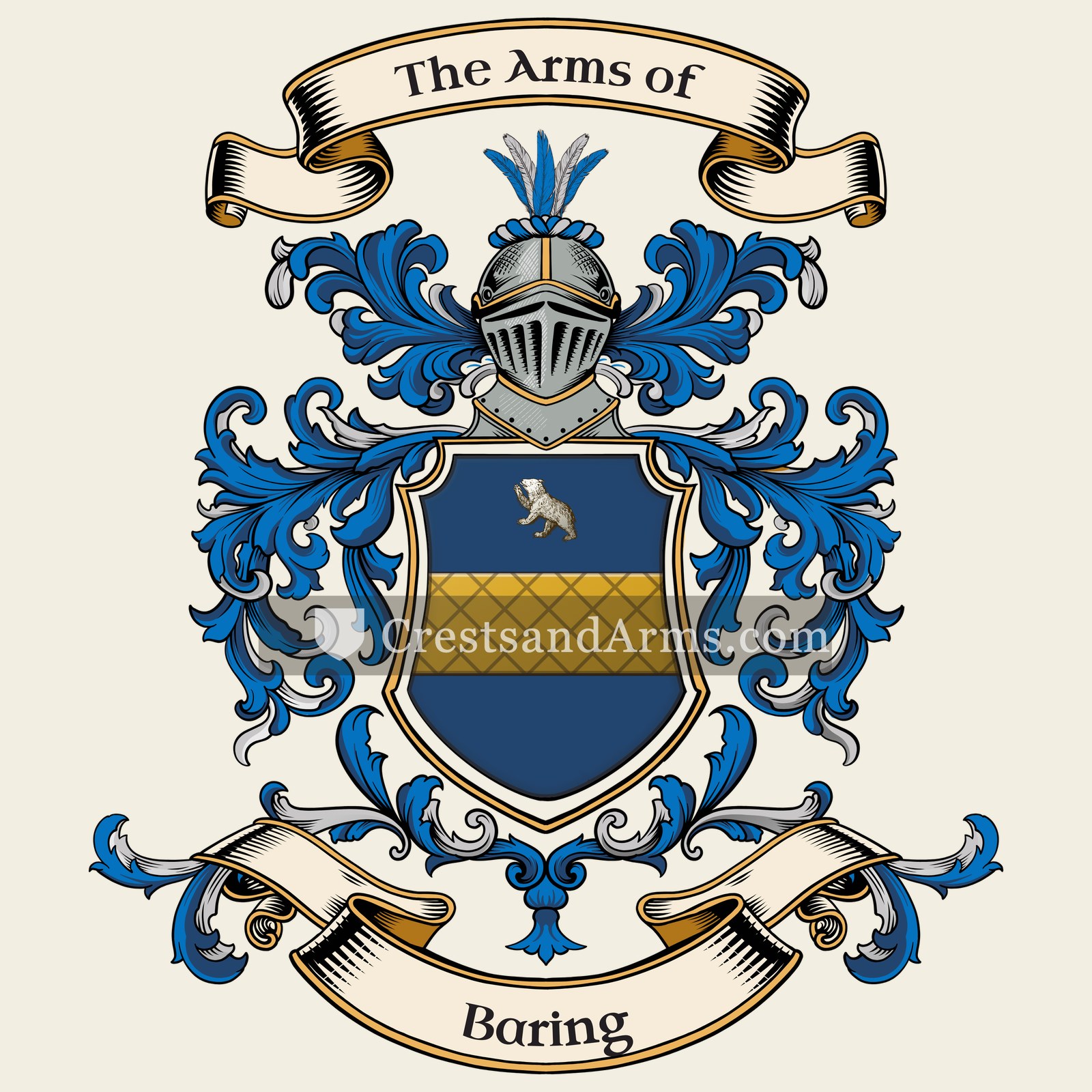
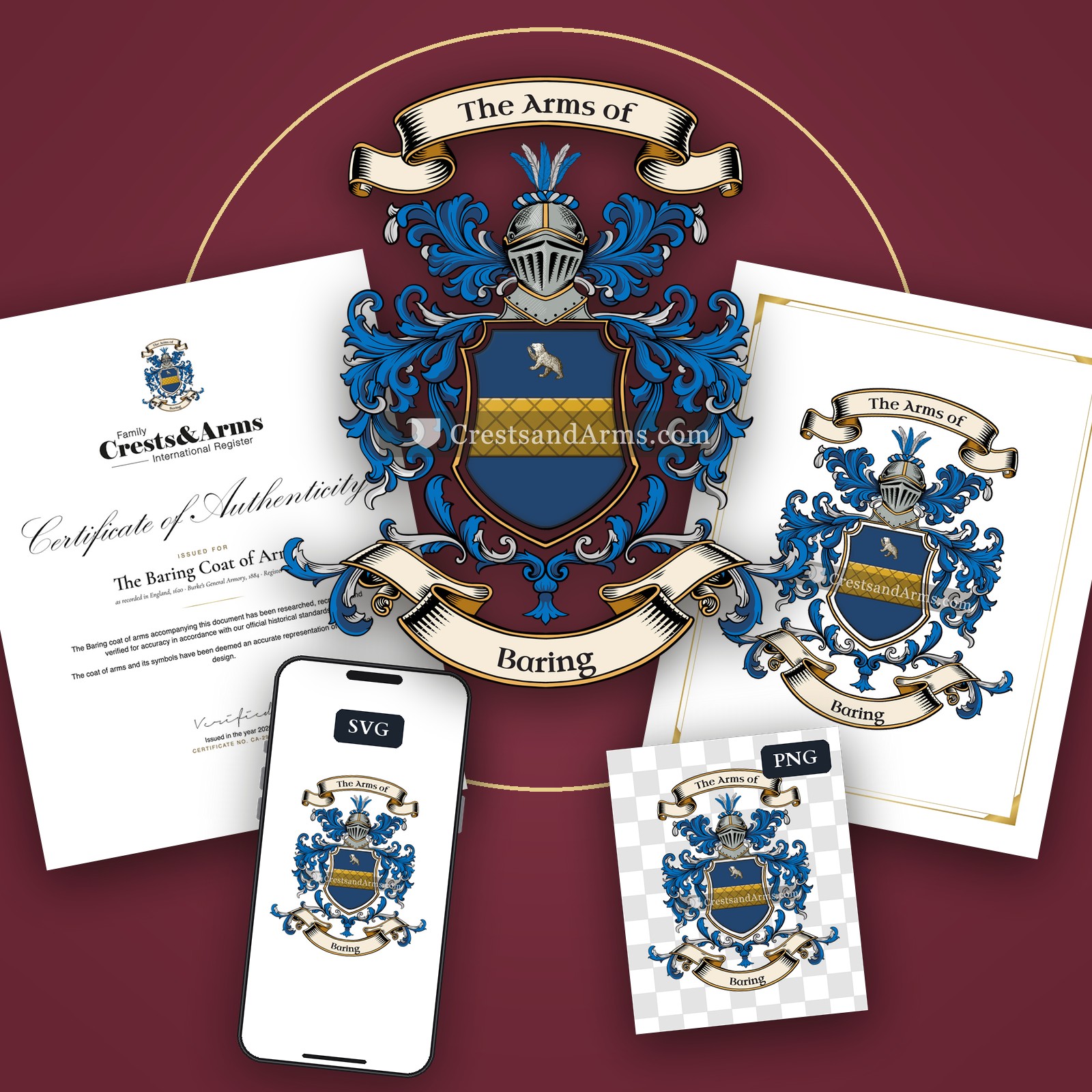
fessThe military belt, and readiness to serve
bearStrength, cunning and protection of kin
Colours
Blue (Azure)Means: Loyalty and truth
Gold (Or)Means: Generosity
Historical info
Source
Sir Bernard Burke, The General Armory of England, Scotland, Ireland and Wales, London: Harrison & Sons, 1884
Blazon (the actual original written record)
“Az. a fesse or, in chief a bear's head ppr. muzzled and ringed gold”
DevonLarkbeer · Devon, c. 1620
Digital archive packCoat of arms PNG, gold border print PDF, vector SVG and the certificate of authenticity. Sent to your email in minutes.
Map of England showing where the Baring arms are recorded
The Baring arms were recorded in Devon, c. 1620.
Devon was a county of small manors and seafaring families. Its gentry were spread thickly across the countryside, and money made at sea often bought an estate, which in turn brought a coat of arms.
This is where the arms were entered in the register. Families often moved to other parts of the country, so the same name can turn up in more than one region.
The body that granted and recorded arms in England in this period.
James VI and I
Sovereign of the period
James VI and I
1603–1625
Reigning in Britain when the Baring arms are first recorded.
How Arms Worked in England
English heraldry allowed arms to be shared by all legitimate descendants of the original owner. These symbols were treated as personal property that moved through the generations to all children. While the eldest son kept the original design, other family members could use the same shield without needing to change it or register their own unique versions.
Granting authority
The College of Arms in London has regulated the use of coats of arms throughout England and Wales since 1484.
How they got arms
Families typically obtained their coats of arms through a formal grant from the Crown or by proving their ancient right to them.
Where arms were recorded
All official coats of arms are recorded in the registers kept at the College of Arms, which date back to the fifteenth century.
The family's standing
Recorded among the armigerous families of Devon.
Origin & History of the Baring Family in England
The Baring family first emerged in the historical record of Devon, England, around 1620. The family name is believed to have German origins, as their ancestors likely migrated from the city of Bremen to the English West Country during the early seventeenth century. Upon settling in Devon, the family established themselves as part of the local mercantile class. They initially focused on the thriving wool and cloth trade that defined the region’s economy at the time. This transition from continental Europe to the English coast allowed the family to build a foundation of trade networks that would eventually support their rise into international finance. By embedding themselves in the local community of Devon, the early Barings successfully integrated into English life while maintaining the industrious spirit that characterized their immigrant roots.
Baring Meaning & Related Branches
Root word
Bara
Old Germanic word meaning son or descendant.
This name
BaringA patronymic surname indicating descent from a person named Bero or Bera.
also spelled
Baringg
Baringe
Barringe
Baryng
Documented Sources
J. B. Rietstap, Armorial Général, Gouda: G. B. van Goor Zonen, 1884–87
Ziegler, Philip. The Sixth Great Power: A History of the Ancient, Glamorous and Sometimes Bankrupt House of Baring. 1988
Guedalla, Philip. The Duke. 1931
The National Archives, Records of Baring Brothers and Co. Ltd. (Ref: GB 0072 Baring)
Hampshire Archives and Local Studies, Records of the Baring Family of Stratton Park (Ref: 11M59)
Digital archive packCoat of arms PNG, gold border print PDF, vector SVG and the certificate of authenticity. Sent to your email in minutes.


 bearStrength, cunning and protection of kin
 bearStrength, cunning and protection of kin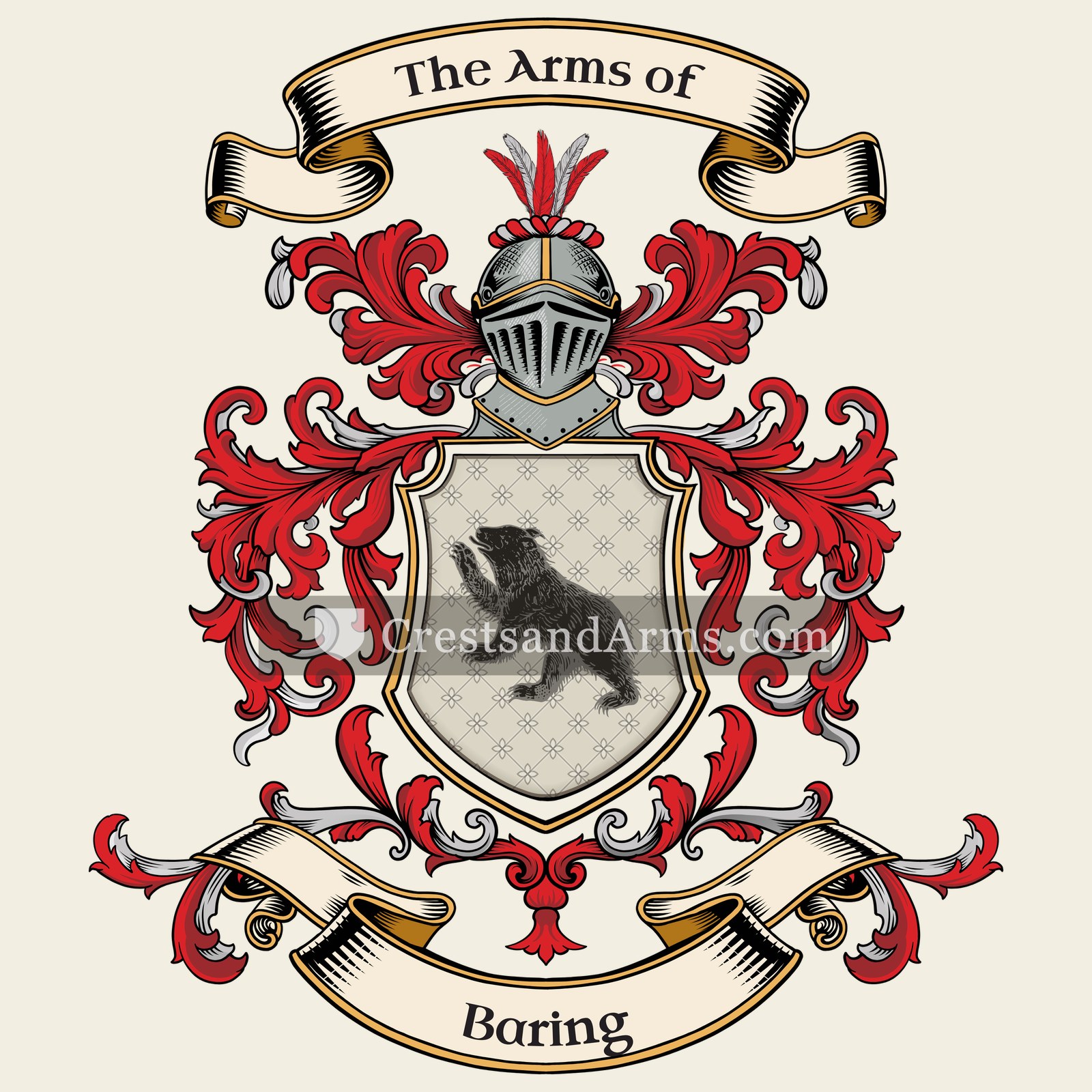


 fessThe military belt, and readiness to serve