A record of documented arms, meaning and origin, researched for the Bark family lines. Documented in 2 countries.
Reg. 9993 · Swedish, A–C
Meaning of the Bark family crest colors & symbols
Symbols on this shield
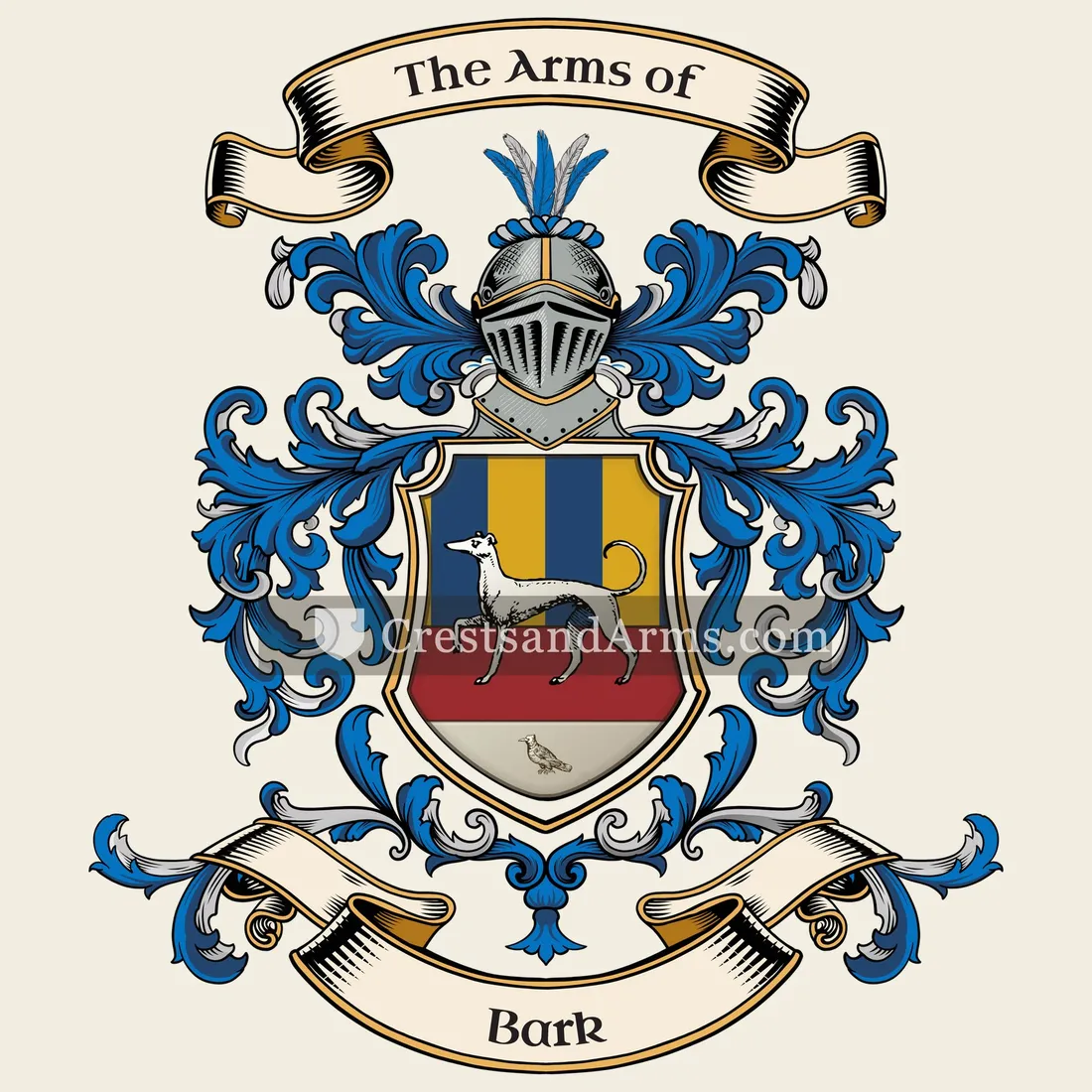
paleMilitary strength, and a fortified defence
greyhoundCourage, vigilance and loyalty
dovePeace, love and the Holy Spirit
Colours
Blue (Azure)Means: Loyalty and truth
Red (Gules)Means: Military strength
Silver (Argent)Means: Peace and sincerity
Gold (Or)Means: Generosity
Historical info
Source
J. B. Rietstap, Armorial Général, Gouda: G. B. van Goor Zonen, 1884–87
Blazon (the actual original written record)
“d'azur au lévrier ramp. et cont. d'arg., coll. de gu., bouclé d'or; b. coupé d'un palé de gu. et d'or de huit pièces, sur gu. à une colombe d'arg. C.: 1° une étoile (8) d'or, entre deux prob. d'arg.; 1. d'arg. et de gu.; 2° une tête et col de lévrier d'or, coll. de gu., bouclé d'or; 1. d'or et d'azur.”
Swedenc. 1700
Digital archive packCoat of arms PNG, gold border print PDF, vector SVG and the certificate of authenticity. Sent to your email in minutes.
Map of Sweden showing where the Bark arms are recorded
The Bark arms were recorded in Sweden, c. 1700.
Arms such as these were typically recorded in Stockholm.
Stockholm held the Swedish court and the House of Nobility, where every noble family's arms were entered and kept. Families ennobled for service registered there, which is why so many are recorded around the city.
This is where the arms were entered in the register. Families often moved to other parts of the country, so the same name can turn up in more than one region.
The body that granted and recorded arms in Sweden in this period.
Carl XII of Sweden
Sovereign of the period
Carl XII of Sweden
1697–1718
Reigning in Sweden when the Bark arms are first recorded.
How Arms Worked in Sweden
In Sweden, a coat of arms belonged to a noble family as a whole rather than just one individual. These arms were passed down through the generations to all legitimate descendants. Younger branches of the family used the same shield without needing to change it. This system ensured that the entire lineage shared the same identity and status under the law.
Granting authority
The Riddarhuset, or House of Nobility, regulated all noble coats of arms in Sweden under royal authority.
How they got arms
Families received their coats of arms through royal grants of nobility which were then officially registered with the House.
Where arms were recorded
Coats of arms were officially recorded in the Swedish House of Nobility register starting in the year 1626.
The family's standing
Recorded among the armigerous families of Sweden.
Origin & History of the Bark Family in Sweden
The family name Bark has deep roots in Swedish history, appearing in official records in Stockholm as early as the year 1700. During this era, many Swedish surnames were adopted by individuals to signify their trade, their geographic origin, or a specific personal characteristic. The word "bark" refers to the outer layer of a tree, which was a vital resource in early modern Sweden for tanning leather, medicinal uses, and even as a source of emergency food during times of famine. Families who took this name often lived near forests or worked in industries that relied on timber and wood processing. As the family established itself in the growing urban environment of Stockholm, they became part of the city's expanding merchant and artisan classes. Over the following decades, the name persisted as the family integrated into the social and economic life of the Swedish capital.
Meaning of the Bark family crest colors & symbols
Symbols on this shield
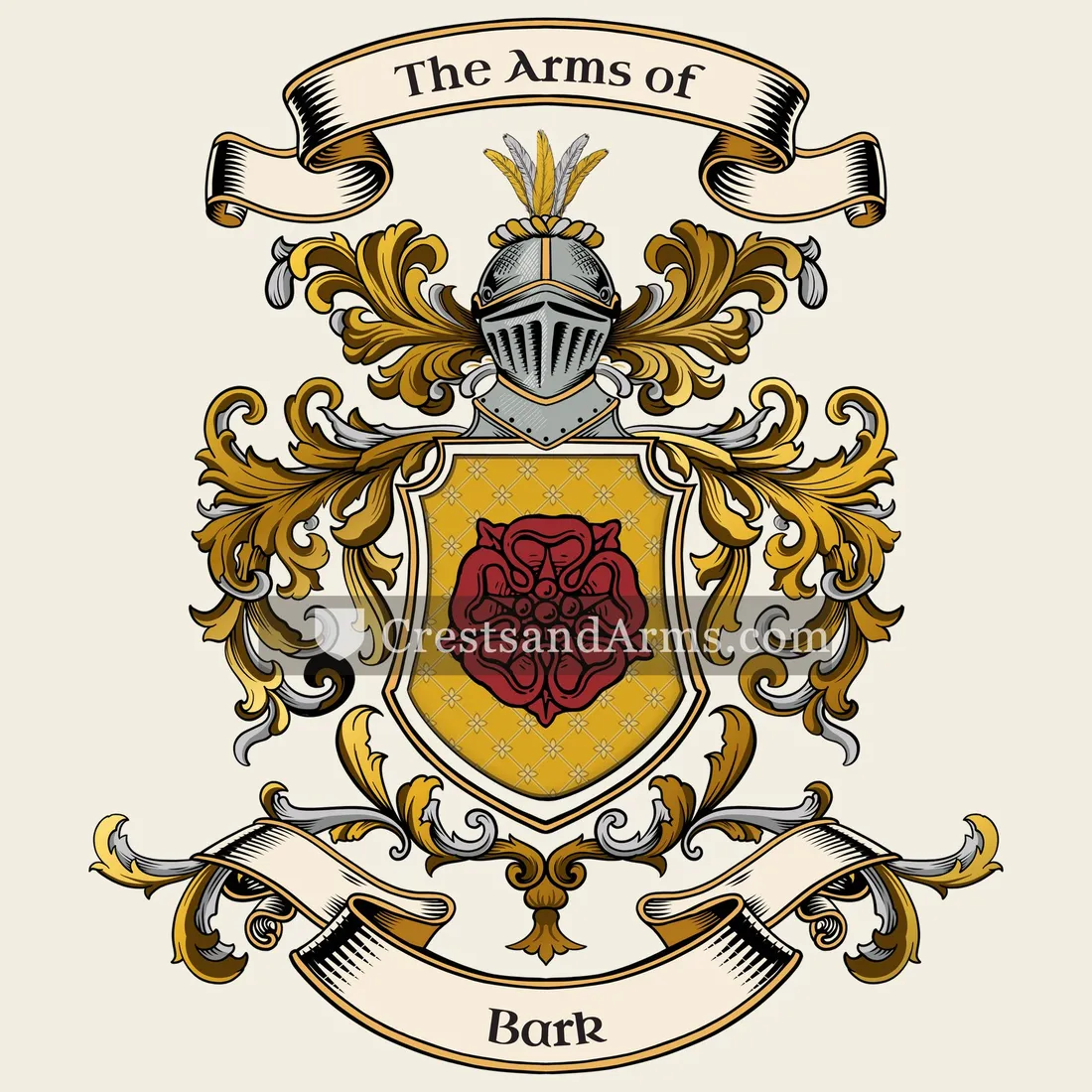
roseThe seventh son, and beauty with grace
Colours
Gold (Or)Means: Generosity
Red (Gules)Means: Military strength
Historical info
Source
J. B. Rietstap, Armorial Général, Gouda: G. B. van Goor Zonen, 1884–87
Blazon (the actual original written record)
“D'or à une rose de gu., bout. du champ.”
Netherlandsc. 1815
Digital archive packCoat of arms PNG, gold border print PDF, vector SVG and the certificate of authenticity. Sent to your email in minutes.
Map of Netherlands showing where the Bark arms are recorded
The Bark arms were recorded in Netherlands, c. 1815.
Arms such as these were typically recorded in Friesland.
Friesland was low, wet country on the northern coast of the Netherlands, farmed by families who had held the same land for centuries. Free landholders were unusually common there, and a free landholder could carry arms.
This is where the arms were entered in the register. Families often moved to other parts of the country, so the same name can turn up in more than one region.
Region
Friesland
First recorded
1815
Granting Authority for the Bark Arms
Hoge Raad van Adel
Photograph made by me · CC BY-SA 3.0
The body that granted and recorded arms in Netherlands in this period.
William I of the Netherlands
Sovereign of the period
William I of the Netherlands
1815–1840
Reigning in Sweden when the Bark arms are first recorded.
How Arms Worked in Netherlands
In the Netherlands, coats of arms were often used by noble families and those who held specific public offices. These arms were passed down through the generations to legitimate descendants. Younger branches of a family usually kept the original design without needing to add special marks. This system ensured that the family identity remained clear and consistent over many years.
Granting authority
The Hoge Raad van Adel is the official body that regulates and manages noble titles and coats of arms in the Netherlands.
How they got arms
Families typically obtained their coats of arms through official royal grants or by proving their long-standing historical use of the symbols.
Where arms were recorded
Coats of arms are officially recorded in the registers held by the Hoge Raad van Adel, which began its work in 1814.
The family's standing
Recorded among the armigerous families of Netherlands.
Origin & History of the Bark Family in Netherlands
The family name Bark has deep roots in the northern province of Friesland, where records confirm the family was established by at least 1815. In the Dutch language, the word "bark" refers to a specific type of sailing vessel, which suggests that the name likely originated as a descriptive occupational surname for someone who worked on or built these ships. During the early 19th century, Friesland was a region defined by its complex network of waterways and its strong connection to maritime trade. Families living in this area often adopted surnames that reflected their daily labor or their relationship to the local geography. As the family moved through the Frisian landscape, the name became a permanent marker of their identity, linking their history to the long tradition of Dutch seafaring and canal-based commerce that shaped the region for centuries.
Bark Meaning & Related Branches
Root word
bark
The outer protective layer of a tree trunk or branch.
This name
BarkAn ornamental name adopted from the Swedish word for tree bark, often used in military or soldier naming.
also spelled
Bark
Documented Sources
J. B. Rietstap, Armorial Général, Gouda: G. B. van Goor Zonen, 1884–87
Stockholm City Archives (Stockholms stadsarkiv), Mantalslängder (Tax Census Records) for Stockholm City
National Archives of Sweden (Riksarkivet), Kyrkoarkiv (Church Records), Födelse- och dopböcker (Birth and Baptismal Records) for Stockholm parishes
Hasselberg, Gösta. Svenska släktnamn: deras uppkomst och utbredning. 1965
Modin, Erik. Svenska släktnamn. 1920
Digital archive packCoat of arms PNG, gold border print PDF, vector SVG and the certificate of authenticity. Sent to your email in minutes.


 paleMilitary strength, and a fortified defence
 greyhoundCourage, vigilance and loyalty
 dovePeace, love and the Holy Spirit
 paleMilitary strength, and a fortified defence
 greyhoundCourage, vigilance and loyalty
 dovePeace, love and the Holy Spirit


 roseThe seventh son, and beauty with grace