Map of England showing where the Barker arms are recorded
The Barker arms were recorded in Salop, c. 1568.
Shropshire lay on the Welsh border, and border country needed men who could fight. Families held their land in return for service, and service in arms is what a coat of arms was originally for.
This is where the arms were entered in the register. Families often moved to other parts of the country, so the same name can turn up in more than one region.
The body that granted and recorded arms in England in this period.
Elizabeth I of England
Sovereign of the period
Elizabeth I of England
1558–1603
Reigning in England when the Barker arms are first recorded.
How Arms Worked in England
English heraldry allowed arms to be shared by all legitimate descendants of the original owner. These symbols were treated as personal property that moved through the generations to all children. While the eldest son kept the original design, other family members could use the same shield without needing to change it or register their own unique versions.
Granting authority
The College of Arms in London has regulated the use of coats of arms throughout England and Wales since 1484.
How they got arms
Families typically obtained their coats of arms through a formal grant from the Crown or by proving their ancient right to them.
Where arms were recorded
All official coats of arms are recorded in the registers kept at the College of Arms, which date back to the fifteenth century.
The family's standing
Recorded among the armigerous families of Salop.
Origin & History of the Barker Family in England
The surname Barker originated in England as an occupational name during the Middle Ages. It refers to a person who worked as a tanner, specifically one who used bark from oak trees to process animal hides into leather. Because leather was essential for clothing, footwear, and tools, these workers were vital members of local village economies. By the time the family was firmly established in the county of Salop by 1568, the name had become a common identifier for families involved in this trade. Over several generations, the name transitioned from a description of a person’s daily work into a permanent hereditary surname passed down from parents to their children. This evolution reflects the broader social history of England, where many surnames were born out of the specific crafts and trades that defined early community life.
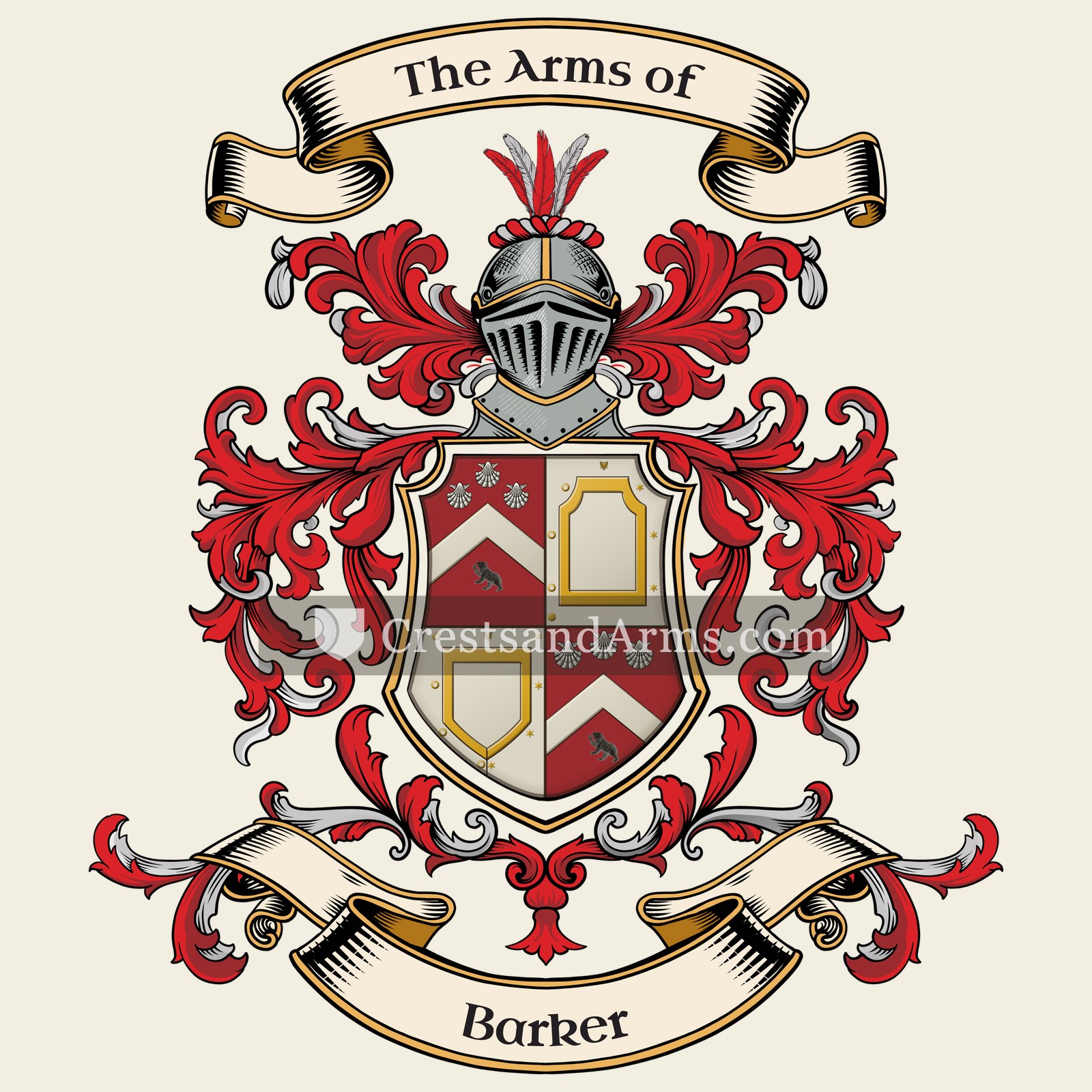
Coat of Arms & Family Crest Details
Symbols on this shield
chevronProtection, and faithful service completed
lionCourage, strength and royalty
crescentHonour by the sovereign, and the second son
Colours
Gold (Or)Means: Generosity
Black (Sable)Means: Constancy
Historical info
Source
Sir Bernard Burke, The General Armory of England, Scotland, Ireland and Wales, London: Harrison & Sons, 1884
Blazon (the actual original written record)
“Per chev engr. or and sa. a lion ramp. counterchanged in the dexter chief point a crescent of the second”
MeathCroboy · Meath, c. 1748
Digital archive packCoat of arms PNG, gold border print PDF, vector SVG and the certificate of authenticity. Sent to your email in minutes.
Map of Scotland showing where the Barker arms are recorded
The Barker arms were recorded in Meath, c. 1748.
Meath was the best farmland in Ireland and the old seat of its high kings. Norman families took it early and held it, and land of that quality kept the same families on it for centuries.
This is where the arms were entered in the register. Families often moved to other parts of the country, so the same name can turn up in more than one region.
The body that granted and recorded arms in Scotland in this period.
George II of Great Britain
Sovereign of the period
George II of Great Britain
1727–1760
Reigning in England when the Barker arms are first recorded.
How Arms Worked in Scotland
Scottish heraldry is unique because it treats a coat of arms as a piece of personal property protected by law. Only one person can own a specific design at any given time. When a family grows, the head keeps the original shield while other relatives must apply for their own distinct version with slight changes to prove their specific identity.
Granting authority
The Court of the Lord Lyon acts as the official body that regulates and controls all heraldic matters throughout Scotland.
How they got arms
Individuals obtain a legal right to their arms through a formal petition process that confirms their identity and family connection.
Where arms were recorded
All valid coats of arms are officially entered into the Public Register of All Arms and Bearings starting from 1672.
The family's standing
Recorded among the armigerous families of Meath.
Origin & History of the Barker Family in Scotland
The surname Barker is an occupational name that originated from the Middle English word for a tanner, someone who prepared animal hides using oak bark. While the name is common across the British Isles, its presence in Scotland is linked to the movement of people across the Irish Sea during the eighteenth century. By 1748, members of the Barker family were well-established in County Meath, Ireland, which often served as a waypoint for families migrating between Scotland and the wider Atlantic world. These early ancestors were likely part of a broader network of tradespeople and farmers who moved to fulfill the growing demand for leather goods and agricultural labor in the region. Their history reflects the mobility of the era, as families frequently crossed borders to seek new opportunities in trade and land management.
Coat of Arms & Family Crest Details
Symbols on this shield
chevronProtection, and faithful service completed
orlePreservation, and protection in battle
escallopThe pilgrim's shell, and a long journey made
bearStrength, cunning and protection of kin
eagleNobility, strength and a keen mind
starThe celestial goddess, and nobility
ringFidelity, and a promise kept
Colours
Red (Gules)Means: Military strength
Silver (Argent)Means: Peace and sincerity
Gold (Or)Means: Generosity
Black (Sable)Means: Constancy
Historical info
Source
Sir Bernard Burke, The General Armory of England, Scotland, Ireland and Wales, London: Harrison & Sons, 1884
Blazon (the actual original written record)
“Quarterly, 1st and 4th, per chev. gu. and ar. in chief three escallops of the last and in base a bear sejant sa. muzzled or, for Barker; 2nd and 3rd, az. an eagle displ. within an orle of four estoiles and as many annulets alternately all or, for Schuldham”
WalesSydney, c. 1647
Digital archive packCoat of arms PNG, gold border print PDF, vector SVG and the certificate of authenticity. Sent to your email in minutes.
Map of Wales showing where the Barker arms are recorded
The Barker arms were recorded in Sydney, c. 1647.
Arms such as these were typically recorded in Denbigh.
Denbighshire was north Welsh country of hills and small estates. Land was held by a great many families rather than a few, and each holding brought its own claim to a coat of arms.
This is where the arms were entered in the register. Families often moved to other parts of the country, so the same name can turn up in more than one region.
The body that granted and recorded arms in Wales in this period.
Charles I of England
Sovereign of the period
Charles I of England
1625–1649
Reigning in England when the Barker arms are first recorded.
How Arms Worked in Wales
English heraldry allowed arms to be shared by all legitimate descendants of the original owner. These symbols were treated as personal property that moved through the generations to all children. While the eldest son kept the original design, other family members could use the same shield without needing to change it or register their own unique versions.
Granting authority
The College of Arms in London has regulated the use of coats of arms throughout England and Wales since 1484.
How they got arms
Families typically obtained their coats of arms through a formal grant from the Crown or by proving their ancient right to them.
Where arms were recorded
All official coats of arms are recorded in the registers kept at the College of Arms, which date back to the fifteenth century.
The family's standing
Recorded among the armigerous families of Wales.
Origin & History of the Barker Family in Wales
The surname Barker is traditionally an occupational name, derived from the Middle English word for a tanner, someone who used tree bark to process animal hides into leather. While the name is common across England, its presence in Wales often reflects the movement of trade and families across the border during the seventeenth century. By 1647, records confirm that members of the Barker family were established in the town of Denbigh. At this time, Denbigh was a significant market center where the leather trade played a vital role in the local economy. The family likely settled in this area to take advantage of the busy trade routes and the demand for skilled leather workers. As they integrated into the Welsh community, the Barkers became part of the local social fabric, contributing to the growth and daily commerce of the region during a period of great political change in Britain.
Barker Meaning & Related Branches
Root word
berc
A Middle English term referring to the process of tanning leather.
This name
BarkerAn occupational surname for someone who worked as a tanner of hides.
also spelled
Barcker
Barkare
Related arms
Harrisonrecorded with Barker, same area
Hullesrecorded with Barker, same area
Larocherecorded with Barker, same area
Moorerecorded with Barker, same area
Documented Sources
Sir Bernard Burke, The General Armory of England, Scotland, Ireland and Wales, London: Harrison & Sons, 1884
Bardsley, Charles Wareing, A Dictionary of English and Welsh Surnames, 1901
Reaney, P.H., A Dictionary of British Surnames, 1958
Shropshire Archives, Diocese of Lichfield Parish Registers, 1568
Digital archive packCoat of arms PNG, gold border print PDF, vector SVG and the certificate of authenticity. Sent to your email in minutes.


 griffinValour and vigilance, guarding great treasure
 arms pheon arrowheadReadiness for battle, and the broad arrow of the sovereign
 griffinValour and vigilance, guarding great treasure
 arms pheon arrowheadReadiness for battle, and the broad arrow of the sovereign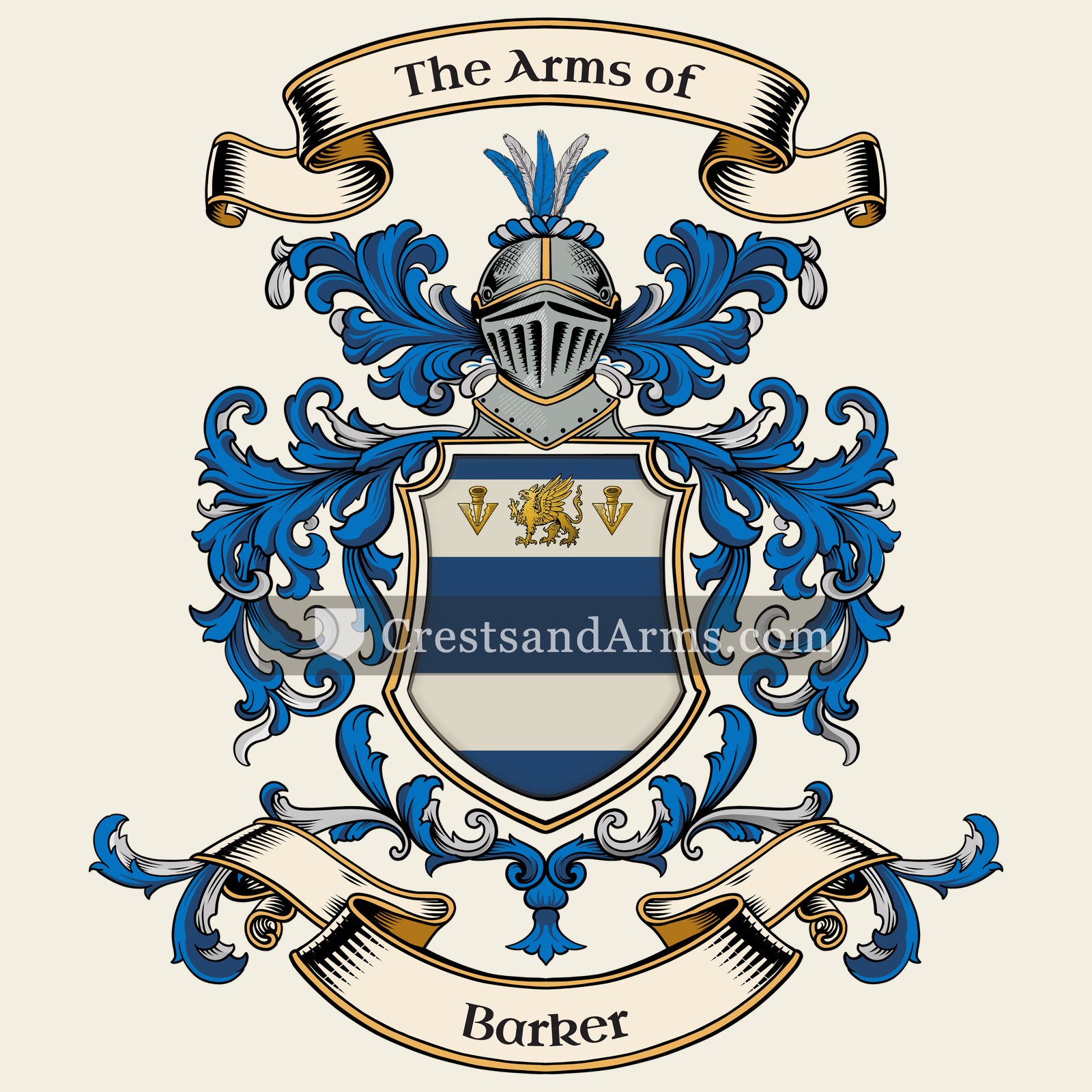


 chevronProtection, and faithful service completed
 lionCourage, strength and royalty
 crescentHonour by the sovereign, and the second son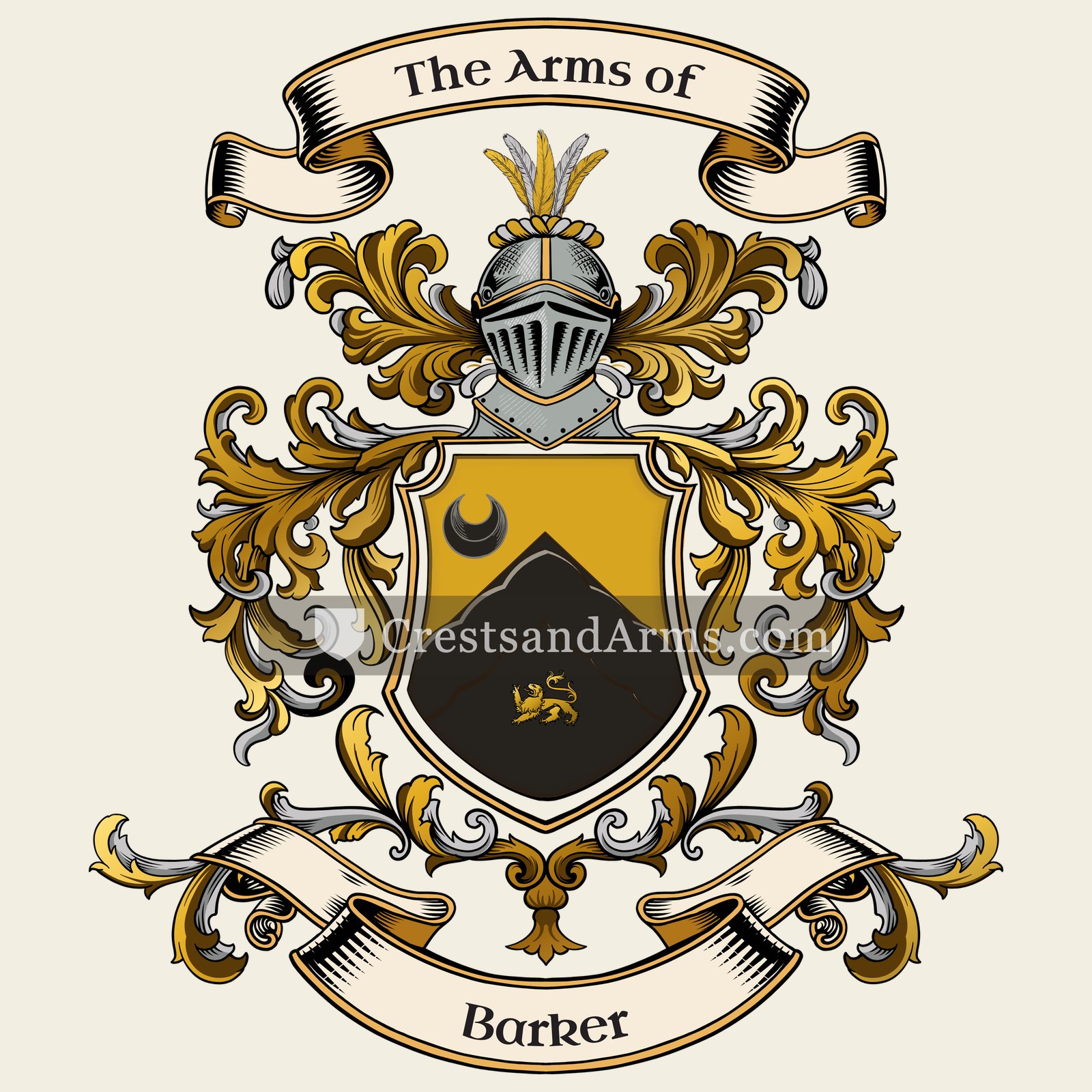


 orlePreservation, and protection in battle
 escallopThe pilgrim's shell, and a long journey made
 bearStrength, cunning and protection of kin
 eagleNobility, strength and a keen mind
 starThe celestial goddess, and nobility
 ringFidelity, and a promise kept