Map of Ireland showing where the Barnewall arms are recorded
The Barnewall arms were recorded in Meath, c. 1645.
Meath was the best farmland in Ireland and the old seat of its high kings. Norman families took it early and held it, and land of that quality kept the same families on it for centuries.
This is where the arms were entered in the register. Families often moved to other parts of the country, so the same name can turn up in more than one region.
The body that granted and recorded arms in Ireland in this period.
Charles I of England
Sovereign of the period
Charles I of England
1625–1649
Reigning in Ireland when the Barnewall arms are first recorded.
How Arms Worked in Ireland
The Ulster King of Arms granted coats of arms to individuals who proved their social standing and good character. These symbols were typically inherited by all legitimate descendants of the original holder. If a family branch wanted a unique look, they could apply for a specific change to their design through the office to ensure their identity remained distinct.
Granting authority
The Ulster King of Arms acted as the official body that regulated and issued all coats of arms throughout Ireland.
How they got arms
Families obtained their arms through formal grants issued by the office after proving their eligibility and paying the required fees.
Where arms were recorded
All official grants were recorded in the registers held by the Ulster King of Arms starting from the year 1552.
The family's standing
Recorded among the armigerous families of Meath.
Origin & History of the Barnewall Family in Ireland
The Barnewall family name arrived in Ireland during the Anglo-Norman expansion, eventually establishing deep roots within County Meath. By the middle of the seventeenth century, the family had become a prominent part of the local landed gentry, holding significant influence in the region by 1645. Their history is closely tied to the shifting political landscape of the Pale, which was the area of Ireland under direct English control. As the family grew in status, they acquired extensive estates and became deeply integrated into the administrative and social life of the Irish midlands. Throughout this period, the Barnewalls navigated complex legal and religious changes, maintaining their position as a notable family in Meath even as the country faced intense periods of conflict and land redistribution.
Coat of Arms & Family Crest Details
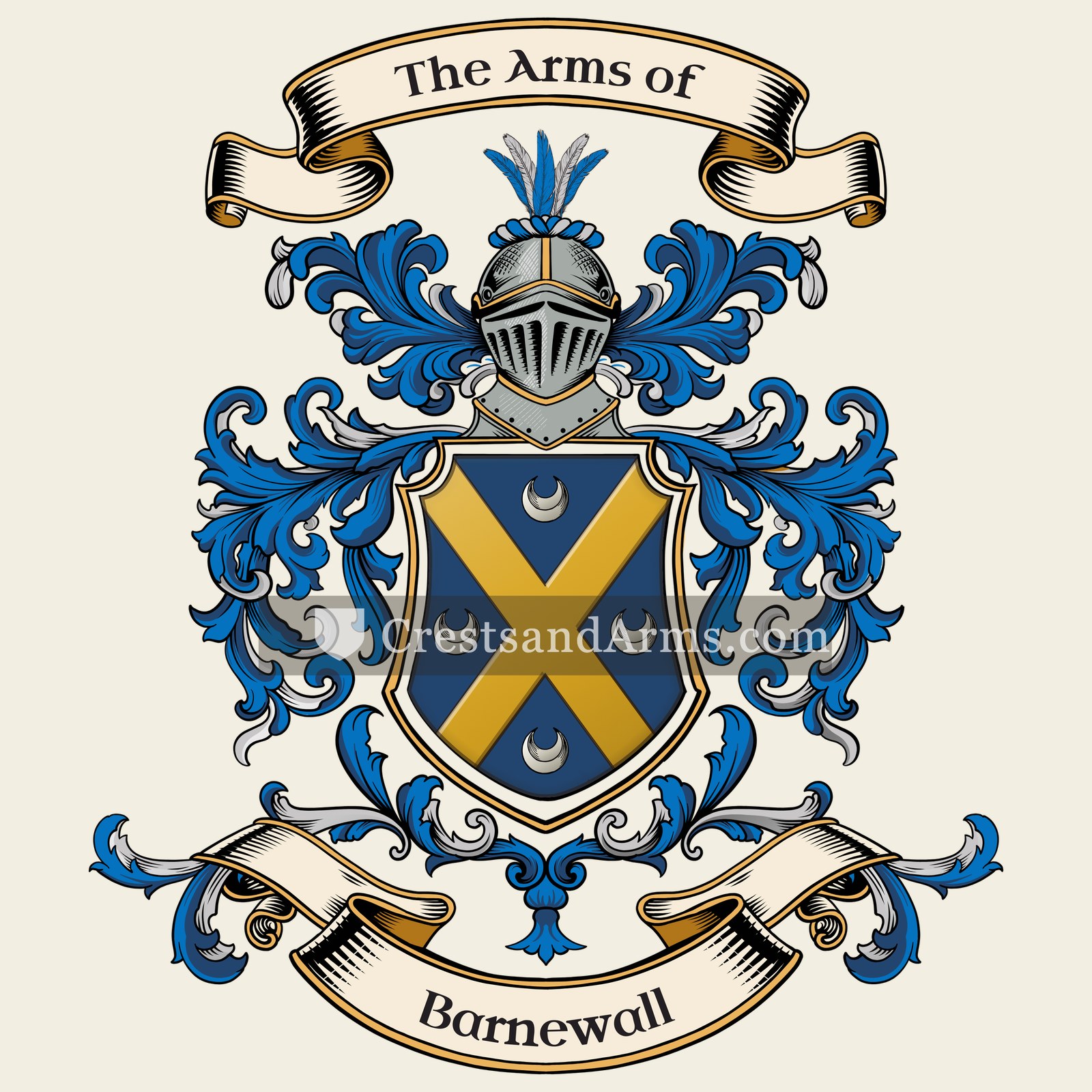
Symbols on this shield
saltireResolution, and St Andrew's cross
crescentHonour by the sovereign, and the second son
Colours
Blue (Azure)Means: Loyalty and truth
Gold (Or)Means: Generosity
Silver (Argent)Means: Peace and sincerity
Historical info
Source
Sir Bernard Burke, The General Armory of England, Scotland, Ireland and Wales, London: Harrison & Sons, 1884
Blazon (the actual original written record)
“Az. a saltire engr. or, betw. four crescents ar”
EssexEssex, c. 1620
Digital archive packCoat of arms PNG, gold border print PDF, vector SVG and the certificate of authenticity. Sent to your email in minutes.
Map of England showing where the Barnewall arms are recorded
The Barnewall arms were recorded in Essex, c. 1620.
Essex lay close enough to London for City money to buy land there. Merchants who prospered moved out to estates within a day's ride, and a new landowner almost always wanted arms to go with the ground.
This is where the arms were entered in the register. Families often moved to other parts of the country, so the same name can turn up in more than one region.
The body that granted and recorded arms in England in this period.
James VI and I
Sovereign of the period
James VI and I
1603–1625
Reigning in Ireland when the Barnewall arms are first recorded.
How Arms Worked in England
English heraldry allowed arms to be shared by all legitimate descendants of the original owner. These symbols were treated as personal property that moved through the generations to all children. While the eldest son kept the original design, other family members could use the same shield without needing to change it or register their own unique versions.
Granting authority
The College of Arms in London has regulated the use of coats of arms throughout England and Wales since 1484.
How they got arms
Families typically obtained their coats of arms through a formal grant from the Crown or by proving their ancient right to them.
Where arms were recorded
All official coats of arms are recorded in the registers kept at the College of Arms, which date back to the fifteenth century.
The family's standing
Recorded among the armigerous families of Essex.
Origin & History of the Barnewall Family in England
The family name Barnewall traces its roots to the movement of settlers across medieval landscapes, eventually establishing a notable presence in the county of Essex by the early 17th century. While the name is often associated with later migrations to Ireland, its English origins reflect the common practice of families identifying with specific local manors or geographic features. By 1620, records indicate that members of the Barnewall family were integrated into the social and economic fabric of Essex, a region known for its agricultural wealth and proximity to London. These early individuals likely participated in the local governance and land management systems that defined life in rural England during the Stuart period. Their presence in Essex suggests a family that was well-established within the local gentry or merchant classes, contributing to the steady development of the region before further expansion or relocation occurred.
Barnewall Meaning & Related Branches
Root word
de Berneval
Derived from the village of Berneval-le-Grand in Normandy, France.
This name
BarnewallRefers to an individual originating from the place of the alder trees.
also spelled
Barnewal
Barnewald
Barnwell
Barnewelle
Related arms
Barnewellvariant spelling
Barnwellvariant spelling
Documented Sources
Sir Bernard Burke, The General Armory of England, Scotland, Ireland and Wales, London: Harrison & Sons, 1884
Canny, Nicholas, Making Ireland British, 1580-1650, 2001
Lodge, John, The Peerage of Ireland, or, A Genealogical History of the Present Nobility of that Kingdom, 1789
National Archives of Ireland, Inquisitionum in Officio Rotulorum Cancellariae Hiberniae Asservatarum Repertorium, 1826
Digital archive packCoat of arms PNG, gold border print PDF, vector SVG and the certificate of authenticity. Sent to your email in minutes.


 bordureA difference between branches of one family
 bordureA difference between branches of one family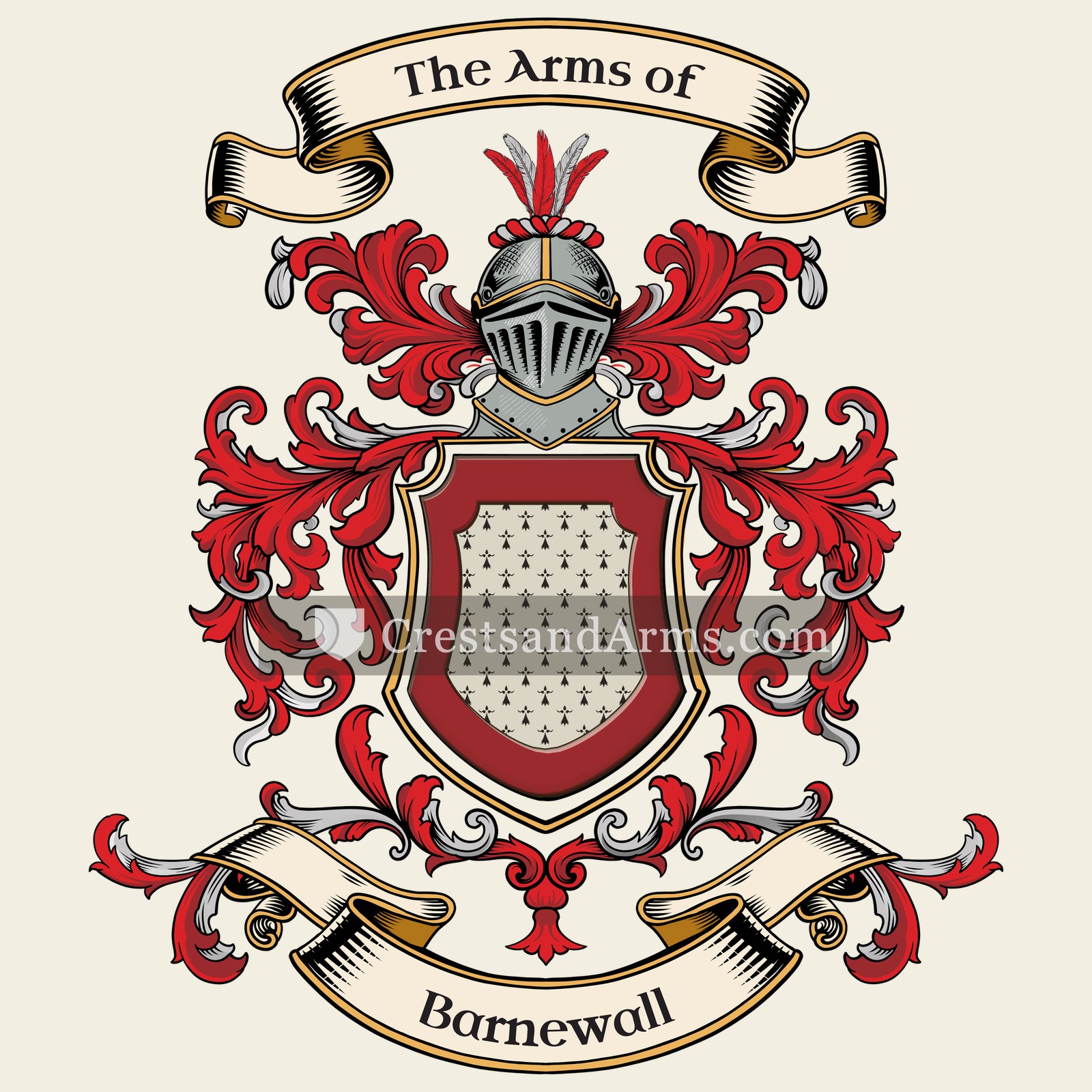


 saltireResolution, and St Andrew's cross
 crescentHonour by the sovereign, and the second son