A record of documented arms, meaning and origin, researched for the Baron family lines. Documented in 3 countries.
Reg. 4945 · French, A–C
Coat of Arms & Family Crest Details
Symbols on this shield
bearStrength, cunning and protection of kin
roseThe seventh son, and beauty with grace
mulletThe third son, and a divine quality from above
Colours
Gold (Or)Means: Generosity
Black (Sable)Means: Constancy
Red (Gules)Means: Military strength
Blue (Azure)Means: Loyalty and truth
Historical info
Source
J. B. Rietstap, Armorial Général, Gouda: G. B. van Goor Zonen, 1884–87
Blazon (the actual original written record)
“D'or à un ours naiss. de sa., la tête cont., tenant une épée d'arg., acc. en chef de deux roses de gu. et en p. d'une étoile d'azur. D.: MERITI TANTA EST FIDUCIA.”
DauphineDauphine, c. 1489
Digital archive packCoat of arms PNG, gold border print PDF, vector SVG and the certificate of authenticity. Sent to your email in minutes.
Map of France showing where the Baron arms are recorded
The Baron arms were recorded in Dauphine, c. 1489.
Dauphine lay in the mountains of south-eastern France, a country of small estates and scattered valleys. Its gentry were many and mostly modest, and even a small landholding was enough to justify arms.
This is where the arms were entered in the register. Families often moved to other parts of the country, so the same name can turn up in more than one region.
The body that granted and recorded arms in France in this period.
Charles VIII of France
Sovereign of the period
Charles VIII of France
1483–1498
Reigning in France when the Baron arms are first recorded.
How Arms Worked in France
In France, a coat of arms was a mark of honor that passed down through the male line to all legitimate descendants. Families often used the same shield without changes to show their shared heritage. If a branch wanted to stand out, they could add a small mark to their shield to show their specific place in the family tree.
Granting authority
The Juge d'armes de France acted as the official authority that regulated and verified coats of arms across the country.
How they got arms
Families typically inherited their arms from ancestors, though they could also receive them through royal grants or by proving their noble status.
Where arms were recorded
Coats of arms were officially recorded in the Armorial Général de France, which began its main collection in the year 1696.
The family's standing
Recorded among the armigerous families of Dauphine.
Origin & History of the Baron Family in France
The surname Baron has deep roots in the historical province of Dauphiné, where records confirm the family was established by at least 1489. During this period, the name functioned as a status-based descriptor rather than just a simple label, as it was often bestowed upon individuals who held significant local authority or served in administrative roles for the regional nobility. Living in the rugged terrain of southeastern France, these early family members were likely involved in the complex social and economic life of the Alpine foothills. As the family grew, they integrated into the local community by managing land and participating in the regional legal systems that governed the province. This early presence in Dauphiné suggests that the ancestors of the Baron family were well-positioned within the social hierarchy, allowing them to maintain a consistent identity across generations during a time of great transition in French society.
Coat of Arms & Family Crest Details
Symbols on this shield
lionCourage, strength and royalty
Colours
Blue (Azure)Means: Loyalty and truth
Red (Gules)Means: Military strength
Silver (Argent)Means: Peace and sincerity
Historical info
Source
Sir Bernard Burke, The General Armory of England, Scotland, Ireland and Wales, London: Harrison & Sons, 1884
Blazon (the actual original written record)
“Per fess az. and gu. two lions pass. guard. ar. collared counterchanged”
EssexAldborough · Essex, c. 1568
Digital archive packCoat of arms PNG, gold border print PDF, vector SVG and the certificate of authenticity. Sent to your email in minutes.
Map of England showing where the Baron arms are recorded
The Baron arms were recorded in Essex, c. 1568.
Essex lay close enough to London for City money to buy land there. Merchants who prospered moved out to estates within a day's ride, and a new landowner almost always wanted arms to go with the ground.
This is where the arms were entered in the register. Families often moved to other parts of the country, so the same name can turn up in more than one region.
The body that granted and recorded arms in England in this period.
Elizabeth I of England
Sovereign of the period
Elizabeth I of England
1558–1603
Reigning in France when the Baron arms are first recorded.
How Arms Worked in England
English heraldry allowed arms to be shared by all legitimate descendants of the original owner. These symbols were treated as personal property that moved through the generations to all children. While the eldest son kept the original design, other family members could use the same shield without needing to change it or register their own unique versions.
Granting authority
The College of Arms in London has regulated the use of coats of arms throughout England and Wales since 1484.
How they got arms
Families typically obtained their coats of arms through a formal grant from the Crown or by proving their ancient right to them.
Where arms were recorded
All official coats of arms are recorded in the registers kept at the College of Arms, which date back to the fifteenth century.
The family's standing
Recorded among the armigerous families of Essex.
Origin & History of the Baron Family in England
The surname Baron has deep roots in English history, functioning originally as a descriptive name that identified a person’s social standing or their role within a local community. By the time the family was firmly established in Essex in 1568, the name had transitioned from a formal title of nobility into a hereditary surname used by common landowners and laborers. During the sixteenth century, families with this name were often integrated into the agricultural life of the English countryside, where they worked the land and participated in the local parish systems. Because the name was tied to the concept of a high-ranking official, it likely served as a nickname for someone who acted with authority or perhaps worked in the household of a wealthy lord. As the family settled in Essex, they became part of the growing class of English citizens who maintained consistent records of their births, marriages, and deaths within the church registers of the era.
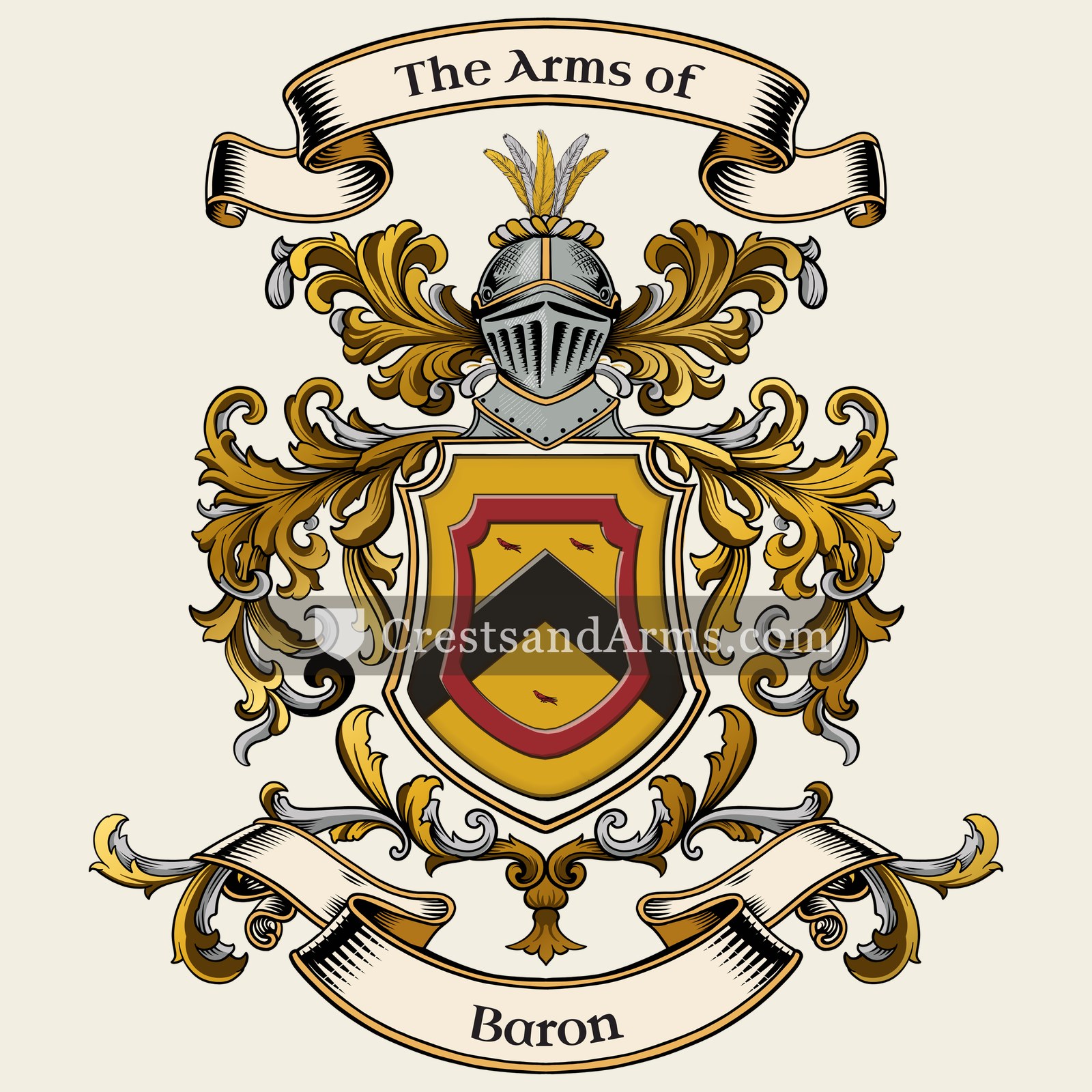
Coat of Arms & Family Crest Details
Symbols on this shield
chevronProtection, and faithful service completed
martletA younger son, who must win his own land
Colours
Gold (Or)Means: Generosity
Black (Sable)Means: Constancy
Red (Gules)Means: Military strength
Historical info
Source
Sir Bernard Burke, The General Armory of England, Scotland, Ireland and Wales, London: Harrison & Sons, 1884
Blazon (the actual original written record)
“Or, a chev. sa. betw. three martlets gu. within a double tressure flory counterflory of the last”
ScotlandKinnaird, c. 1748
Digital archive packCoat of arms PNG, gold border print PDF, vector SVG and the certificate of authenticity. Sent to your email in minutes.
Map of Scotland showing where the Baron arms are recorded
The Baron arms were recorded in Kinnaird, c. 1748.
Arms such as these were typically recorded in Edinburgh.
Edinburgh was the seat of Scotland's government, its courts and its heralds. Families with business there settled nearby, and being close to where arms were recorded is exactly why so many of them appear.
This is where the arms were entered in the register. Families often moved to other parts of the country, so the same name can turn up in more than one region.
The body that granted and recorded arms in Scotland in this period.
George II of Great Britain
Sovereign of the period
George II of Great Britain
1727–1760
Reigning in France when the Baron arms are first recorded.
How Arms Worked in Scotland
Scottish heraldry is unique because it treats a coat of arms as a piece of personal property protected by law. Only one person can own a specific design at any given time. When a family grows, the head keeps the original shield while other relatives must apply for their own distinct version with slight changes to prove their specific identity.
Granting authority
The Court of the Lord Lyon acts as the official body that regulates and controls all heraldic matters throughout Scotland.
How they got arms
Individuals obtain a legal right to their arms through a formal petition process that confirms their identity and family connection.
Where arms were recorded
All valid coats of arms are officially entered into the Public Register of All Arms and Bearings starting from 1672.
The family's standing
Recorded among the armigerous families of Scotland.
Origin & History of the Baron Family in Scotland
The surname Baron has deep roots in Scotland, where it emerged as a name often linked to individuals who held land or served in administrative roles within the feudal system. By the mid-eighteenth century, the family had established a notable presence in Edinburgh, a city that served as the bustling center of Scottish legal, intellectual, and social life. Records from 1748 confirm that members of the Baron family were active participants in the urban development of the capital during this era of significant growth. As the city expanded, these early residents contributed to the local economy and community life, helping to solidify the family name within the historical fabric of the region. Their presence in Edinburgh suggests they were part of the rising middle class that helped shape the city into a hub of commerce and culture during the Enlightenment.
Baron Meaning & Related Branches
Root word
baro
A Latin term meaning a man, warrior, or free man.
This name
BaronA noble title denoting a man of high rank or a feudal lord.
also spelled
Barron
Barun
Related arms
Barron de Glenannavariant spelling
Barron de Gleuannavariant spelling
Barranvariant spelling
Chantenelrecorded with Baron, same area
Documented Sources
J. B. Rietstap, Armorial Général, Gouda: G. B. van Goor Zonen, 1884–87
Chorier, Nicolas. Histoire générale de Dauphiné. 1661
Roman, Joseph. Dictionnaire topographique du département des Hautes-Alpes. 1884
Archives départementales de l'Isère, Série B: Cours et juridictions
Archives départementales de la Drôme, Série E: Familles et notaires
Digital archive packCoat of arms PNG, gold border print PDF, vector SVG and the certificate of authenticity. Sent to your email in minutes.


 bearStrength, cunning and protection of kin
 roseThe seventh son, and beauty with grace
 mulletThe third son, and a divine quality from above
 bearStrength, cunning and protection of kin
 roseThe seventh son, and beauty with grace
 mulletThe third son, and a divine quality from above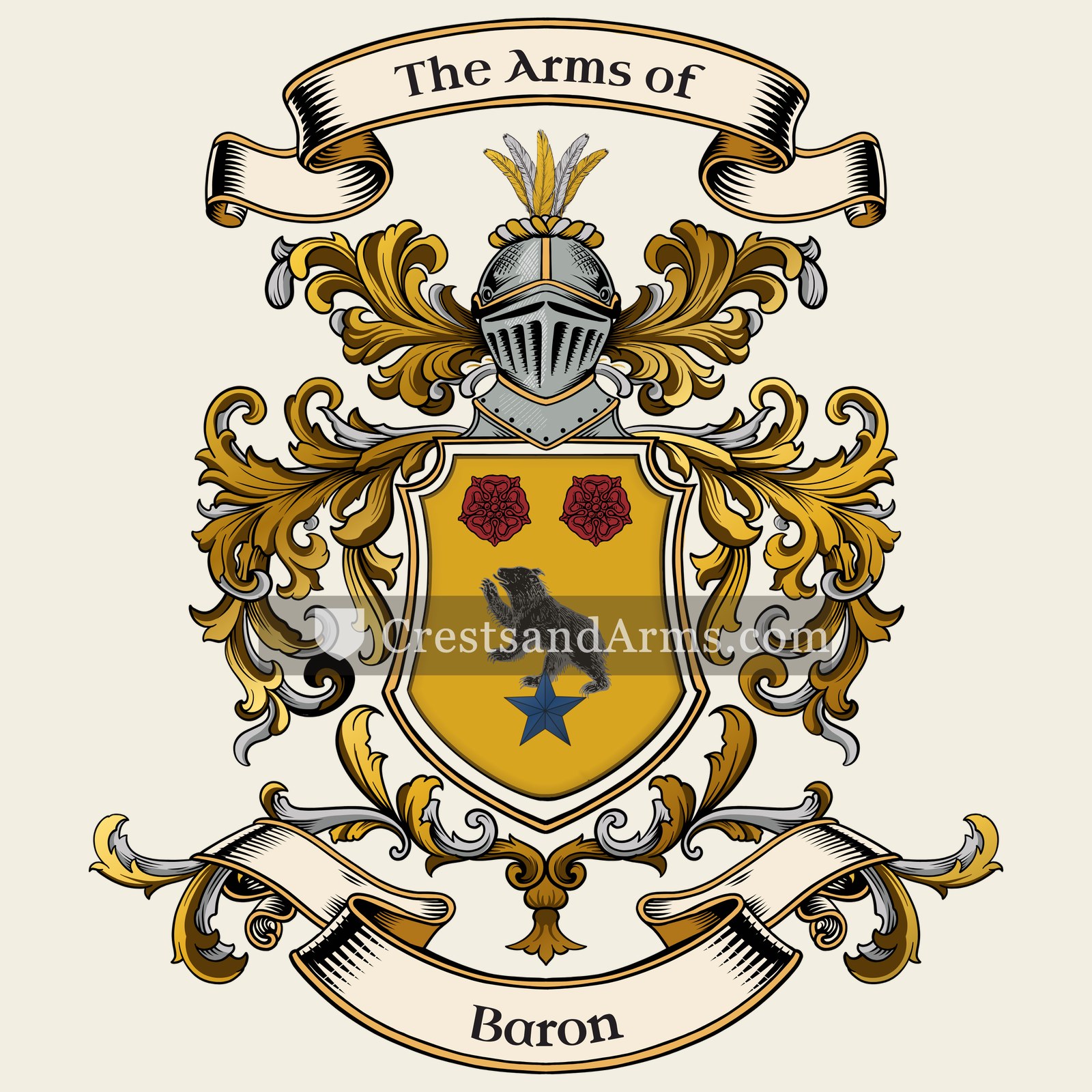


 lionCourage, strength and royalty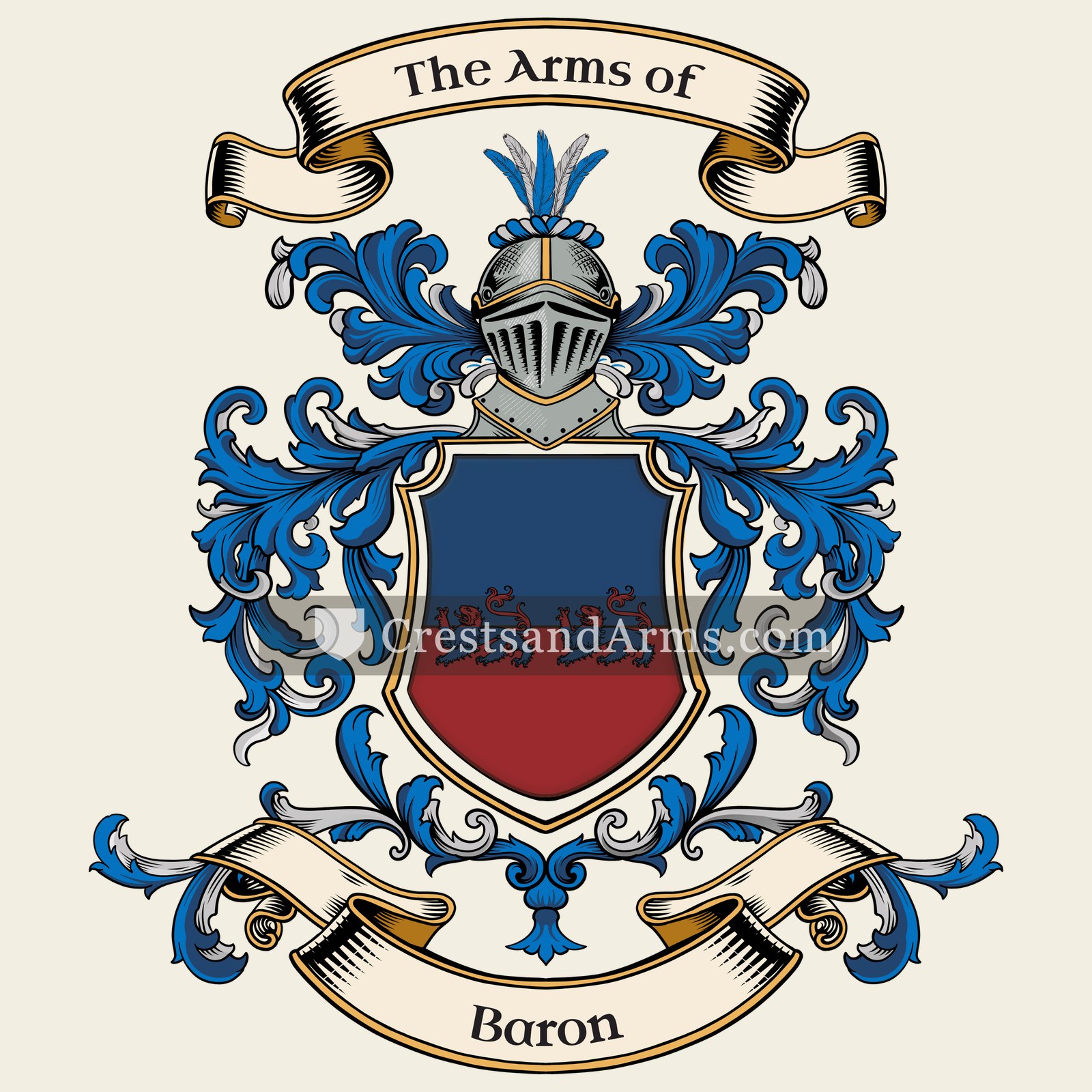


 chevronProtection, and faithful service completed
 martletA younger son, who must win his own land