Map of Belgium showing where the Barquin arms are recorded
The Barquin arms were recorded in Luxemb, c. 1721.
This is where the arms were entered in the register. Families often moved to other parts of the country, so the same name can turn up in more than one region.
The body that granted and recorded arms in Belgium in this period.
Charles VI, Holy Roman Emperor
Sovereign of the period
Charles VI, Holy Roman Emperor
1711–1740
Reigning in Belgium when the Barquin arms are first recorded.
How Arms Worked in Belgium
In Belgium, a coat of arms is considered personal property that is passed down through the male line to legitimate descendants. Families often use the same shield design across generations to show their shared heritage. If a branch of the family wants to change the design, they must apply for an official update to their specific version of the arms.
Granting authority
The Conseil héraldique is the official body that regulates and approves all coats of arms in Belgium.
How they got arms
Families obtain their coats of arms through formal royal grants or by confirming their historical right to use existing designs.
Where arms were recorded
All approved coats of arms are officially recorded in the public registers of the Conseil héraldique since 1844.
The family's standing
Recorded among the armigerous families of Belgium.
Origin & History of the Barquin Family in Belgium
The Barquin family name has deep roots in the border regions between Belgium and Luxembourg, with documented evidence placing family members in the Luxembourg area as early as 1721. During the eighteenth century, this region was part of the Southern Netherlands, which was under the control of the Austrian Habsburg monarchy. Families like the Barquins often lived in small, rural communities where they were deeply connected to the local agricultural economy and the shifting political borders of the time. As the region transitioned through various European conflicts, the Barquin family remained a part of the local social fabric, likely working as tradespeople or farmers who helped sustain the village life of the era. Their presence in these records suggests that they were established members of the community who navigated the complex administrative changes of the eighteenth century while maintaining their family identity across generations.
Coat of Arms & Family Crest Details
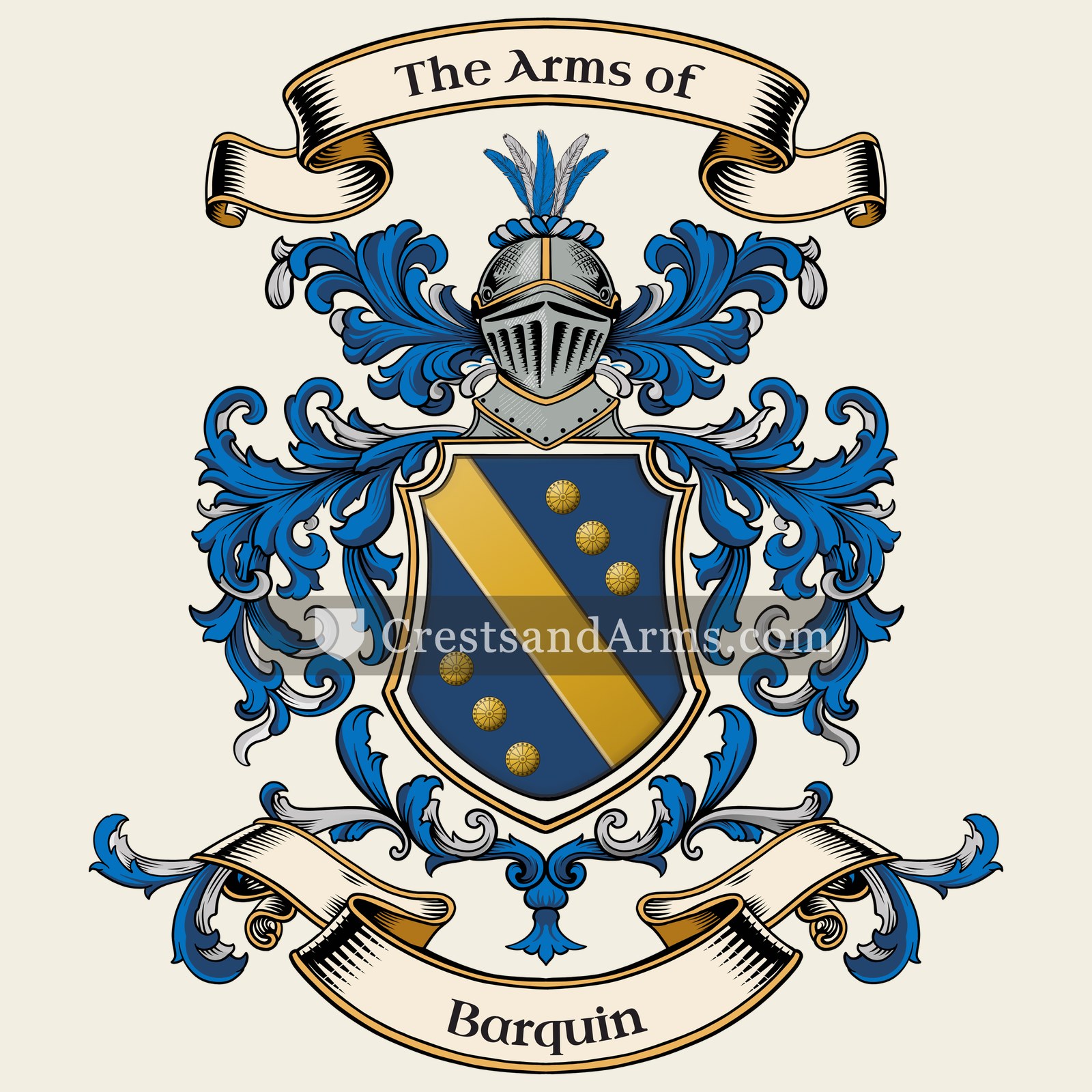
Symbols on this shield
bendDefence, and the scarf of a commander
roundelA coin, and one who has been to the crusades
Colours
Blue (Azure)Means: Loyalty and truth
Gold (Or)Means: Generosity
Historical info
Source
J. B. Rietstap, Armorial Général, Gouda: G. B. van Goor Zonen, 1884–87
Blazon (the actual original written record)
“D'azur à la bande d'or, acc. de six bes. du même, rangés en orle.”
ProvenceProvence, c. 1663
Digital archive packCoat of arms PNG, gold border print PDF, vector SVG and the certificate of authenticity. Sent to your email in minutes.
Map of France showing where the Barquin arms are recorded
The Barquin arms were recorded in Provence, c. 1663.
Provence was old country, with towns dating to the Romans and families who traced their land back nearly as far. Its gentry were many and long-settled, and long settlement is what fills a register.
This is where the arms were entered in the register. Families often moved to other parts of the country, so the same name can turn up in more than one region.
The body that granted and recorded arms in France in this period.
Louis XIV of France
Sovereign of the period
Louis XIV of France
1643–1715
Reigning in Belgium when the Barquin arms are first recorded.
How Arms Worked in France
In France, a coat of arms was a mark of honor that passed down through the male line to all legitimate descendants. Families often used the same shield without changes to show their shared heritage. If a branch wanted to stand out, they could add a small mark to their shield to show their specific place in the family tree.
Granting authority
The Juge d'armes de France acted as the official authority that regulated and verified coats of arms across the country.
How they got arms
Families typically inherited their arms from ancestors, though they could also receive them through royal grants or by proving their noble status.
Where arms were recorded
Coats of arms were officially recorded in the Armorial Général de France, which began its main collection in the year 1696.
The family's standing
Recorded among the armigerous families of Provence.
Origin & History of the Barquin Family in France
The Barquin family name has deep roots in the sun-drenched region of Provence, where records confirm their presence as early as 1663. During this period, the family lived in a landscape defined by small agricultural villages and the influence of the Catholic Church. The name itself likely evolved from local linguistic traditions in southern France, where regional dialects often shaped how surnames were recorded by parish clerks. As members of a society built on land ownership and trade, the early Barquins were part of the rural fabric that sustained the economy of the French Mediterranean coast. By settling in Provence, they became part of a long history of families who navigated the social changes and religious shifts that defined the seventeenth century in France.
Barquin Meaning & Related Branches
Root word
Barca
A Latin or Phoenician term referring to a boat or ship.
This name
BarquinA topographic or occupational surname likely denoting someone who lived near a boat landing or worked as a boatman.
also spelled
Barquinn
Barquine
Barkin
Related arms
Monet (du) - Dauphinésame arms
St.-Gerysame arms
Carondeletsimilar arms
Documented Sources
J. B. Rietstap, Armorial Général, Gouda: G. B. van Goor Zonen, 1884–87
Archives de l'État à Arlon, Registres paroissiaux de la province de Luxembourg
Muller, Jean-Claude, Les familles de la région de Luxembourg aux XVIIIe et XIXe siècles, 1994
Digital archive packCoat of arms PNG, gold border print PDF, vector SVG and the certificate of authenticity. Sent to your email in minutes.


 bearStrength, cunning and protection of kin
 bearStrength, cunning and protection of kin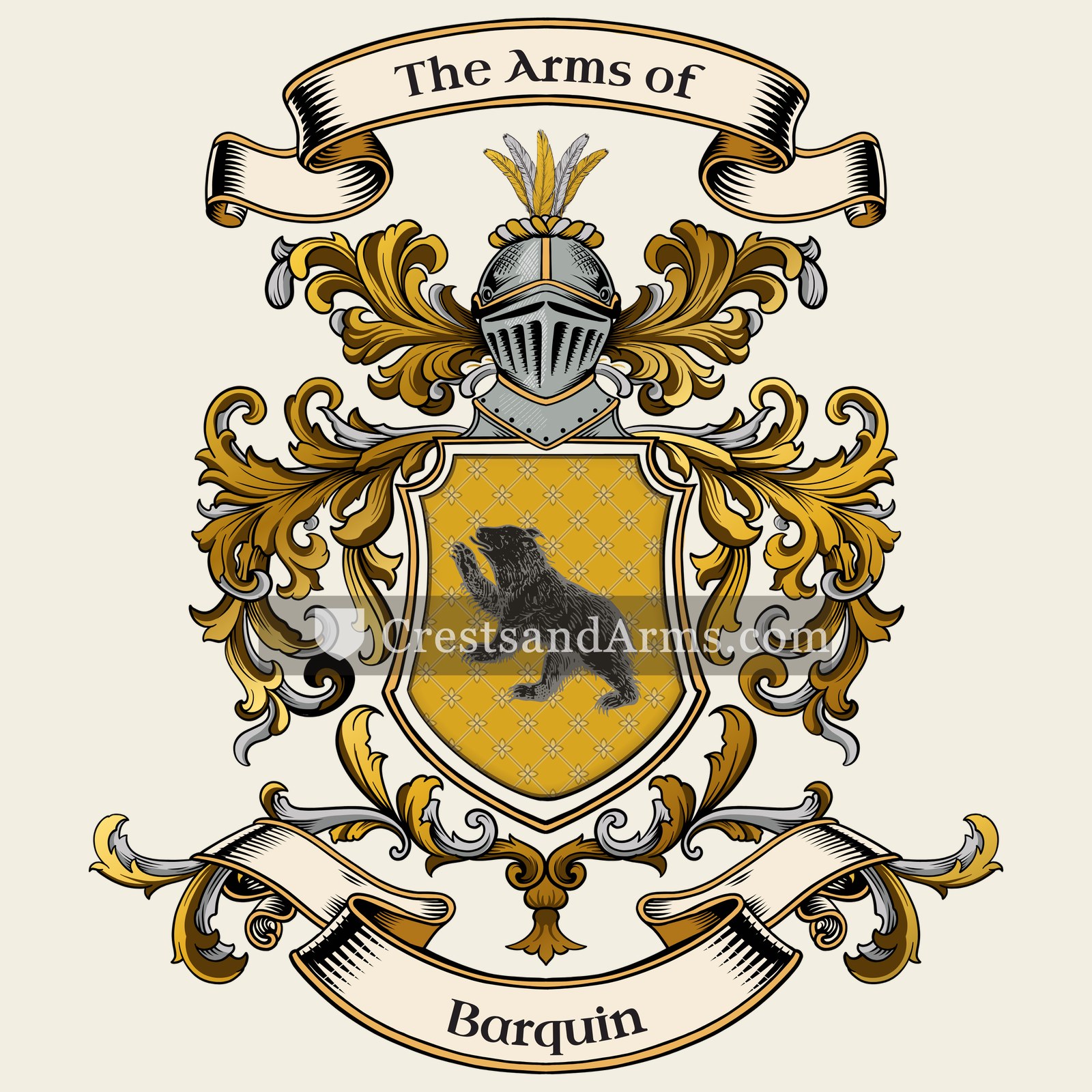


 bendDefence, and the scarf of a commander
 roundelA coin, and one who has been to the crusades