A record of documented arms, meaning and origin, researched for the Bars family lines. Documented in 3 countries.
Reg. 7656 · German, A–C
Coat of Arms & Family Crest Details
Symbols on this shield
roseThe seventh son, and beauty with grace
Colours
Silver (Argent)Means: Peace and sincerity
Red (Gules)Means: Military strength
Historical info
Source
J. B. Rietstap, Armorial Général, Gouda: G. B. van Goor Zonen, 1884–87
Blazon (the actual original written record)
“Coupé: au 1 d'arg. à deux roses accostées de gu.; au 2 d'arg. à trois barres de gu. C.: trois tuyaux d'or soutenus d'une boule du même et sommés chacun de trois plumes de paon au nat.”
MecklenburgMecklenburg, c. 1765
Digital archive packCoat of arms PNG, gold border print PDF, vector SVG and the certificate of authenticity. Sent to your email in minutes.
Map of Germany showing where the Bars arms are recorded
The Bars arms were recorded in Mecklenburg, c. 1765.
Mecklenburg was farming country in the north of Germany, held by a small number of families who kept their estates for generations. Owning land was what entitled a family to arms, so a great many Mecklenburg names ended up in the registers.
This is where the arms were entered in the register. Families often moved to other parts of the country, so the same name can turn up in more than one region.
The body that granted and recorded arms in Germany in this period.
Francis I, Holy Roman Emperor
Sovereign of the period
Francis I, Holy Roman Emperor
1745–1765
Reigning in Germany when the Bars arms are first recorded.
How Arms Worked in Germany
In the Holy Roman Empire, coats of arms were often granted to individuals by the Emperor or his representatives. These arms were then passed down through the generations to all legitimate descendants of the original holder. Younger branches of a family usually kept the same shield design without needing to change it, as the arms belonged to the entire lineage.
Granting authority
The Holy Roman Emperor held the sole power to grant new coats of arms throughout his vast imperial territories.
How they got arms
Families typically obtained their coats of arms through a formal imperial grant or by proving their noble status to the authorities.
Where arms were recorded
These grants were officially recorded in the Imperial Chancery registers, which began keeping formal records of such honors during the Middle Ages.
The family's standing
Recorded among the armigerous families of Mecklenburg.
Origin & History of the Bars Family in Germany
The family name Bars has deep roots in the northern regions of Germany, particularly within the historic state of Mecklenburg. During the eighteenth century, the name was already well-established in this area, as evidenced by records confirming family members lived there by 1765. The name itself is likely derived from the Middle Low German word for a perch, which is a type of freshwater fish common in the rivers and lakes of the Baltic region. In medieval times, names were often taken from the natural world or local geography to help distinguish individuals in a growing population. Because Mecklenburg was a rural area defined by its vast waterways and agricultural landscape, it is probable that the name originated as a descriptive nickname for a person who lived near a fishing site or worked as a fisherman. Over generations, this descriptive label transitioned into a permanent hereditary surname, marking the family as a long-standing part of the northern German community.
Coat of Arms & Family Crest Details
Symbols on this shield
mountThe ground held, and steadfastness upon it
knightChivalry and service in arms
mulletThe third son, and a divine quality from above
lionCourage, strength and royalty
Colours
Silver (Argent)Means: Peace and sincerity
Blue (Azure)Means: Loyalty and truth
Green (Vert)Means: Hope
Gold (Or)Means: Generosity
Historical info
Source
J. B. Rietstap, Armorial Général, Gouda: G. B. van Goor Zonen, 1884–87
Blazon (the actual original written record)
“Ec.: au 1 d'arg. à un sauvage de carn., ceint et cour. de lierre, la main appuyée sur une massue, le tout soutenu d'une terrasse de sin.; aux 2 et 3 d'azur à l'étoile d'or; au 4 de gu. au lion d'or, tenant de sa patte dextre un flambeau allumé du même. Cq. cour. C.: un bras, arm. d'arg., brandissant une épée du même, garnie d'or. L. d'or, d'arg. et d'azur.”
RussiaEsthonie, c. 1784
Digital archive packCoat of arms PNG, gold border print PDF, vector SVG and the certificate of authenticity. Sent to your email in minutes.
Map of Russia showing where the Bars arms are recorded
The Bars arms were recorded in Esthonie, c. 1784.
Arms such as these were typically recorded in Moscow.
Moscow held the Russian court, and rank there came from service rather than land. Families who served the Tsar were entered in the registers of nobility, and that entry is where their arms are recorded.
This is where the arms were entered in the register. Families often moved to other parts of the country, so the same name can turn up in more than one region.
The body that granted and recorded arms in Russia in this period.
Catherine II of Russia
Sovereign of the period
Catherine II of Russia
1762–1796
Reigning in Germany when the Bars arms are first recorded.
How Arms Worked in Russia
Russian heraldry was strictly tied to the nobility and the state service system. Families proved their ancient status or earned new rank to receive an official grant from the Tsar. These symbols were then inherited by all legitimate children of the noble line. If a family lacked proof of their status, they were often excluded from the official records entirely.
Granting authority
The Herald Master's Office acted as the central state body that strictly regulated and verified all noble heraldic symbols.
How they got arms
Families typically received their arms through a formal state grant or by proving their noble status to the government authorities.
Where arms were recorded
All approved coats of arms were officially recorded in the General Armorial of the Noble Families of the Russian Empire starting in 1797.
The family's standing
Recorded among the armigerous families of Russia.
Origin & History of the Bars Family in Russia
The history of the Bars family in Russia is deeply connected to the social and professional shifts of the late eighteenth century. By 1784, members of the family were already established in Moscow, a time when the city served as a vibrant center for the Russian nobility and the growing administrative class. The surname itself is often associated with the Russian word for a leopard or a lynx, which suggests that the name may have originated as a descriptive nickname before becoming a formal family title. As the family settled into life in Moscow, they integrated into the local social fabric, likely participating in the educational and governmental circles that defined the era. Their presence in the capital during this period indicates a level of stability and status that allowed them to navigate the complexities of Russian society during the reign of Catherine the Great. Over the following decades, the family continued to contribute to the professional life of the empire, leaving behind a legacy that reflects the broader movement of families into the heart of Russian urban culture.
Coat of Arms & Family Crest Details
Symbols on this shield
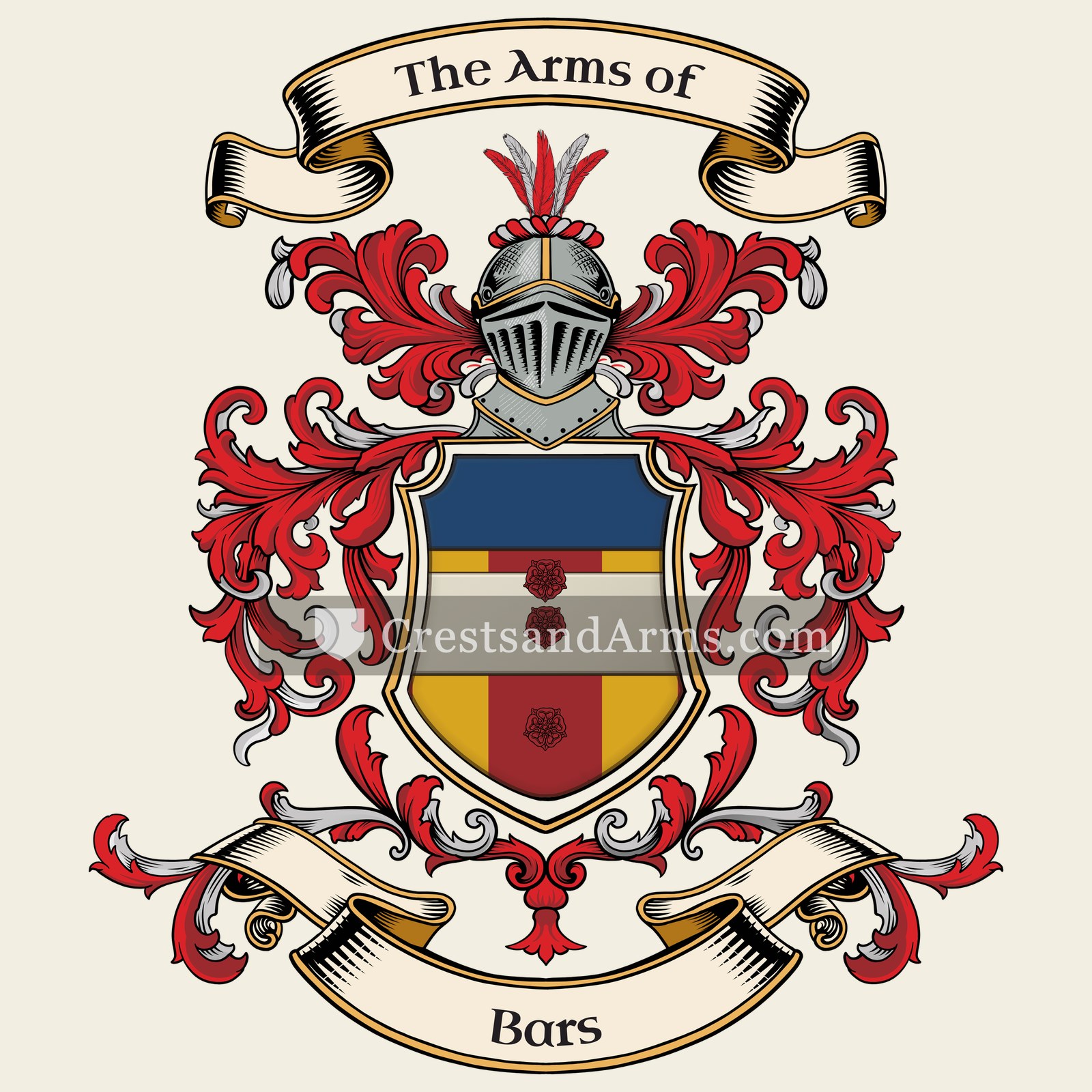
paleMilitary strength, and a fortified defence
chiefAuthority, wisdom and dominion
roseThe seventh son, and beauty with grace
Colours
Red (Gules)Means: Military strength
Gold (Or)Means: Generosity
Blue (Azure)Means: Loyalty and truth
Silver (Argent)Means: Peace and sincerity
Historical info
Source
J. B. Rietstap, Armorial Général, Gouda: G. B. van Goor Zonen, 1884–87
Blazon (the actual original written record)
“De gu. à deux pals d'or, ch. chacun de trois roses du champ; au chef d'azur, ch. de deux bars d'arg. en fasce.”
PerigordPerigord, c. 1663
Digital archive packCoat of arms PNG, gold border print PDF, vector SVG and the certificate of authenticity. Sent to your email in minutes.
Map of France showing where the Bars arms are recorded
The Bars arms were recorded in Perigord, c. 1663.
Perigord was wooded upland country in south-western France, thick with small castles. Its gentry were numerous and mostly poor, and even a modest holding justified a shield of one's own.
This is where the arms were entered in the register. Families often moved to other parts of the country, so the same name can turn up in more than one region.
The body that granted and recorded arms in France in this period.
Louis XIV of France
Sovereign of the period
Louis XIV of France
1643–1715
Reigning in Germany when the Bars arms are first recorded.
How Arms Worked in France
In France, a coat of arms was a mark of honor that passed down through the male line to all legitimate descendants. Families often used the same shield without changes to show their shared heritage. If a branch wanted to stand out, they could add a small mark to their shield to show their specific place in the family tree.
Granting authority
The Juge d'armes de France acted as the official authority that regulated and verified coats of arms across the country.
How they got arms
Families typically inherited their arms from ancestors, though they could also receive them through royal grants or by proving their noble status.
Where arms were recorded
Coats of arms were officially recorded in the Armorial Général de France, which began its main collection in the year 1696.
The family's standing
Recorded among the armigerous families of Perigord.
Origin & History of the Bars Family in France
The history of the Bars family in France is deeply rooted in the southwestern region of Périgord, where records confirm their presence as early as 1663. During this period, families in the Périgord region were often closely tied to the land and the local agricultural economy. The name itself likely originated as a topographic descriptor, referring to people who lived near a "bar," which in Old French and regional dialects often denoted a ridge, a sandbank, or a fortified barrier. By the mid-17th century, the family was well-established within the social fabric of the province, likely participating in the local governance or trade networks that defined life in rural France before the Revolution. As they settled into the landscape, the family name became a permanent marker of their identity in the region, reflecting both their geographic origins and their endurance through the centuries of French history.
Bars Meaning & Related Branches
Root word
Bar
Middle High German term for a bear.
This name
BarsA nickname for a person with a strong or burly nature like a bear.
also spelled
Bar
Related arms
Lohendahlsimilar arms
Baarsvariant spelling
Barvariant spelling
Documented Sources
J. B. Rietstap, Armorial Général, Gouda: G. B. van Goor Zonen, 1884–87
Heintze, Albert. Die deutschen Familiennamen, geschichtlich, geographisch, sprachlich. 1903
Bahlow, Hans. Deutsches Namenlexikon: Familien- und Vornamen nach Ursprung und Sinn erklärt. 1967
Digital archive packCoat of arms PNG, gold border print PDF, vector SVG and the certificate of authenticity. Sent to your email in minutes.


 roseThe seventh son, and beauty with grace
 roseThe seventh son, and beauty with grace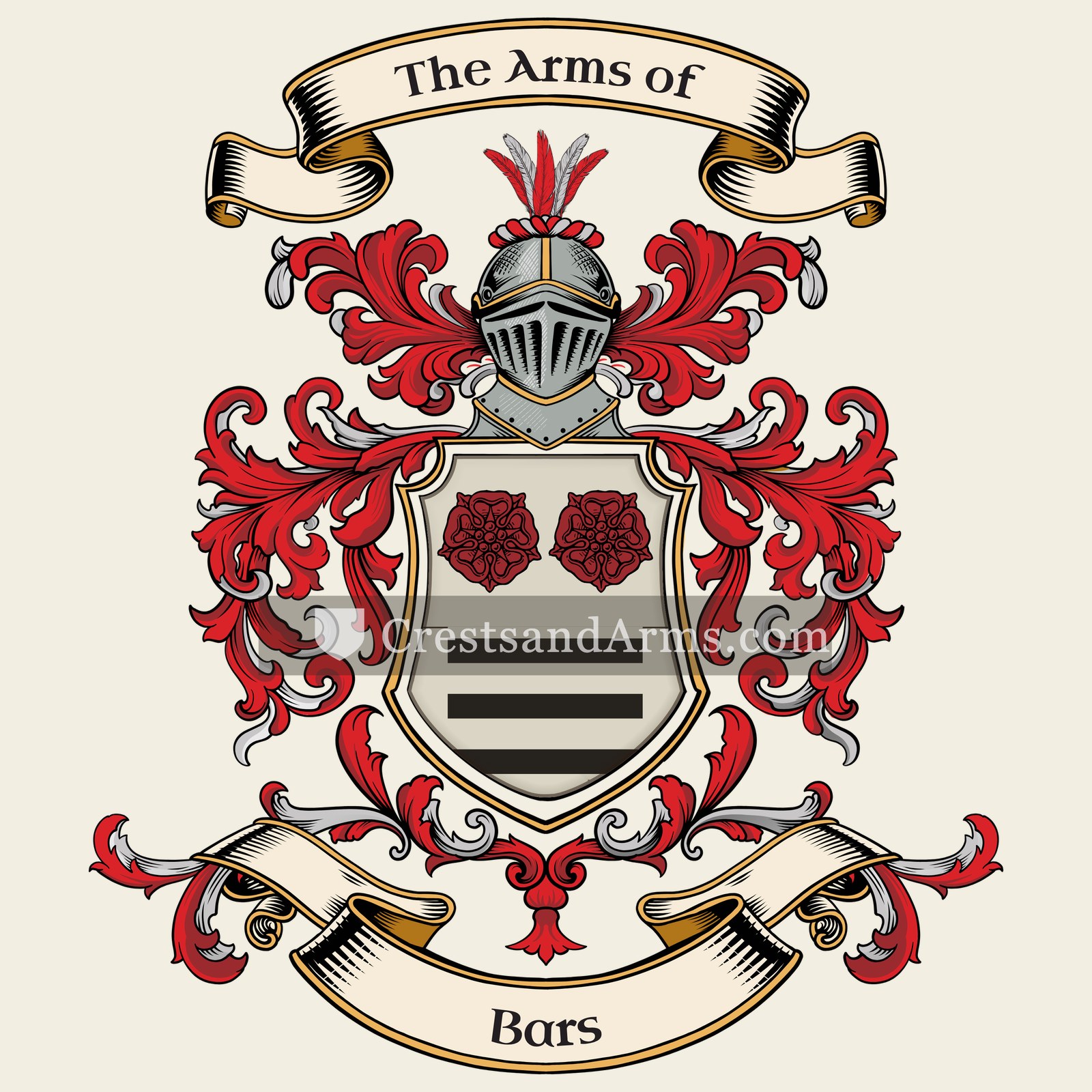


 mountThe ground held, and steadfastness upon it
 knightChivalry and service in arms
 mulletThe third son, and a divine quality from above
 lionCourage, strength and royalty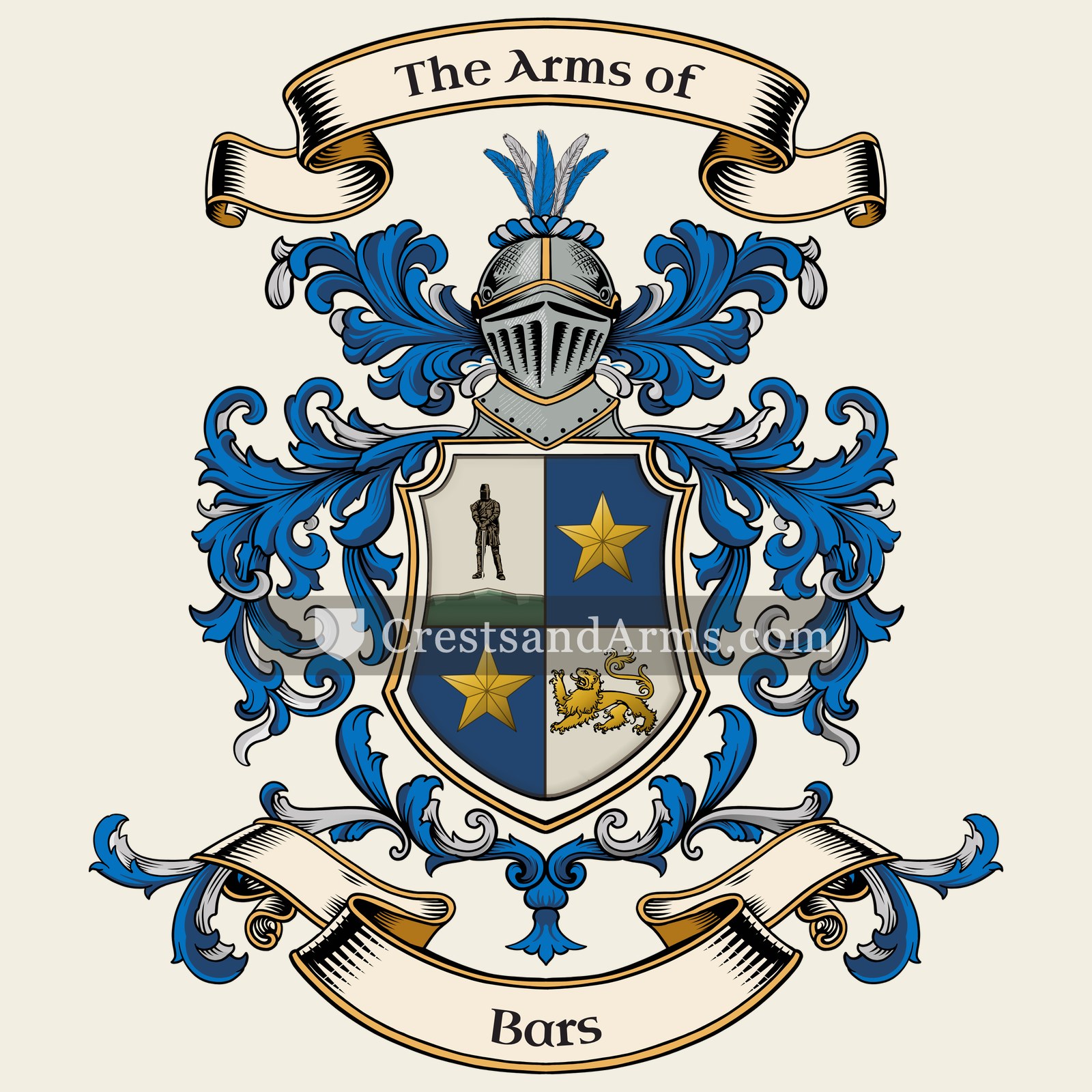


 paleMilitary strength, and a fortified defence
 chiefAuthority, wisdom and dominion