Map of England showing where the Bartnik arms are recorded
The Bartnik arms were recorded in London, c. 1416.
This is where the arms were entered in the register. Families often moved to other parts of the country, so the same name can turn up in more than one region.
The body that granted and recorded arms in England in this period.
Henry V of England
Sovereign of the period
Henry V of England
1413–1422
Reigning in England when the Bartnik arms are first recorded.
How Arms Worked in England
English heraldry allowed arms to be shared by all legitimate descendants of the original owner. These symbols were treated as personal property that moved through the generations to all children. While the eldest son kept the original design, other family members could use the same shield without needing to change it or register their own unique versions.
Granting authority
The College of Arms in London has regulated the use of coats of arms throughout England and Wales since 1484.
How they got arms
Families typically obtained their coats of arms through a formal grant from the Crown or by proving their ancient right to them.
Where arms were recorded
All official coats of arms are recorded in the registers kept at the College of Arms, which date back to the fifteenth century.
The family's standing
Recorded among the armigerous families of England.
Origin & History of the Bartnik Family in England
The surname Bartnik carries a history rooted in the professional life of medieval Europe, specifically relating to the occupation of a beekeeper or one who managed forest hives. While the name is of Slavic origin, records confirm that individuals bearing this name were present in London as early as 1416. During the fifteenth century, London was a bustling center of trade that attracted skilled workers and merchants from across the continent. Those who arrived with the name Bartnik likely integrated into the city’s complex guild system, where their expertise in natural resources or trade would have been valued. Over time, these early settlers helped bridge the gap between their ancestral traditions and the growing commercial landscape of England. By establishing themselves in the capital, these early family members became part of the diverse tapestry of London’s historical population, moving from their origins as forest specialists to becoming residents of a major medieval metropolis.
Meaning of the Bartnik family crest colors & symbols
Symbols on this shield
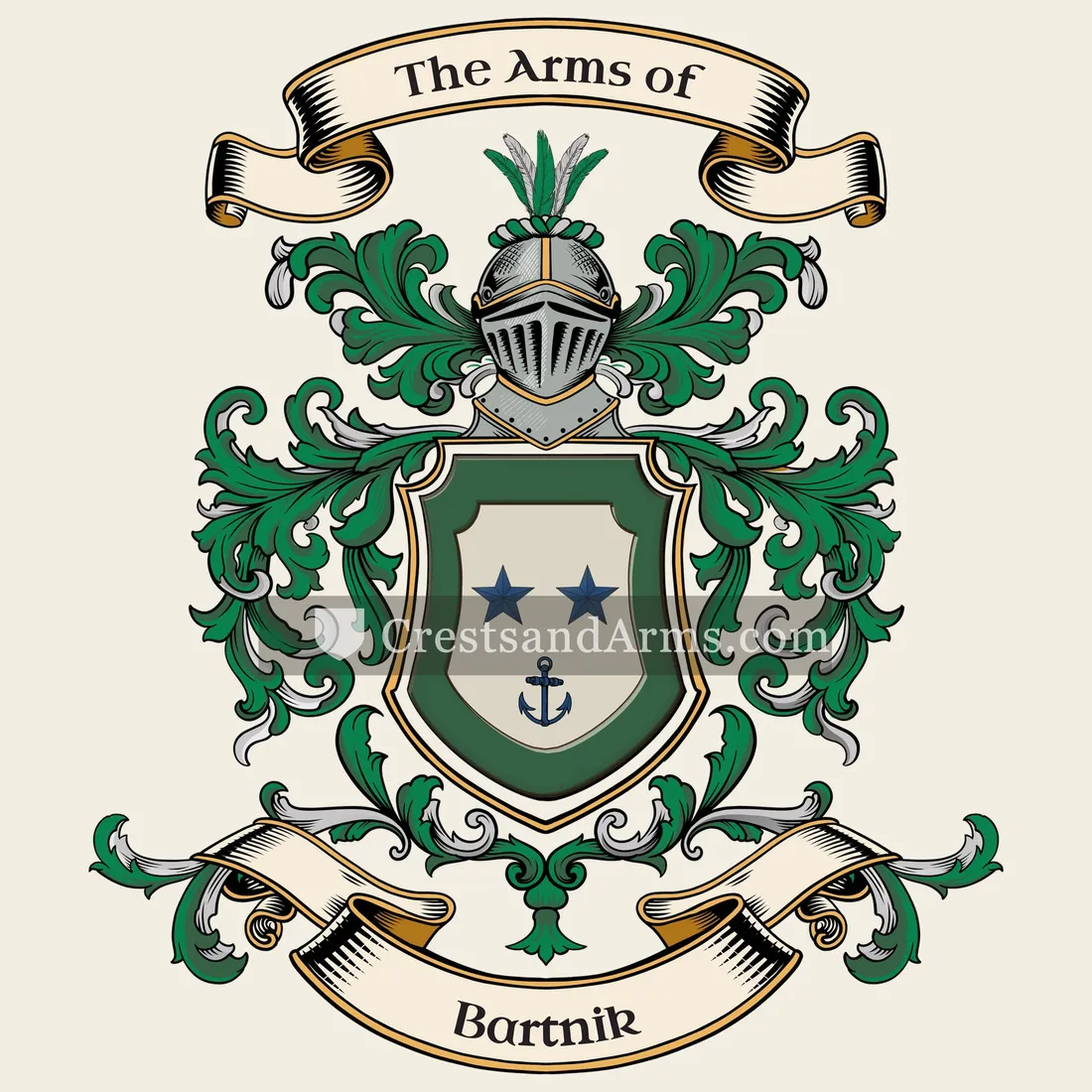
bordureA difference between branches of one family
anchorHope, and steadfastness in trouble
mulletThe third son, and a divine quality from above
Colours
Silver (Argent)Means: Peace and sincerity
Green (Vert)Means: Hope
Blue (Azure)Means: Loyalty and truth
Historical info
Source
Sir Bernard Burke, The General Armory of England, Scotland, Ireland and Wales, London: Harrison & Sons, 1884
Blazon (the actual original written record)
“Ar. an anchor in pale az. placed in the sea ppr. betw. two mullets of the second all within a bordure vert”
EdinburghEdinburgh, c. 1672
Digital archive packCoat of arms PNG, gold border print PDF, vector SVG and the certificate of authenticity. Sent to your email in minutes.
Map of Scotland showing where the Bartnik arms are recorded
The Bartnik arms were recorded in Edinburgh, c. 1672.
Edinburgh was the seat of Scotland's government, its courts and its heralds. Families with business there settled nearby, and being close to where arms were recorded is exactly why so many of them appear.
This is where the arms were entered in the register. Families often moved to other parts of the country, so the same name can turn up in more than one region.
The body that granted and recorded arms in Scotland in this period.
Charles II of England
Sovereign of the period
Charles II of England
1660–1685
Reigning in England when the Bartnik arms are first recorded.
How Arms Worked in Scotland
Scottish heraldry is unique because it treats a coat of arms as a piece of personal property protected by law. Only one person can own a specific design at any given time. When a family grows, the head keeps the original shield while other relatives must apply for their own distinct version with slight changes to prove their specific identity.
Granting authority
The Court of the Lord Lyon acts as the official body that regulates and controls all heraldic matters throughout Scotland.
How they got arms
Individuals obtain a legal right to their arms through a formal petition process that confirms their identity and family connection.
Where arms were recorded
All valid coats of arms are officially entered into the Public Register of All Arms and Bearings starting from 1672.
The family's standing
Recorded among the armigerous families of Edinburgh.
Origin & History of the Bartnik Family in Scotland
The surname Bartnik is traditionally rooted in Slavic origins, where it served as an occupational descriptor for a beekeeper or a forest worker who tended to wild honeybees. While the name is not native to the Scottish Highlands or Lowlands, records confirm that members of the family were established in Edinburgh by 1672. During this period, Scotland was a hub of international trade and intellectual exchange, which likely drew skilled laborers and merchants from across Europe to the capital city. These early settlers would have integrated into the local community by adapting their professional skills to the Scottish economy. Over time, the family name became a part of the diverse social fabric of Edinburgh, reflecting the city’s history as a place where people from various backgrounds settled to build new lives.
Meaning of the Bartnik family crest colors & symbols
Symbols on this shield
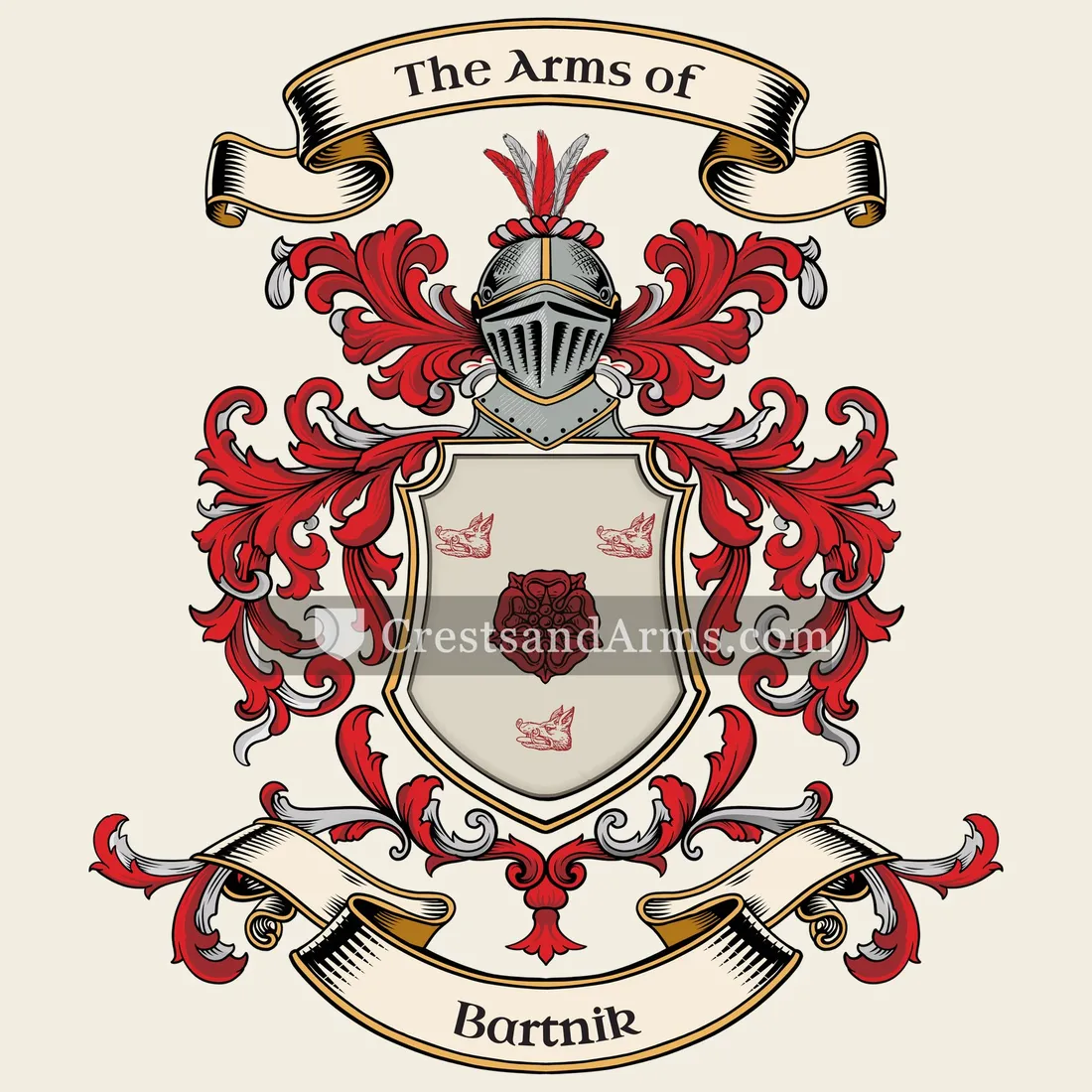
roseThe seventh son, and beauty with grace
boars headA fierce fighter who battles to the end
Colours
Silver (Argent)Means: Peace and sincerity
Red (Gules)Means: Military strength
Historical info
Source
Sir Bernard Burke, The General Armory of England, Scotland, Ireland and Wales, London: Harrison & Sons, 1884
Blazon (the actual original written record)
“Ar. a rose betw. three boars' heads erased gu”
TipperaryGrove · Tipperary, c. 1645
Digital archive packCoat of arms PNG, gold border print PDF, vector SVG and the certificate of authenticity. Sent to your email in minutes.
Map of Ireland showing where the Bartnik arms are recorded
The Bartnik arms were recorded in Tipperary, c. 1645.
Tipperary was the best grazing land in Ireland, held by a small number of powerful families. Land of that value stayed in the same hands, and unbroken holding is what puts a name in the records.
This is where the arms were entered in the register. Families often moved to other parts of the country, so the same name can turn up in more than one region.
The body that granted and recorded arms in Ireland in this period.
Charles I of England
Sovereign of the period
Charles I of England
1625–1649
Reigning in England when the Bartnik arms are first recorded.
How Arms Worked in Ireland
The Ulster King of Arms granted coats of arms to individuals who proved their social standing and good character. These symbols were typically inherited by all legitimate descendants of the original holder. If a family branch wanted a unique look, they could apply for a specific change to their design through the office to ensure their identity remained distinct.
Granting authority
The Ulster King of Arms acted as the official body that regulated and issued all coats of arms throughout Ireland.
How they got arms
Families obtained their arms through formal grants issued by the office after proving their eligibility and paying the required fees.
Where arms were recorded
All official grants were recorded in the registers held by the Ulster King of Arms starting from the year 1552.
The family's standing
Recorded among the armigerous families of Tipperary.
Origin & History of the Bartnik Family in Ireland
The history of the Bartnik name in Ireland is a unique study of migration and integration during a period of great upheaval. While the name is of Slavic origin, historical records confirm that members of the family were firmly established in County Tipperary by 1645. During the mid-seventeenth century, Ireland experienced significant political instability, including the Cromwellian conquest which led to the displacement of many families. The presence of the Bartnik family in Tipperary during this time suggests they were part of a small wave of continental Europeans who settled in rural Ireland, likely drawn by opportunities in agriculture or trade. Over the following generations, the family adapted to the local customs and social structures of the region. By integrating into the Tipperary community, they transitioned from outsiders to established residents, leaving a lasting mark on the local history of the area despite their distinct linguistic roots.
Bartnik Meaning & Related Branches
Root word
Bartłomiej
A Polish form of Bartholomew meaning son of Talmai.
This name
BartnikAn occupational surname for a beekeeper or someone who tended to beehives.
also spelled
Barten
Documented Sources
Sir Bernard Burke, The General Armory of England, Scotland, Ireland and Wales, London: Harrison & Sons, 1884
The National Archives, Early Chancery Proceedings, C 1/13/164
London Metropolitan Archives, Corporation of London Records Office, Letter Book I
Reaney, P.H. and Wilson, R.M., A Dictionary of English Surnames, 1991
Dunkling, Leslie, The Guinness Book of Names, 1993
Digital archive packCoat of arms PNG, gold border print PDF, vector SVG and the certificate of authenticity. Sent to your email in minutes.


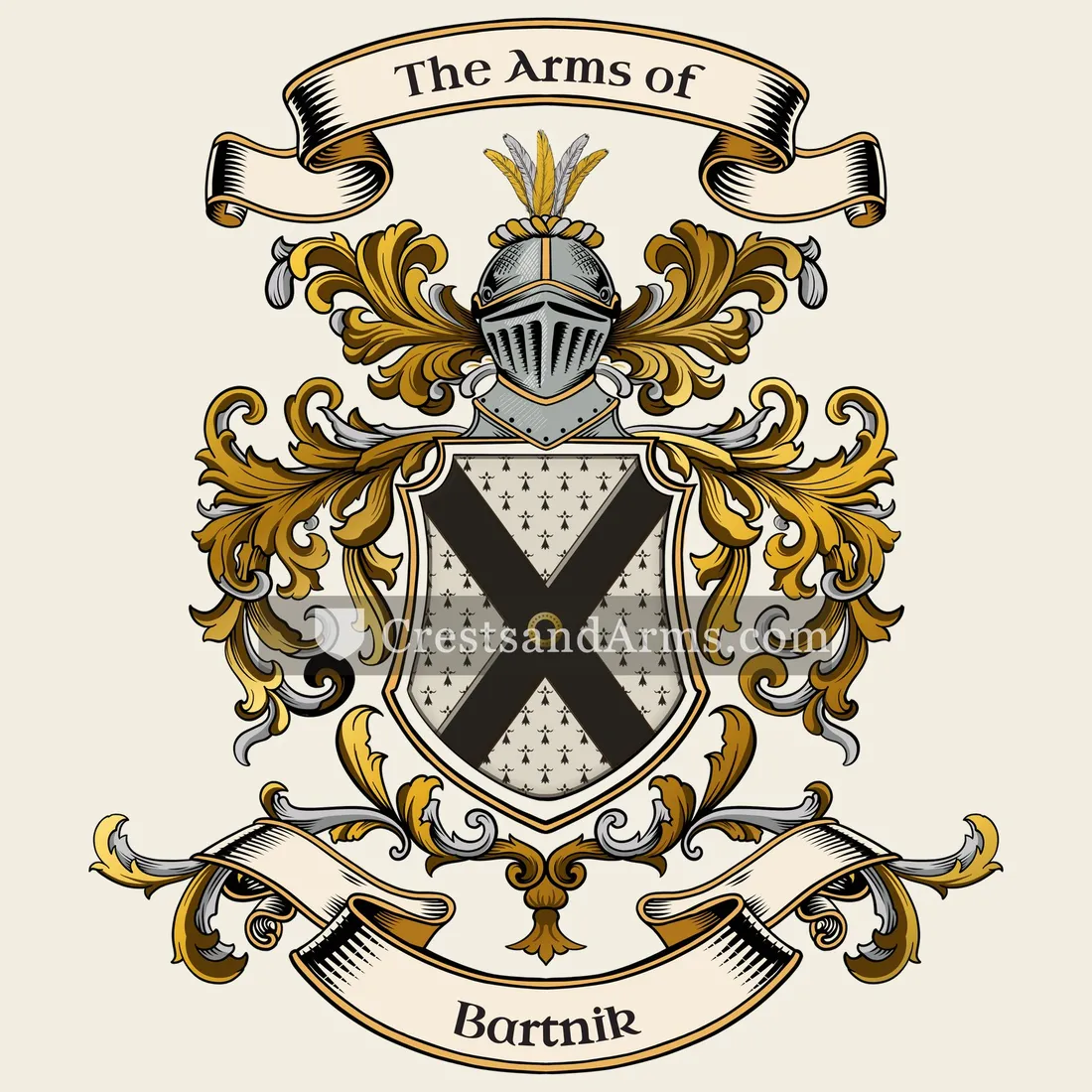
 saltireResolution, and St Andrew's cross
 ringFidelity, and a promise kept
 saltireResolution, and St Andrew's cross
 ringFidelity, and a promise kept


 bordureA difference between branches of one family
 anchorHope, and steadfastness in trouble
 mulletThe third son, and a divine quality from above


 roseThe seventh son, and beauty with grace
 boars headA fierce fighter who battles to the end