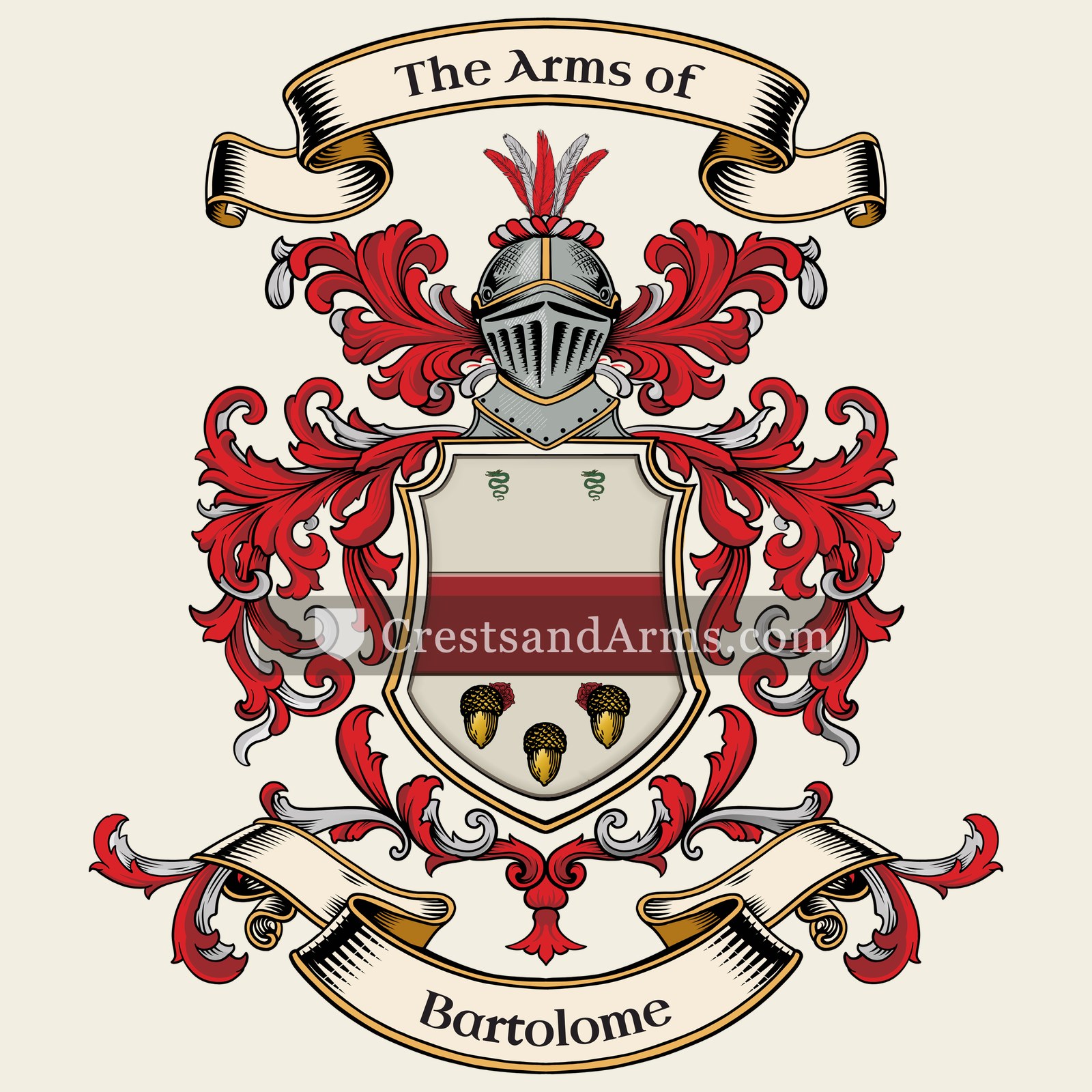
A record of documented arms, meaning and origin, researched for the Bartolome family of Belgium.
Reg. 7038 · Belgian, A–C
Coat of Arms & Family Crest Details
Symbols on this shield
fessThe military belt, and readiness to serve
saltireResolution, and St Andrew's cross
serpentWisdom, healing and prudence
roseThe seventh son, and beauty with grace
acornAntiquity and strength from small beginnings
Colours
Silver (Argent)Means: Peace and sincerity
Red (Gules)Means: Military strength
Green (Vert)Means: Hope
Gold (Or)Means: Generosity
Historical info
Source
J. B. Rietstap, Armorial Général, Gouda: G. B. van Goor Zonen, 1884–87
Blazon (the actual original written record)
“D'arg. à la fasce de gu., acc. en chef de deux serpents couchés de sin., passés en saut., les têtes à dextre; lesdits serpents accostés de deux roses de gu., bout. d'or, tigées et feuillées de sin.; la fasce acc. en p. de trois glands d'or aux coques de sin., tigés et feuillés du même, la queue en bas. C.: une rose tigée et feuillée de l'écu.”
LiegeLiege, c. 1737
Digital archive packCoat of arms PNG, gold border print PDF, vector SVG and the certificate of authenticity. Sent to your email in minutes.
Map of Belgium showing where the Bartolome arms are recorded
The Bartolome arms were recorded in Liege, c. 1737.
Liege was a prosperous town and its surrounding country, living on metalworking and trade. Merchant families grew rich, bought land outside the walls, and took arms as landowners rather than tradesmen.
This is where the arms were entered in the register. Families often moved to other parts of the country, so the same name can turn up in more than one region.
The body that granted and recorded arms in Belgium in this period.
Charles VI, Holy Roman Emperor
Sovereign of the period
Charles VI, Holy Roman Emperor
1711–1740
Reigning in Belgium when the Bartolome arms are first recorded.
How Arms Worked in Belgium
In Belgium, a coat of arms is considered personal property that is passed down through the male line to legitimate descendants. Families often use the same shield design across generations to show their shared heritage. If a branch of the family wants to change the design, they must apply for an official update to their specific version of the arms.
Granting authority
The Conseil héraldique is the official body that regulates and approves all coats of arms in Belgium.
How they got arms
Families obtain their coats of arms through formal royal grants or by confirming their historical right to use existing designs.
Where arms were recorded
All approved coats of arms are officially recorded in the public registers of the Conseil héraldique since 1844.
The family's standing
Recorded among the armigerous families of Liege.
Origin & History of the Bartolome Family in Belgium
The surname Bartolome originates from the personal name Bartholomew, which traces its roots back to the Aramaic language. Over many centuries, this name evolved into a family identifier as surnames became necessary for record-keeping across Europe. By the year 1737, historical documents confirm that members of the Bartolome family were established in the city of Liège. During this period, Liège was a prominent center for trade and industry within the Prince-Bishopric of Liège. Families living in this region often worked in skilled crafts or local administration, contributing to the growth of the city during the eighteenth century. The presence of the name in these early civic records suggests that the family was well-integrated into the social and economic life of the community long before the modern era.
Related Branches & Arms
Root word
Bar-Talmai
Aramaic for son of the furrowed one or son of Talmai.
This name
BartolomeDerived from the Aramaic name Bartholomew, meaning son of the one who abounds in furrows.
also spelled
Bartolome
Bartholomy
Bartolomey
Bartholomew
Documented Sources
J. B. Rietstap, Armorial Général, Gouda: G. B. van Goor Zonen, 1884–87
Archives de l'État à Liège, Registres paroissiaux de la ville de Liège
Archives de l'État à Liège, Cour féodale de Liège
Dauzat, Albert, Dictionnaire étymologique des noms de famille et prénoms de France, 1951
Herbillon, Jules and Germain, Jean, Dictionnaire des noms de famille en Belgique romane et dans les régions limitrophes, 1996
Digital archive packCoat of arms PNG, gold border print PDF, vector SVG and the certificate of authenticity. Sent to your email in minutes.


 fessThe military belt, and readiness to serve
 saltireResolution, and St Andrew's cross
 serpentWisdom, healing and prudence
 roseThe seventh son, and beauty with grace
 acornAntiquity and strength from small beginnings
 fessThe military belt, and readiness to serve
 saltireResolution, and St Andrew's cross
 serpentWisdom, healing and prudence
 roseThe seventh son, and beauty with grace
 acornAntiquity and strength from small beginnings