Map of England showing where the Barton arms are recorded
The Barton arms were recorded in London, c. 1416.
This is where the arms were entered in the register. Families often moved to other parts of the country, so the same name can turn up in more than one region.
The body that granted and recorded arms in England in this period.
Henry V of England
Sovereign of the period
Henry V of England
1413–1422
Reigning in England when the Barton arms are first recorded.
How Arms Worked in England
English heraldry allowed arms to be shared by all legitimate descendants of the original owner. These symbols were treated as personal property that moved through the generations to all children. While the eldest son kept the original design, other family members could use the same shield without needing to change it or register their own unique versions.
Granting authority
The College of Arms in London has regulated the use of coats of arms throughout England and Wales since 1484.
How they got arms
Families typically obtained their coats of arms through a formal grant from the Crown or by proving their ancient right to them.
Where arms were recorded
All official coats of arms are recorded in the registers kept at the College of Arms, which date back to the fifteenth century.
The family's standing
Recorded among the armigerous families of England.
Origin & History of the Barton Family in England
The name Barton originated as a descriptive term in medieval England, typically referring to someone who lived near a "barton," which was a common word for the demesne lands or the farmyard of a manor house. Because this term was used across many different regions, families with this name often emerged independently in various counties rather than descending from a single ancestor. By the early fifteenth century, the name was well-established in urban centers, including a notable presence in London by 1416. During this period, individuals named Barton were often involved in the city’s growing trade networks and civic life. As the family grew, they moved from being identified simply by their proximity to a specific farm to becoming recognized as a distinct lineage within the developing social structure of English society.
Meaning of the Barton family crest colors & symbols
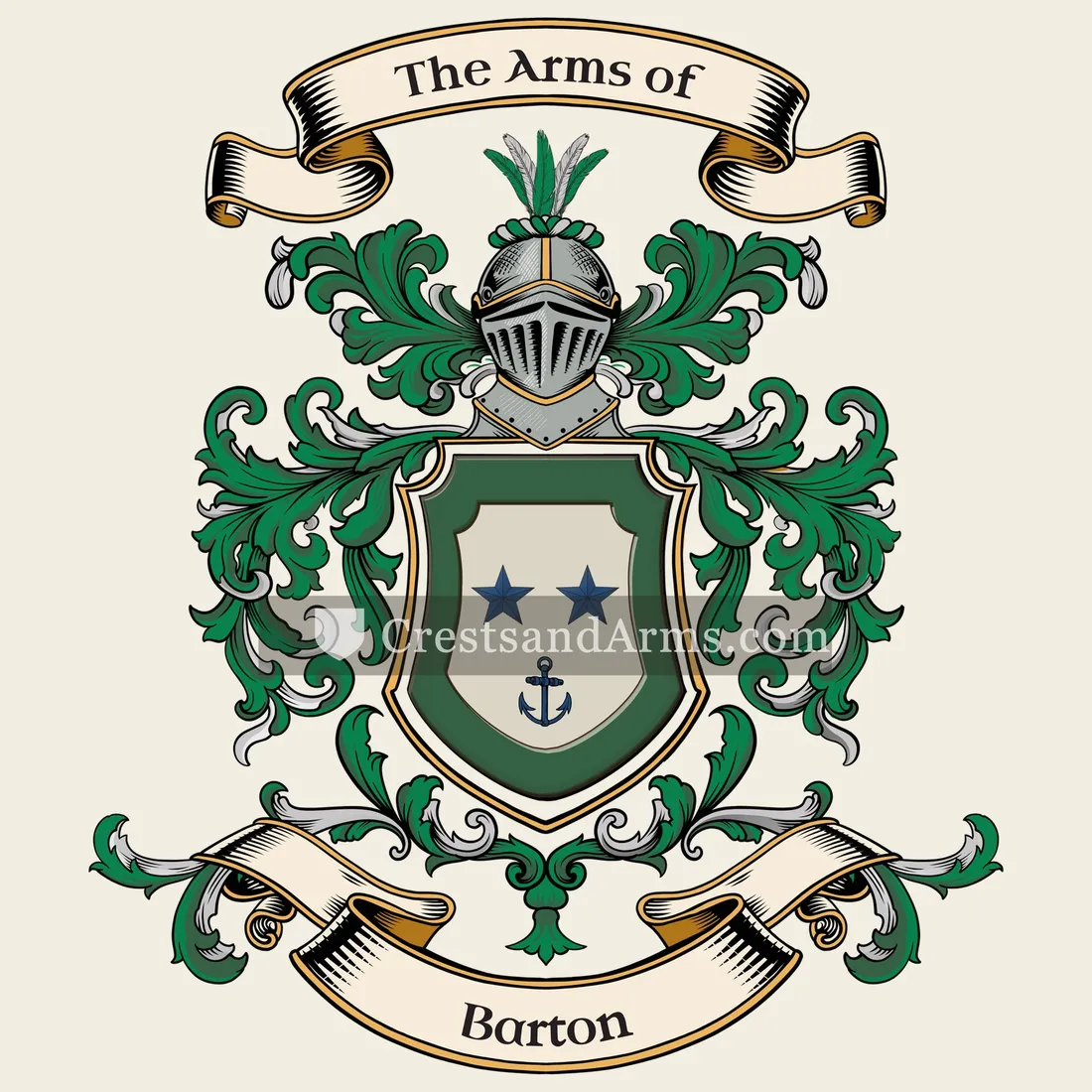
Symbols on this shield
bordureA difference between branches of one family
anchorHope, and steadfastness in trouble
mulletThe third son, and a divine quality from above
Colours
Silver (Argent)Means: Peace and sincerity
Green (Vert)Means: Hope
Blue (Azure)Means: Loyalty and truth
Historical info
Source
Sir Bernard Burke, The General Armory of England, Scotland, Ireland and Wales, London: Harrison & Sons, 1884
Blazon (the actual original written record)
“Ar. an anchor in pale az. placed in the sea ppr. betw. two mullets of the second all within a bordure vert”
EdinburghEdinburgh, c. 1672
Digital archive packCoat of arms PNG, gold border print PDF, vector SVG and the certificate of authenticity. Sent to your email in minutes.
Map of Scotland showing where the Barton arms are recorded
The Barton arms were recorded in Edinburgh, c. 1672.
Edinburgh was the seat of Scotland's government, its courts and its heralds. Families with business there settled nearby, and being close to where arms were recorded is exactly why so many of them appear.
This is where the arms were entered in the register. Families often moved to other parts of the country, so the same name can turn up in more than one region.
The body that granted and recorded arms in Scotland in this period.
Charles II of England
Sovereign of the period
Charles II of England
1660–1685
Reigning in England when the Barton arms are first recorded.
How Arms Worked in Scotland
Scottish heraldry is unique because it treats a coat of arms as a piece of personal property protected by law. Only one person can own a specific design at any given time. When a family grows, the head keeps the original shield while other relatives must apply for their own distinct version with slight changes to prove their specific identity.
Granting authority
The Court of the Lord Lyon acts as the official body that regulates and controls all heraldic matters throughout Scotland.
How they got arms
Individuals obtain a legal right to their arms through a formal petition process that confirms their identity and family connection.
Where arms were recorded
All valid coats of arms are officially entered into the Public Register of All Arms and Bearings starting from 1672.
The family's standing
Recorded among the armigerous families of Edinburgh.
Origin & History of the Barton Family in Scotland
The name Barton has deep roots in the history of Scotland, where it functioned as a topographic surname derived from the Old English words for a barley enclosure or farm. By the time the family was firmly established in Edinburgh in 1672, they were already integrated into the complex social fabric of the city. During this period, Edinburgh was a bustling center of trade and law, and families with this name often held roles as merchants or skilled craftsmen who contributed to the growing urban economy. The name reflects a history of people who lived on or managed specific agricultural lands before moving into the capital to seek new opportunities. As the family settled in the city, they became part of the local records that tracked property ownership and civic duties, marking their transition from rural landowners to active participants in Scottish city life.
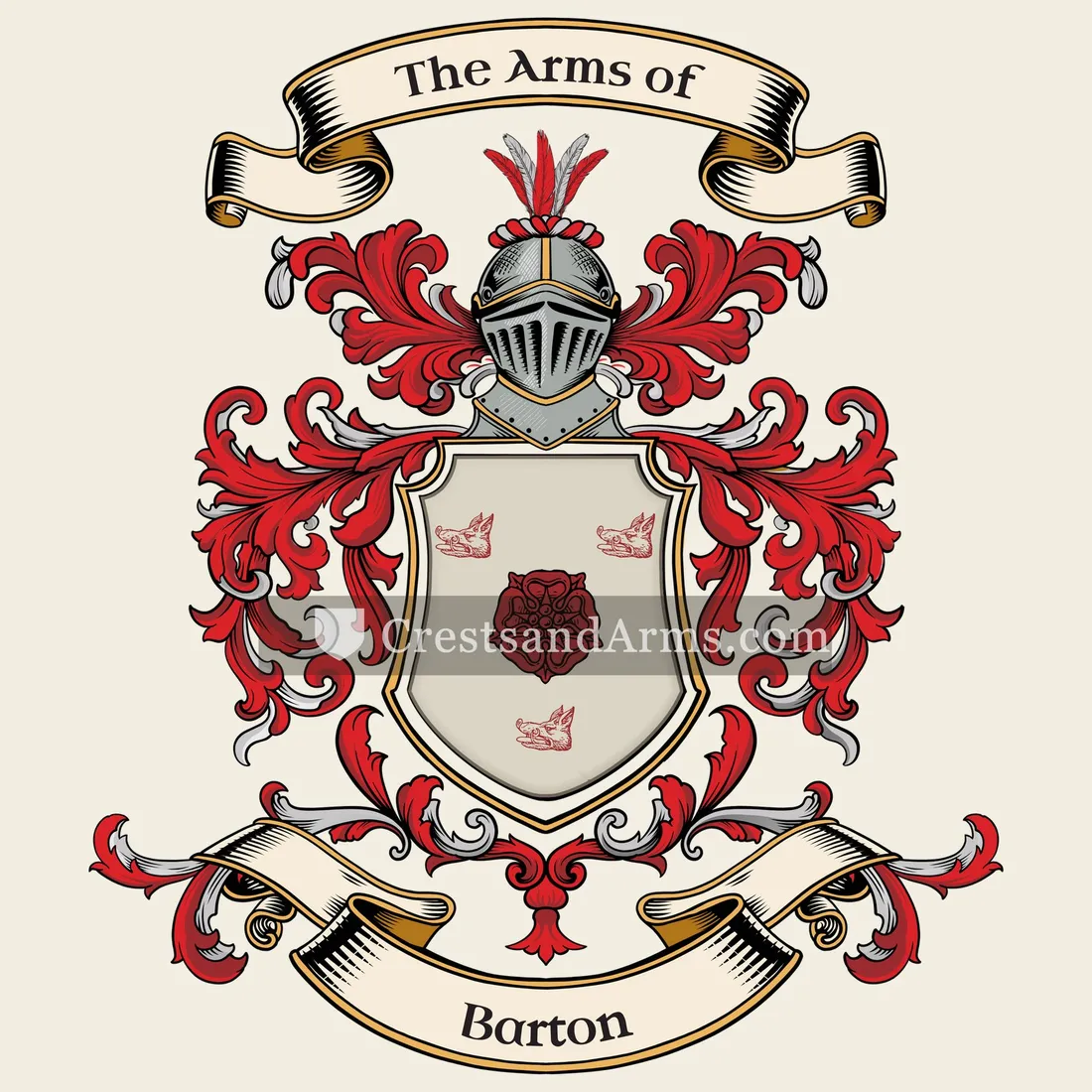
Meaning of the Barton family crest colors & symbols
Symbols on this shield
roseThe seventh son, and beauty with grace
boars headA fierce fighter who battles to the end
Colours
Silver (Argent)Means: Peace and sincerity
Red (Gules)Means: Military strength
Historical info
Source
Sir Bernard Burke, The General Armory of England, Scotland, Ireland and Wales, London: Harrison & Sons, 1884
Blazon (the actual original written record)
“Ar. a rose betw. three boars' heads erased gu”
TipperaryGrove · Tipperary, c. 1645
Digital archive packCoat of arms PNG, gold border print PDF, vector SVG and the certificate of authenticity. Sent to your email in minutes.
Map of Ireland showing where the Barton arms are recorded
The Barton arms were recorded in Tipperary, c. 1645.
Tipperary was the best grazing land in Ireland, held by a small number of powerful families. Land of that value stayed in the same hands, and unbroken holding is what puts a name in the records.
This is where the arms were entered in the register. Families often moved to other parts of the country, so the same name can turn up in more than one region.
The body that granted and recorded arms in Ireland in this period.
Charles I of England
Sovereign of the period
Charles I of England
1625–1649
Reigning in England when the Barton arms are first recorded.
How Arms Worked in Ireland
The Ulster King of Arms granted coats of arms to individuals who proved their social standing and good character. These symbols were typically inherited by all legitimate descendants of the original holder. If a family branch wanted a unique look, they could apply for a specific change to their design through the office to ensure their identity remained distinct.
Granting authority
The Ulster King of Arms acted as the official body that regulated and issued all coats of arms throughout Ireland.
How they got arms
Families obtained their arms through formal grants issued by the office after proving their eligibility and paying the required fees.
Where arms were recorded
All official grants were recorded in the registers held by the Ulster King of Arms starting from the year 1552.
The family's standing
Recorded among the armigerous families of Tipperary.
Origin & History of the Barton Family in Ireland
The Barton family name in Ireland is deeply rooted in the history of County Tipperary, where members of the family were firmly established by 1645. While the name itself has English origins, referring to a barley farm or a demesne land, those who settled in Ireland often integrated into the local social and political landscape during a period of significant upheaval. By the mid-seventeenth century, the Bartons were part of a shifting demographic, often associated with the land-owning classes who navigated the complex transitions of the Cromwellian era. Their presence in Tipperary suggests they were involved in the agricultural development of the region, which was a common path for families settling in the Irish midlands during that time. Over the following generations, the family became a fixture of the local community, blending their ancestral background with the unique cultural and economic environment of rural Ireland.
Barton Meaning & Related Branches
Root word
bere-tun
Old English terms for barley and an enclosed settlement or farm.
This name
BartonAn inhabitant of a farmstead where barley was grown or stored.
also spelled
Barten
Related arms
Beartonvariant spelling
Bertonvariant spelling
Aslack, Aslake, or Aslokerecorded with Barton, same area
Cockramrecorded with Barton, same area
Documented Sources
Sir Bernard Burke, The General Armory of England, Scotland, Ireland and Wales, London: Harrison & Sons, 1884
Bardsley, Charles Wareing, A Dictionary of English and Welsh Surnames, 1901
Ekwall, Eilert, The Concise Oxford Dictionary of English Place-names, 1960
Reaney, Percy Hide, A Dictionary of British Surnames, 1958
The National Archives, Calendar of Letter-Books of the City of London, Letter-Book I, 1400–1422
Digital archive packCoat of arms PNG, gold border print PDF, vector SVG and the certificate of authenticity. Sent to your email in minutes.


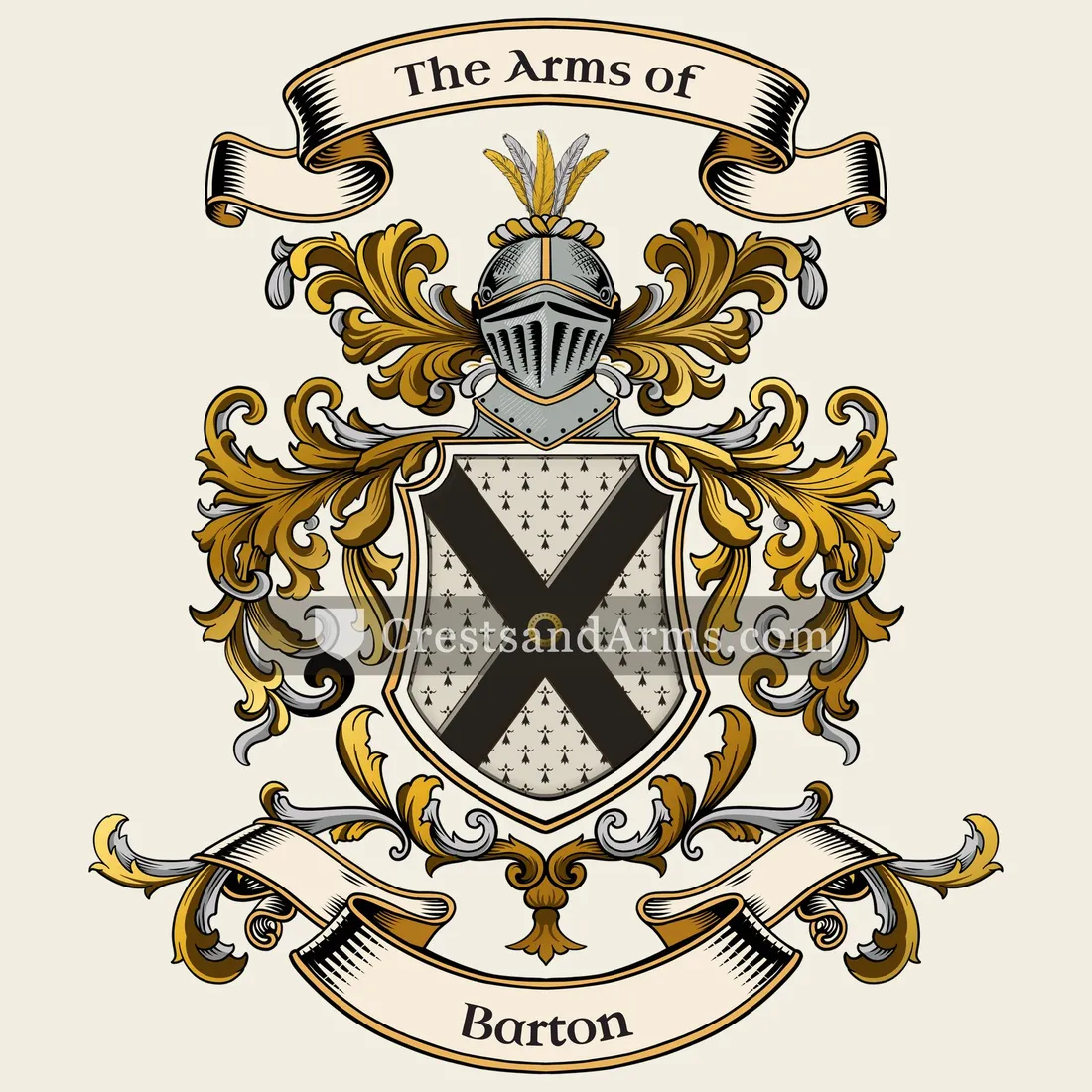
 saltireResolution, and St Andrew's cross
 ringFidelity, and a promise kept
 saltireResolution, and St Andrew's cross
 ringFidelity, and a promise kept


 bordureA difference between branches of one family
 anchorHope, and steadfastness in trouble
 mulletThe third son, and a divine quality from above


 roseThe seventh son, and beauty with grace
 boars headA fierce fighter who battles to the end