A record of documented arms, meaning and origin, researched for the Bartram family lines. Documented in 2 countries.
Reg. 1260 · Finnish, A–C
Coat of Arms & Family Crest Details
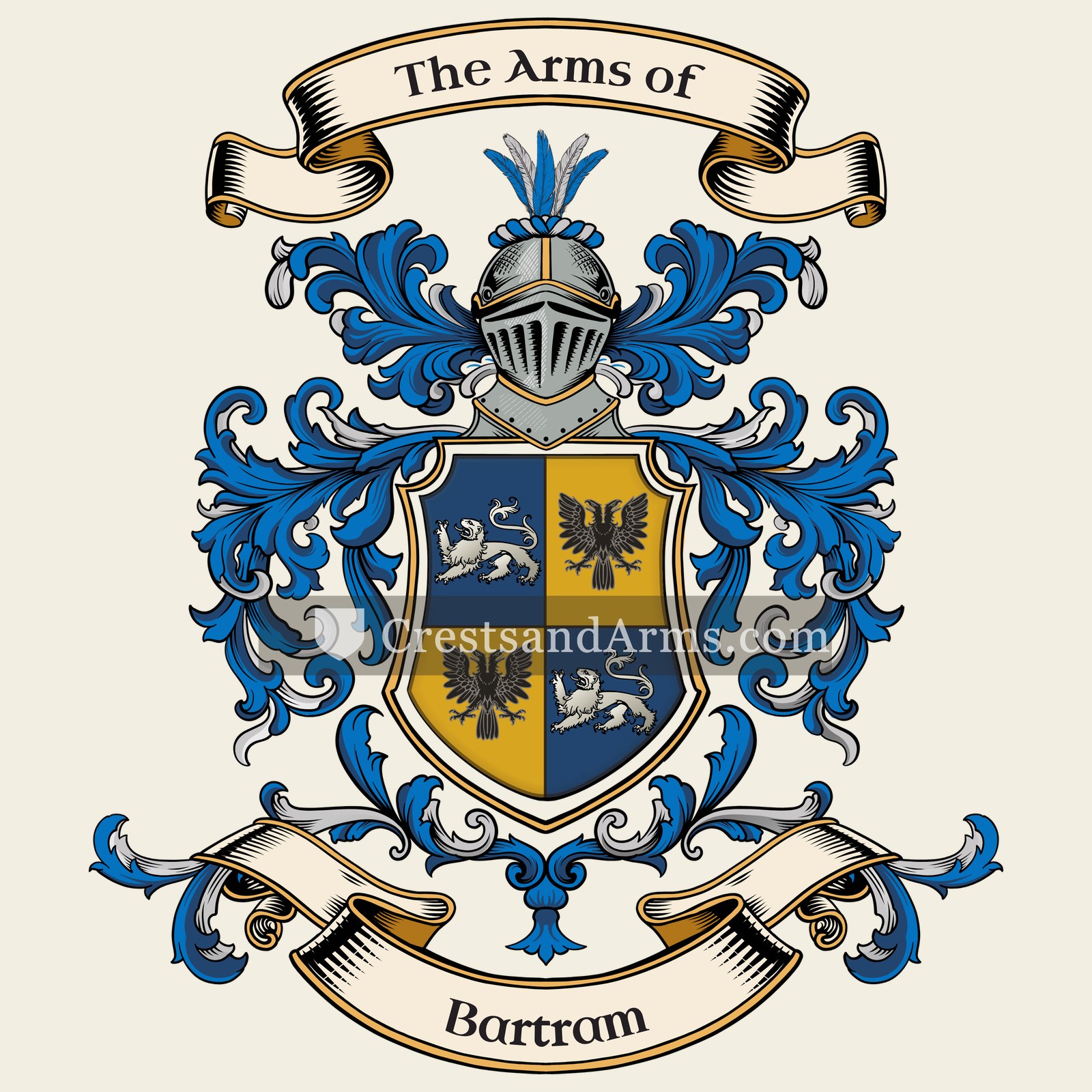
Symbols on this shield
lionCourage, strength and royalty
eagleNobility, strength and a keen mind
Colours
Blue (Azure)Means: Loyalty and truth
Gold (Or)Means: Generosity
Silver (Argent)Means: Peace and sincerity
Black (Sable)Means: Constancy
Historical info
Source
J. B. Rietstap, Armorial Général, Gouda: G. B. van Goor Zonen, 1884–87
Blazon (the actual original written record)
“Ec.: aux 1 et 4 d'azur au lion d'arg. celui du 1 cont.; aux 2 et 3 d'or à l'aigle de sa., celle du 3 cont. Sur le tout de sin. à cinq étoiles d'or, 2, et 2. Deux cq. cour. C.: 1° le lion du 1, iss.; l. d'arg et d'azur; 2° l'aigle du 2, iss.; l. d'or et de sa.”
Finlandc. 1792
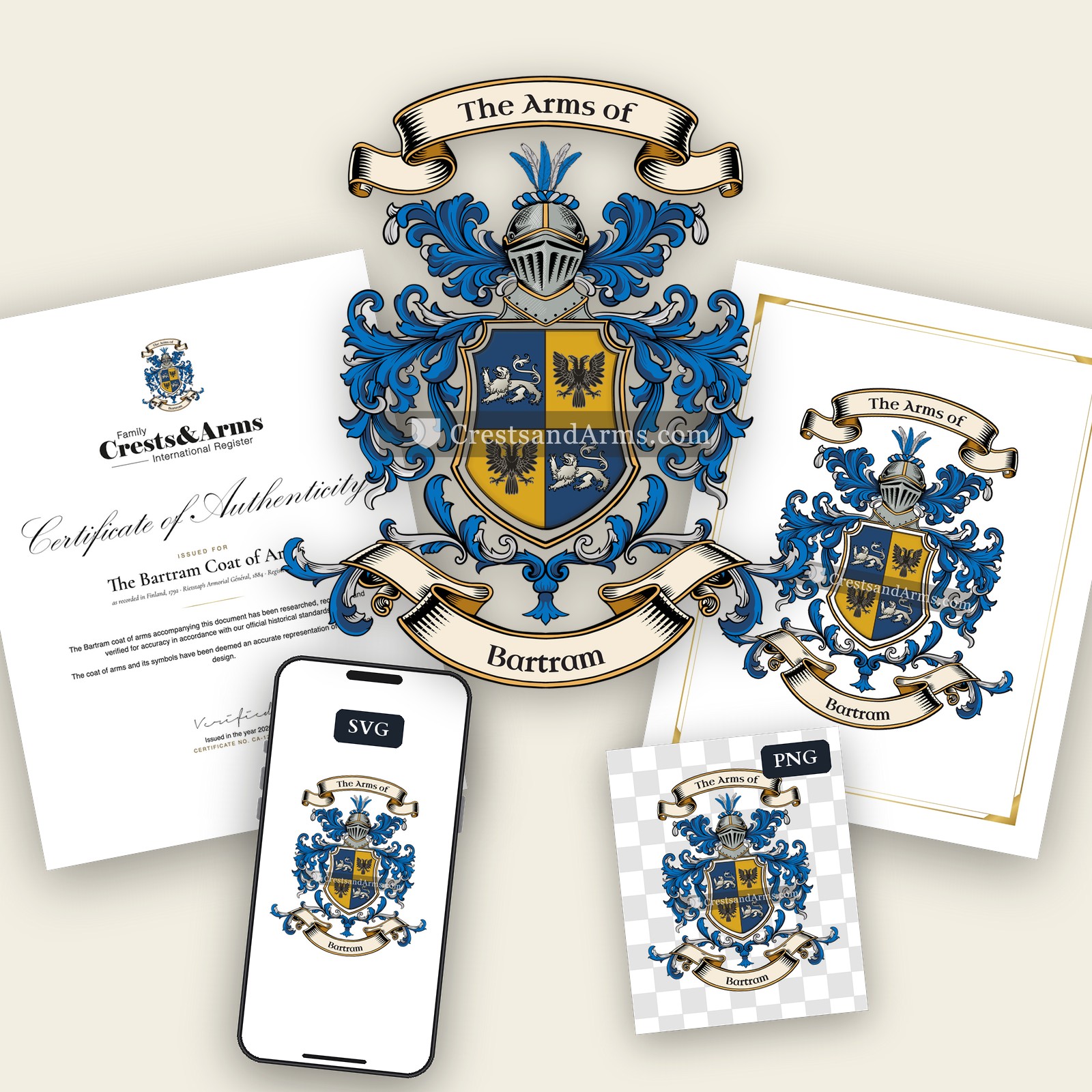
Digital archive packCoat of arms PNG, gold border print PDF, vector SVG and the certificate of authenticity. Sent to your email in minutes.
Map of Finland showing where the Bartram arms are recorded
The Bartram arms were recorded in Finland, c. 1792.
Arms such as these were typically recorded in Uusimaa.
Uusimaa was the Finnish coast facing Sweden, and the part of the country most closely tied to Stockholm. Its landowners and officers served the Swedish crown, and that service is what put their arms on record.
This is where the arms were entered in the register. Families often moved to other parts of the country, so the same name can turn up in more than one region.
The body that granted and recorded arms in Finland in this period.
How Arms Worked in Finland
Nobility in Finland held the exclusive right to register their coats of arms with the House of Nobility. These symbols were tied to the family name and were inherited by all members of the noble house. If a family branch moved or changed status, they kept their original design to maintain their identity within the official records.
Granting authority
The Finnish House of Nobility served as the official body that managed and protected all noble coats of arms.
How they got arms
Families received their arms through formal letters of nobility or by having their existing ancestral symbols confirmed by the House.
Where arms were recorded
All approved coats of arms were officially recorded in the Finnish House of Nobility Armorial starting in 1818.
The family's standing
Recorded among the armigerous families of Finland.
Origin & History of the Bartram Family in Finland
The history of the Bartram name in Finland is deeply rooted in the coastal region of Uusimaa, where early records confirm the family’s presence by 1792. During this period, Finland was part of the Swedish realm, and the name likely arrived through maritime trade routes or military service connections that linked the Nordic countries to the broader Baltic region. Families like the Bartrams often settled in these southern coastal areas because they were centers for commerce and administration. As the family established themselves in Uusimaa, they became part of the local social fabric, likely working as skilled craftsmen, farmers, or sailors. Their survival and growth in this specific region reflect the broader movement of people across the Baltic Sea during the late eighteenth century, marking the beginning of the family’s long-standing connection to Finnish history.
Coat of Arms & Family Crest Details
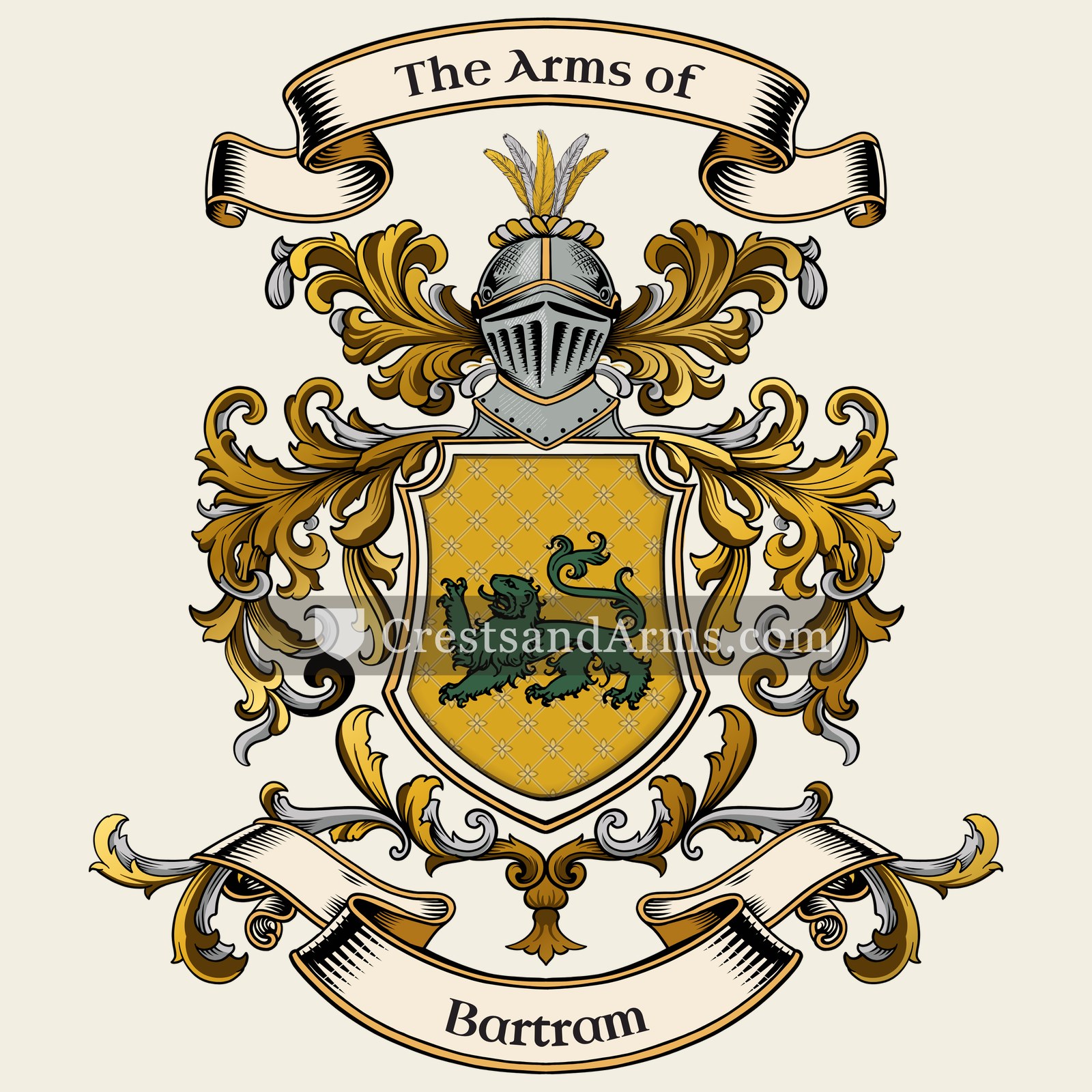
Symbols on this shield
lionCourage, strength and royalty
Colours
Gold (Or)Means: Generosity
Green (Vert)Means: Hope
Historical info
Source
Sir Bernard Burke, The General Armory of England, Scotland, Ireland and Wales, London: Harrison & Sons, 1884
Blazon (the actual original written record)
“Or, a lion ramp. vert”
Englandc. 1614
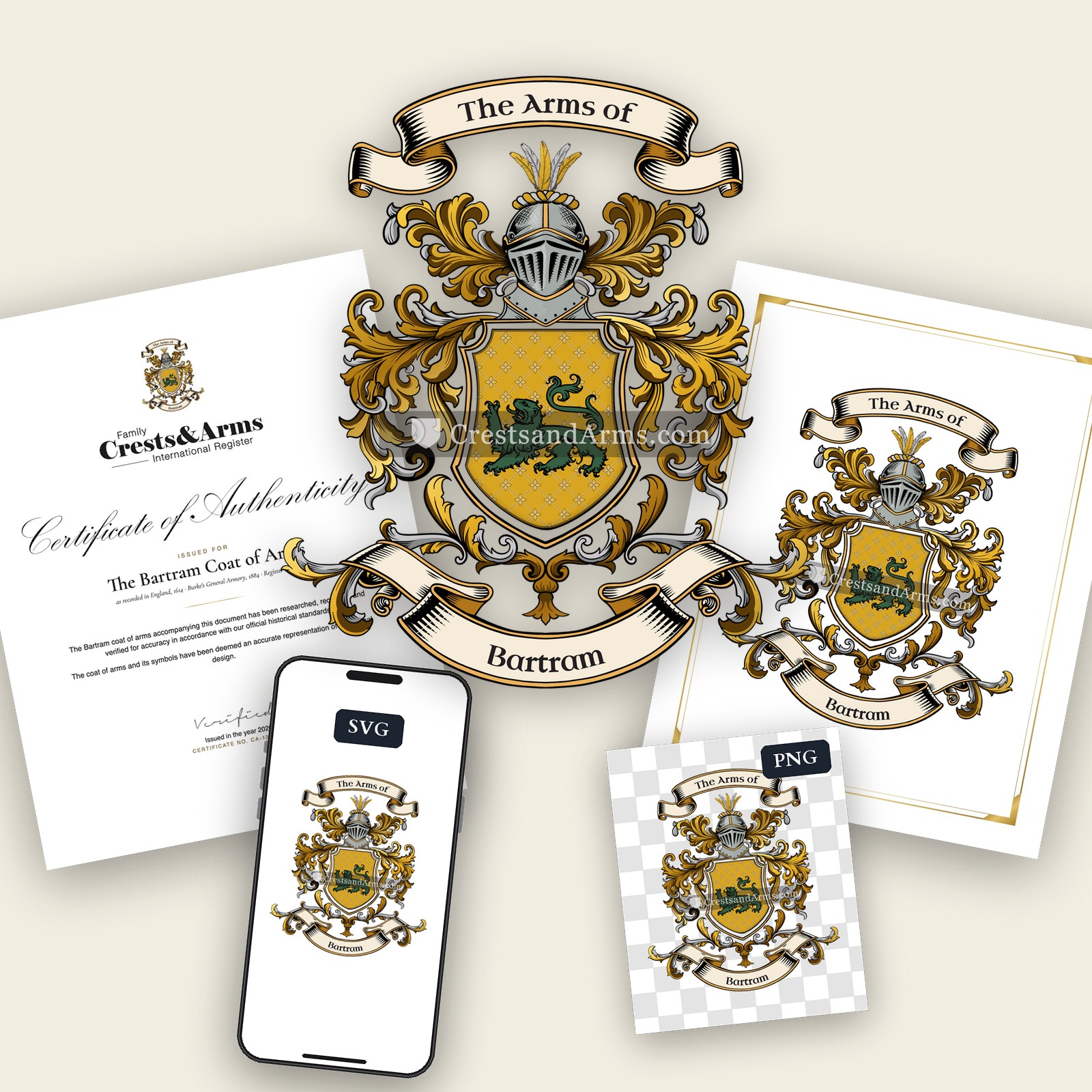
Digital archive packCoat of arms PNG, gold border print PDF, vector SVG and the certificate of authenticity. Sent to your email in minutes.
Map of England showing where the Bartram arms are recorded
The Bartram arms were recorded in England, c. 1614.
Arms such as these were typically recorded in York.
Yorkshire is the largest of the English counties, and it held more gentry families than any other. Land there was split among a great many households rather than a few, so a great many of them carried arms.
This is where the arms were entered in the register. Families often moved to other parts of the country, so the same name can turn up in more than one region.
The body that granted and recorded arms in England in this period.
James VI and I
Sovereign of the period
James VI and I
1603–1625
Reigning in Finland when the Bartram arms are first recorded.
How Arms Worked in England
English heraldry allowed arms to be shared by all legitimate descendants of the original owner. These symbols were treated as personal property that moved through the generations to all children. While the eldest son kept the original design, other family members could use the same shield without needing to change it or register their own unique versions.
Granting authority
The College of Arms in London has regulated the use of coats of arms throughout England and Wales since 1484.
How they got arms
Families typically obtained their coats of arms through a formal grant from the Crown or by proving their ancient right to them.
Where arms were recorded
All official coats of arms are recorded in the registers kept at the College of Arms, which date back to the fifteenth century.
The family's standing
Recorded among the armigerous families of England.
Origin & History of the Bartram Family in England
The surname Bartram has deep roots in Northern England, where it emerged as a variation of the ancient name Bertram. By the early seventeenth century, the family had established a clear presence in the city of York. Records from 1614 confirm that members of the Bartram family were living and working in this historic hub, which served as a major center for trade and administration in the north. During this period, families like the Bartrams often played active roles in the local economy, contributing to the growth of York as it transitioned through the Stuart era. The name itself reflects a long history of migration and linguistic evolution across the British Isles, moving from its Old Germanic origins into the distinct regional identity that characterized the families living in Yorkshire during the early 1600s.
Bartram Meaning & Related Branches
Root word
Bertram
Derived from the Germanic elements for bright and raven.
This name
BartramA surname of Germanic origin meaning bright raven, often associated with wisdom and intelligence.
also spelled
Bertram
Bartrum
Bartrim
Related arms
Geigersimilar arms
Bertramvariant spelling
Bortramvariant spelling
Documented Sources
J. B. Rietstap, Armorial Général, Gouda: G. B. van Goor Zonen, 1884–87
National Archives of Finland, HisKi-projektin seurakuntien kastettujen, vihittyjen ja haudattujen luettelot (Church records for Uusimaa parishes)
Pirjo Mikkonen and Sirkka Paikkala, Sukunimet, 2000
Digital archive packCoat of arms PNG, gold border print PDF, vector SVG and the certificate of authenticity. Sent to your email in minutes.


 lionCourage, strength and royalty
 eagleNobility, strength and a keen mind
 lionCourage, strength and royalty
 eagleNobility, strength and a keen mind