Map of England showing where the Barwick arms are recorded
The Barwick arms were recorded in Northumberland, c. 1620.
Northumberland was border country facing Scotland, raided and fought over for three hundred years. Families held their land in return for defending it, and a defending household carried a shield.
This is where the arms were entered in the register. Families often moved to other parts of the country, so the same name can turn up in more than one region.
The body that granted and recorded arms in England in this period.
James VI and I
Sovereign of the period
James VI and I
1603–1625
Reigning in England when the Barwick arms are first recorded.
How Arms Worked in England
English heraldry allowed arms to be shared by all legitimate descendants of the original owner. These symbols were treated as personal property that moved through the generations to all children. While the eldest son kept the original design, other family members could use the same shield without needing to change it or register their own unique versions.
Granting authority
The College of Arms in London has regulated the use of coats of arms throughout England and Wales since 1484.
How they got arms
Families typically obtained their coats of arms through a formal grant from the Crown or by proving their ancient right to them.
Where arms were recorded
All official coats of arms are recorded in the registers kept at the College of Arms, which date back to the fifteenth century.
The family's standing
Recorded among the armigerous families of Northumberland.
Origin & History of the Barwick Family in England
The surname Barwick is a locational name that originated from various places in England, most notably in Yorkshire and Norfolk. The name itself is derived from Old English words meaning a barley farm or an outlying grange. By the early 17th century, the family had established a notable presence in the northern county of Northumberland. During this period, members of the family were often involved in local agriculture and trade, which was common for families living in the rugged border regions of northern England. As the family settled into these northern lands, they became part of the local social fabric, contributing to the development of their communities through their work on the land and their participation in parish life. This migration from southern farming roots to the northern frontier highlights the mobility of families during the late Renaissance era as they sought new opportunities in different parts of the country.
Barwick Meaning & Related Branches
Root word
Berewic
Old English term for an outlying farm or corn farm.
This name
BarwickDerived from a place name referring to a settlement or farmstead located on the outskirts.
also spelled
Berwick
Barwyke
Related arms
Barwykevariant spelling
Berwickvariant spelling
Borwickvariant spelling
Documented Sources
Sir Bernard Burke, The General Armory of England, Scotland, Ireland and Wales, London: Harrison & Sons, 1884
Reaney, P.H., A Dictionary of English Surnames, 1991
Ekwall, Eilert, The Concise Oxford Dictionary of English Place-names, 1960


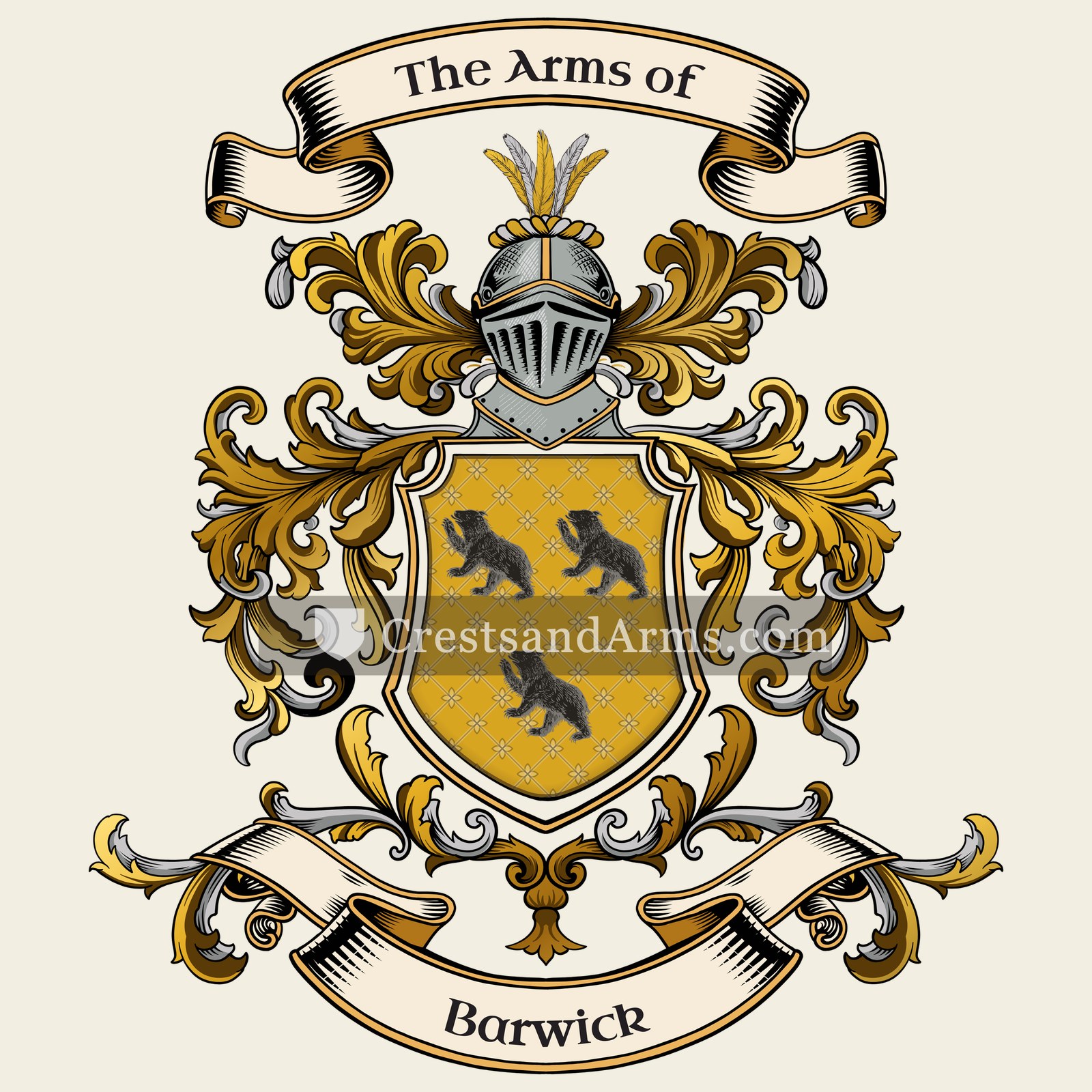
 bearStrength, cunning and protection of kin
 bearStrength, cunning and protection of kin