Map of Belgium showing where the Bary arms are recorded
The Bary arms were recorded in Tournai, c. 1737.
This is where the arms were entered in the register. Families often moved to other parts of the country, so the same name can turn up in more than one region.
The body that granted and recorded arms in Belgium in this period.
Charles VI, Holy Roman Emperor
Sovereign of the period
Charles VI, Holy Roman Emperor
1711–1740
Reigning in Belgium when the Bary arms are first recorded.
How Arms Worked in Belgium
In Belgium, a coat of arms is considered personal property that is passed down through the male line to legitimate descendants. Families often use the same shield design across generations to show their shared heritage. If a branch of the family wants to change the design, they must apply for an official update to their specific version of the arms.
Granting authority
The Conseil héraldique is the official body that regulates and approves all coats of arms in Belgium.
How they got arms
Families obtain their coats of arms through formal royal grants or by confirming their historical right to use existing designs.
Where arms were recorded
All approved coats of arms are officially recorded in the public registers of the Conseil héraldique since 1844.
The family's standing
Recorded among the armigerous families of Belgium.
Origin & History of the Bary Family in Belgium
The history of the Bary family in Belgium is deeply rooted in the cultural landscape of the city of Tournai. By the year 1737, records confirm that members of the family were already established residents within this historic municipality. During the eighteenth century, Tournai served as a vital center for trade and craftsmanship in the Southern Netherlands, which provided a stable environment for families to grow and contribute to the local economy. The name itself is thought to be linked to the geography of the region, as it likely served as a topographic identifier for people living near specific landmarks or settlements. As the family integrated into the social fabric of the city, they participated in the daily life of a community known for its resilience and long history of urban development. Over time, the presence of the Bary name in local documents reflects a steady progression of generations who helped shape the identity of the Tournai area during a period of significant regional transition.
Coat of Arms & Family Crest Details
Symbols on this shield
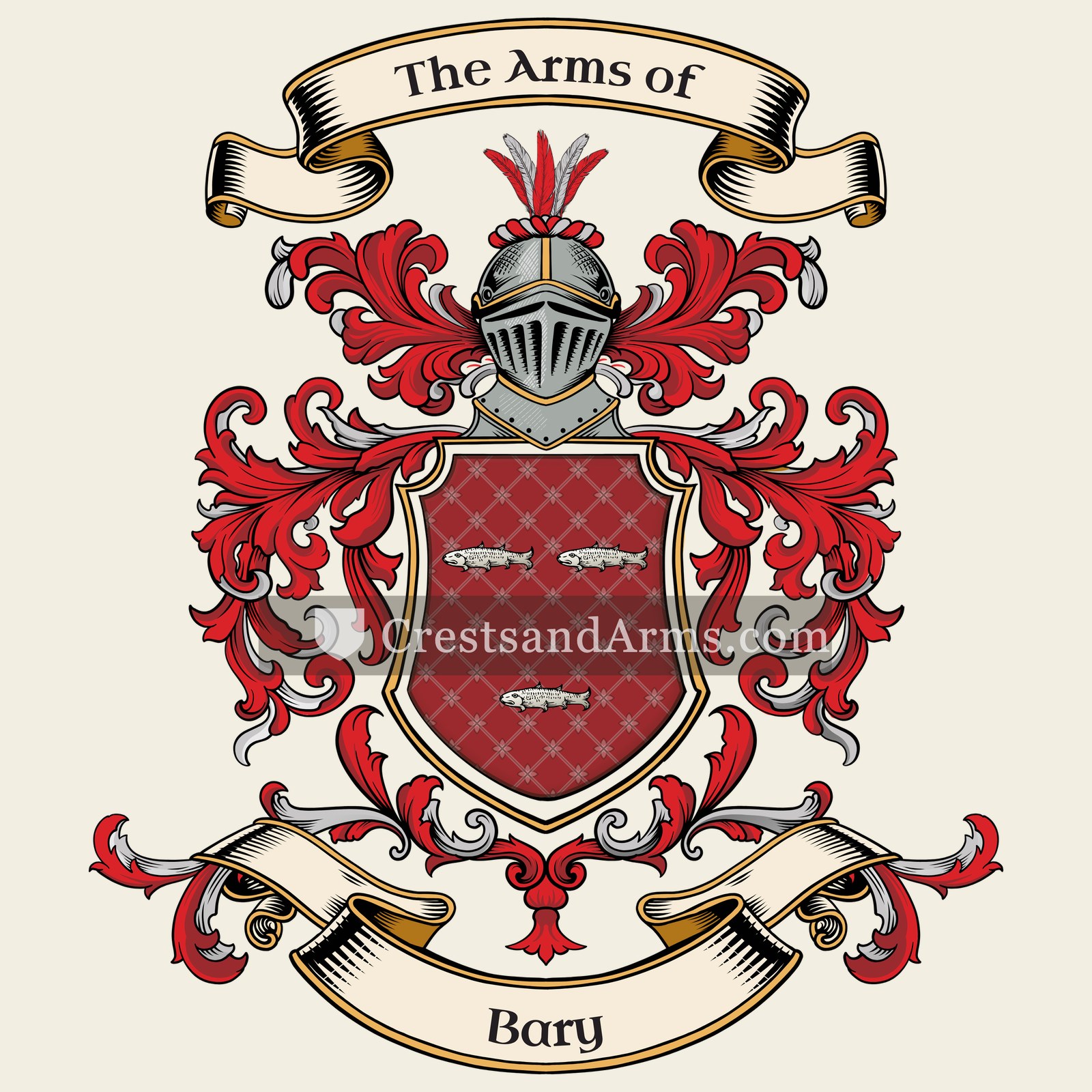
fishA true and generous mind, and Christian faith
Colours
Red (Gules)Means: Military strength
Silver (Argent)Means: Peace and sincerity
Historical info
Source
J. B. Rietstap, Armorial Général, Gouda: G. B. van Goor Zonen, 1884–87
Blazon (the actual original written record)
“De gu. à trois têtes de barbeaux d'arg., posées en fasces, 2 et 1. C.: une étoile d'arg., entre un vol de gu. S.: deux griffons d'or [La branche d'Angl., au comté de Warwick, porte pour D.: FIDUS DEO ET REGL]”
HesseFrancfort s · Hesse, c. 1859
Digital archive packCoat of arms PNG, gold border print PDF, vector SVG and the certificate of authenticity. Sent to your email in minutes.
Map of Germany showing where the Bary arms are recorded
The Bary arms were recorded in Hesse, c. 1859.
Hesse was central German country, divided among a large number of small landowners and prosperous towns. So many separate households held ground there that the region produced an unusual number of coats of arms.
This is where the arms were entered in the register. Families often moved to other parts of the country, so the same name can turn up in more than one region.
The body that granted and recorded arms in Germany in this period.
Frederick William IV of Prussia
Sovereign of the period
Frederick William IV of Prussia
1840–1861
Reigning in Belgium when the Bary arms are first recorded.
How Arms Worked in Germany
Prussian heraldry was strictly tied to social rank and noble status rather than being a free choice for every citizen. These symbols were treated as permanent family property that moved through the generations to all legitimate heirs. If a family branch wanted to change their design to stand out, they had to apply for official permission to alter their specific version of the shield.
Granting authority
The Prussian Heroldsamt acted as the central state office that managed and strictly controlled all noble titles and coats of arms.
How they got arms
Families usually obtained their arms through formal royal grants or by proving their long-standing noble status to the state authorities.
Where arms were recorded
All official coats of arms were kept in the rolls of the Prussian Heroldsamt, which functioned from 1706 until 1918.
The family's standing
Recorded among the armigerous families of Hesse.
Origin & History of the Bary Family in Germany
The family name Bary has deep roots in the German region of Hesse, where records confirm members of the family were established by at least 1859. Historically, the name likely emerged as a locational or occupational identifier during the period when surnames became common across Central Europe. In the Hessian landscape, families like the Bary line often lived in rural or semi-urban communities where they contributed to the local economy through farming, trade, or craft specialization. As the nineteenth century progressed, the family name became part of the social fabric of the region, reflecting the broader patterns of German migration and community growth. By the mid-1800s, individuals carrying this name were integrated into the local administrative systems of Hesse, which documented their births, marriages, and daily lives within the changing political landscape of the German states.
Coat of Arms & Family Crest Details
Symbols on this shield
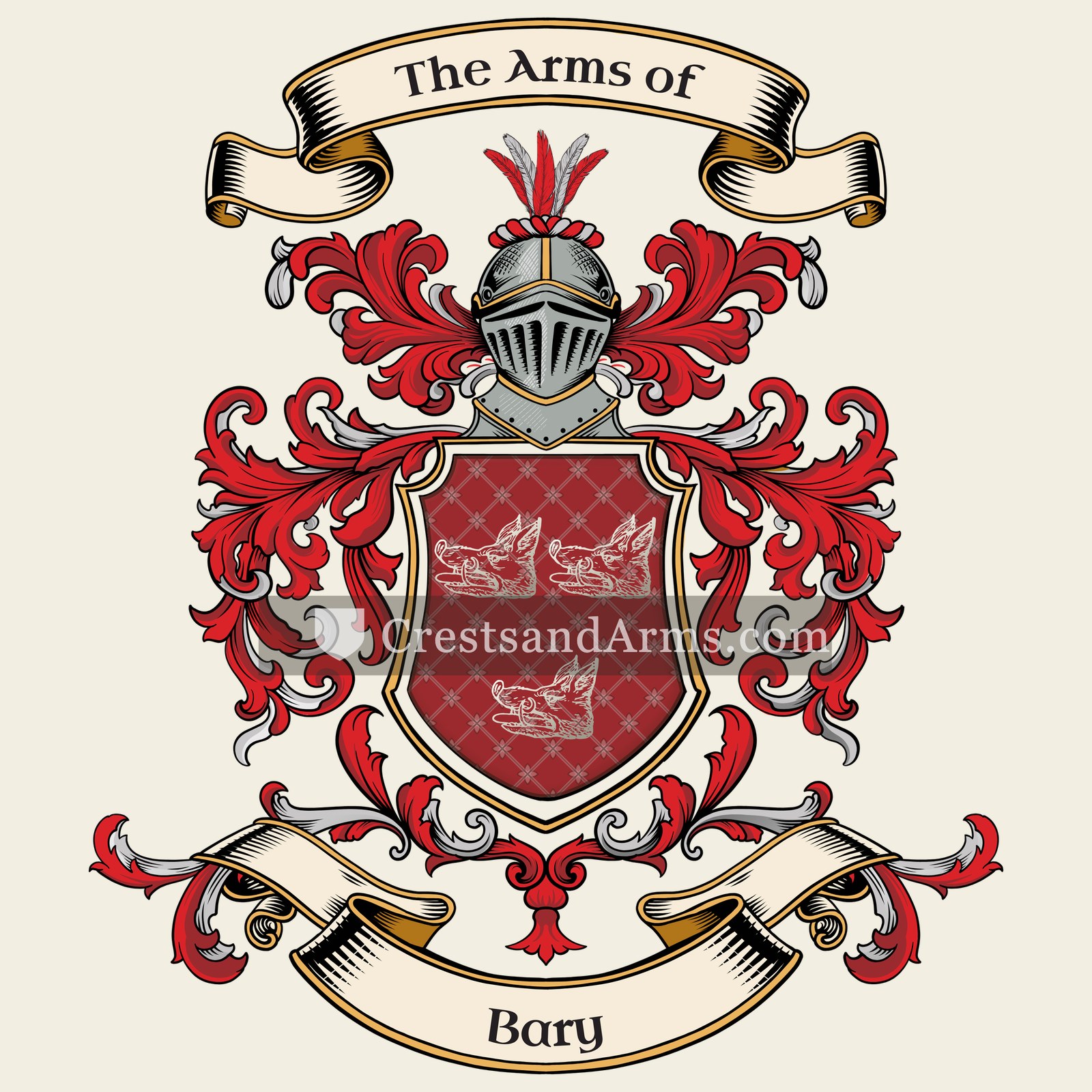
boars headA fierce fighter who battles to the end
Colours
Red (Gules)Means: Military strength
Silver (Argent)Means: Peace and sincerity
Historical info
Source
Sir Bernard Burke, The General Armory of England, Scotland, Ireland and Wales, London: Harrison & Sons, 1884
Blazon (the actual original written record)
“Gu. three boars' heads ar”
Englandc. 1568
Digital archive packCoat of arms PNG, gold border print PDF, vector SVG and the certificate of authenticity. Sent to your email in minutes.
Map of England showing where the Bary arms are recorded
The Bary arms were recorded in England, c. 1568.
Arms such as these were typically recorded in York.
Yorkshire is the largest of the English counties, and it held more gentry families than any other. Land there was split among a great many households rather than a few, so a great many of them carried arms.
This is where the arms were entered in the register. Families often moved to other parts of the country, so the same name can turn up in more than one region.
The body that granted and recorded arms in England in this period.
Elizabeth I of England
Sovereign of the period
Elizabeth I of England
1558–1603
Reigning in Belgium when the Bary arms are first recorded.
How Arms Worked in England
English heraldry allowed arms to be shared by all legitimate descendants of the original owner. These symbols were treated as personal property that moved through the generations to all children. While the eldest son kept the original design, other family members could use the same shield without needing to change it or register their own unique versions.
Granting authority
The College of Arms in London has regulated the use of coats of arms throughout England and Wales since 1484.
How they got arms
Families typically obtained their coats of arms through a formal grant from the Crown or by proving their ancient right to them.
Where arms were recorded
All official coats of arms are recorded in the registers kept at the College of Arms, which date back to the fifteenth century.
The family's standing
Recorded among the armigerous families of England.
Origin & History of the Bary Family in England
The history of the Bary family in England is rooted in the northern city of York, where records confirm their presence as early as 1568. During the sixteenth century, York served as a vital hub for trade and administration, placing the family in a region defined by its deep medieval heritage and shifting social structures. Families like the Barys often lived in close-knit urban parishes, where they participated in the local economy and contributed to the growth of the city during the Elizabethan era. While the origins of the name may connect to older linguistic traditions, its survival in the historical record of York suggests that the family was well-integrated into the community life of the north. By maintaining a steady presence in this historic city, the early members of the Bary family helped shape the local narrative of a region transitioning from the Middle Ages into the early modern period.
Bary Meaning & Related Branches
Root word
Barri
Old French term referring to a gate, fence, or barrier.
This name
BaryA topographic name for someone who lived near a gate or a fortified enclosure.
also spelled
Barry
Barie
Barrey
Barrie
Related arms
Barryvariant spelling
Barreyvariant spelling
Barrievariant spelling
Documented Sources
J. B. Rietstap, Armorial Général, Gouda: G. B. van Goor Zonen, 1884–87
Archives de l’État à Tournai, État civil, Registres paroissiaux de la ville de Tournai
Chotin, Adolphe, Histoire de Tournai et du Tournésis, 1840
Dumont, Georges-Henri, Histoire de la Belgique: des origines à nos jours, 1977
Digital archive packCoat of arms PNG, gold border print PDF, vector SVG and the certificate of authenticity. Sent to your email in minutes.


 boars headA fierce fighter who battles to the end
 boars headA fierce fighter who battles to the end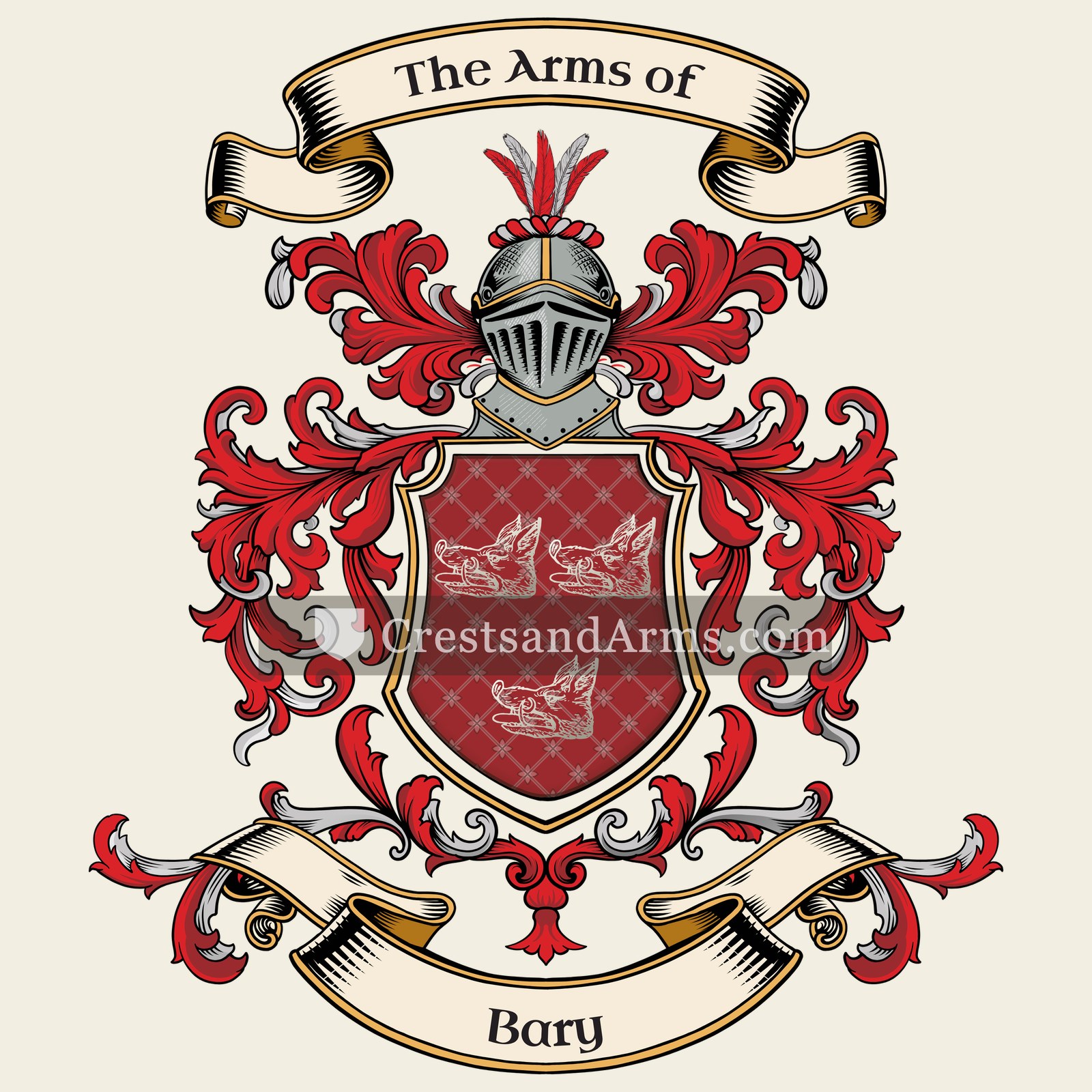


 fishA true and generous mind, and Christian faith