A record of documented arms, meaning and origin, researched for the Barys family lines. Documented in 3 countries.
Reg. 9447 · German, A–C
Meaning of the Barys family crest colors & symbols
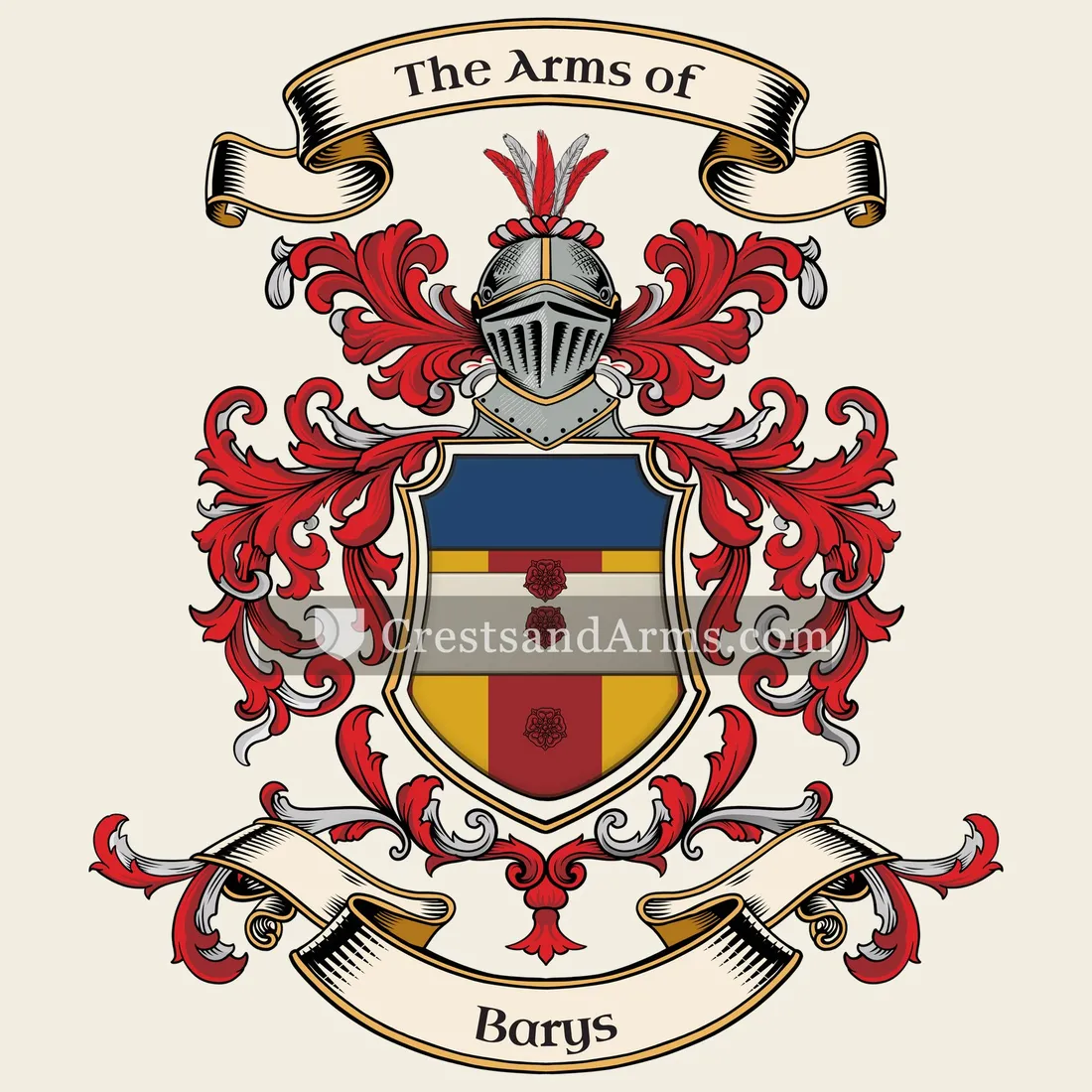
Symbols on this shield
roseThe seventh son, and beauty with grace
Colours
Silver (Argent)Means: Peace and sincerity
Red (Gules)Means: Military strength
Historical info
Source
J. B. Rietstap, Armorial Général, Gouda: G. B. van Goor Zonen, 1884–87
Blazon (the actual original written record)
“Coupé: au 1 d'arg. à deux roses accostées de gu.; au 2 d'arg. à trois barres de gu. C.: trois tuyaux d'or soutenus d'une boule du même et sommés chacun de trois plumes de paon au nat.”
MecklenburgMecklenburg, c. 1765
Digital archive packCoat of arms PNG, gold border print PDF, vector SVG and the certificate of authenticity. Sent to your email in minutes.
Map of Germany showing where the Barys arms are recorded
The Barys arms were recorded in Mecklenburg, c. 1765.
Mecklenburg was farming country in the north of Germany, held by a small number of families who kept their estates for generations. Owning land was what entitled a family to arms, so a great many Mecklenburg names ended up in the registers.
This is where the arms were entered in the register. Families often moved to other parts of the country, so the same name can turn up in more than one region.
The body that granted and recorded arms in Germany in this period.
Francis I, Holy Roman Emperor
Sovereign of the period
Francis I, Holy Roman Emperor
1745–1765
Reigning in Germany when the Barys arms are first recorded.
How Arms Worked in Germany
In the Holy Roman Empire, coats of arms were often granted to individuals by the Emperor or his representatives. These arms were then passed down through the generations to all legitimate descendants of the original holder. Younger branches of a family usually kept the same shield design without needing to change it, as the arms belonged to the entire lineage.
Granting authority
The Holy Roman Emperor held the sole power to grant new coats of arms throughout his vast imperial territories.
How they got arms
Families typically obtained their coats of arms through a formal imperial grant or by proving their noble status to the authorities.
Where arms were recorded
These grants were officially recorded in the Imperial Chancery registers, which began keeping formal records of such honors during the Middle Ages.
The family's standing
Recorded among the armigerous families of Mecklenburg.
Origin & History of the Barys Family in Germany
The name Barys carries a distinct history rooted in the northern regions of Germany, specifically within the state of Mecklenburg. By the year 1765, records confirm that members of the family were already established in this area, living as part of a society deeply connected to the land and local trade. During the eighteenth century, Mecklenburg was a landscape defined by large agricultural estates and a rigid social structure that influenced how families lived and moved. The Barys family likely belonged to the class of rural inhabitants or small-scale artisans who helped sustain the local economy of the region. Because surnames were often tied to specific geographic locations or local dialects, the presence of the name in Mecklenburg suggests that the family had deep ties to the Baltic coast. Over time, these early ancestors helped shape the cultural identity of their community through their daily labor and their participation in the traditions of northern Germany.
Meaning of the Barys family crest colors & symbols
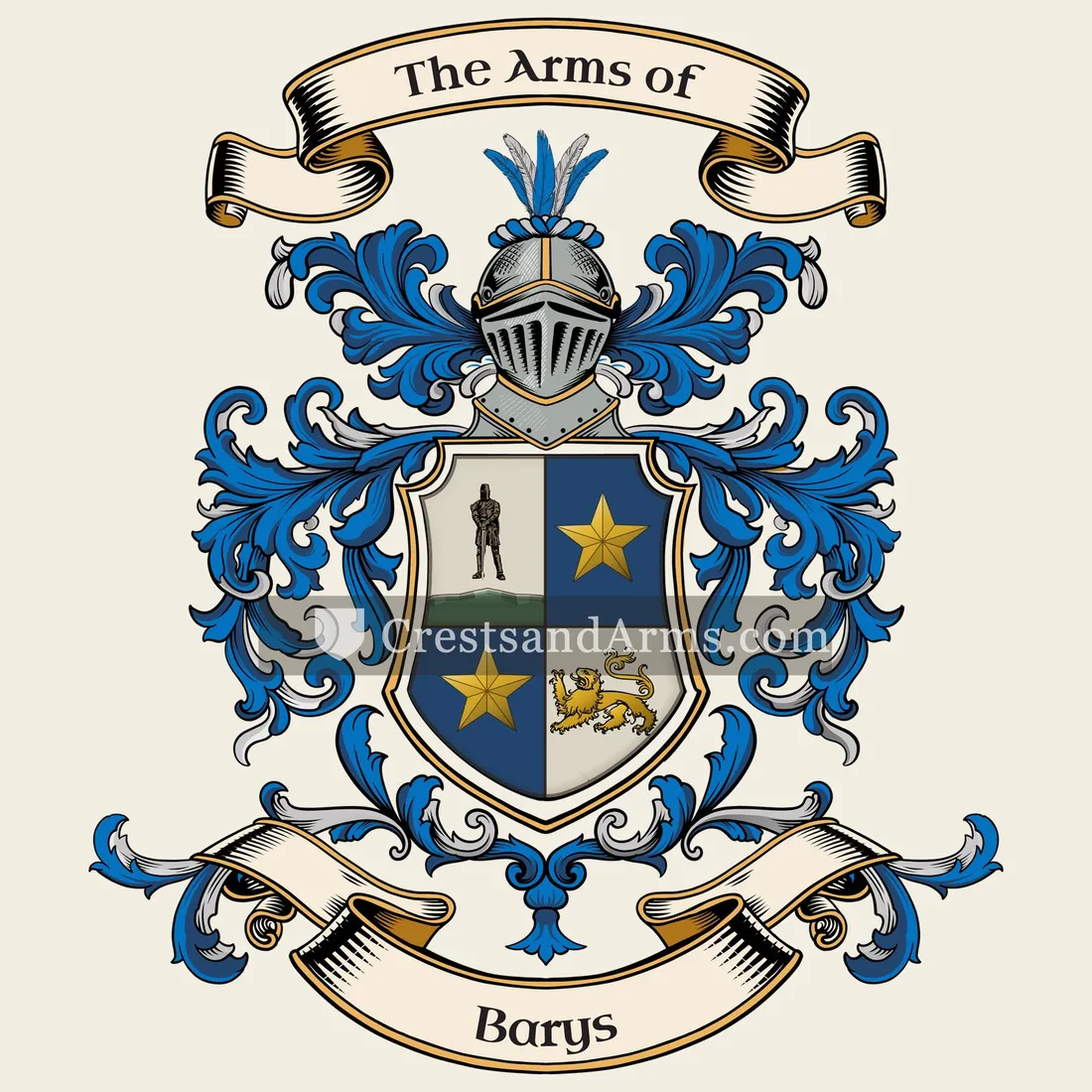
Symbols on this shield
mountThe ground held, and steadfastness upon it
knightChivalry and service in arms
mulletThe third son, and a divine quality from above
lionCourage, strength and royalty
Colours
Silver (Argent)Means: Peace and sincerity
Blue (Azure)Means: Loyalty and truth
Green (Vert)Means: Hope
Gold (Or)Means: Generosity
Historical info
Source
J. B. Rietstap, Armorial Général, Gouda: G. B. van Goor Zonen, 1884–87
Blazon (the actual original written record)
“Ec.: au 1 d'arg. à un sauvage de carn., ceint et cour. de lierre, la main appuyée sur une massue, le tout soutenu d'une terrasse de sin.; aux 2 et 3 d'azur à l'étoile d'or; au 4 de gu. au lion d'or, tenant de sa patte dextre un flambeau allumé du même. Cq. cour. C.: un bras, arm. d'arg., brandissant une épée du même, garnie d'or. L. d'or, d'arg. et d'azur.”
RussiaEsthonie, c. 1784
Digital archive packCoat of arms PNG, gold border print PDF, vector SVG and the certificate of authenticity. Sent to your email in minutes.
Map of Russia showing where the Barys arms are recorded
The Barys arms were recorded in Esthonie, c. 1784.
Arms such as these were typically recorded in Moscow.
Moscow held the Russian court, and rank there came from service rather than land. Families who served the Tsar were entered in the registers of nobility, and that entry is where their arms are recorded.
This is where the arms were entered in the register. Families often moved to other parts of the country, so the same name can turn up in more than one region.
The body that granted and recorded arms in Russia in this period.
Catherine II of Russia
Sovereign of the period
Catherine II of Russia
1762–1796
Reigning in Germany when the Barys arms are first recorded.
How Arms Worked in Russia
Russian heraldry was strictly tied to the nobility and the state service system. Families proved their ancient status or earned new rank to receive an official grant from the Tsar. These symbols were then inherited by all legitimate children of the noble line. If a family lacked proof of their status, they were often excluded from the official records entirely.
Granting authority
The Herald Master's Office acted as the central state body that strictly regulated and verified all noble heraldic symbols.
How they got arms
Families typically received their arms through a formal state grant or by proving their noble status to the government authorities.
Where arms were recorded
All approved coats of arms were officially recorded in the General Armorial of the Noble Families of the Russian Empire starting in 1797.
The family's standing
Recorded among the armigerous families of Russia.
Origin & History of the Barys Family in Russia
The family name Barys emerged within the social landscape of late eighteenth-century Moscow, where records confirm the presence of family members by 1784. During this period, Moscow served as a bustling center for trade and administration, attracting individuals from various backgrounds who sought to establish themselves in the heart of the Russian Empire. The name itself is rooted in linguistic traditions that often denoted strength or a specific regional origin, reflecting the diverse cultural tapestry of the era. As the family integrated into the urban fabric of the city, they participated in the daily life and professional activities that defined the late imperial period. By maintaining a documented presence in Moscow, the early generations of the Barys family contributed to the historical continuity of the city during a time of significant social and economic change.
Meaning of the Barys family crest colors & symbols
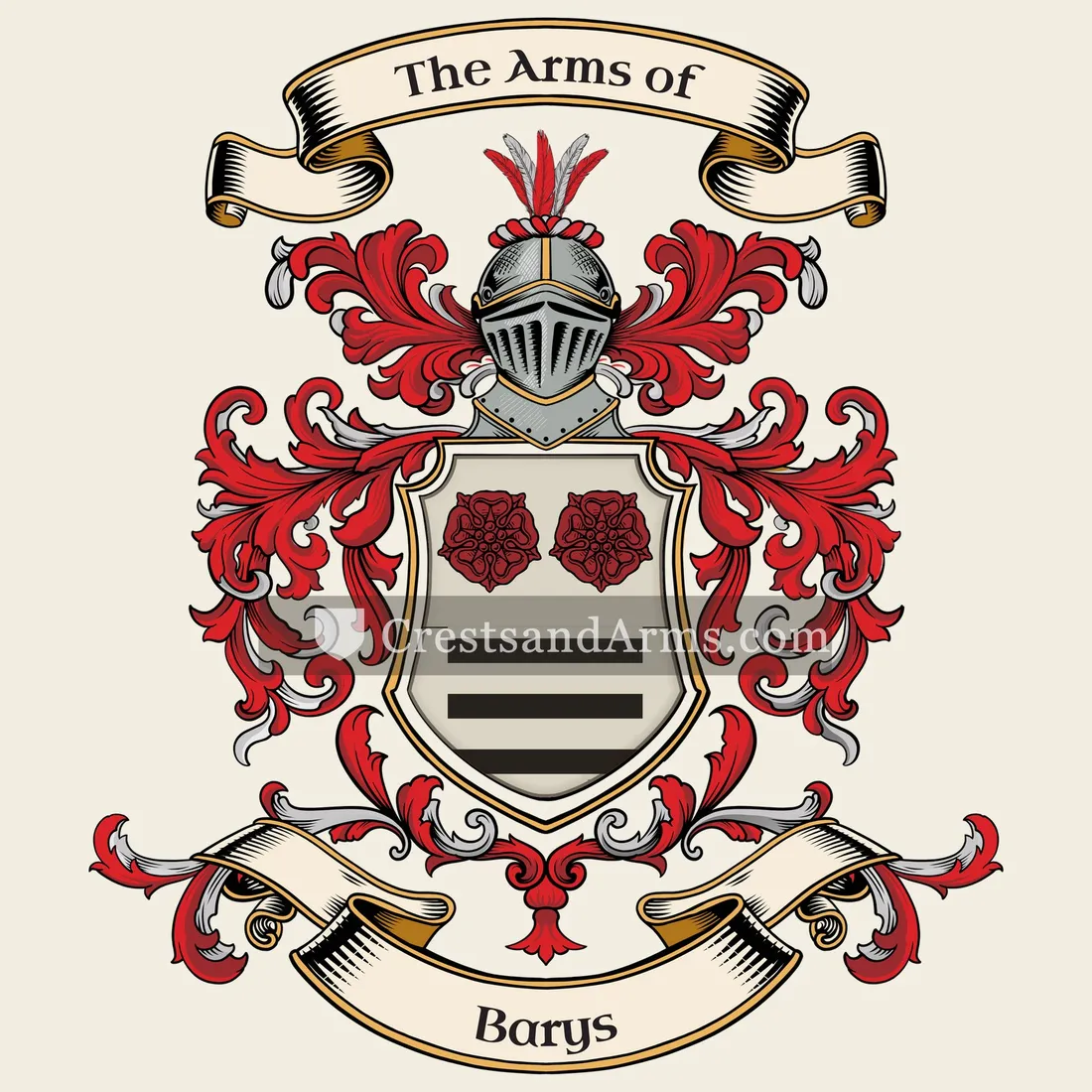
Symbols on this shield
paleMilitary strength, and a fortified defence
chiefAuthority, wisdom and dominion
roseThe seventh son, and beauty with grace
Colours
Red (Gules)Means: Military strength
Gold (Or)Means: Generosity
Blue (Azure)Means: Loyalty and truth
Silver (Argent)Means: Peace and sincerity
Historical info
Source
J. B. Rietstap, Armorial Général, Gouda: G. B. van Goor Zonen, 1884–87
Blazon (the actual original written record)
“De gu. à deux pals d'or, ch. chacun de trois roses du champ; au chef d'azur, ch. de deux bars d'arg. en fasce.”
PerigordPerigord, c. 1663
Digital archive packCoat of arms PNG, gold border print PDF, vector SVG and the certificate of authenticity. Sent to your email in minutes.
Map of France showing where the Barys arms are recorded
The Barys arms were recorded in Perigord, c. 1663.
Perigord was wooded upland country in south-western France, thick with small castles. Its gentry were numerous and mostly poor, and even a modest holding justified a shield of one's own.
This is where the arms were entered in the register. Families often moved to other parts of the country, so the same name can turn up in more than one region.
The body that granted and recorded arms in France in this period.
Louis XIV of France
Sovereign of the period
Louis XIV of France
1643–1715
Reigning in Germany when the Barys arms are first recorded.
How Arms Worked in France
In France, a coat of arms was a mark of honor that passed down through the male line to all legitimate descendants. Families often used the same shield without changes to show their shared heritage. If a branch wanted to stand out, they could add a small mark to their shield to show their specific place in the family tree.
Granting authority
The Juge d'armes de France acted as the official authority that regulated and verified coats of arms across the country.
How they got arms
Families typically inherited their arms from ancestors, though they could also receive them through royal grants or by proving their noble status.
Where arms were recorded
Coats of arms were officially recorded in the Armorial Général de France, which began its main collection in the year 1696.
The family's standing
Recorded among the armigerous families of Perigord.
Origin & History of the Barys Family in France
The history of the Barys family in France is deeply rooted in the rugged landscape of the Périgord region. By the year 1663, records confirm that members of the family were already established in this area, which was known for its dense forests and limestone cliffs. During the seventeenth century, families in this part of southwestern France often lived as tenant farmers or skilled craftsmen who worked closely with the local landowning nobility. The name itself likely evolved from regional dialects, reflecting the way people identified themselves based on their specific village or their role within the local agricultural community. Life in Périgord during this era was defined by the rhythms of the seasons and the influence of the Catholic Church, which kept meticulous registers of births, marriages, and deaths. These early Barys ancestors were part of a resilient population that navigated the complex social changes of the French provinces, helping to shape the cultural identity of the region long before the modern era.
Barys Meaning & Related Branches
Root word
Baro
Old Germanic term referring to a free man or warrior.
This name
BarysDerived from a status-based descriptor for a freeman or a soldier in medieval society.
also spelled
Bar
Documented Sources
J. B. Rietstap, Armorial Général, Gouda: G. B. van Goor Zonen, 1884–87
Landeshauptarchiv Schwerin, Kirchenbücher der Evangelisch-Lutherischen Landeskirche Mecklenburgs
Lisch, Georg Christian Friedrich, Mecklenburgische Urkunden und Daten zur Landesgeschichte, 1860
Mylius, Ernst, Die Ortsnamen des Landes Mecklenburg, 1935
Digital archive packCoat of arms PNG, gold border print PDF, vector SVG and the certificate of authenticity. Sent to your email in minutes.


 roseThe seventh son, and beauty with grace
 roseThe seventh son, and beauty with grace


 mountThe ground held, and steadfastness upon it
 knightChivalry and service in arms
 mulletThe third son, and a divine quality from above
 lionCourage, strength and royalty


 paleMilitary strength, and a fortified defence
 chiefAuthority, wisdom and dominion