A record of documented arms, meaning and origin, researched for the Bas family lines. Documented in 2 countries.
Reg. 7177 · Dutch, A–C
Coat of Arms & Family Crest Details
Symbols on this shield
fessThe military belt, and readiness to serve
vairProtection, and the winter fur
eagleNobility, strength and a keen mind
martletA younger son, who must win his own land
Colours
Blue (Azure)Means: Loyalty and truth
Silver (Argent)Means: Peace and sincerity
Historical info
Source
J. B. Rietstap, Armorial Général, Gouda: G. B. van Goor Zonen, 1884–87
Blazon (the actual original written record)
“Parti: au 1 d'azur à l'aigle d'arg., tenant en son bec un rameau d'olivier de sin.; au 2 coupé: a. d'azur à un vanneau d'arg.; b. fascé de gu. et de vair, la première fasce supp. le vanneau. C.: le vanneau, entre un vol au nat.”
Netherlandsc. 1610
Digital archive packCoat of arms PNG, gold border print PDF, vector SVG and the certificate of authenticity. Sent to your email in minutes.
Map of Netherlands showing where the Bas arms are recorded
The Bas arms were recorded in Netherlands, c. 1610.
Arms such as these were typically recorded in Friesland.
Friesland was low, wet country on the northern coast of the Netherlands, farmed by families who had held the same land for centuries. Free landholders were unusually common there, and a free landholder could carry arms.
This is where the arms were entered in the register. Families often moved to other parts of the country, so the same name can turn up in more than one region.
Region
Friesland
First recorded
1610
Granting Authority for the Bas Arms
Hoge Raad van Adel
Photograph made by me · CC BY-SA 3.0
The body that granted and recorded arms in Netherlands in this period.
How Arms Worked in Netherlands
In the Netherlands, coats of arms were often used by noble families and those who held specific public offices. These arms were passed down through the generations to legitimate descendants. Younger branches of a family usually kept the original design without needing to add special marks. This system ensured that the family identity remained clear and consistent over many years.
Granting authority
The Hoge Raad van Adel is the official body that regulates and manages noble titles and coats of arms in the Netherlands.
How they got arms
Families typically obtained their coats of arms through official royal grants or by proving their long-standing historical use of the symbols.
Where arms were recorded
Coats of arms are officially recorded in the registers held by the Hoge Raad van Adel, which began its work in 1814.
The family's standing
Recorded among the armigerous families of Netherlands.
Origin & History of the Bas Family in Netherlands
The surname Bas has deep roots in the northern regions of the Netherlands, particularly within the province of Friesland. By the early seventeenth century, records confirm that families bearing this name were already established in the area. In the Dutch language, the word "bas" often carries meanings related to being a master, a leader, or a person of low stature, which likely influenced how the name was first assigned to ancestors as a descriptive nickname. During the 1600s, Friesland was a hub of maritime trade and agricultural development, providing a stable environment for these early families to grow and settle. As the name spread from these Frisian origins, it became a distinct marker of identity for families navigating the social and economic shifts of the Dutch Golden Age. Because the name is short and simple, it was easy for clerks and local officials to record in parish registers, helping the family name persist through centuries of regional history.
Coat of Arms & Family Crest Details
Symbols on this shield
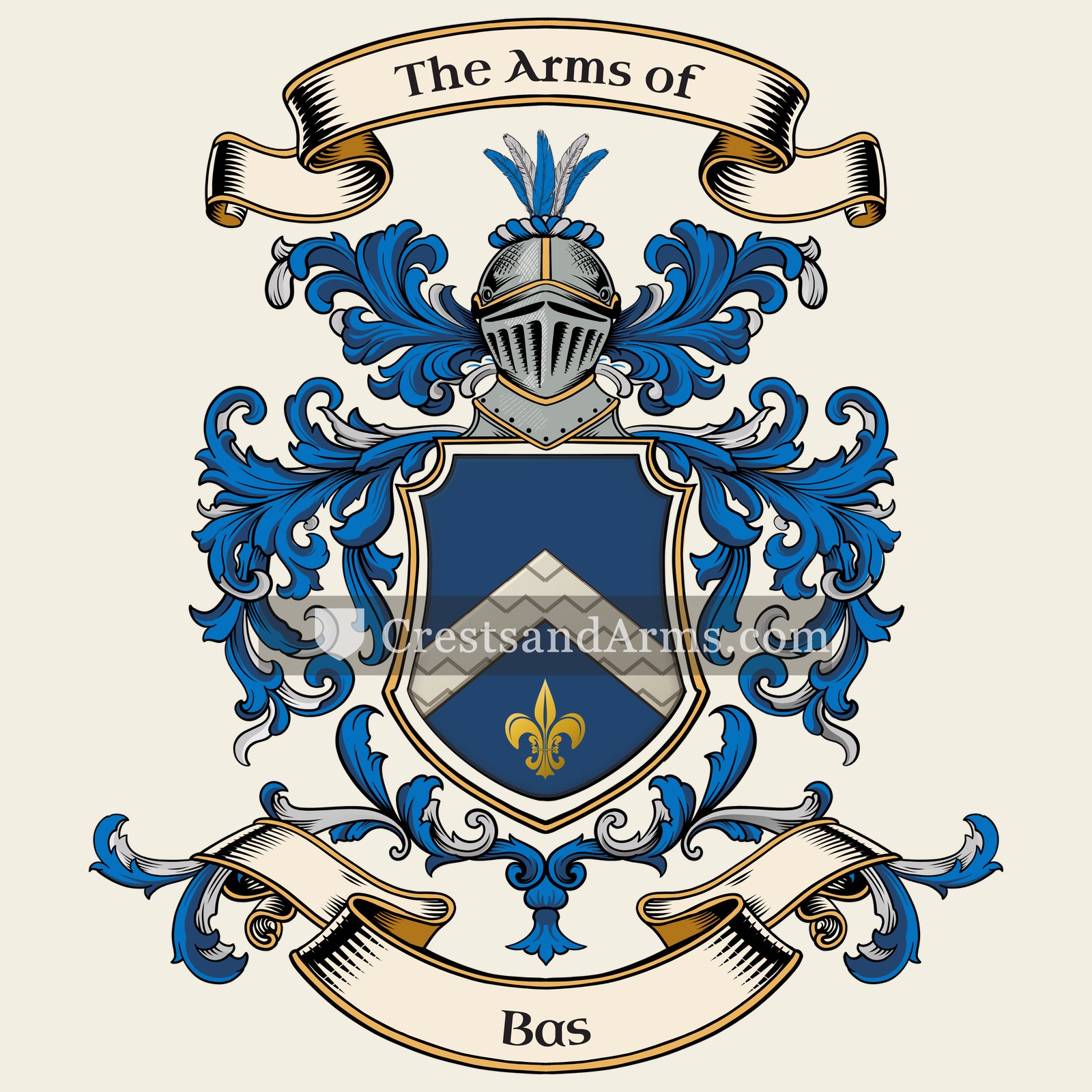
chevronProtection, and faithful service completed
fleur de lisPurity, light, and the sixth son
Colours
Blue (Azure)Means: Loyalty and truth
Silver (Argent)Means: Peace and sincerity
Gold (Or)Means: Generosity
Historical info
Source
J. B. Rietstap, Armorial Général, Gouda: G. B. van Goor Zonen, 1884–87
Blazon (the actual original written record)
“D'azur au chev. d'arg., acc. en p. d'une fleur-de-lis d'or.”
Spainc. 1722
Digital archive packCoat of arms PNG, gold border print PDF, vector SVG and the certificate of authenticity. Sent to your email in minutes.
Map of Spain showing where the Bas arms are recorded
The Bas arms were recorded in Spain, c. 1722.
Arms such as these were typically recorded in Castile.
Castile was the heart of Spain and the source of most of its noble families. Land won in the long wars against the Moors was granted out to fighting men, and a man granted land was granted arms along with it.
This is where the arms were entered in the register. Families often moved to other parts of the country, so the same name can turn up in more than one region.
The body that granted and recorded arms in Spain in this period.
Philip V of Spain
Sovereign of the period
Philip V of Spain
1714–1724
Reigning in Netherlands when the Bas arms are first recorded.
How Arms Worked in Spain
In Spain, a coat of arms was considered a form of property that belonged to the entire family line. These arms were passed down from a father to all his children equally. Younger branches of the family usually kept the original design without needing to add any special marks to distinguish their specific line.
Granting authority
The Cronista Rey de Armas was the official body that regulated and granted coats of arms throughout Spain.
How they got arms
Families often obtained their arms through royal grants or by proving their noble status to the official heraldic authority.
Where arms were recorded
Coats of arms were officially recorded in the registers of the Cronista Rey de Armas starting in 1496.
The family's standing
Recorded among the armigerous families of Spain.
Origin & History of the Bas Family in Spain
The surname Bas has deep roots within the Iberian Peninsula, functioning as a topographic name that historically identified families living near specific landmarks or low-lying areas. By the early eighteenth century, the family established a notable presence in the region of Castile, a central territory that served as the heart of the Spanish kingdom. During this era, individuals bearing the name were often integrated into the local social fabric through agricultural land management and participation in parish life. Because Castile was a hub for internal migration and administrative record-keeping, the presence of the Bas family in 1722 suggests they were part of a stable community that relied on documented lineage for legal and property matters. This period of history reflects a time when families were increasingly tied to specific municipalities, allowing the name to persist through generations of farmers, tradespeople, and local officials who helped shape the identity of the Castilian landscape.
Bas Meaning & Related Branches
Root word
Sebastianus
Derived from the Greek word sebastos meaning venerable or revered.
This name
BasA short form of the name Sebastian, signifying a person who is worthy of deep respect.
also spelled
Baz
Bass
Documented Sources
J. B. Rietstap, Armorial Général, Gouda: G. B. van Goor Zonen, 1884–87
Meertens, P.J., Voornamen en familienamen in Nederland, 1964
Tresoar (Fries Historisch en Letterkundig Centrum), Doop-, trouw- en begraafboeken (DTB) van Friesland, 1610
Van der Schaar, J., Woordenboek van voornamen, 1964
Digital archive packCoat of arms PNG, gold border print PDF, vector SVG and the certificate of authenticity. Sent to your email in minutes.


 fessThe military belt, and readiness to serve
 eagleNobility, strength and a keen mind
 martletA younger son, who must win his own land
 fessThe military belt, and readiness to serve
 eagleNobility, strength and a keen mind
 martletA younger son, who must win his own land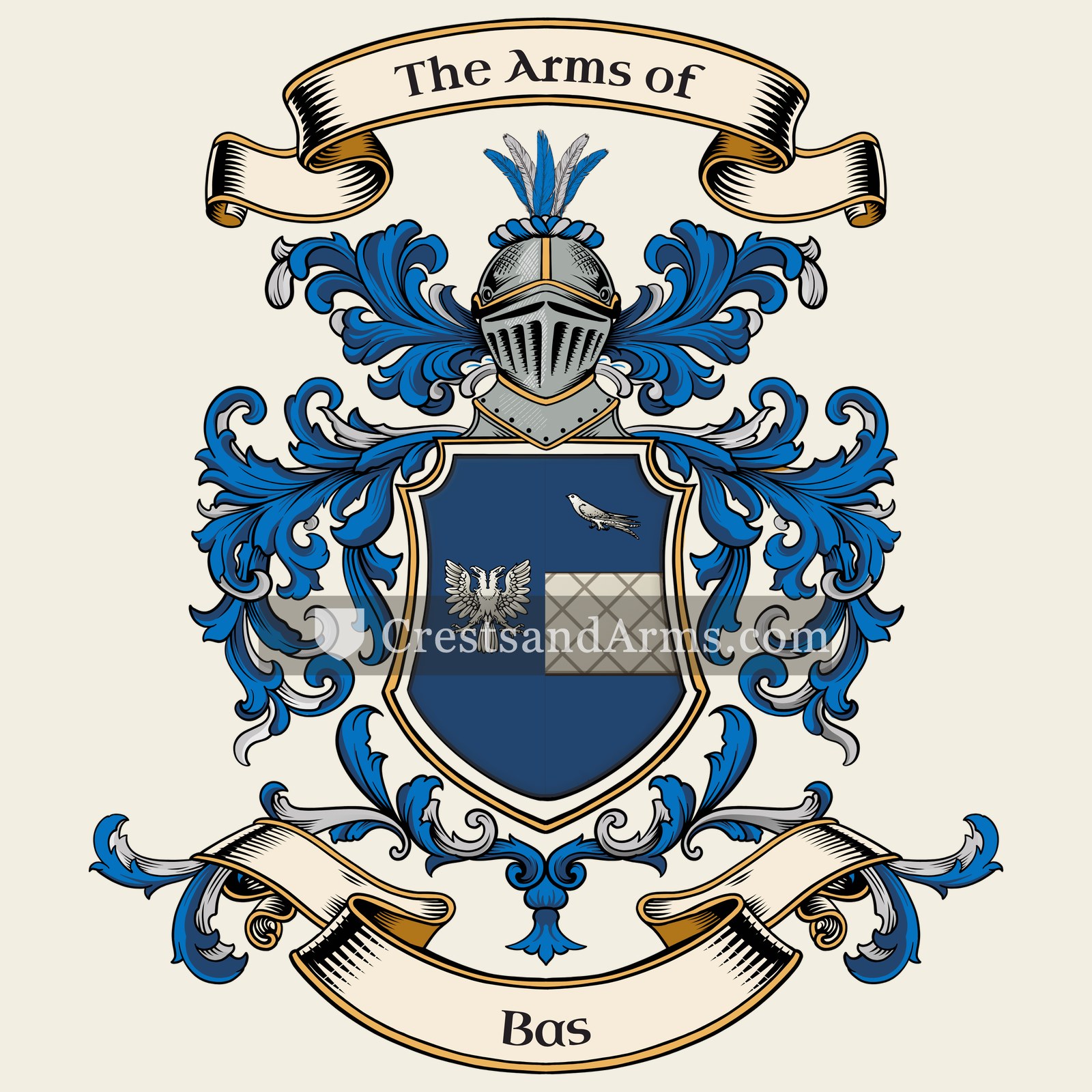

 chevronProtection, and faithful service completed
 fleur de lisPurity, light, and the sixth son