Map of England showing where the Basak arms are recorded
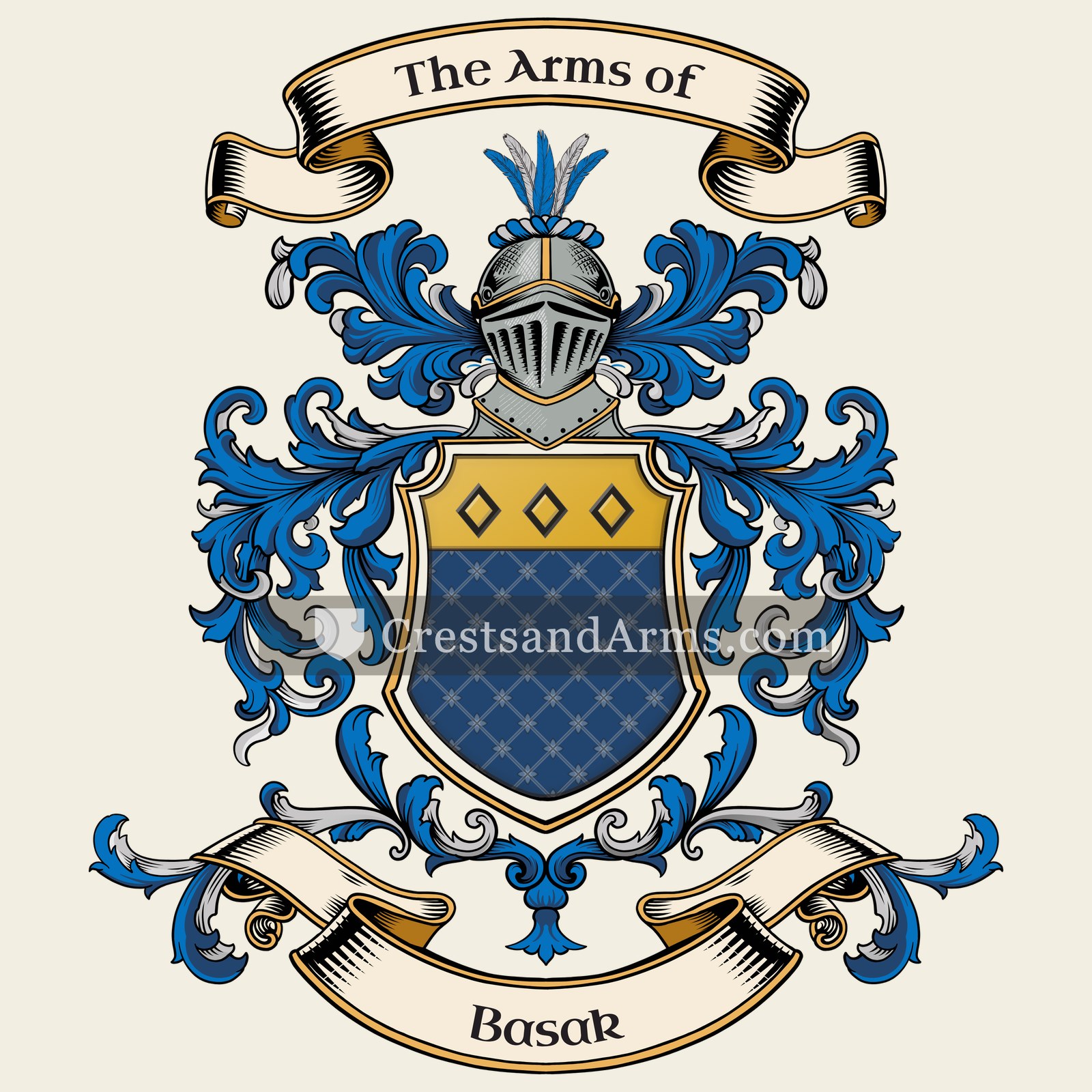
The Basak arms were recorded in Middlesex, c. 1620.
Middlesex was the county around London, and City money flowed straight into it. Merchants and officials bought estates within reach of the capital, and a new estate brought a coat of arms with it.
This is where the arms were entered in the register. Families often moved to other parts of the country, so the same name can turn up in more than one region.
The body that granted and recorded arms in England in this period.
James VI and I
Sovereign of the period
James VI and I
1603–1625
Reigning in England when the Basak arms are first recorded.
How Arms Worked in England
English heraldry allowed arms to be shared by all legitimate descendants of the original owner. These symbols were treated as personal property that moved through the generations to all children. While the eldest son kept the original design, other family members could use the same shield without needing to change it or register their own unique versions.
Granting authority
The College of Arms in London has regulated the use of coats of arms throughout England and Wales since 1484.
How they got arms
Families typically obtained their coats of arms through a formal grant from the Crown or by proving their ancient right to them.
Where arms were recorded
All official coats of arms are recorded in the registers kept at the College of Arms, which date back to the fifteenth century.
The family's standing
Recorded among the armigerous families of Middlesex.
Origin & History of the Basak Family in England
The surname Basak carries a history rooted in the movement of people across early modern Europe and into the English colonies. While the name has distinct linguistic origins in Central and Eastern Europe, where it often relates to terms for a young head of grain or a specific type of plant, its presence in Middlesex by 1620 suggests a family that was part of the early wave of transatlantic migration. Settling in Middlesex during this period placed the family at the center of a rapidly changing colonial landscape, where they likely participated in the agricultural development and trade networks that defined the region. These early settlers were among the pioneers who navigated the challenges of establishing a new life in a foreign environment, contributing to the local economy and the social fabric of the growing settlement. By maintaining their identity while adapting to the demands of life in the seventeenth century, the Basak family helped shape the early demographic character of the area.
Related Branches & Arms
Root word
Basse
A Middle English term for a short, stout person.
This name
BasakA topographic or occupational name referring to a dweller by a low-lying area or a maker of mats.
also spelled
Bassac
Bassake
Documented Sources
Sir Bernard Burke, The General Armory of England, Scotland, Ireland and Wales, London: Harrison & Sons, 1884
Coldham, Peter Wilson, The Complete Book of Emigrants, 1607–1660, 1987
The National Archives, Colonial Office: Records of the Board of Trade and Secretaries of State, CO 1
Digital archive packCoat of arms PNG, gold border print PDF, vector SVG and the certificate of authenticity. Sent to your email in minutes.


 chiefAuthority, wisdom and dominion
 masclePersuasion and the mail of a knight's coat
 chiefAuthority, wisdom and dominion
 masclePersuasion and the mail of a knight's coat