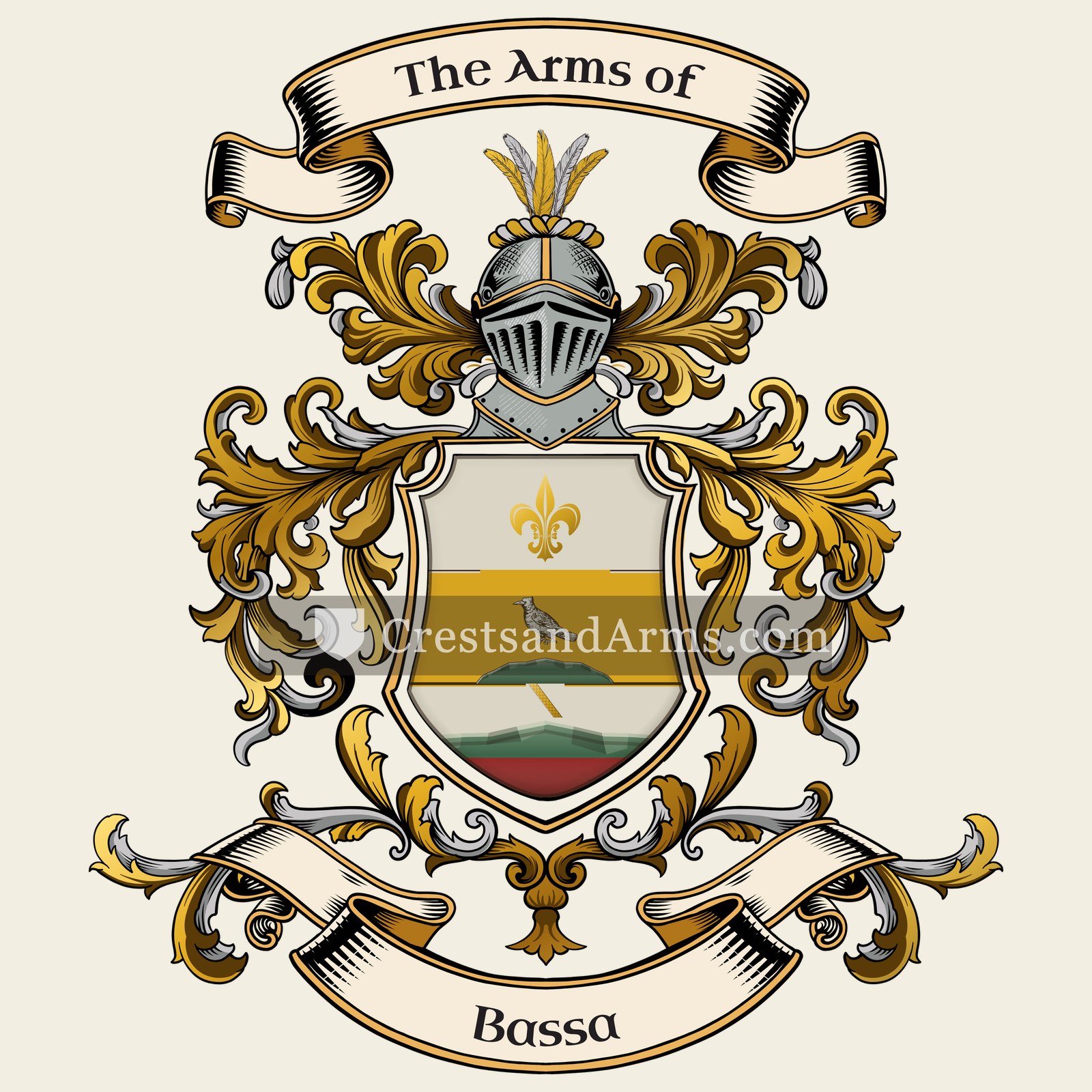
A record of documented arms, meaning and origin, researched for the Bassa family of Italy.
Reg. 5920 · Italian, A–C
Coat of Arms & Family Crest Details
Symbols on this shield
mountThe ground held, and steadfastness upon it
bendDefence, and the scarf of a commander
fleur de lisPurity, light, and the sixth son
dovePeace, love and the Holy Spirit
Colours
Silver (Argent)Means: Peace and sincerity
Gold (Or)Means: Generosity
Green (Vert)Means: Hope
Historical info
Source
J. B. Rietstap, Armorial Général, Gouda: G. B. van Goor Zonen, 1884–87
Blazon (the actual original written record)
“Tiercé en fasce: au 1 d'arg. à la fleur-de-lis d'or; au 2 d'or à une colombe d'arg., tenant en son bec un rameau d'olivier de sin. et posée sur un tertre du même; au 3 d'arg. à trois bandes d'or.”
ItalyVérone, c. 1775
Digital archive packCoat of arms PNG, gold border print PDF, vector SVG and the certificate of authenticity. Sent to your email in minutes.
Map of Italy showing where the Bassa arms are recorded
The Bassa arms were recorded in Vérone, c. 1775.
This is where the arms were entered in the register. Families often moved to other parts of the country, so the same name can turn up in more than one region.
The body that granted and recorded arms in Italy in this period.
Alvise Giovanni Mocenigo
Sovereign of the period
Alvise Giovanni Mocenigo
1763–1778
Reigning in Italy when the Bassa arms are first recorded.
How Arms Worked in Italy
In the Italian states, coats of arms were often used by noble families to show their status and history. These symbols were passed down through the generations to all legitimate male descendants. Younger branches of a family usually kept the original design but sometimes added small changes to distinguish their specific line from the main branch.
Granting authority
Various local rulers and city governments controlled the use of coats of arms across the different Italian states.
How they got arms
Families often assumed their own arms or received them as official grants from local lords, popes, or city councils.
Where arms were recorded
Arms were recorded in local city archives or private family books rather than in one single national register.
The family's standing
Recorded among the armigerous families of Italy.
Origin & History of the Bassa Family in Italy
The Bassa family name carries a deep connection to the historic city of Verona, where records confirm members of the family were well-established by 1775. During the late 18th century, Verona was a significant cultural and economic hub under the influence of the Republic of Venice. Families like the Bassas often played active roles in the local community, contributing to the city's vibrant trade and social life during this period of transition. While the name has roots that likely stretch back even further into the Italian peninsula, the presence of the family in Verona during the 1700s highlights their long-standing integration into the region's urban history. By studying the lives of these early ancestors, we gain a clearer picture of how families navigated the political and social changes of northern Italy before the turn of the 19th century.
Bassa Meaning & Related Branches
Root word
Bassus
Latin term meaning thick, dense, or stout.
This name
BassaA descriptive nickname for a person of short, stocky, or thickset physical stature.
also spelled
Basa
Documented Sources
J. B. Rietstap, Armorial Général, Gouda: G. B. van Goor Zonen, 1884–87
Archivio di Stato di Verona, Anagrafe storica della città di Verona
Archivio Storico Diocesano di Verona, Registri parrocchiali di battesimo e matrimonio
Da Re, Giuseppe, Storia di Verona, 1920
Simeoni, Luigi, Verona: guida storica e artistica, 1909
Digital archive packCoat of arms PNG, gold border print PDF, vector SVG and the certificate of authenticity. Sent to your email in minutes.


 mountThe ground held, and steadfastness upon it
 bendDefence, and the scarf of a commander
 fleur de lisPurity, light, and the sixth son
 dovePeace, love and the Holy Spirit
 mountThe ground held, and steadfastness upon it
 bendDefence, and the scarf of a commander
 fleur de lisPurity, light, and the sixth son
 dovePeace, love and the Holy Spirit