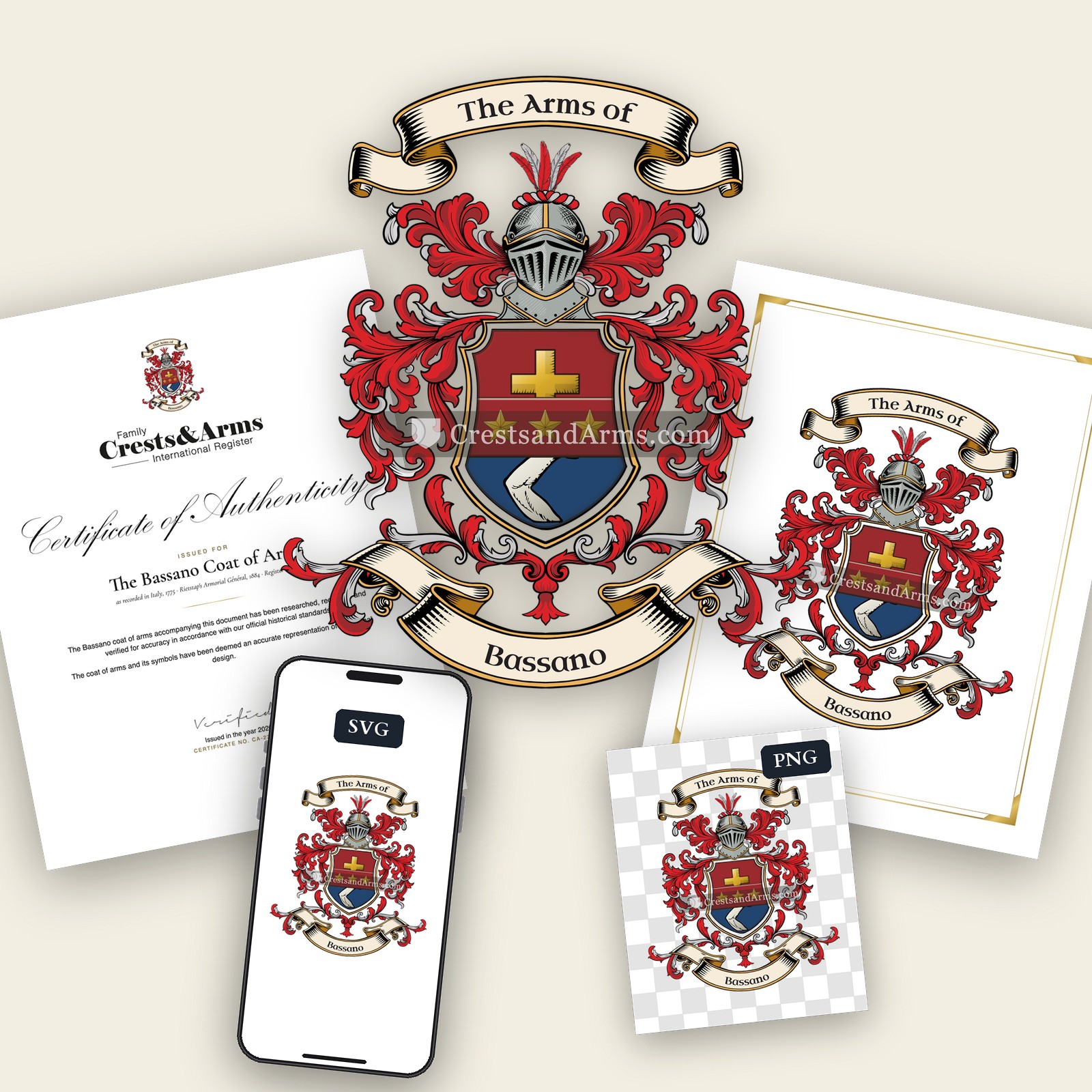
A record of documented arms, meaning and origin, researched for the Bassano family lines. Documented in 2 countries.
Reg. 2332 · Italian, A–C
Coat of Arms & Family Crest Details
Symbols on this shield
cross symbolChristian faith and service
fessThe military belt, and readiness to serve
mulletThe third son, and a divine quality from above
armA person of action, industrious and laborious
Colours
Red (Gules)Means: Military strength
Blue (Azure)Means: Loyalty and truth
Gold (Or)Means: Generosity
Historical info
Source
J. B. Rietstap, Armorial Général, Gouda: G. B. van Goor Zonen, 1884–87
Blazon (the actual original written record)
“Coupé, de gu. à une croisette pattée d'or, sur azur à un avant-bras, posé en pal, paré de sin., rebr. d'or, mouv. de la p., la main adossée; à la fasce de gu., ch. de trois étoiles d'or, br. sur le coupé.”
ItalyVérone, c. 1775
Digital archive packCoat of arms PNG, gold border print PDF, vector SVG and the certificate of authenticity. Sent to your email in minutes.
Map of Italy showing where the Bassano arms are recorded
The Bassano arms were recorded in Vérone, c. 1775.
This is where the arms were entered in the register. Families often moved to other parts of the country, so the same name can turn up in more than one region.
The body that granted and recorded arms in Italy in this period.
Alvise Giovanni Mocenigo
Sovereign of the period
Alvise Giovanni Mocenigo
1763–1778
Reigning in Italy when the Bassano arms are first recorded.
How Arms Worked in Italy
In the Italian states, coats of arms were often used by noble families to show their status and history. These symbols were passed down through the generations to all legitimate male descendants. Younger branches of a family usually kept the original design but sometimes added small changes to distinguish their specific line from the main branch.
Granting authority
Various local rulers and city governments controlled the use of coats of arms across the different Italian states.
How they got arms
Families often assumed their own arms or received them as official grants from local lords, popes, or city councils.
Where arms were recorded
Arms were recorded in local city archives or private family books rather than in one single national register.
The family's standing
Recorded among the armigerous families of Italy.
Origin & History of the Bassano Family in Italy
The name Bassano is deeply rooted in the history of northern Italy, where it emerged as a locative surname derived from the town of Bassano del Grappa. Families carrying this name often established themselves in prosperous urban centers throughout the Veneto region, reflecting the movement of people across the Italian peninsula during the eighteenth century. By 1775, records confirm that members of the Bassano family were well-established in the city of Verona. At this time, Verona served as a vital cultural and commercial crossroads under the influence of the Venetian Republic. The family likely participated in the local economy of this historic city, which was famous for its trade networks and architectural heritage. Over time, the name became a marker of regional identity, connecting the family to the rich traditions and social shifts that defined life in northern Italy during the late Enlightenment period.
Coat of Arms & Family Crest Details
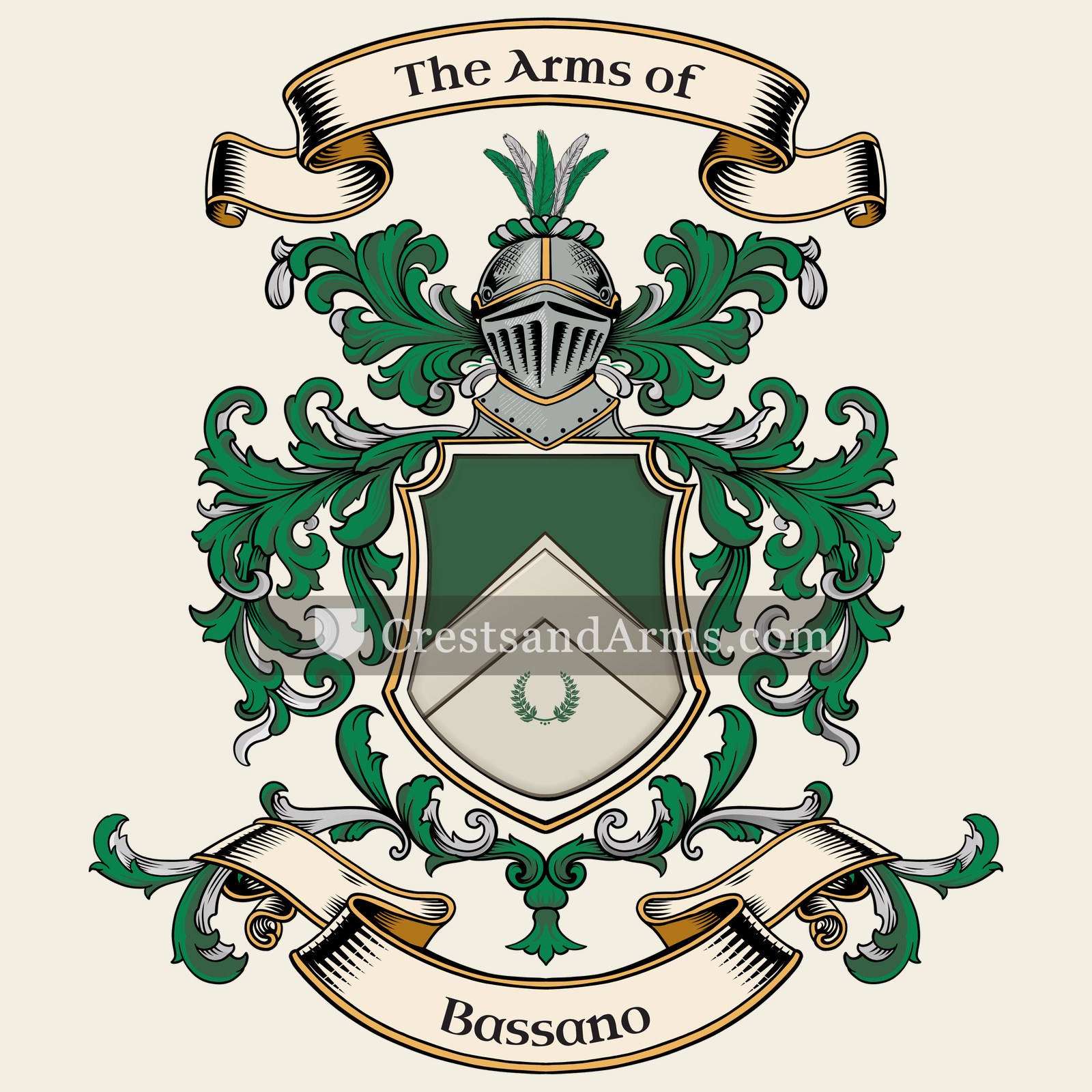
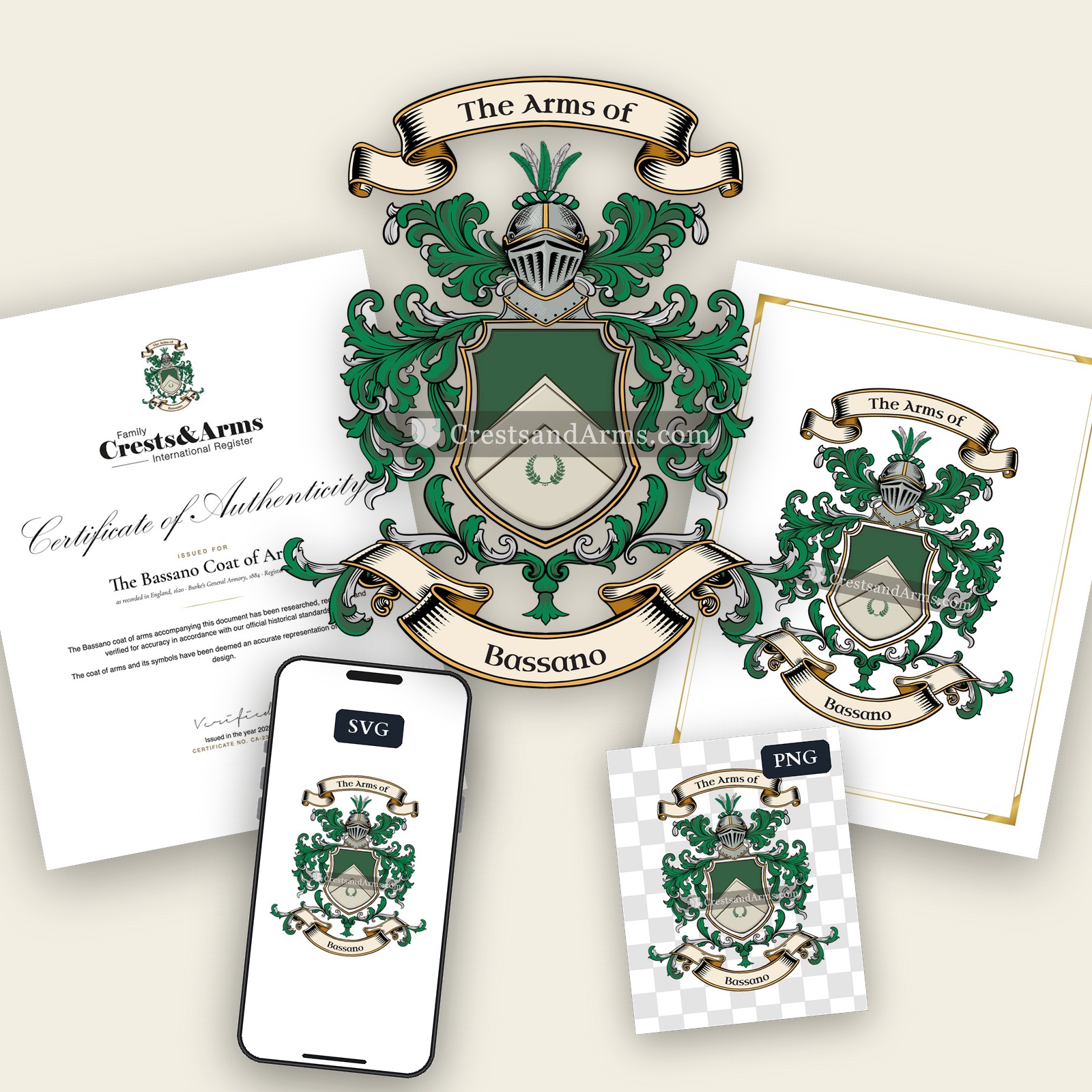
Symbols on this shield
chevronProtection, and faithful service completed
wreathHonour, and a victory crowned
Colours
Green (Vert)Means: Hope
Silver (Argent)Means: Peace and sincerity
Historical info
Source
Sir Bernard Burke, The General Armory of England, Scotland, Ireland and Wales, London: Harrison & Sons, 1884
Blazon (the actual original written record)
“Per chev. vert and ar. in chief three silkworm moths and in base a laurel tree counterchanged”
EssexLondon · Essex, c. 1620
Digital archive packCoat of arms PNG, gold border print PDF, vector SVG and the certificate of authenticity. Sent to your email in minutes.
Map of England showing where the Bassano arms are recorded
The Bassano arms were recorded in Essex, c. 1620.
Essex lay close enough to London for City money to buy land there. Merchants who prospered moved out to estates within a day's ride, and a new landowner almost always wanted arms to go with the ground.
This is where the arms were entered in the register. Families often moved to other parts of the country, so the same name can turn up in more than one region.
The body that granted and recorded arms in England in this period.
James VI and I
Sovereign of the period
James VI and I
1603–1625
Reigning in Italy when the Bassano arms are first recorded.
How Arms Worked in England
English heraldry allowed arms to be shared by all legitimate descendants of the original owner. These symbols were treated as personal property that moved through the generations to all children. While the eldest son kept the original design, other family members could use the same shield without needing to change it or register their own unique versions.
Granting authority
The College of Arms in London has regulated the use of coats of arms throughout England and Wales since 1484.
How they got arms
Families typically obtained their coats of arms through a formal grant from the Crown or by proving their ancient right to them.
Where arms were recorded
All official coats of arms are recorded in the registers kept at the College of Arms, which date back to the fifteenth century.
The family's standing
Recorded among the armigerous families of Essex.
Origin & History of the Bassano Family in England
The Bassano family name arrived in England during the sixteenth century, primarily through a group of talented musicians who traveled from Italy to serve in the royal court of King Henry VIII. These early family members were renowned for their skill with woodwind instruments, particularly the recorder and the shawm, and they established a long-standing tradition of musical service that spanned several generations. By the year 1620, records confirm that members of the family had settled in the county of Essex, where they integrated into the local community while maintaining their professional reputation. This transition from royal musicians to established residents of the English countryside highlights how the family adapted to life in a new country. Their presence in Essex marks a significant point in their history as they moved away from the immediate influence of the royal court and became part of the broader social fabric of seventeenth-century England.
Bassano Meaning & Related Branches
Root word
Bassus
Latin term meaning thick, dense, or stout.
This name
BassanoDerived from a place name indicating a settlement belonging to a person named Bassus.
also spelled
Basano
Bassana
Bassane
Documented Sources
J. B. Rietstap, Armorial Général, Gouda: G. B. van Goor Zonen, 1884–87
Canevazzi, Giovanni, Storia di Bassano e del suo territorio, 1928
Mantese, Giovanni, Memorie storiche della Chiesa vicentina, 1954
Archivio di Stato di Verona, Anagrafe storica della città di Verona
Archivio Storico Comunale di Bassano del Grappa, Registri dei battesimi e stati delle anime
Digital archive packCoat of arms PNG, gold border print PDF, vector SVG and the certificate of authenticity. Sent to your email in minutes.


 cross symbolChristian faith and service
 fessThe military belt, and readiness to serve
 mulletThe third son, and a divine quality from above
 armA person of action, industrious and laborious
 cross symbolChristian faith and service
 fessThe military belt, and readiness to serve
 mulletThe third son, and a divine quality from above
 armA person of action, industrious and laborious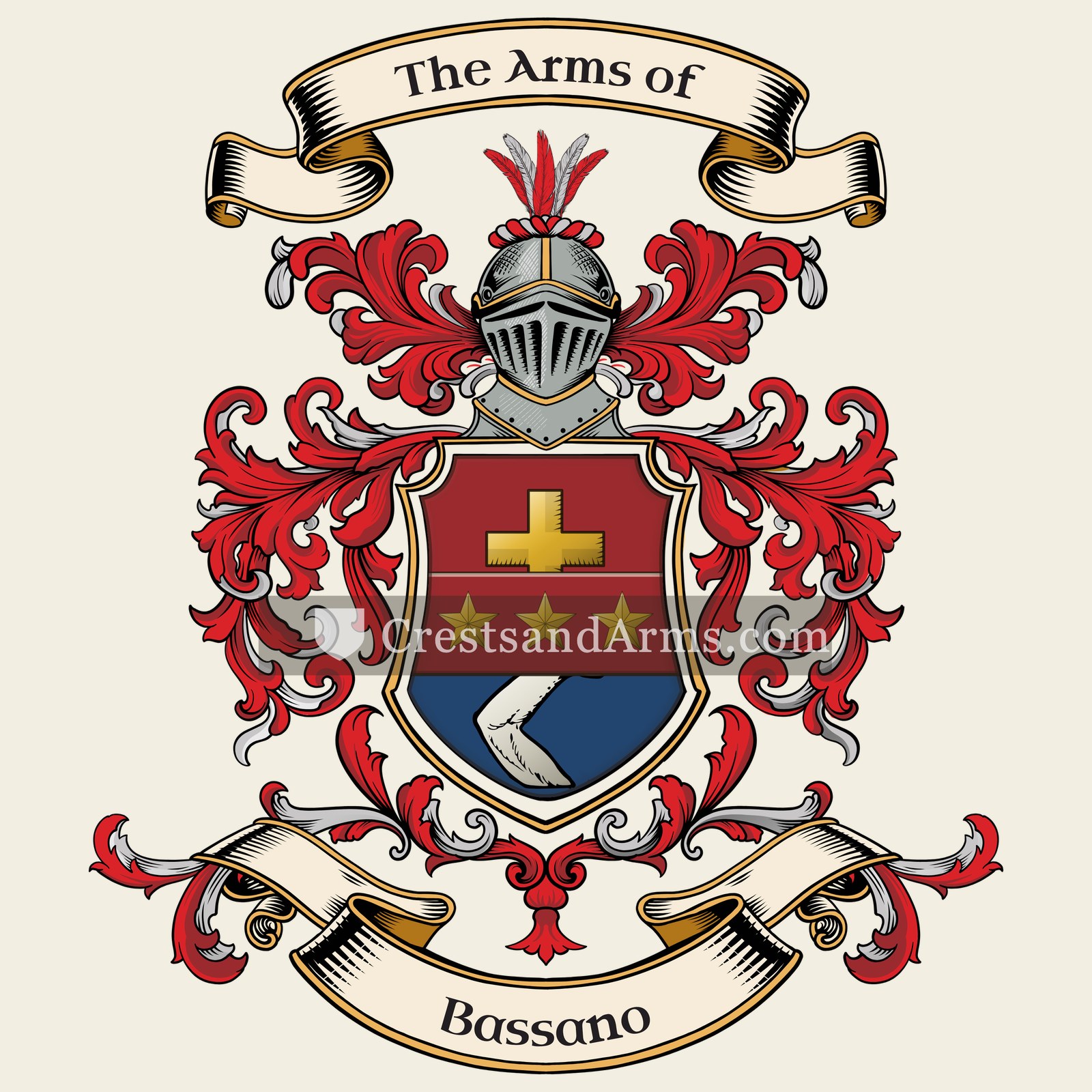


 chevronProtection, and faithful service completed
 wreathHonour, and a victory crowned