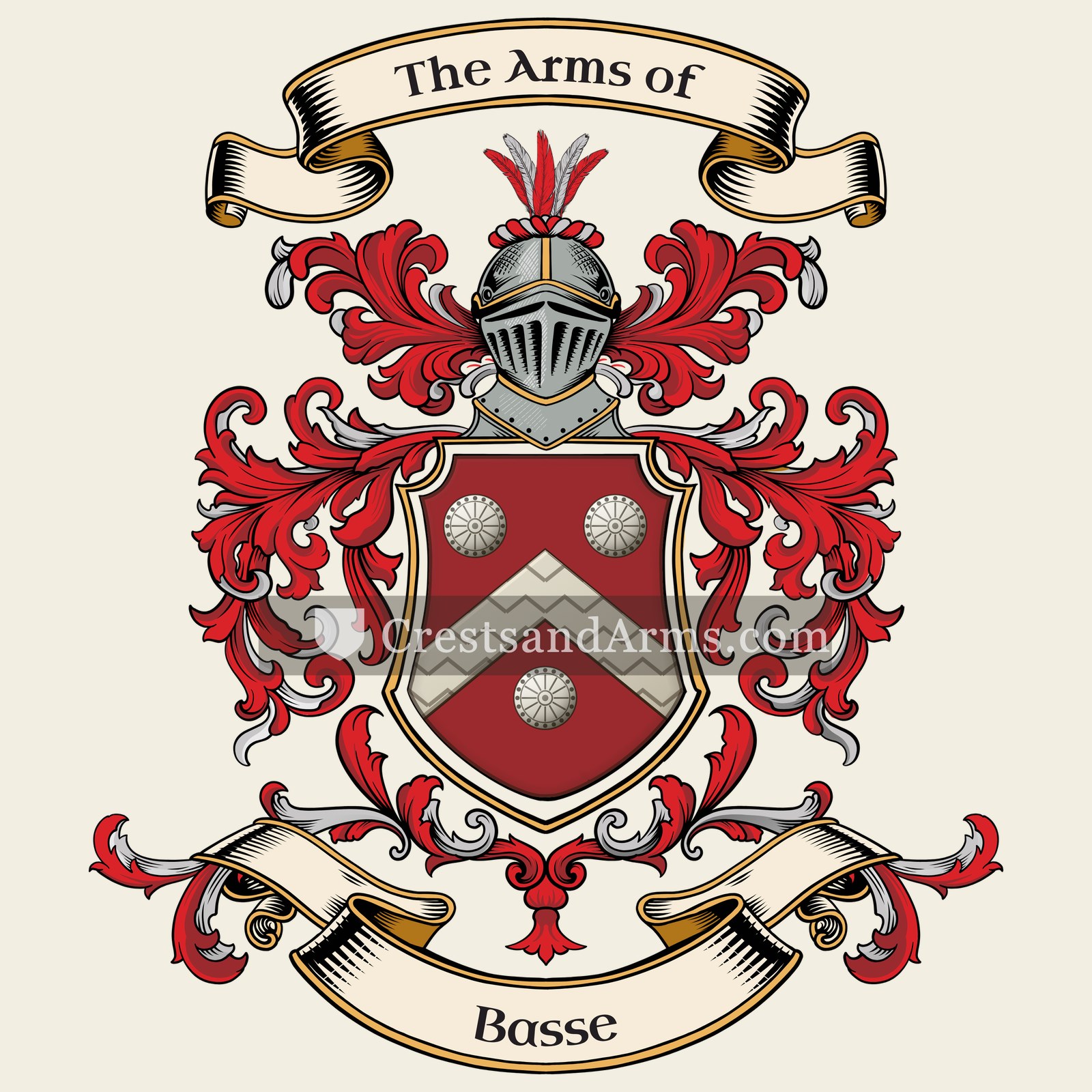
A record of documented arms, meaning and origin, researched for the Basse family lines. Documented in 3 countries.
Reg. 1698 · Danish, A–C
Coat of Arms & Family Crest Details
Symbols on this shield
hunting horn stringedOne who delights in the chase
Colours
Silver (Argent)Means: Peace and sincerity
Black (Sable)Means: Constancy
Historical info
Source
J. B. Rietstap, Armorial Général, Gouda: G. B. van Goor Zonen, 1884–87
Blazon (the actual original written record)
“D'arg. à deux cors-de-chasse de sa., liés et eng. du champ, l'un sur l'autre. C.: un arbre au nat., accosté des deux cors de l'écu, adossés, posés en pals contre le fût de l'arbre, les embouchures en haut. - 2° De gu. au bouc sautant de sa. - 3° D'arg. au bouc naiss. de sa. - 4° De gu. à trois fleurs-de-lis d'or. - 5° D'azur à une tête et col de sanglier d'arg., coupée de gu. C.: un arbre de sin., accosté de deux écureuils adossés au nat. - 6° D'azur à deux prob. de gu. C.: les prob. - 7° D'azur à la fasce d'arg., ch. d'un cor-de-chasse de sa., lié et eng. d'arg. C.: deux prob., coupées alt. d'arg. et d'azur.”
Denmarkc. 1722
Digital archive packCoat of arms PNG, gold border print PDF, vector SVG and the certificate of authenticity. Sent to your email in minutes.
Map of Denmark showing where the Basse arms are recorded
The Basse arms were recorded in Denmark, c. 1722.
Arms such as these were typically recorded in Sjaælland.
Zealand held the Danish court, the crown's offices and Copenhagen itself. Families who served the king kept estates within reach of it, and royal service was the ordinary route to a coat of arms.
This is where the arms were entered in the register. Families often moved to other parts of the country, so the same name can turn up in more than one region.
The body that granted and recorded arms in Denmark in this period.
Frederik IV of Denmark
Sovereign of the period
Frederik IV of Denmark
1699–1730
Reigning in Denmark when the Basse arms are first recorded.
How Arms Worked in Denmark
Danish heraldry during this period was closely tied to noble status and royal favor rather than being open to all citizens. Arms were typically granted by the monarch to individuals, and these symbols were then shared by all members of the noble house. If a family line died out, the right to use those specific arms ended with them.
Granting authority
The Danish royal chancery held the power to issue and regulate official coats of arms for the kingdom.
How they got arms
Families usually received their arms through a formal royal grant that confirmed their noble status and rights.
Where arms were recorded
These grants were officially recorded in the Danish Royal Chancery records starting in the sixteenth century.
The family's standing
Recorded among the armigerous families of Denmark.
Origin & History of the Basse Family in Denmark
The family name Basse has deep roots in the history of Denmark, particularly within the region of Sjælland. By the year 1722, records confirm that members of the family were already established in this area. The name itself is thought to have originated as a descriptive nickname, as the word "basse" was historically used in the Danish language to describe a person of sturdy or large physical build. Over many generations, this nickname transitioned from a simple way to identify a specific individual into a formal hereditary surname passed down through the family line. During the early eighteenth century, families like the Basses were often tied to the local agricultural landscape, living as tenant farmers or tradespeople within the rural parishes of Sjælland. Their presence in the historical record during this time offers a glimpse into the lives of common Danish citizens who helped shape the local community through their daily work and family connections.
Coat of Arms & Family Crest Details
Symbols on this shield
bendDefence, and the scarf of a commander
heronPatience and quiet watchfulness
lionCourage, strength and royalty
Colours
Red (Gules)Means: Military strength
Silver (Argent)Means: Peace and sincerity
Blue (Azure)Means: Loyalty and truth
Historical info
Source
J. B. Rietstap, Armorial Général, Gouda: G. B. van Goor Zonen, 1884–87
Blazon (the actual original written record)
“Coupé: au 1 parti: a. de gu. à la grue cont., avec sa vigilance, au nat.; b. d'arg. au lion de gu.; au 2 d'or à trois bandes d'azur. C.: 1° le lion, cont.; 2° quatre pl. d'aut.: d'or, d'azur, d'arg. et de gu.; 3° la grue, tournée à dextre. L.: à dextre d'arg. et de gu., à sen. d'or et d'azur.”
Austriac. 1771
Digital archive packCoat of arms PNG, gold border print PDF, vector SVG and the certificate of authenticity. Sent to your email in minutes.
Map of Austria showing where the Basse arms are recorded
The Basse arms were recorded in Austria, c. 1771.
Arms such as these were typically recorded in Tyrol.
Tyrol was mountain country in western Austria, where the valleys were held by families who had been there a very long time. Old tenure counted for more than money, and old families carried arms.
This is where the arms were entered in the register. Families often moved to other parts of the country, so the same name can turn up in more than one region.
Region
Tyrol
First recorded
1771
Granting Authority for the Basse Arms
Imperial and Royal chancery
Sodacan · CC BY-SA 3.0
The body that granted and recorded arms in Austria in this period.
Joseph II, Holy Roman Emperor
Sovereign of the period
Joseph II, Holy Roman Emperor
1765–1790
Reigning in Denmark when the Basse arms are first recorded.
How Arms Worked in Austria
Austrian coats of arms were often linked directly to noble titles granted by the Emperor. These symbols belonged to the entire family line rather than just one individual. When a family grew, new branches kept the original design without needing to change it. This system allowed all members of a noble house to share the same identity across many generations.
Granting authority
The Imperial and Royal chancery managed all heraldic matters and controlled the official granting of arms throughout the Austrian lands.
How they got arms
Families typically received their arms through a formal imperial decree that often accompanied the elevation of a person to noble status.
Where arms were recorded
Official records of these grants were kept in the Imperial Register of Nobility which began its formal documentation process in 1453.
The family's standing
Recorded among the armigerous families of Austria.
Origin & History of the Basse Family in Austria
The history of the Basse family in Austria is deeply rooted in the rugged landscapes of the Tyrol region. By 1771, records confirm that members of the family were already established residents within this mountainous territory. During this period, the name was often associated with families living near low-lying lands or river basins, as the term itself frequently referred to geographical features in local dialects. Because Tyrol served as a vital crossroads for trade between northern and southern Europe, the Basse family likely participated in the vibrant exchange of goods and ideas that defined the region. Their presence in these alpine communities suggests they were integrated into the local social structure, working as farmers, craftsmen, or merchants who helped shape the early development of the area. Over time, the family became a part of the unique cultural tapestry that defines the Tyrolean identity.
Coat of Arms & Family Crest Details
Symbols on this shield
chevronProtection, and faithful service completed
roundelA coin, and one who has been to the crusades
Colours
Red (Gules)Means: Military strength
Silver (Argent)Means: Peace and sincerity
Historical info
Source
Sir Bernard Burke, The General Armory of England, Scotland, Ireland and Wales, London: Harrison & Sons, 1884
Blazon (the actual original written record)
“Gu. a chev. ar. betw. three plates”
Englandc. 1620
Digital archive packCoat of arms PNG, gold border print PDF, vector SVG and the certificate of authenticity. Sent to your email in minutes.
Map of England showing where the Basse arms are recorded
The Basse arms were recorded in England, c. 1620.
Arms such as these were typically recorded in York.
Yorkshire is the largest of the English counties, and it held more gentry families than any other. Land there was split among a great many households rather than a few, so a great many of them carried arms.
This is where the arms were entered in the register. Families often moved to other parts of the country, so the same name can turn up in more than one region.
The body that granted and recorded arms in England in this period.
James VI and I
Sovereign of the period
James VI and I
1603–1625
Reigning in Denmark when the Basse arms are first recorded.
How Arms Worked in England
English heraldry allowed arms to be shared by all legitimate descendants of the original owner. These symbols were treated as personal property that moved through the generations to all children. While the eldest son kept the original design, other family members could use the same shield without needing to change it or register their own unique versions.
Granting authority
The College of Arms in London has regulated the use of coats of arms throughout England and Wales since 1484.
How they got arms
Families typically obtained their coats of arms through a formal grant from the Crown or by proving their ancient right to them.
Where arms were recorded
All official coats of arms are recorded in the registers kept at the College of Arms, which date back to the fifteenth century.
The family's standing
Recorded among the armigerous families of England.
Origin & History of the Basse Family in England
The surname Basse has deep roots in England, where it likely emerged as a descriptive name for individuals who were shorter in stature or lived in low-lying areas. By the early 17th century, the family had established a notable presence in the historic city of York. Records from 1620 confirm that members of the Basse family were active residents within this northern hub, which was a center for trade and religious life at the time. During this period, families with this name were often involved in local commerce and civic duties, helping to shape the social fabric of the region. As the 1600s progressed, the name became increasingly associated with the industrious middle class, reflecting a history of steady growth and integration into the evolving English landscape.
Basse Meaning & Related Branches
Root word
Bassus
A Latin term meaning thick, dense, or stout.
This name
BasseA descriptive nickname for a person of heavy or stocky physical build.
also spelled
Basay
Bas
Related arms
Bassvariant spelling
Bassyvariant spelling
Documented Sources
J. B. Rietstap, Armorial Général, Gouda: G. B. van Goor Zonen, 1884–87
Hald, Kristian. Personnavne i Danmark: Oldtiden. 1971
Nielsen, Oluf. Olddanske Personnavne. 1883
Rigsarkivet (Danish National Archives), Kirkebøger for Sjællands Stift (Parish registers for the Diocese of Sjælland)
Digital archive packCoat of arms PNG, gold border print PDF, vector SVG and the certificate of authenticity. Sent to your email in minutes.


 hunting horn stringedOne who delights in the chase
 hunting horn stringedOne who delights in the chase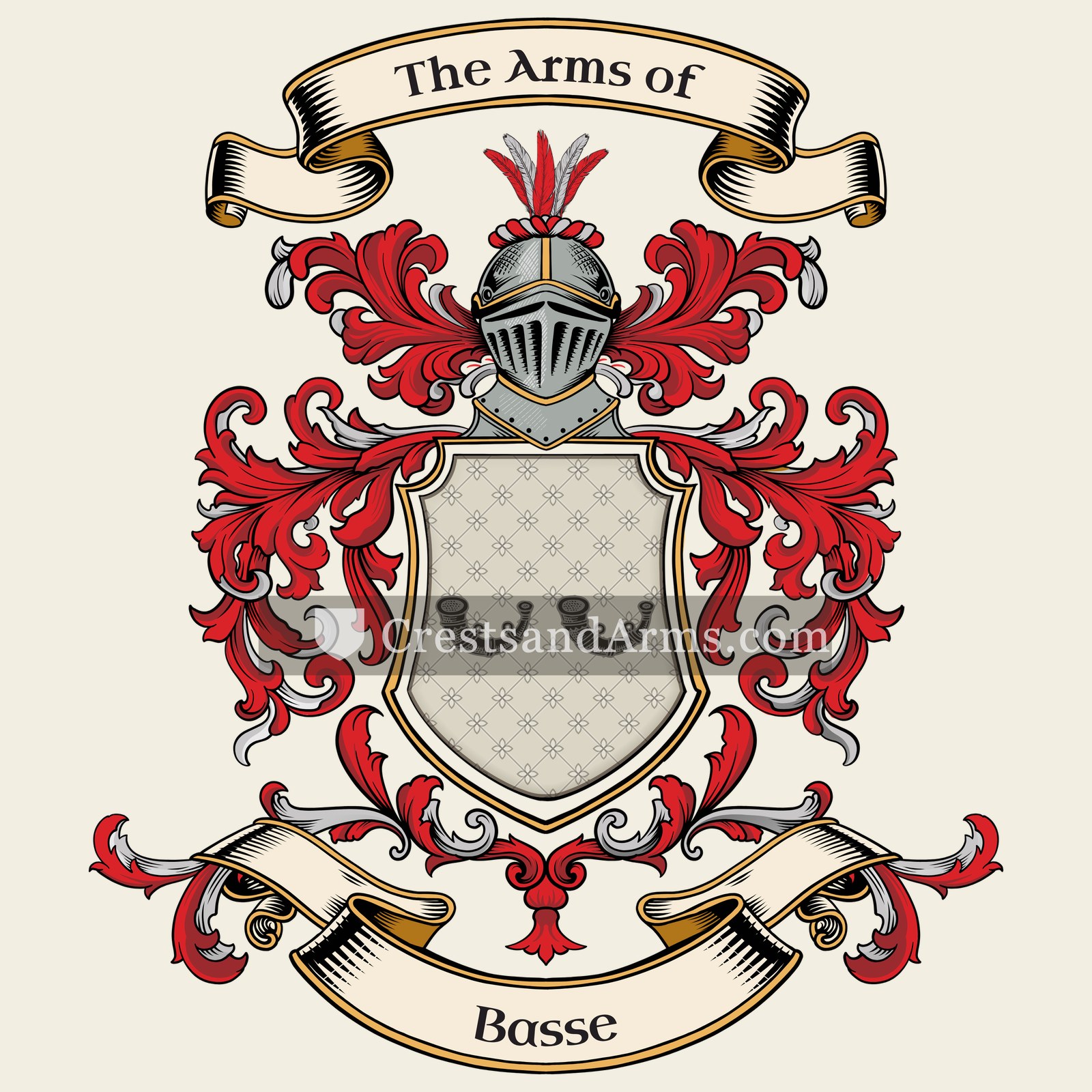


 bendDefence, and the scarf of a commander
 heronPatience and quiet watchfulness
 lionCourage, strength and royalty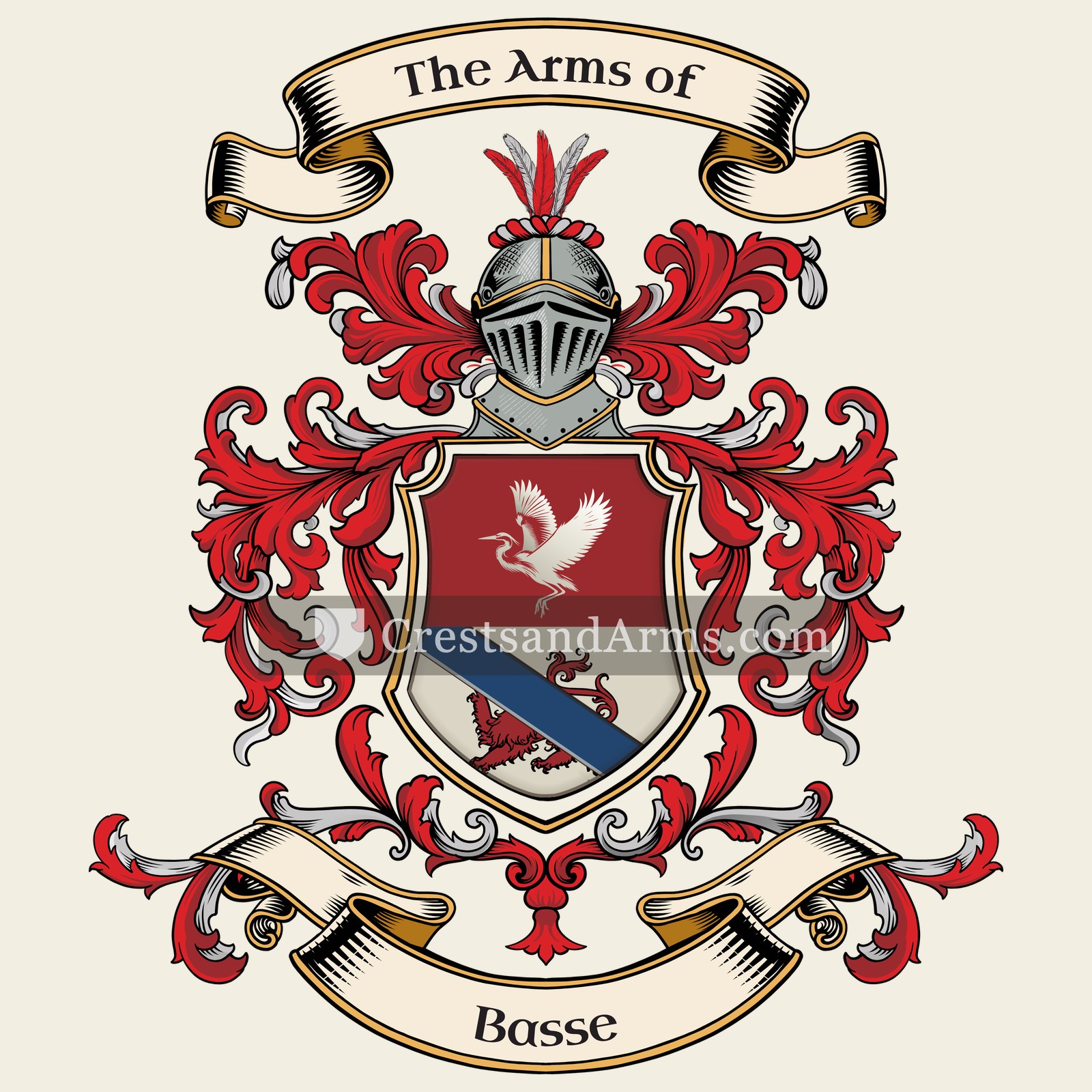


 chevronProtection, and faithful service completed
 roundelA coin, and one who has been to the crusades