Map of Britain showing where the Bastard arms are recorded
The Bastard arms were recorded in Cornouailles, c. 1700.
This is where the arms were entered in the register. Families often moved to other parts of the country, so the same name can turn up in more than one region.
The body that granted and recorded arms in Britain in this period.
William III of England
Sovereign of the period
William III of England
1694–1702
Reigning in Britain when the Bastard arms are first recorded.
How Arms Worked in Britain
English heraldry allowed arms to be shared by all legitimate descendants of the original owner. These symbols were treated as personal property that moved through the generations to all children. While the eldest son kept the original design, other family members could use the same shield without needing to change it or register their own unique versions.
Granting authority
The College of Arms in London has regulated the use of coats of arms throughout England and Wales since 1484.
How they got arms
Families typically obtained their coats of arms through a formal grant from the Crown or by proving their ancient right to them.
Where arms were recorded
All official coats of arms are recorded in the registers kept at the College of Arms, which date back to the fifteenth century.
The family's standing
Recorded among the armigerous families of Britain.
Origin & History of the Bastard Family in Britain
The surname Bastard has deep roots in British history, appearing in records shortly after the Norman Conquest of 1066. While the word itself eventually took on a negative meaning, it was originally used as a descriptive term or a nickname to identify individuals of noble but illegitimate birth. Many families carrying this name established themselves in the West Country of England, particularly in Devon and Cornwall. By the year 1700, the family had become well-integrated into the social fabric of Cornwall, where they were recognized as established landowners and members of the local gentry. Their presence in these rural communities suggests a long history of agricultural management and local governance that helped shape the development of the region over several centuries.
Coat of Arms & Family Crest Details
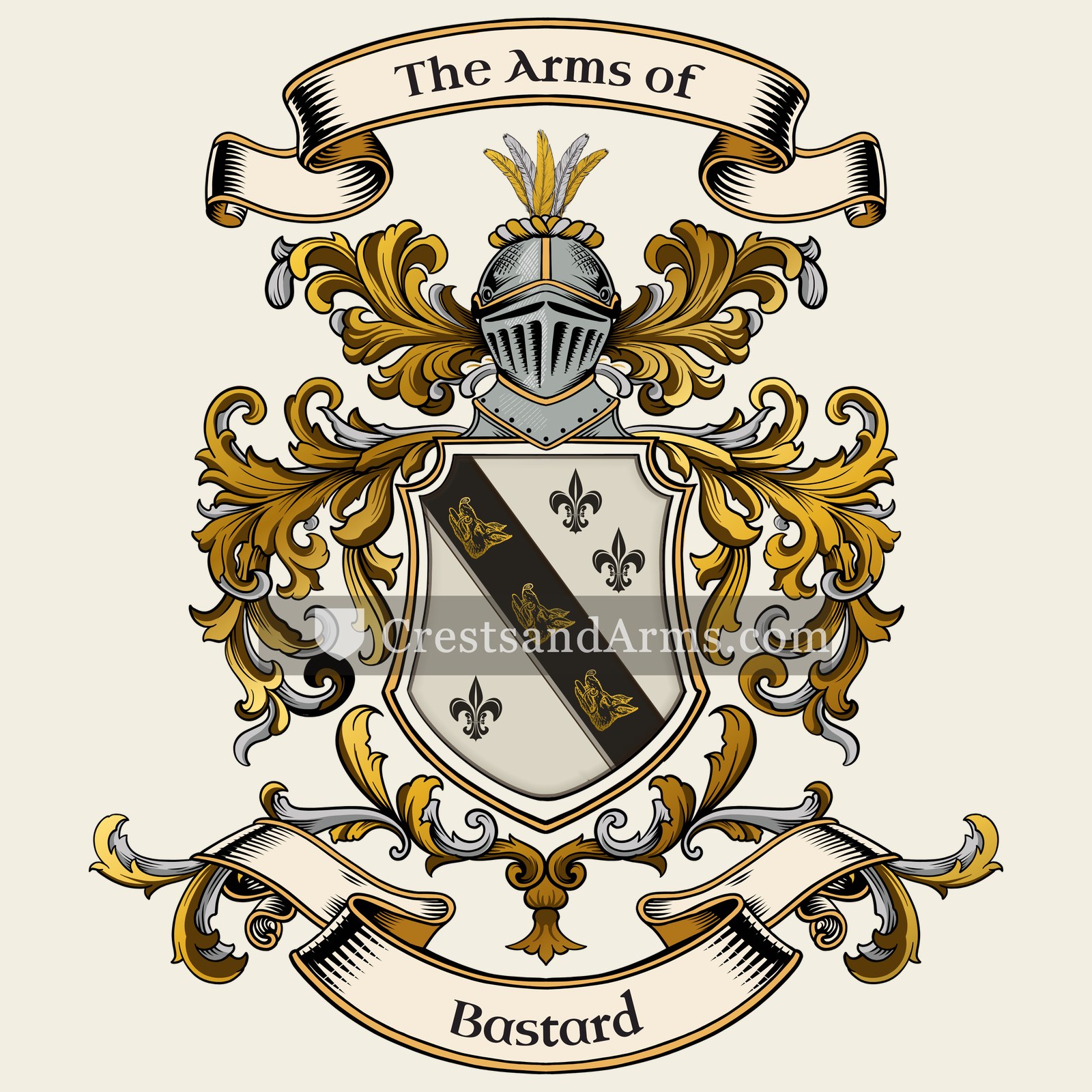
Symbols on this shield
bendDefence, and the scarf of a commander
fleur de lisPurity, light, and the sixth son
boars headA fierce fighter who battles to the end
Colours
Silver (Argent)Means: Peace and sincerity
Black (Sable)Means: Constancy
Gold (Or)Means: Generosity
Historical info
Source
Sir Bernard Burke, The General Armory of England, Scotland, Ireland and Wales, London: Harrison & Sons, 1884
Blazon (the actual original written record)
“Ar. on a bend betw. three fleurs-de-lis sa. as many boars' heads couped or”
NorfolkAslington · Norfolk, c. 1620
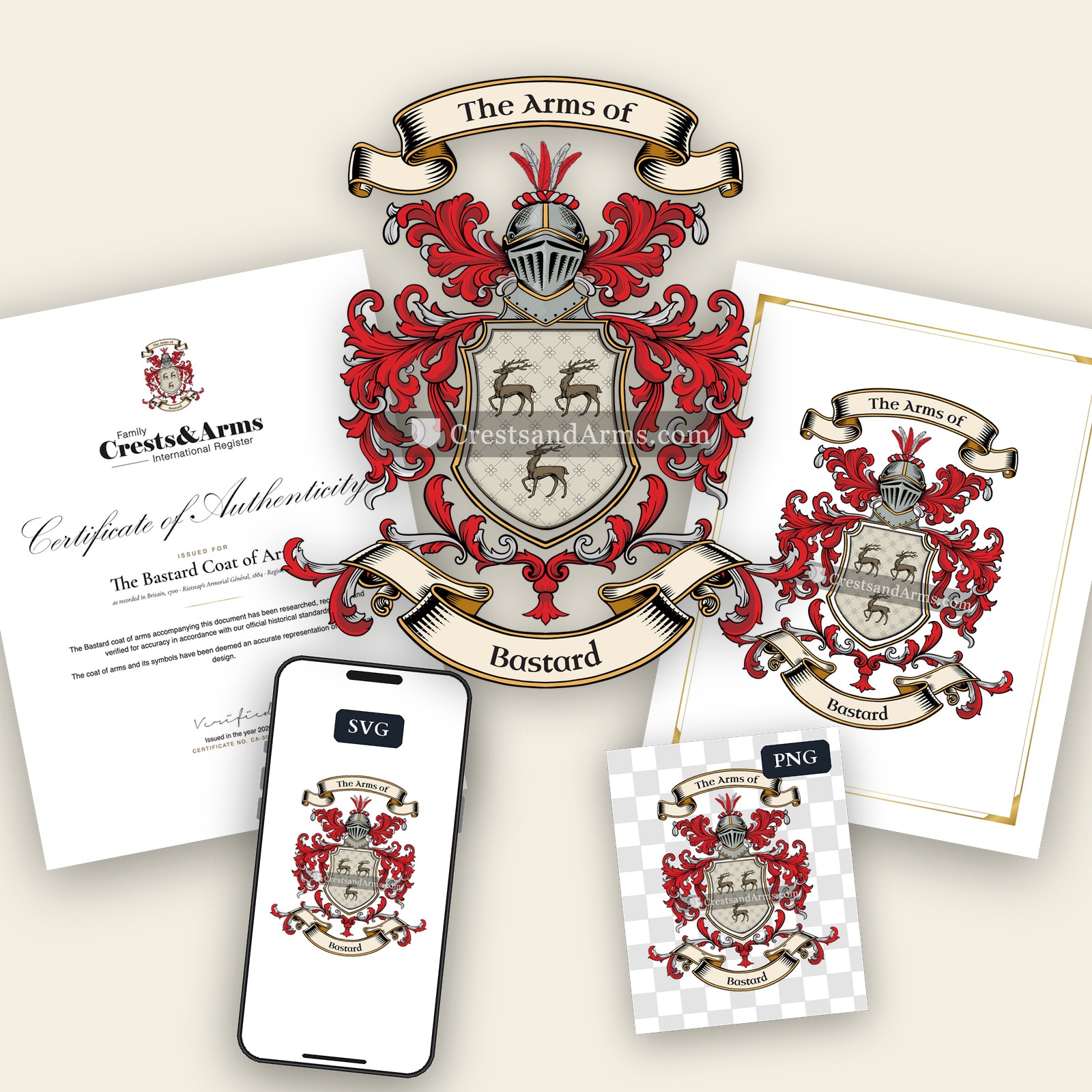
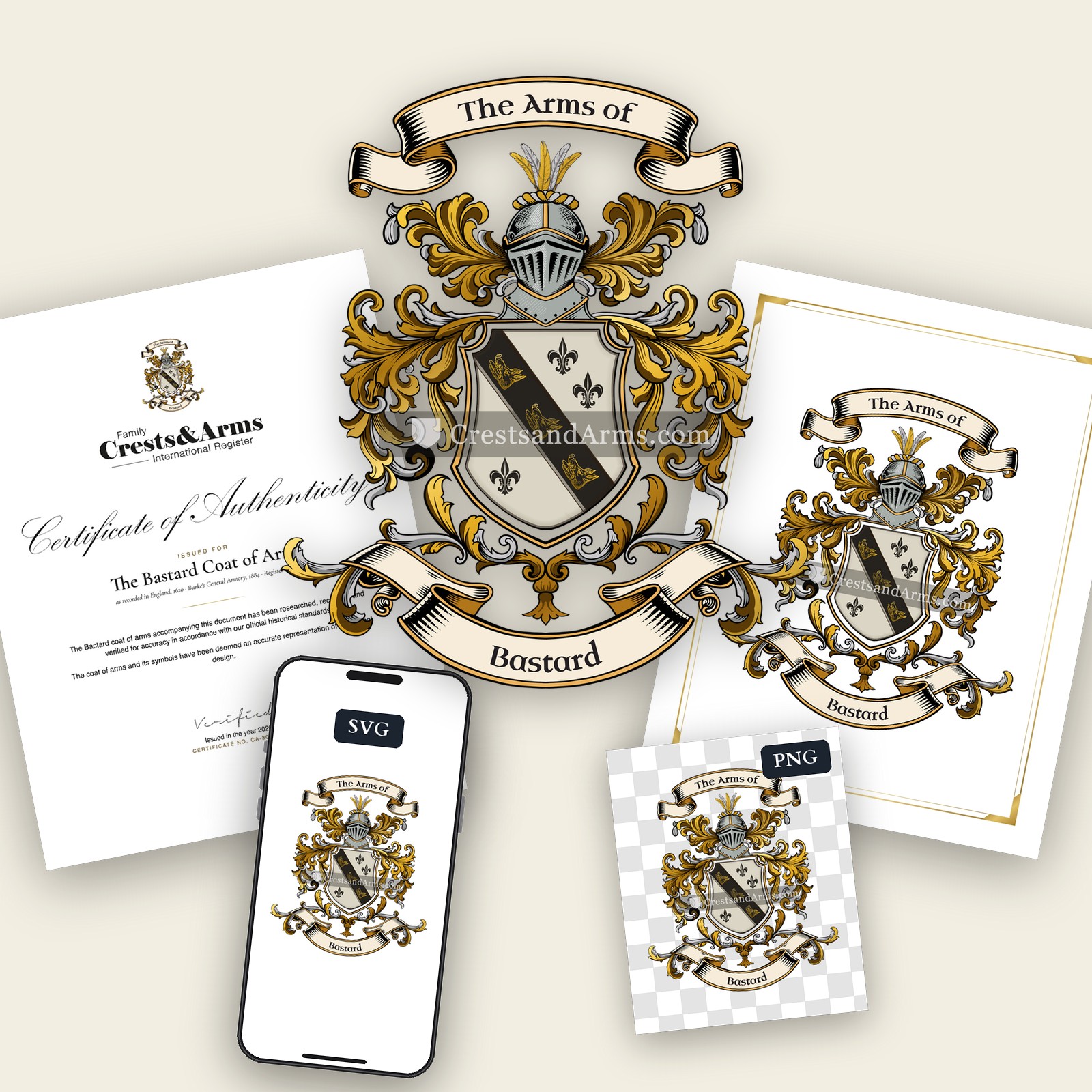
Digital archive packCoat of arms PNG, gold border print PDF, vector SVG and the certificate of authenticity. Sent to your email in minutes.
Map of England showing where the Bastard arms are recorded
The Bastard arms were recorded in Norfolk, c. 1620.
Norfolk grew rich on wool and grain, and its wealth was spread among many middling families rather than a few great ones. Households of that kind bought land and took arms, and the county holds a large share of English names.
This is where the arms were entered in the register. Families often moved to other parts of the country, so the same name can turn up in more than one region.
The body that granted and recorded arms in England in this period.
James VI and I
Sovereign of the period
James VI and I
1603–1625
Reigning in Britain when the Bastard arms are first recorded.
How Arms Worked in England
English heraldry allowed arms to be shared by all legitimate descendants of the original owner. These symbols were treated as personal property that moved through the generations to all children. While the eldest son kept the original design, other family members could use the same shield without needing to change it or register their own unique versions.
Granting authority
The College of Arms in London has regulated the use of coats of arms throughout England and Wales since 1484.
How they got arms
Families typically obtained their coats of arms through a formal grant from the Crown or by proving their ancient right to them.
Where arms were recorded
All official coats of arms are recorded in the registers kept at the College of Arms, which date back to the fifteenth century.
The family's standing
Recorded among the armigerous families of Norfolk.
Origin & History of the Bastard Family in England
The surname Bastard has deep roots in English history, appearing in records long before the family settled in Norfolk during the early seventeenth century. The name originated as a descriptive term during the Middle Ages, often used to identify individuals based on their social status or family circumstances. By the time the family established a presence in Norfolk in 1620, they were part of a long tradition of English families who carried names derived from medieval nicknames. These early ancestors were often landowners or farmers who integrated into local village life. Over several generations, the name transitioned from a simple descriptor into a permanent family identifier that was passed down through the male line. This evolution reflects the broader patterns of how surnames became fixed in English society as record-keeping became more formal and organized.
Bastard Meaning & Related Branches
Root word
bastardus
Late Latin term for an illegitimate child or someone of base birth.
This name
BastardA surname originally used as a descriptive nickname for a person born out of wedlock.
also spelled
Bastart
Bastar
Basterd
Basterde
Related arms
Baistard, or Basterdvariant spelling
Pollexfenrecorded with Bastard, same area
Documented Sources
J. B. Rietstap, Armorial Général, Gouda: G. B. van Goor Zonen, 1884–87
Reaney, P.H., A Dictionary of English Surnames, 1991
Cornwall Archives, Quarter Sessions Records and Estate Papers of the Bastard Family, 17th–18th Century
Gover, J.E.B., Mawer, A., and Stenton, F.M., The Place-Names of Devon, 1931
Digital archive packCoat of arms PNG, gold border print PDF, vector SVG and the certificate of authenticity. Sent to your email in minutes.


 stagPeace and harmony, and one who will not fight unprovoked
 stagPeace and harmony, and one who will not fight unprovoked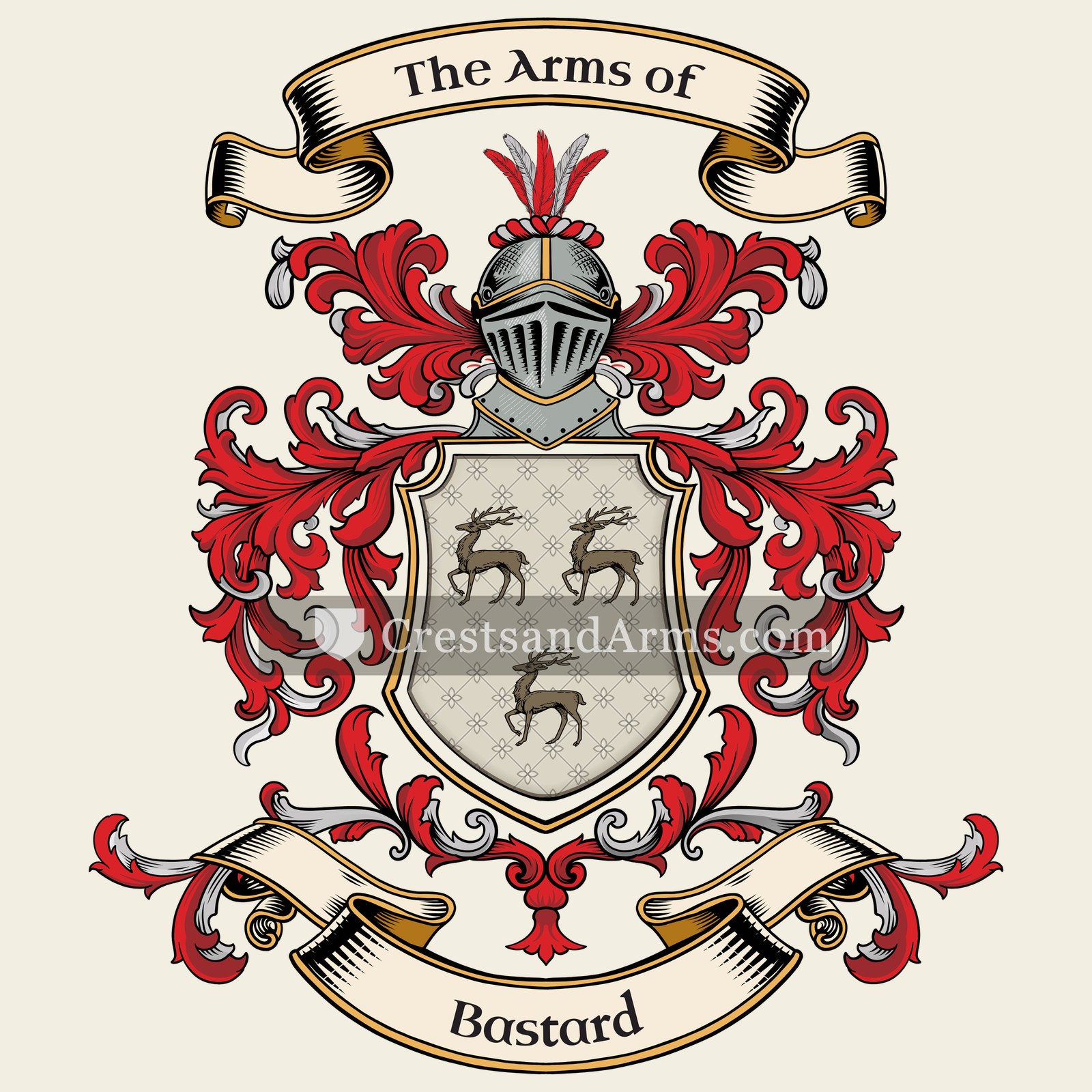


 bendDefence, and the scarf of a commander
 fleur de lisPurity, light, and the sixth son
 boars headA fierce fighter who battles to the end